
Citation Analysis
AI Citation Tracking Guide: What it is, How to Measure it, and How to Turn it into Action

 Jose Luis García del RíoGrowthatOmnia
 Daniel EspejoFounder & CEOatOmnia
TL;DR
You'll learn how to evaluate the best citation analysis options for optimizing AI search based on features that provide real value: URL-level and domain-level citation tracking, localized tracking by country to capture regional differences, competitor benchmarking showing who wins citation slots and why, and an action layer that generates content briefs and distribution strategies. Top AI platform citation tracking tools like Omnia track ChatGPT, Perplexity, and Google AI Overviews, extract exact citation sources, identify citation gaps where competitors dominate, and turn insights into executable recommendations. Use the procurement checklist, 30-day implementation playbook, and tool comparison to shortlist platforms that ship work, not dashboards.
The shift from backlink to citation importance changed everything for marketing and SEO leads. It also opened up a path to discoverability that was previously unattainable for startups and scaleups operating in a space dominated by well-established players. Backlinks require Domain Authority you don't have. But citations require earning placements on sources AI engines trust, where scrappy execution beats deep pockets.
Without citation analysis, though, you can’t see which sources matter, where competitors dominate, or why several AI engines are overlooking your content. Manual citation checks don't scale. You need tools showing exact cited URLs, competitor gaps, and which third-party domains to target.
This guide evaluates 13 platforms on URL-level tracking, domain classification, competitor benchmarking, localized tracking by country, and whether they ship actionable recommendations or just charts. You'll get tool comparisons, a procurement checklist with data integrity questions, and a 30-day playbook turning tracking into execution.
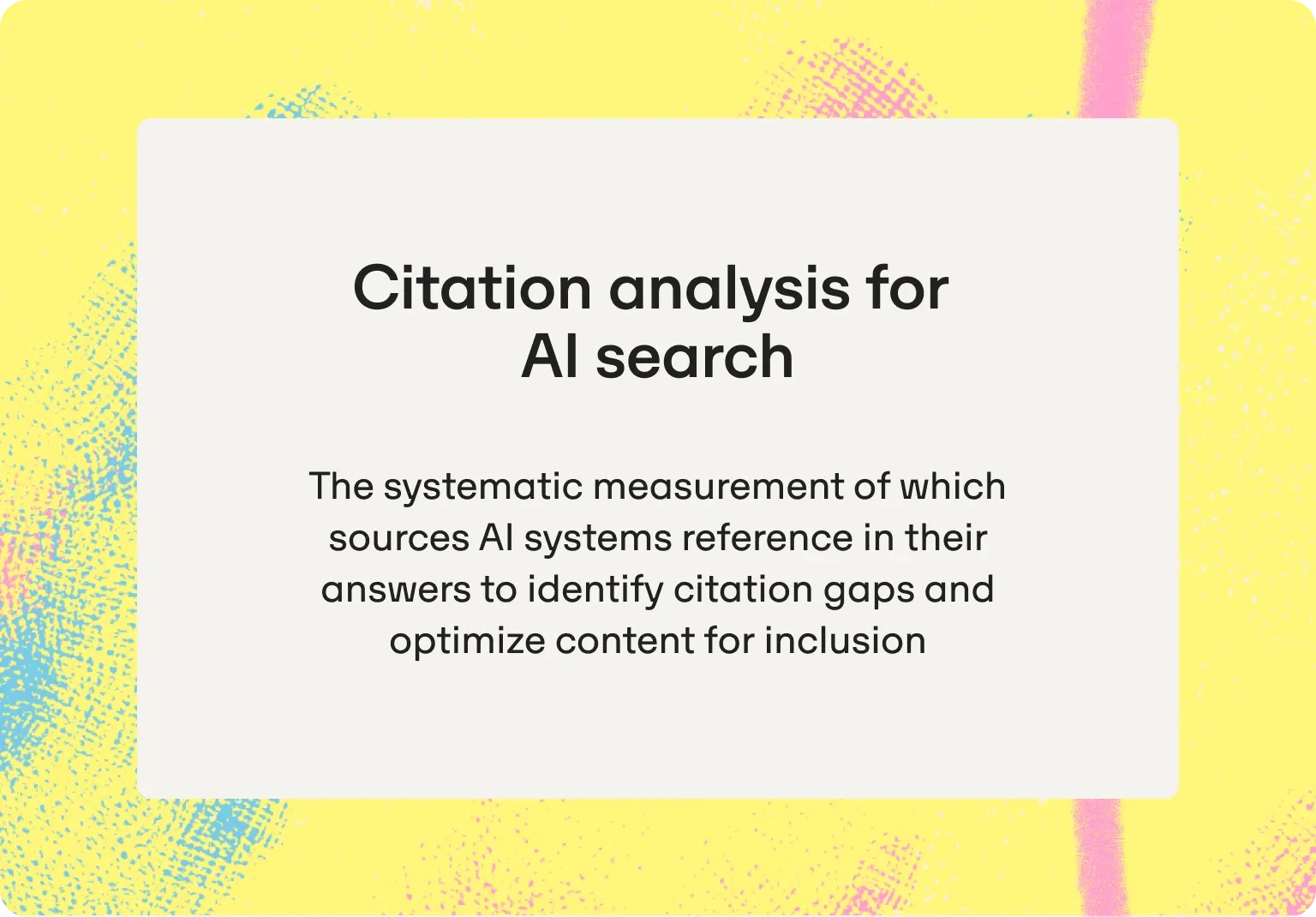
Citation analysis for AI search measures which sources (URLs, domains, and entities) AI search systems reference when generating answers, then uses that intelligence to make your content eligible for those citations. It reveals the exact pages ChatGPT, Perplexity, or Google AI Overview pulls from, why competitors get cited instead of you, and which third-party sources you need to target.
Most teams can't easily understand which citations AI models use, why specific sources are winning AI search, or how to systematically close those gaps. Citation analysis services for AI SEO and citation analysis software solve this, whether you're buying a done-for-you strategy or a self-serve platform.
This isn’t backlink analysis rebranded. Traditional SEO tools track citations in AI answers the same way they track traditional search rankings as static, keyword-driven metrics. But AI citations are variable, multi-source, and governed by different rules per engine.
A SERP rank report would show: “You rank #5 for ‘CRM software.’” A prompt-level citation report would show you: “For ‘best CRM software,’ ChatGPT cited TechCrunch (40%), G2 (30%), Salesforce blog (20%), and Reddit (10%) across 10 runs. Your domain appeared zero times.” Citation analysis tools for SEO optimize for inclusion in those multi-source answers, not keyword rankings.
Mentions vs citations vs recommendations (why your brand can “appear” but not be credited)
Your brand can appear in AI answers three ways, and they're not interchangeable:
Your exec team cares about recommendations because they drive pipeline. But to diagnose why you're not recommended, you need citation evidence. This shows you which sources are being cited instead, which URLs win trust, and why competitors own those citation slots. Most visibility dashboards conflate these metrics. Citation analysis tools separate them.
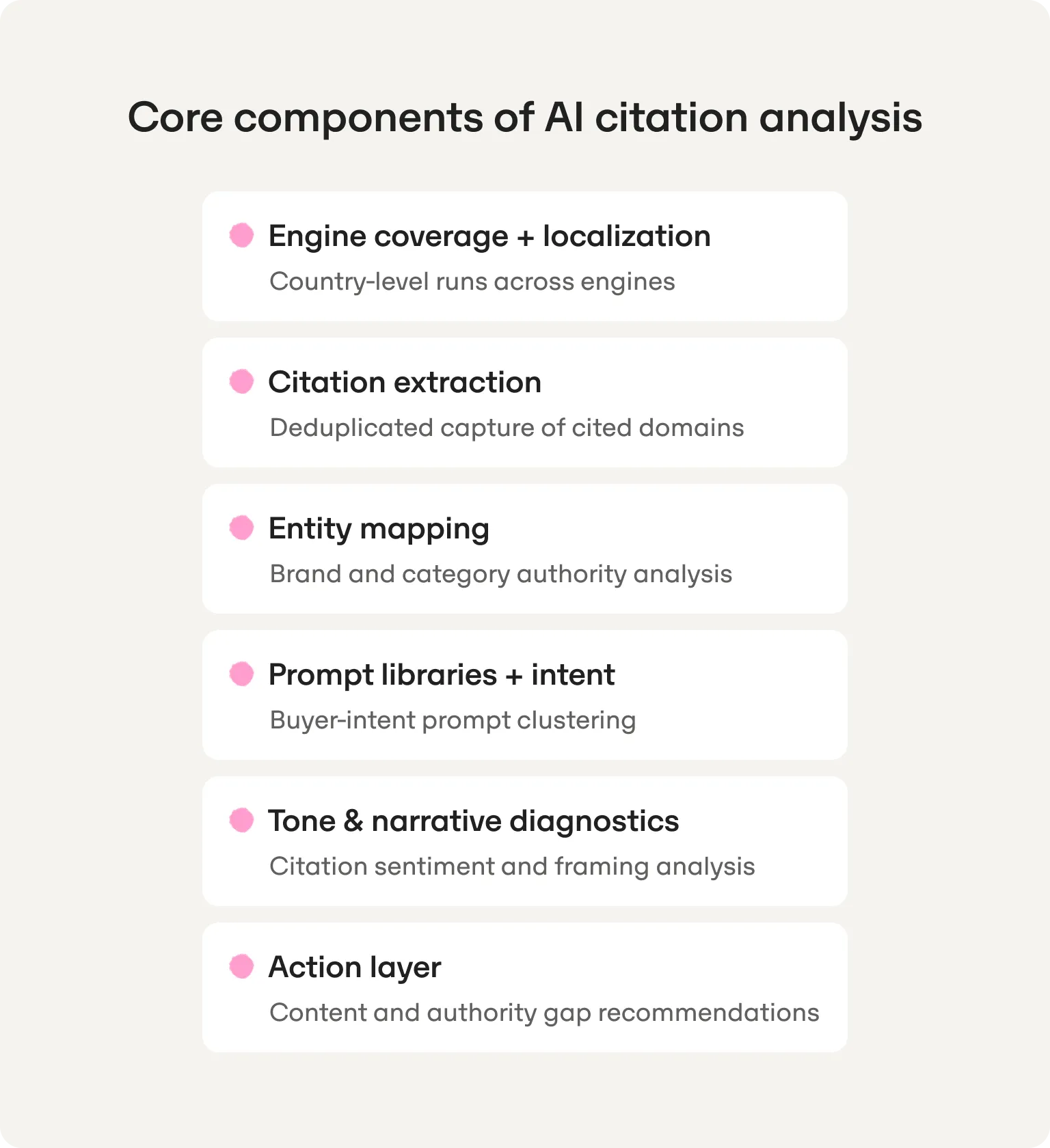
Citation analysis platforms operate through systematic execution. They run structured prompt libraries across major engines (ChatGPT, Perplexity, Gemini, Google AI Overviews), capture complete AI-generated responses, extract every citation and source reference, canonicalize URLs to deduplicate variations, and trend citation performance over time.
The most reliable citation analysis for AI search engines isn't defined by dashboard aesthetics or data volume. Rather, it's defined by repeatability and transparent methodology. Repeatability means running the same prompt multiple times (3-10 samples) to account for AI variability, capturing full response evidence, and tracking citation patterns across weeks rather than single snapshots.
Transparent methodology means showing exactly how citations were extracted (browser-based simulation vs API access), how domains were classified (editorial vs UGC vs corporate), and what sampling controls were applied (geographic location, model version, prompt phrasing).
For example, Omnia simulates real user behavior by opening actual browsers for ChatGPT (typing queries, clicking send, extracting live citations) rather than relying solely on APIs. This ensures the data reflects what users actually see, and not sanitized API responses.
AI outputs vary dramatically by geography, language, and product availability. ChatGPT in the US might cite TechCrunch and G2 for “best CRM,” while ChatGPT in Spain could cite local publications and European directories. Proper localized tracking by country requires:
Omnia executes this by opening browsers in real locations within each country to extract the data users actually see in those markets, and not simulated locale settings that miss regional nuances. Without true geographic execution, you're measuring visibility in one market while being invisible in others, missing where competitors own regional citation authority you need to challenge.
Citation extraction
Effective tools for measuring citation insights in AI-powered search results must accurately capture source URLs, canonicalize variants, group citations by root domain, deduplicate repeated references, and preserve historical snapshots for trend analysis. But citation extraction faces technical challenges. AI models sometimes reference sources without providing clickable links, format URLs inconsistently, or cite paywalled content users can't verify.
Reliable tools handle this through canonicalization, entity resolution, and evidence preservation. The output should be a deduplicated list of domains with citation rate, a URL-level breakdown showing specific pages cited, and time-series data revealing when citations emerged or disappeared.
AI engines cite sources based on entities, not keywords. When a user asks “what's the best CRM,” ChatGPT synthesizes entity knowledge (which brands are CRM vendors, which sources discuss category trends, which domains published comparisons) rather than querying SERPs. That’s why you can rank in the top three in Google but never get cited.
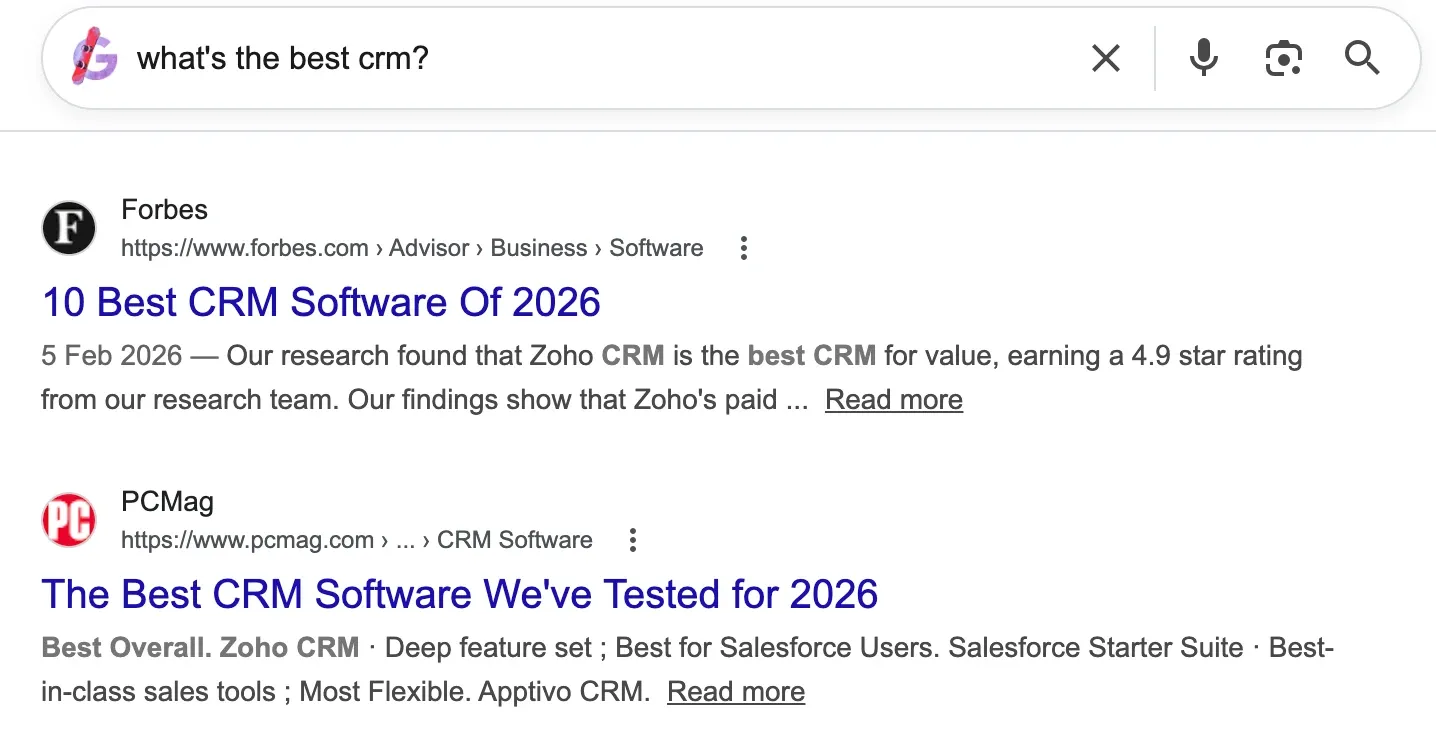
Take this example of the #1 and #2 SERP positions for “what's the best CRM” for Forbes and PCMag, respectively. When you query ChatGPT, Forbes earns a citation, yet PCMag doesn't, despite a high ranking in Google. The reason is entity authority. ChatGPT recognizes Forbes as a trusted business and technology authority with established entity associations to CRM vendors and category discussions, while PCMag's entity profile doesn't align as strongly for this query.
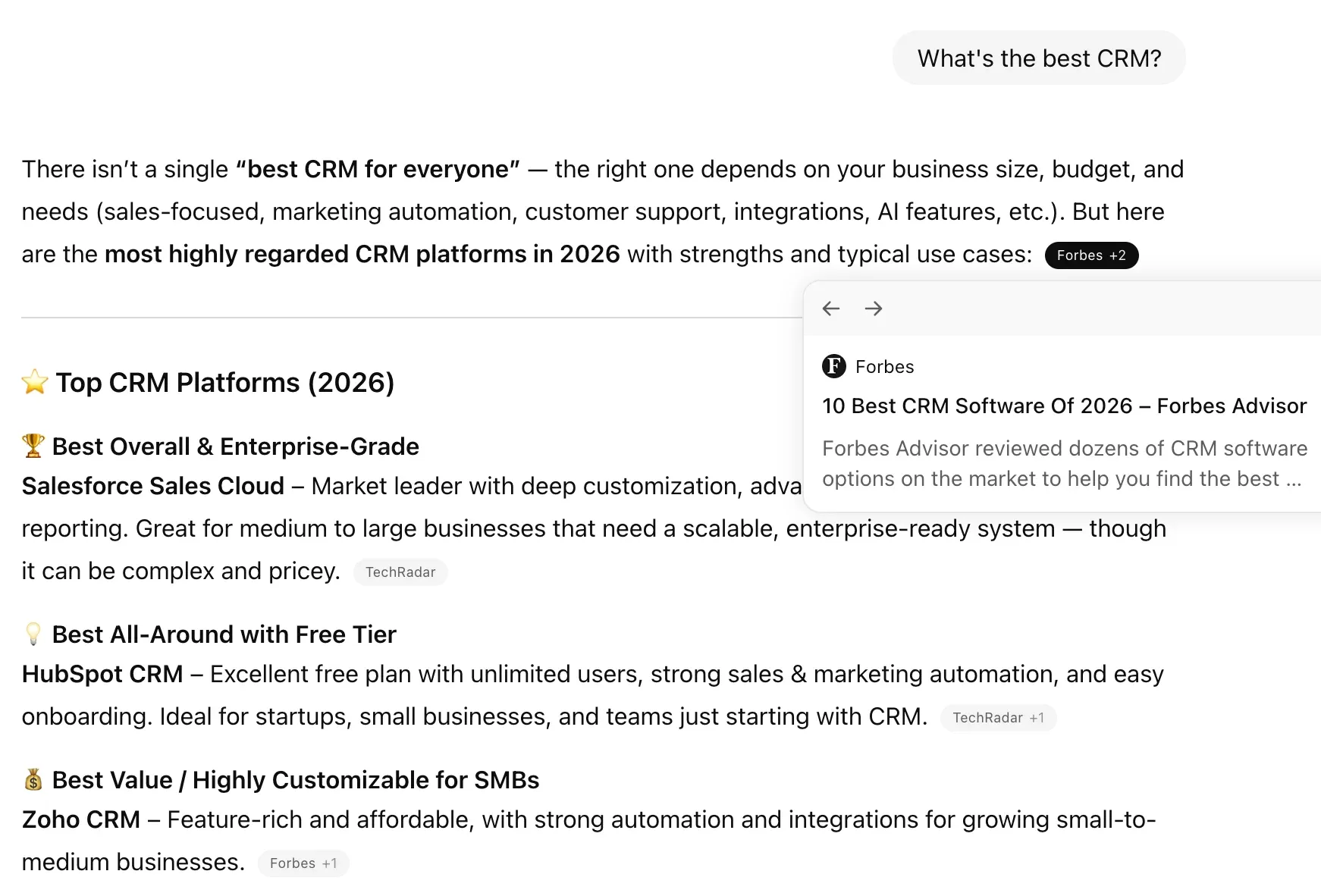
Entity resolution in citation analysis maps which entities (brands, products, category terms) appear in AI answers, which sources cite those entities, and how citation patterns reveal competitive positioning. If Salesforce gets cited from 15 different domains while your CRM gets cited from 3, the gap is source diversity, not visibility.
Citation optimization requires prompt libraries segmented by buyer intent and funnel stage:
Strong tools help you build prompt sets reflecting real buyer journeys, prioritize winnable prompts where you can feasibly earn citations (long-tail, niche use cases, specific personas), and segment results by funnel stage to match content strategy to intent.
For startups and scaleups with lean teams, this matters more than tracking 500 generic head terms. You need fast feedback loops showing which prompts you can win this quarter, which sources to target, and which content gaps to close, revealing whether you're never cited for decision-stage prompts because you lack comparison content or appear only in research prompts from your own blog (zero third-party authority).
Beyond which sources cite you, tools for tracking tone patterns in AI citations should reveal how those sources frame your brand. Are citations presenting you positively, neutrally, or negatively? Are claims accurate? Does the overall narrative reinforce or contradict your positioning?
Robust tone diagnostics provide sentiment scoring at the citation level, flagged sentences that misrepresent your product, and narrative themes across citations, with outputs including examples, source-level attribution, and frequency.
If 8 of 12 citations frame you incorrectly, that's an immediate outreach task. If citations mention outdated features, update content and re-pitch journalists, citation volume without narrative control is noise.
Action layer
Dashboards show you the problem. AI citation optimization tools tell you what to do about it through actionable recommendations, content briefs, technical fixes, and source seeding opportunities derived directly from citation gaps.
If ChatGPT cites Forbes, G2, and Reddit for “best CRM” but never your domain, the action layer should generate:
Tools with strong action layers provide specific content recommendations, distribution guidance, technical optimizations, and source seeding strategies. Citation analysis without an action layer is research. With it, it's a growth system.
Start by shortlisting 2–3 tools with this table. Then, read the detailed reviews for each platform below.
| Tool | Best For | Engine/LLM coverage | Geographical coverage (base plan) | Action layer | Price range per month |
|---|---|---|---|---|---|
| Omnia | Startups & scaleups | 7 | Unlimited countries, unlimited languages |  |
€79–custom pricing |
| Peec AI | Growing startups | 7 | Unlimited regions, 115+ languages |  |
€89–custom pricing |
| Rankscale AI | Startups & SMBs | 8 | Unlimited regions | |
€20–€780 |
| Scrunch AI | Growth teams & agencies | 8 | Multi-region | |
$100–custom pricing |
| AirOps | Growth teams & content marketers | 5 | 1 region | |
$200–custom pricing |
| AI Peekaboo | Agencies & SMBs | 5 | 1 country, 1 language | |
$50–custom pricing |
| Athena HQ | Enterprises | 6 | 1 region, 1 language | |
$295–custom pricing |
| Semrush | Existing Semrush users | 6 | Not specified | |
$99 |
| Ahrefs | Existing Ahrefs users | 6 | Not specified | |
$199–$699 |
| Moz | Growing SEO teams | 1 | Not specified | |
$49–$299 |
| SE Ranking | Agencies & SMBs | 4 | Not specified | |
$129–custom pricing |
| cloro | Engineering teams & tool builders | 7 | Country and city level | |
Free–$5,000 |
| Profound | Enterprises | 10 | 1 country, 1 language | |
$99–custom pricing |
| BrightEdge | Enterprises | 3 | Not specified | |
No published pricing |
Here are 13 platforms ranked by their citation analysis capabilities, execution focus, and value for different team types. Each tool is evaluated on citation depth, engine coverage, geographic reach, action layer strength, and pricing transparency.
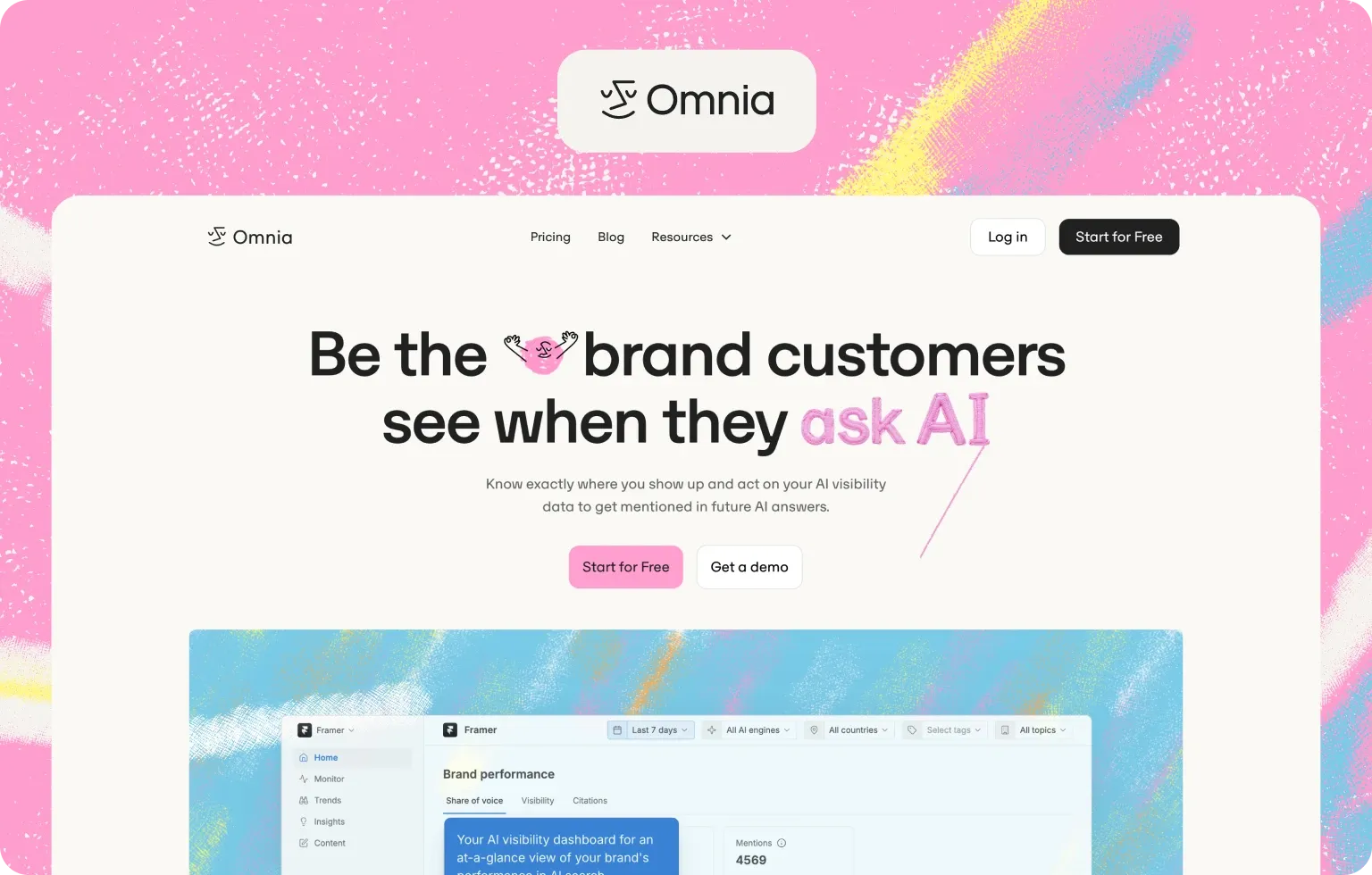
Omnia is an AI citation intelligence platform that tracks which sources AI engines reference across prompts, then turns citation gaps into executable content recommendations and distribution strategies.
Best for
Startups and scaleups with active content programs seeking citation-level insights and actionable recommendations without hiring specialized teams.
What it does well
Omnia shows you exactly which pages win citations and why. Every cited source is captured at the URL level, aggregated by domain, classified by page type (3rd party, owned, and social), and mapped to entities (your brand, competitors, third-party authorities). The platform tracks share of voice against competitors across prompts, shows exactly which URLs drive citations (yours vs third-party), and monitors visibility across ChatGPT, Perplexity, Google AI Overviews, and Google AI Mode with daily updates
What separates Omnia from monitoring-only platforms is localized tracking by country and the action layer. Omnia executes prompts via real browsers in actual geographic locations (not API-simulated locales), capturing country-specific citation patterns across unlimited countries and languages without surcharges. Then, the platform generates specific content briefs, identifies which third-party domains to target for placements, and recommends where content should live to earn citations. This turns citation data into a week-by-week execution roadmap.
Key features
Good fit if
Not a fit if
Enterprise: Custom
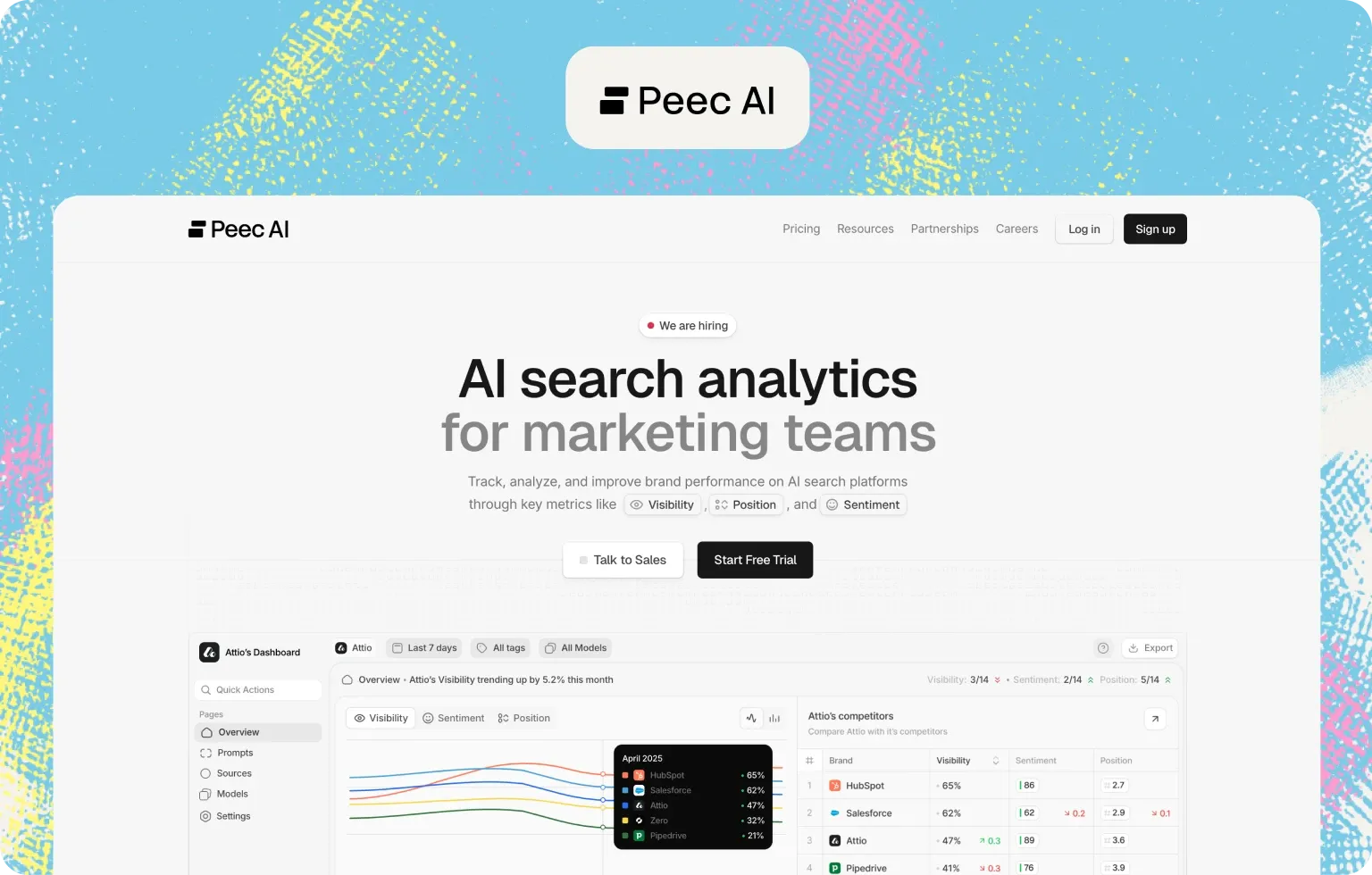
Peec AI is a comprehensive AI citation tracker, classifying sources by domain type and page type.
Best for
Startups and mid-market content teams who need granular, filterable citation data with URL-level classification.
What it does well
Peec AI provides a comprehensive citation feature that surfaces the exact domains and individual URLs that large language models reference when generating answers to tracked prompts. It shows both mentions and citations.
Key features
Watch-outs
The platform is better for research and exploration. If you need immediate alerts, other tools may offer stronger monitoring features.
Pricing
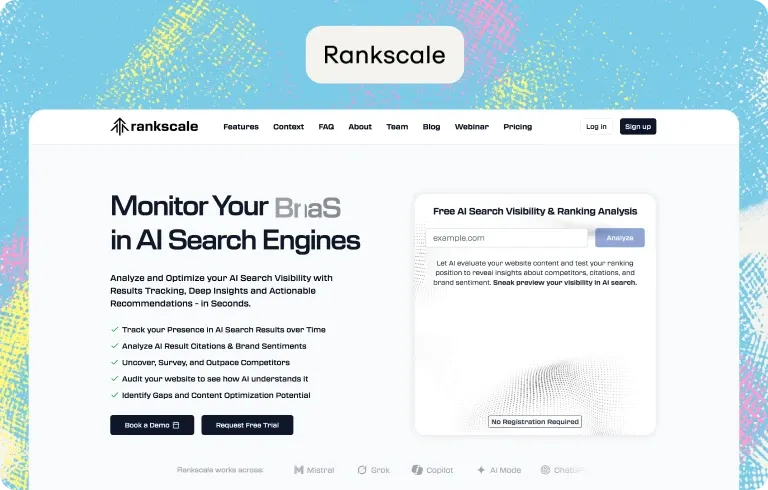
Rankscale AI is a credit-based citation tracking platform.
Best for
Budget-conscious teams and agencies who want prompt-level citation tracking with cross-model overlap scores.
What it does well
Rankscale AI offers a dedicated citation-analysis suite that lets users see exactly which websites and content pieces are being cited by major generative-search engines
Key features
Watch-outs
Rankscale AI features emphasize monitoring more than hands-on AEO execution features.
Pricing
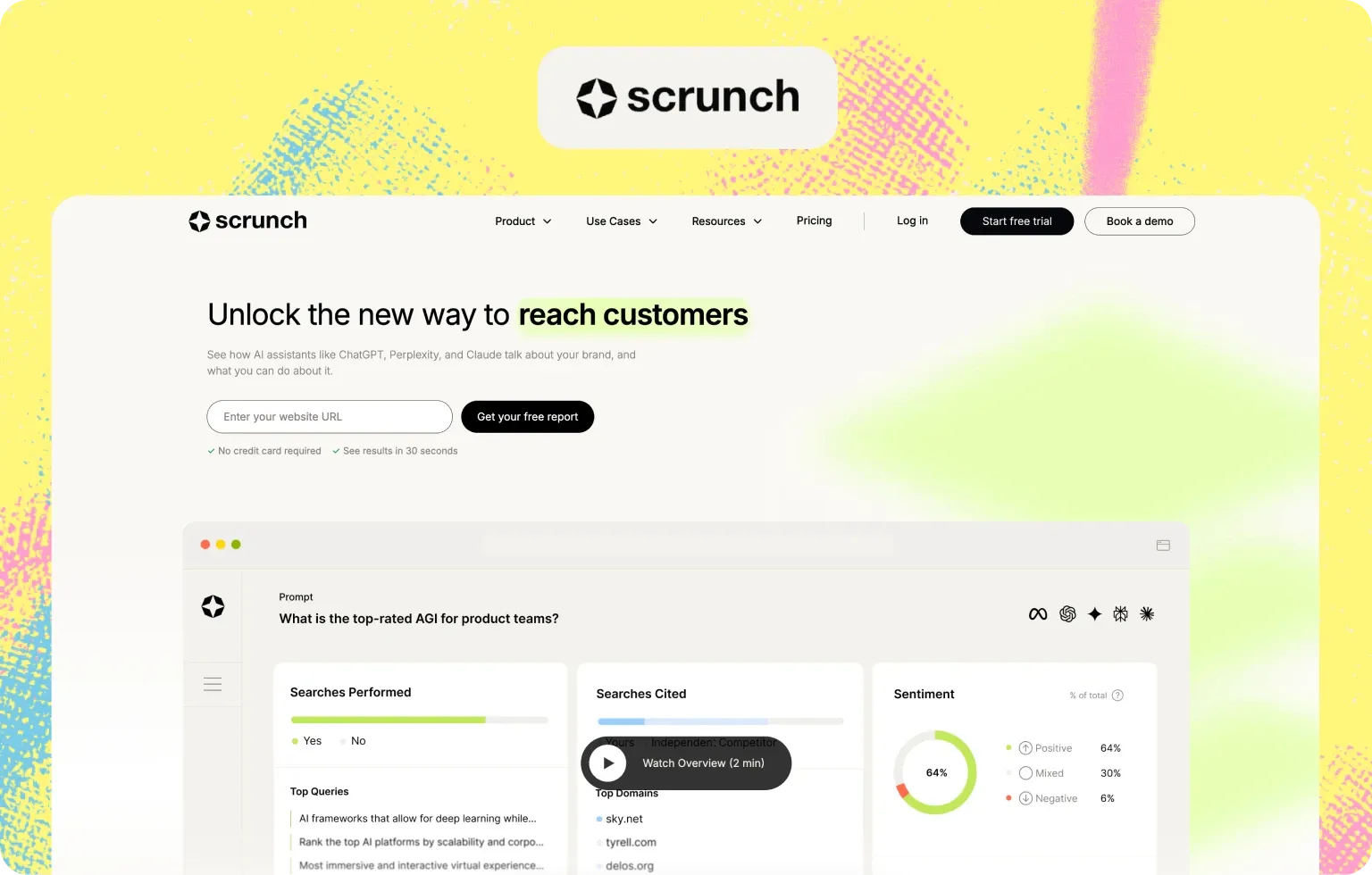
Scrunch AI is an AI search visibility tool that provides running citation lists with influence scores, citation gap identification, and persona-based filtering.
Best for
Agencies and enterprises that want citation gap analysis with persona and funnel-stage segmentation.
What it does well
Scrunch AI's citation analysis continuously records every domain and individual URL that LLMs cite in responses to the prompts you monitor.
Key features
Watch-outs
Detailed reporting (depth and complexity of data) can feel overwhelming at times.
Pricing
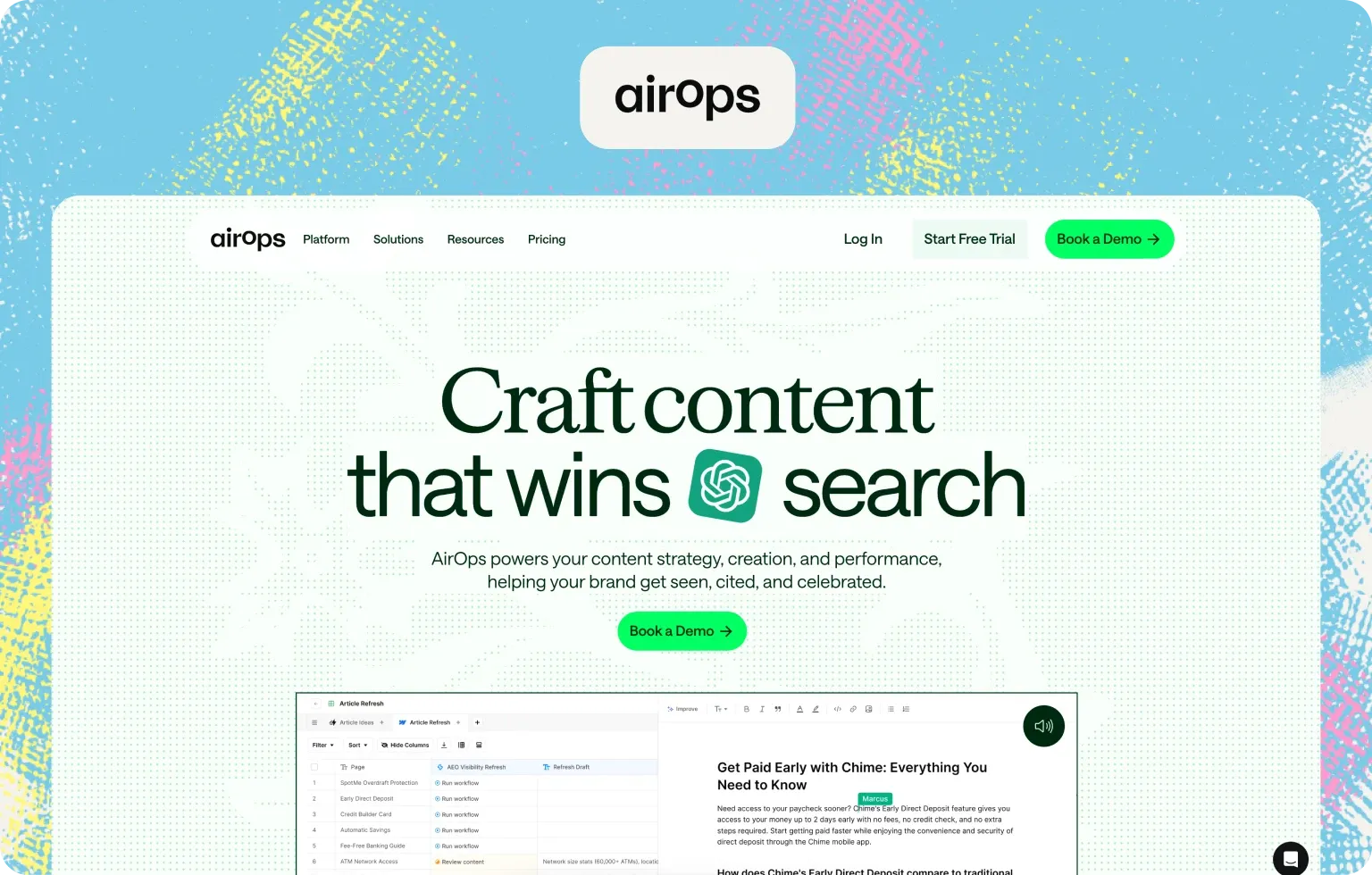
AirOps is a content operations platform that integrates citation insights with workflow automation.
Best for
Marketing teams wanting citation data integrated with workflow automation.
What it does well
AirOps' AI citation tracking lets you see exactly which URLs and domains LLMs reference when answering prompts, breaking down performance at both the individual page level and the aggregated domain level.
Key features
Watch-outs
AirOps is much more expensive than other competitors. It also comes with a steep learning curve that often requires onboarding support.
Pricing
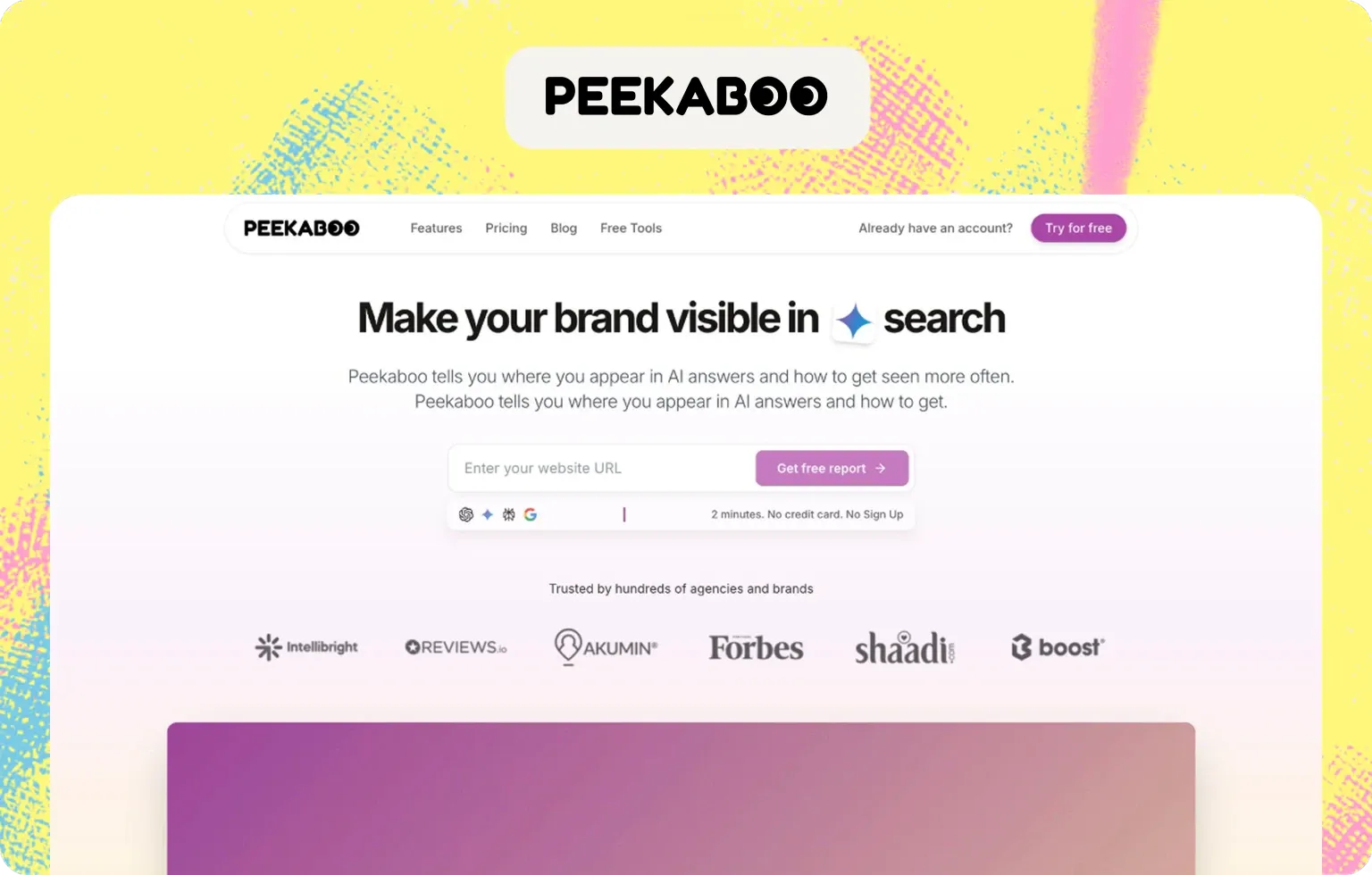
AI Peekaboo monitors how brands appear inside real AI interfaces, not API endpoints.
Best for
Agencies and brands running multiple client accounts that need to see exactly what AI users see, without per-seat fees.
What it does well
AI Peekaboo monitors live AI interfaces (ChatGPT, Perplexity, Gemini, and Google AI Overviews) by rendering actual browser sessions, not querying APIs, so the data reflects what real users experience. Pay-per-prompt pricing and no per-seat fees set it apart in the category, and white-label reporting lets agencies deliver AI visibility data under their own brand.
Key features
Watch-outs
Focused on visibility monitoring rather than citation gap analysis or editorial brief generation; works best alongside a content strategy or link-building workflow.
Pricing
Athena HQ is an enterprise answer engine optimization (AEO) platform that tracks citations across six AI models.
Best for
Enterprises needing granular authority and citation intelligence with persona-level targeting.
What it does well
Athena HQ provides daily citation tracking as an early signal of future AI impressions; its dashboard combines source-level citation insights, prompt-level monitoring, sentiment scoring and actionable recommendations within a unified “Action Center.”
Key features
Watch-outs
Base plan is very costly and not realistic for small or bootstrapped teams.
Pricing
Semrush is a comprehensive SEO platform that integrates AI citation tracking with traditional SEO workflows.
Best for
SEO teams and Semrush users that want to improve their ability to track brand mentions in the same platform.
What it does well
Semrush's AI analytics suite includes a dedicated AI Visibility Toolkit that lets users monitor citation performance at both the domain and individual-URL level. It reveals how many AI Overview mentions, cited pages and keyword triggers a site has.
Key features
Watch-outs
The AI toolkit is an add-on, so companies need to invest in a base Semrush subscription to access these features.
Pricing
Ahrefs is an all-in-one SEO platform that features Brand Radar, a citation tracker tool for AI visibility insights.
Best for
Existing Ahrefs users and SEO strategy professionals who want citation tracking alongside traditional backlink and AI visibility analysis.
What it does well
Ahrefs Brand Radar tracks AI citations by linking each AI-generated answer to the exact source that the model references, allowing users to view citations both at the domain level and the individual URL level.
Key features
Watch-outs
Access to all AI platforms comes at a steep price of $699/mo.
Pricing
Moz Pro is an SEO platform that provides citation tracking with Domain Authority scoring, EEAT signals, and Link Intersect for citation gap analysis.
Best for
SEO teams wanting citation tracking with Domain Authority and EEAT signals
What it does well
Moz AI includes a dedicated citation-tracking capability that lets users capture and analyze the URLs and domains cited by AI-generated answers. It has tools that surface both the raw URLs and their domain-level attributes such as Domain Authority, Brand Authority, trust signals and E-E-A-T metrics
Key features
Watch-outs
The AI citation features are newer additions, meaning the platform is less mature than specialized AEO tools.
Pricing
SE Ranking is an all-in-one SEO platform that provides daily citation logs with historical tracking, domain trust scores, and citation placement tracking within AI snippets.
Best for
Agencies and SMBs wanting affordable, comprehensive citation tracking with daily updates.
What it does well
SE Ranking's AI Results Tracker monitors AI-generated answers across Google's AI Overviews, AI Mode, ChatGPT, Gemini and Perplexity, logging every instance where a brand or URL is cited, linked or merely mentioned.
Key features
Watch-outs
All of the AI visibility features are spread across three separate interfaces.
Pricing
cloro is a citation API that returns every source an AI engine referenced in an answer as structured data, with no dashboard layer on top.
Best for
Teams with an existing data stack who want citation data inside their own models, and vendors building citation analysis into a product of their own.
What it does well
cloro returns citations at the URL level, with position and title, for each individual answer rather than aggregated into a score. Because you receive the underlying rows, domain classification and competitor benchmarking are defined by your team rather than by a vendor's rollup. Localization is handled as a request parameter by country and down to city level, so comparing two markets is the same call with one field changed. Ahrefs, BrightEdge, Evertune and Gauge run on it.
Key features
Watch-outs
There is no action layer, which means no briefs, no recommendations and no interface. Interpretation and reporting sit entirely with your team, so it suits anyone building the answer rather than anyone who needs the answer delivered.
Pricing
Profound is an enterprise AI visibility tracking platform that provides enhanced citation categories with automatic domain classification and URL-level authority ranking.
Best for
Enterprises that need enhanced citation categories and source-level intelligence at scale.
What it does well
Profound AI's citation monitoring captures every URL and domain that LLMs reference when answering questions. It surfaces these at both the domain and the individual page level and classifies each domain by type.
Key features
Watch-outs
High price gatekeeps smaller startups and scaleups.
Pricing
BrightEdge is an enterprise SEO platform that provides citation volatility analysis across domain types.
Best for
Enterprises needing citation volatility analysis and industry-specific citation benchmarks
What it does well
Brightedge has advanced features for persona development, intent mapping, and journey analysis. These reveal how your audience interacts with AI systems throughout their decision-making process.
Key features
Watch-outs
The platform is more enterprise-focused, so smaller teams may find it overwhelming.
Pricing
Evaluating which citation analysis service is best for AI SEO requires a structured checklist that separates marketing claims from platform capabilities.
Use these 10 criteria:
Scoring: 8+/10 = production-ready. 5-7 = trial first. <5 = skip.
Before purchasing, ask vendors these questions:
Vendors who answer with specifics (like 5 samples per prompt daily, store full HTML, browser-based execution) demonstrate rigor. Vendors who say “proprietary algorithm” without details are likely hiding incomplete methodology.
The best tools for tracking citation data AI search rankings provide granular, exportable data, not aggregated dashboards.
Require these export fields:
These are optional but still valuable:
Tools that only export “brand visibility score” without URL-level detail force you to screenshot dashboards, which is useless for content teams. Demand CSV export or API access.
Citation analysis services for AI SEO provide full-service offerings: They build prompt libraries, run monitoring, deliver citation gap reports, and sometimes create content briefs or execute outreach. Best for startups with <3 marketing people or teams without dedicated AI visibility owners.
Self-serve software gives you the platform, prompt templates, and dashboards, but you manage everything yourself. It’s best for teams with SEO/content leads who want control and cost efficiency.
Hybrid models (platform + advisory check-ins) split the difference.
There is another option sits under all three: the data layer they are built on. A citation API returns the engine’s answer and its cited URLs as JSON, and your team builds the tracking around it. That is the right call when the output has to live in your warehouse next to pipeline data, or when you are the vendor rather than the buyer.
If you lack bandwidth to review citation insights weekly, build content briefs, and manage outreach campaigns, software alone won't deliver results, you'll pay for a dashboard you ignore. Match tool type to team reality, not aspirations.
Here's your 30-day execution plan to move from citation data to measurable citation lift. Start this on Monday, not “someday.”
Use an AI SEO platform to track brand citations in ChatGPT and other engines to establish your citation baseline:
Which third-party domains appear frequently? What content types get cited (comparisons, reviews, how-tos)?
Make your content citation-eligible before chasing new sources.
First, implement technical fixes:
Then, update content:
Use the best tools for tracking citations in AI search to prioritize outreach.
Identify target sources:
Build your outreach list:
Email 10-15 target sources with specific pitches and offer real value. Follow up once if there’s no response.
Use tools for tracking citations in AI responses to measure results and create monitoring systems. Follow these three parts.
Measure citation lift:
Define success metrics:
Set ongoing monitoring:
If you're a VC-backed startup or scaleup, you're optimizing for citations, not backlinks because citations drive AI visibility, and AI visibility determines whether AI search platforms recommend your product when buyers ask. Startups need actionable clarity, not dashboards. You need a platform showing which URLs AI engines cite, why competitors win those slots, and what to create or fix this week.
Omnia delivers citation intelligence built for startup execution speed. Using real browser simulation rather than API-only approaches, it captures accurate country-specific citation insights across unlimited geographies without surcharges. The platform handles duplicate brand names intelligently (merging "Coca Cola" and "Coca Cola Company" variations), eliminating manual cleanup. Omnia delivers URL-level, domain-level, and entity-level citation breakdowns showing exactly where competitors win and which third-party sources to target.
What separates Omnia from passive monitoring tools is the action layer. While competitors show charts, Omnia breaks down AI citations by source, page, and entity, then those insights are transformed into executable content recommendations and distribution strategies. For founders where execution bottlenecks disrupt growth, this removes the interpretation gap between “here's the data” and “here's what to do.”
Stop treating AI visibility like SEO when it's driven by citations, not backlinks. Omnia turns citation data into a scalable acquisition channel your lean team can execute in weeks. Book a demo to see your cited URLs in ChatGPT, Perplexity, Google AI Overviews, and what to publish next to win more citations. Or start tracking your citations today with a 14-day free trial on the Growth plan.
Omnia offers a 14-day free trial on the Growth plan.
No credit card required. See exactly where your brand shows up (or doesn't) across AI engines, then let the platform's recommendations guide your next move.

Yes, advanced AI citation tracking tools with sentiment analysis capabilities monitor how sources frame your brand across AI responses, flagging positive, neutral, or negative citations, identifying narrative misalignments, and tracking which domains drive each narrative.
SEO tools for tracking AI citations reveal competitive citation gaps through URL-level source analysis showing which specific pages AI systems cite, domain diversity metrics , and entity mapping demonstrating why certain brands dominate.
Increase AI citations by using AI visibility tracking tools to establish a baseline across 25-50 category prompts, then fix eligibility blockers like GPTBot/PerplexityBot crawl access and Article/FAQ schema to ensure answer engines can cite your content. Target high-authority domains already cited in your category through editorial pitches and review site updates, while creating optimized content modeled on top-cited page types tracked via AI search visibility tools showing measurable citation lift within 30 days.
Increase AI visibility requires optimizing for citations across multiple AI platforms: Use AI visibility tracking tools to monitor brand visibility on ChatGPT, Perplexity, and Google AI Overviews, identifying which prompts cite competitors but not you. Implement technical foundations that make content citation-eligible. Build topical authority through comprehensive category coverage answering buyer questions at each funnel stage. Target third-party domains AI platforms already cite through SEO strategy combining content distribution, expert contributions, and review site optimization. Track progress via AI visibility metrics and weekly trend reports showing citation rate improvements and competitive standing shifts.
Written By
 Daniel EspejoFounder & CEOatOmniaJose Luis García del RíoGrowthatOmnia
 AndreiHead of GrowthatOmnia
 AndreiHead of GrowthatOmnia
No credit card required · Free for 14 days · See your AI visibility within 3 minutes