
Product
Project Suggestions. AKA Proactive Omnia Agent

 Daniel EspejoFounder & CEOatOmniaDaniel EspejoFounder & CEOatOmnia
TL;DR
Google AI Overviews and Google AI Mode are two separate experiences with meaningfully different visibility dynamics, and treating them as a single metric creates misleading data. Understanding the distinction helps you decide whether to focus on traditional SEO authority or on the content depth that drives AI Mode inclusion.
In this article:
Since Omnia began measuring visibility in Google AI Mode, the same question always comes up:
'But isn't this the same as AI Overviews?'
The short answer: no. They share a home, use AI, and live within Google, but for your brand, they behave like two different things. If you stick everything in the same 'Google AI' box, the data becomes useless.
AI Overviews is that AI response block that Google puts on top of the usual search engine. Google AI Mode is another experience: a kind of assistant mode where the long answer is the main thing and the links accompany it, rather than command it.
At Omnia, you can now see visibility in both separately. Let's see why this matters.
AI Overviews is what appears when you do a search and, before the usual results, you see a box with AI-generated text that attempts to answer your query directly. Below that, the normal links appear as usual.
The logic is simple: Google is still Google, but now it summarises the picture for you at the top. This block usually includes a few sites as 'sources' for the answer. If your brand is there, you gain a lot of visibility even before the first organic result. If you're not there, you depend solely on the classic SERP.
Think of AI Overviews as a layer that relies heavily on what already works in the traditional search engine.
Google AI Mode is another story. Here, the user enters a different mode, more like talking to an assistant than viewing a list of links. It is the closest to the LLMs we are used to, such as ChatGPT or Perplexity.
The page changes structure. What dominates is a long AI-generated response, usually organised into sections, with context and suggestions for new questions. The links are still there, but they are integrated into that response or at the end.
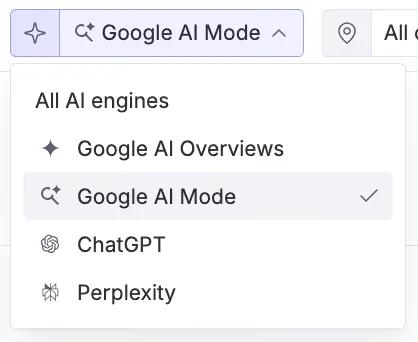
The key is in the intention. AI Overviews 'jumps' only when Google decides, mostly for easy searches. AI Mode is activated explicitly by the person when they want to delve deeper, compare calmly, or solve something more complex than a quick search. An example would be someone looking for an in-depth comparison between services or products.
In AI Overviews, the user remains in the usual search engine. There is an AI block at the top and a list of pages below. You can read the summary, ignore it, or go directly to the third result if you wish. It is a SERP with a comment on top.
In AI Mode, the experience revolves around the answer. Users enter this view because they want the model to think and summarise for them. They can continue asking questions, clarifying, asking for more detail, all within the same flow.
This has very direct consequences. You can have a presence in AI Overviews because your classic SEO works well, and still hardly appear in AI Mode because your content is not designed to withstand a long explanation. And vice versa: brands that barely feature in the traditional SERP are starting to gain ground in AI Mode if they explain the category better than their competitors.
If you take AI Overviews and AI Mode, mix them together into a single number and call it 'visibility on Google AI,' you end up with no useful information.
What we see when we analyse brands with Omnia looks a lot like this:
If you only look at one of the two models, you get a distorted picture. You may think 'we're doing well in AI' because you see yourself in an Overview, while in AI Mode you don't exist. Or vice versa, you may believe that your SEO is strong because you've seen yourself in AI Mode, when you still don't appear in the normal search engine.
That's why at Omnia we've decided to treat Google AI Overviews and Google AI Mode as separate engines. For each one, you can see if you are mentioned, how you are described, who you share responses with, and what sources the model is using to talk about your category.
Once you see your visibility in Google AI Overviews and Google AI Mode separately in Omnia, you understand where your brand is positioned.
See if your brand appears in Overviews, in AI Mode, in both, or in neither. That alone will tell you whether the model has you on its radar for that intent or not.
See if you compete against the same brands in both models or if the names change.
Don't just focus on whether it mentions you. Look at which websites it cites all the time: comparison sites, media, blogs, product listings, official documents. If you don't appear on those sites or you appear poorly, that's the first place you need to take action.
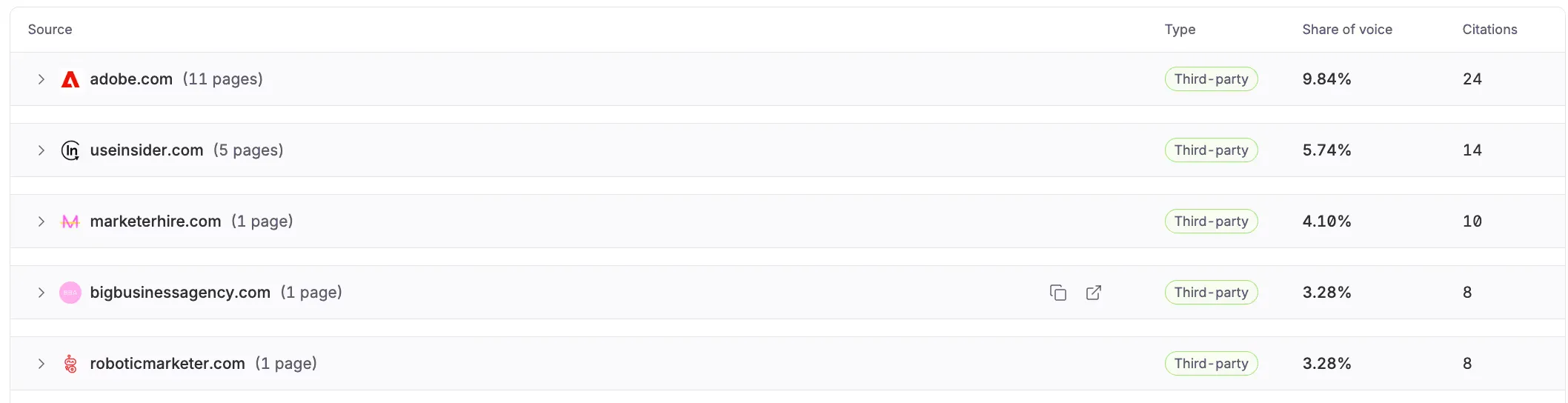
With these three things clear, the work is more obvious:
Going to Google and searching for a key query in your category will show you something very simple: whether or not you appear. That's fine as a first step. But if you want to truly understand your visibility, see how it changes between AI Overviews and AI Mode, which brands dominate each experience, and what sources AI is using to talk about your market, you need something more. That's where Omnia comes in: it gives you that complete view by engine, by query and by brand, and from there you can start working on how to improve your visibility, not just checking whether you appear or not.
Ready to see where your brand appears in AI Overviews and AI Mode separately? Try it for free with Omnia or Get a Demo.
Omnia offers a 14-day free trial on the Growth plan.
No credit card required. See exactly where your brand shows up (or doesn't) across AI engines, then let the platform's recommendations guide your next move.
Written By
 Daniel EspejoFounder & CEOatOmniaDaniel EspejoFounder & CEOatOmnia
 Miguel FernándezFounder & CTOatOmnia
 Miguel FernándezFounder & CTOatOmnia
 Alfredo BernalOrganic Growth LeadatOmnia
 ButiBuilderatOmnia
No credit card required · Free for 14 days · See your AI visibility within 3 minutes