Alto&Claro
How a digital marketing agency turned AI monitoring into a scalable client service.
How Answer Engine Optimisation helped TUIO dominate AI-driven insurance discovery
A practical look at Answer Engine Optimisation (AEO)
Until recently, discovering a brand meant opening a browser, typing a query and scanning a list of blue links. Today, more users go straight to generative AI engines such as ChatGPT, Gemini and Perplexity. When someone asks “What’s the best value-for-money home insurance in Spain?”, these models don’t redirect to pages, they generate an answer that, for many consumers, becomes the decision.
TUIO decided to lean into that shift and measure it with Omnia, a platform that tracks how brands appear inside answers from AI engines such as ChatGPT, Gemini, Perplexity and Google AI.
If your brand is absent, it effectively doesn’t exist in that moment of choice. Answer Engine Optimisation (AEO) is the discipline that tackles exactly this: making sure your brand is cited, recommended or included inside those AI-generated answers.
AEO is the process of optimising your brand’s presence inside the answers generated by AI engines. While traditional SEO focuses on ranking in a list of links, AEO focuses on being part of the response itself.
Every prompt to a generative engine represents a new kind of search moment. A few examples:
In reality, prompts go much deeper: “Home insurance for remote workers in Barcelona”, “Fastest claims process for young couples”, “Eco-friendly insurers Spain”. AEO demands that you work from the full spectrum of questions, not just the obvious ones.
Because generative engines synthesise sources and answer directly, the visibility logic changes. You no longer optimise for page one, you optimise to be cited in the answer, at the exact moment a decision is being made. That makes visibility inside AI generated answers a critical gateway to discovery and trust, with decision prompts often converting several times better than traditional search traffic.
TUIO, a digital native insurer in Spain focused on home insurance, recognised this shift early. As users began bypassing traditional search engines and relying more on generative AI for insurance advice, TUIO treated it as an opportunity.
They adopted a simple but disciplined workflow, supported by Omnia, to make their brand measurable and optimisable in the AI visibility landscape.
TUIO’s weekly routine followed three core steps:
Using the data they collected, TUIO were able to drive meaningful results:
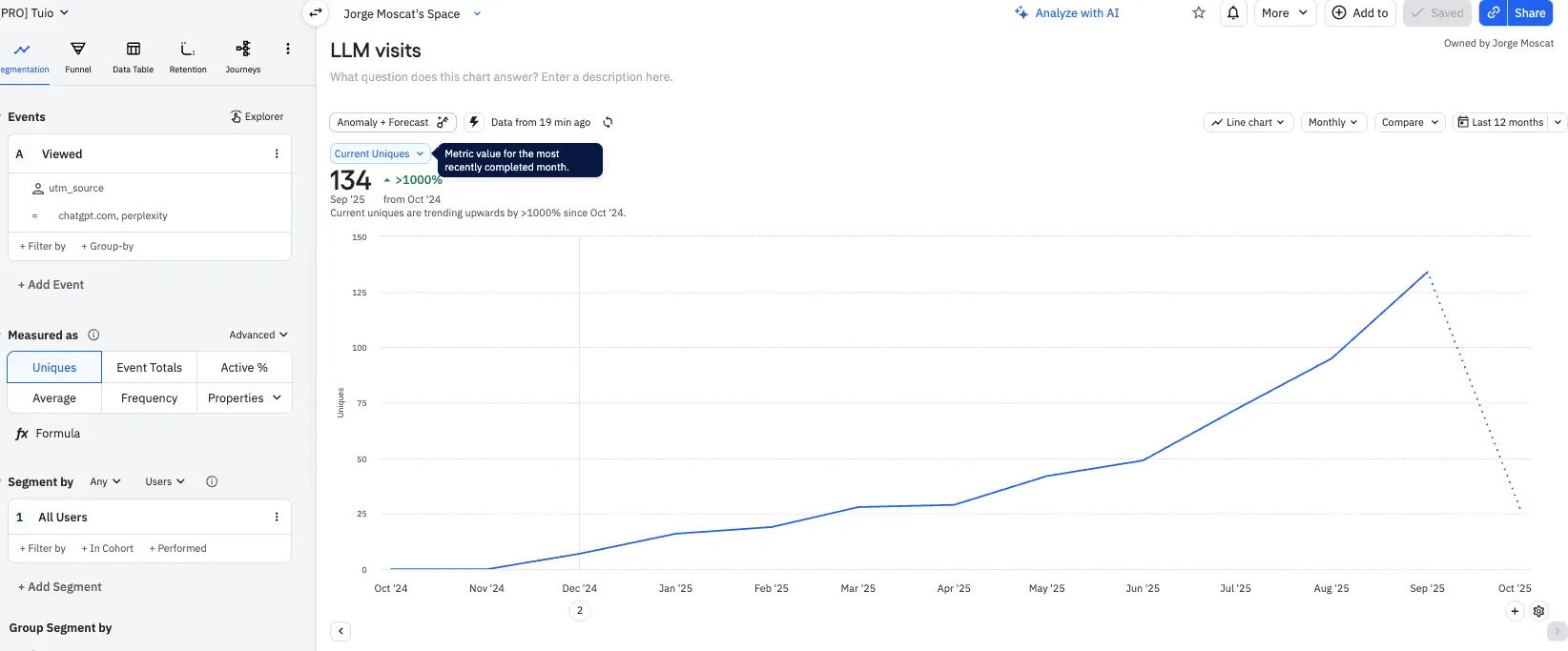
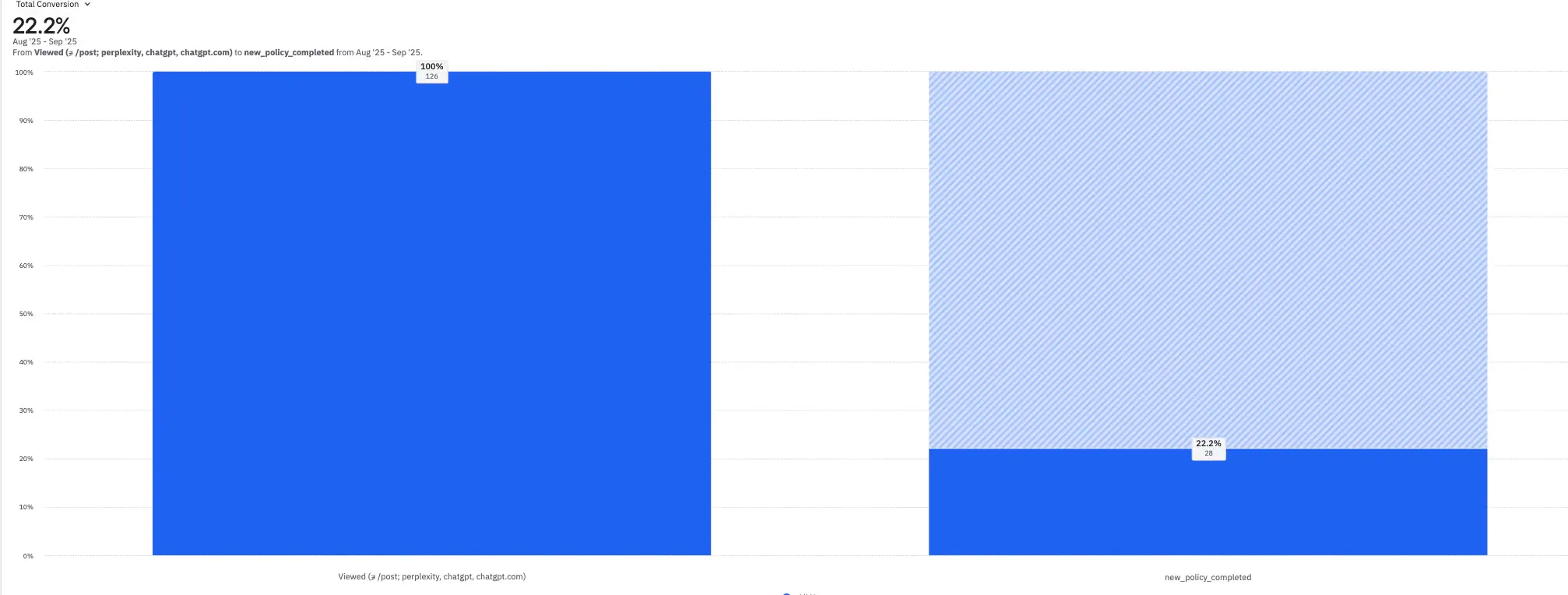
By September 2025, with a consistent AEO workflow in place, TUIO achieved a global Share of Voice of 11.79% with 1,844 brand mentions, surpassing giants like Mapfre (7.14%) and Santalucía (7.63%).
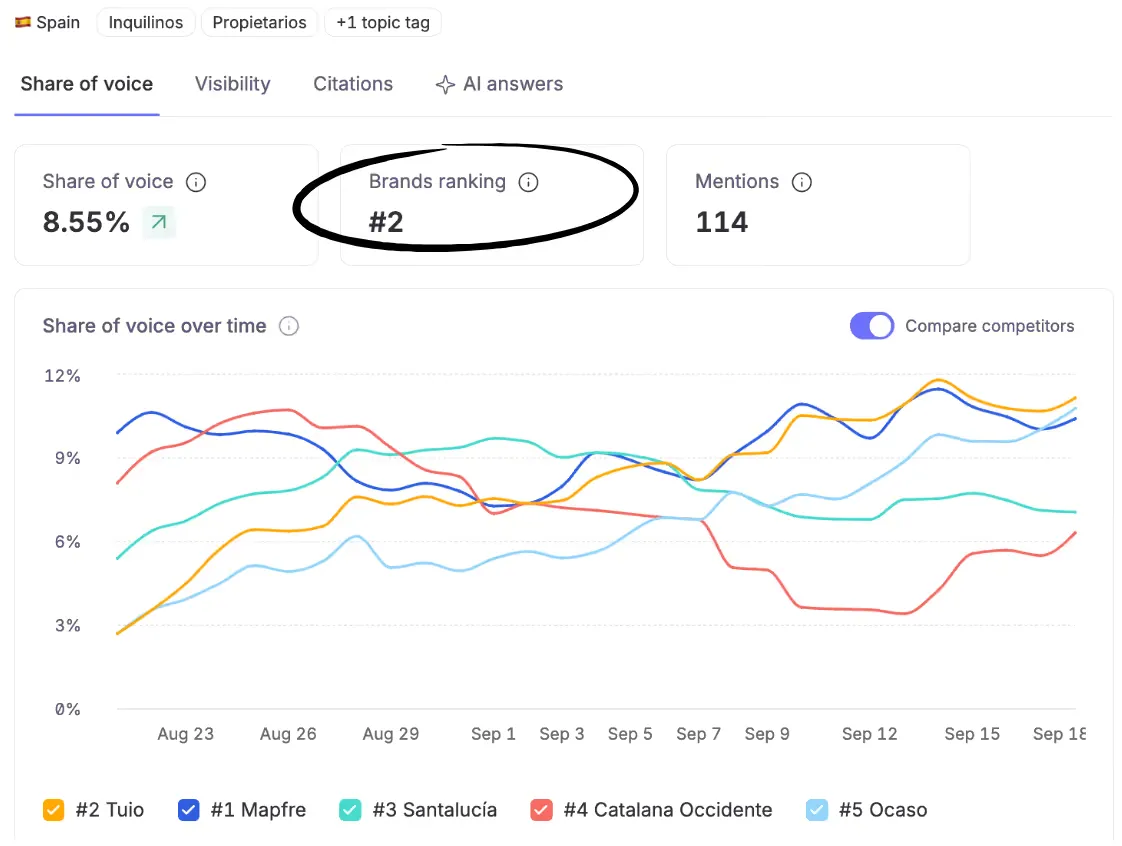
In the space of months, the brand became the most visible home insurer across major AI engines.
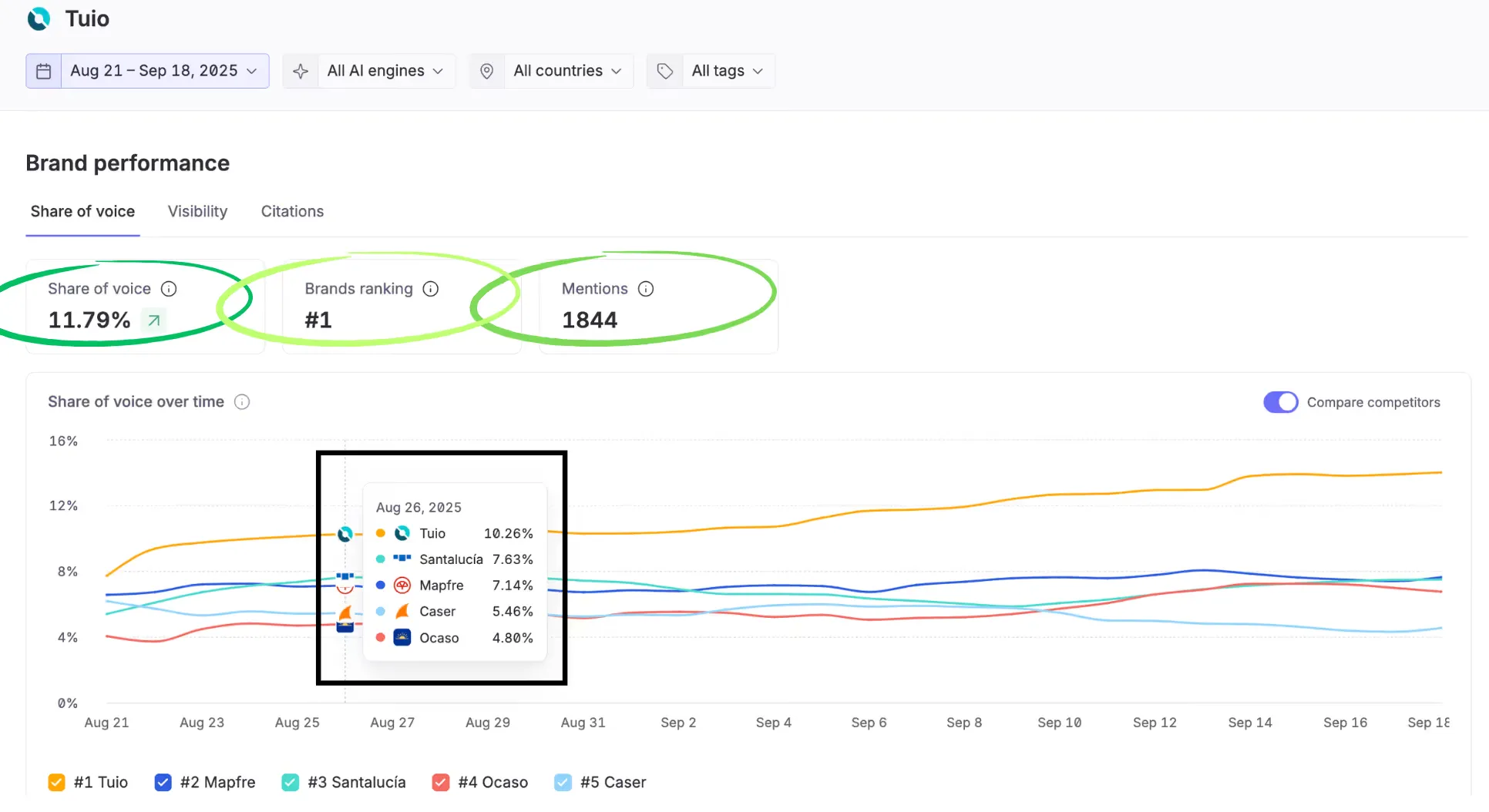
These numbers, provided by TUIO, underscore that visibility inside generative‑AI answers can convert into measurable business outcomes.
So far, TUIO have focused on measuring where they appear, how they are described and which sources drive that visibility. The next step is to scale what already works.
Omnia now automatically analyses the top-performing citations for each category, surfaces the patterns in how AI engines talk about brands (structure, claims, language) and generates content suggestions based on those patterns. TUIO can use these insights to publish and update content that aligns more closely with what models already trust.
That allows them to widen the gap with slower competitors, not just maintain their current lead.
TUIO’s journey shows that visibility in AI engines is real and measurable. It can be optimised and translated into business growth.
AI is fast becoming the default interface for discovery and decision-making. More than 40% of users already use it to research or buy products. Brands that ignore it risk disappearing from the conversation. That’s why now is the time to start measuring your visibility. Few brands are doing it, which makes it a strategic advantage.
AEO today stands where SEO stood twenty years ago: as a new competitive edge for those who understand it early.
How a digital marketing agency turned AI monitoring into a scalable client service.
Discover how a fintech company improved their AI visibility to generate more inbound qualified leads from AI with Omnia.

AI-attributed sales grew 95% a single month after adopting Omnia

From manual prompt tracking in spreadsheets to a system clients can act on.
How a nutrition SaaS went from invisible to top-ranked in AI search with Omnia.
How a growth consultancy added AI visibility to their agency stack to deliver sharper strategies and measurable growth.
How a edtech scale-up invested in AI visibility and grew 150% in a year.
How PLEO turned AI visibility into a measurable organic growth channel.
How a small insurer outranked industry giants across AI search engines.
How a travel credit card company used AI visibility data to dominate Avios prompts and turn recommendations into sign-ups.
No credit card required · Free for 14 days · See your AI visibility within 3 minutes