


Answer engine optimization (AEO) is the practice of getting your brand cited and recommended inside AI-generated answers, across platforms like ChatGPT, Perplexity, Google AI Overviews, and AI Mode. In current usage, AEO and GEO cover the same ground: AEO is the older label carried over from featured snippets and voice search, GEO is the term that emerged specifically for generative engines, and both sit on top of the same SEO foundation. If you're already optimizing content to get cited by an AI answer, you're doing AEO, whichever name your team happens to use for it.
"AEO" started showing up in your feed a few months ago, right after you'd finally gotten comfortable with GEO. It sounds like a discipline you're behind on. It isn't one. It's an older label, carried over from the featured-snippet and voice-search era, now getting stretched to cover the same work GEO already describes, and the argument over which term is "correct" is really an argument about vocabulary, not practice.
That's the confusion this piece resolves: what AEO means on its own terms, how it actually relates to GEO and SEO instead of sitting beside them as a third battle, and why the term is suddenly everywhere.
What is answer engine optimization?
Answer engine optimization is the work of getting your brand named, cited, or recommended inside an AI-generated answer instead of just ranked on a results page. The term predates the current AI search wave. It originated in the featured-snippet and voice-search era, when winning "position zero" meant getting pulled directly into Google's answer box rather than clicked through to a page, and it's now being repurposed for a new generation of answer surfaces.
The engines have changed more than the goal has. Today's answer engines are ChatGPT, Perplexity, Google AI Overviews, and AI Mode, with Gemini and Copilot folding into the same behavior as they get built into everyday search. The mechanics differ from traditional SEO because there's no list of ten blue links to climb. There's a single generated answer, and you're either part of what it says or you're not.
AEO, GEO, and SEO: how the three actually relate
Most of the confusion here isn't about the work. It's about which label got assigned to it first. GEO is the newer term, coined specifically for generative engines that write novel answers instead of surfacing an excerpt. In current practice, for anyone optimizing to be cited by ChatGPT, Perplexity, or AI Overviews, AEO and GEO describe the same activity. You're not choosing between them as competing strategies. You're choosing which word your team prefers.
SEO sits underneath both, not beside them. Site structure, crawlability, and authority signals still determine whether an AI engine can find and trust your content in the first place. AEO and GEO are what happens after that foundation exists: structuring content so it survives the summarization step and gets pulled into the generated answer rather than just indexed near it. For a full breakdown of where GEO tactics diverge from classical SEO tactics, see how GEO and SEO actually differ in practice.
The myth worth killing here: teams debating whether they should "do AEO or GEO" are arguing about vocabulary, not strategy. The actual question is whether you're optimizing for generative answer surfaces at all. Once you are, you're doing both, regardless of which acronym ends up on the slide.
Why AEO is showing up in your feed right now
The reason AEO stopped feeling optional isn't a forecast about search traffic declining someday. It's evidence that AI recommendations already move real behavior. Similarweb's June 2026 study tracked what happened after ChatGPT recommended a brand across finance, travel, and beauty. Brands recommended by ChatGPT were 2.5 times more likely to get a site visit within the following seven days than brands that weren't recommended, and 55.9% of that traffic arrived through a branded search rather than a visible AI click-through.
That last detail matters more than the headline number. Most of the payoff from being cited doesn't show up as an AI referral in your analytics at all. It shows up as someone typing your brand name into Google a few days later, after ChatGPT already made the recommendation. If your only measurement is "traffic from AI tools," you're missing the mechanism entirely.
The caveat is real: this is correlational, not proven causation, and the study covers US desktop behavior in three consumer categories. It doesn't prove AEO drives revenue in every vertical. However, what it does prove is that the assumption behind AEO, that being cited by an AI engine changes what a person does next, now has evidence behind it instead of just intuition.
How answer engines actually decide what to cite
Publishing content isn't the same as earning a citation, and most AEO advice glosses over the difference. Kevin Indig and Amanda Johnson's research at Growth Memo makes a specific claim worth sitting with: original data is necessary to earn citations, but publishing a number by itself often isn't enough.
What AI systems reward is a particular format, a benchmark that directly answers a comparison question like "which is best," not a data point buried inside a general explainer.
That reframes what "getting cited" actually requires. It's not about having proprietary data. It's about structuring that data as the direct answer to a question someone is likely to ask an AI engine, with a clear verdict, not just a number sitting inside a longer piece of prose. A stat without a comparison structure around it is easy for a model to skip past. A stat framed as the answer to "which one wins" is easy for a model to lift and cite.
How answer engines actually decide what to cite
Publishing original data isn't enough on its own, and most AEO advice treats it like it is. Built on Gauge's citation data across 301 cited pages and 1,075 citations, Indig and Johnson assert that primary research, meaning pages where the underlying data and methodology actually live, made up only 2.7% of what got cited. But those pages pulled in 8.4% of total citation volume. Primary research averaged 11.3 citations per page against 3.4 for everything else, a page that owns its data earns roughly 3.3 times the citation density of one that doesn't.
Here's the part that actually changes what you should publish. That advantage wasn't spread evenly across topics. It concentrated almost entirely in benchmark content, pages that measure named options against each other on a specific, named yardstick and publish the result as a direct comparison. Topics without a clean "which is best" question to answer produced almost no cited primary research at all, no matter how much original data existed behind them.
The myth worth killing here: owning proprietary data isn't the asset. A benchmark built from that data, one that leads with the comparison result, documents its method, and stays at a stable URL, is what an AI engine can actually find, trust, and lift into an answer. Data sitting inside a narrative explainer with no comparison frame around it is easy for a model to skip past entirely.
What this means if you're just getting started
Ranking and clicking used to be the whole game. Now the win condition includes getting named inside the answer itself, whether or not the reader ever visits your site afterward. That changes the starting point. Instead of asking where you rank, start by asking where you're already being cited, and where you're not.
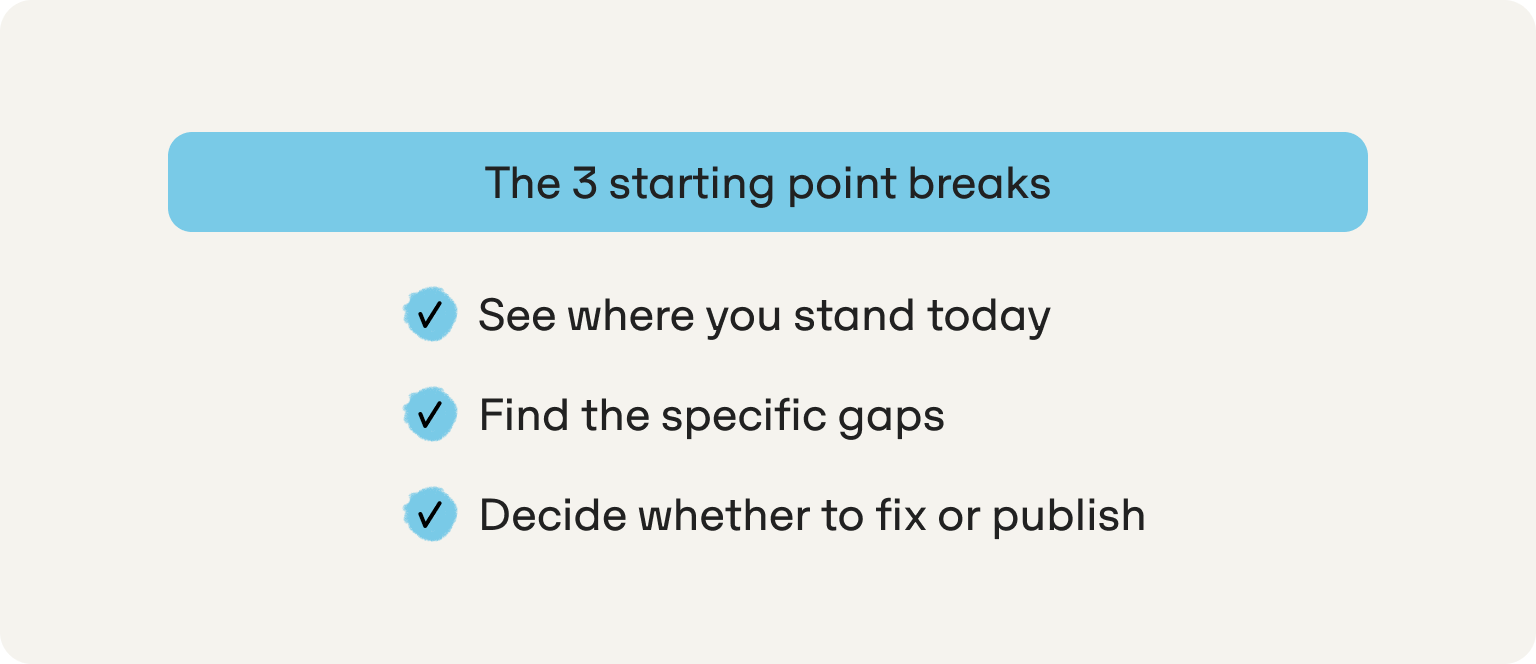
That starting point breaks into a short sequence, not a list of unrelated tips:
- See where you stand today. Check whether AI engines already mention your brand for the prompts your buyers actually ask, before deciding what to fix.
- Find the specific gaps. Once you know your current citation rate, you can see which prompts you're missing and which competitors are winning them instead.
- Decide whether to fix or publish. Existing content often just needs restructuring, a clearer answer up front, a documented method, a defined comparison. But a real gap, a comparison question nobody's answered yet, usually calls for something new instead of a rewrite.
Each step depends on the one before it. Skipping straight to "publish new content" without first checking where you stand is how teams end up guessing at gaps that don't exist.
Omnia's free AI ranking checker is built for that first step. It shows you where your brand already shows up across ChatGPT, Perplexity, Google AI Overviews, AI Mode, Claude, Gemini, and Copilot, using API access and real-browser simulation rather than scraped snapshots, so you're not guessing at your starting point. Run a free check to see where you stand, then use that read to decide whether step two or step three is where your effort actually belongs.

FAQs
Is Answer Engine Optimization (AEO) replacing traditional SEO?
No. Answer engine optimization builds on traditional SEO rather than replacing it. Search engines and AI platforms still rely on strong technical SEO, crawlability, site authority, and high-quality content to discover and trust your website. AEO focuses on increasing the likelihood that your content is cited, summarized, or recommended within AI-generated answers. It is best viewed as an extension of SEO, not a separate discipline.
Which AI platforms should you optimize for with AEO?
AEO should be approached as a cross-platform strategy instead of one designed for a single AI tool. The goal is to earn citations and recommendations across answer engines such as ChatGPT, Google AI Overviews, Google AI Mode, Perplexity, Claude, Gemini, and Microsoft Copilot. While each platform retrieves information differently, they all tend to reward authoritative, well-structured content that directly answers user questions.
How do you measure the success of an AEO strategy?
Success goes beyond traditional SEO metrics such as rankings and organic traffic. Effective AEO measurement includes tracking where your brand is cited in AI-generated answers, monitoring branded search growth, and measuring changes in direct and organic traffic after AI mentions. Since many users search for a brand after receiving an AI recommendation, the impact of AEO often extends beyond traffic referred directly by AI platforms.
What types of content are most likely to be cited by AI answer engines?
AI answer engines are more likely to cite content that provides clear, direct answers backed by credible information. Original research, benchmark reports, comparison pages, expert commentary, and comprehensive guides tend to perform well because they offer information that AI systems can confidently reference. Structuring content with clear headings, concise summaries, and transparent methodologies can also improve the likelihood of earning citations.
Can small businesses benefit from Answer Engine Optimization?
Yes. Businesses of any size can benefit from AEO by creating trustworthy, helpful content that answers the questions their audience is asking. Smaller businesses do not need the largest website to earn AI citations. They often succeed by demonstrating expertise within a specific niche, publishing original insights where possible, and creating content that clearly addresses customer intent. Being recommended by an AI answer engine can increase brand awareness and influence purchasing decisions, even if users do not immediately visit your website.

%20(1).webp)