


Most advice on optimizing content for Gemini-generated answers treats it as a page optimization problem. Gemini's citation data shows it is primarily a content placement and format problem: 90.1% of Gemini citations go to third-party editorial sources, with only 4.28 domains cited per answer. The content decisions that move Gemini citations are where content is placed, what format it takes, and how consistently it frames the brand across cited sources, and not whether owned pages are structured for extractability.
The most widely circulated advice for improving visibility in Gemini-generated answers tells SEO leaders to optimize their own pages: tighten headings, add FAQ schema, write direct answers under structured headings. For Gemini specifically, that advice addresses the wrong end of the citation chain.
Omnia's citation database, covering the four-week window in May/June 2026, shows 90.1% of Gemini citations going to third-party editorial and independent web content. Owned domains account for 6.7%. With only 4.28 distinct domains cited per answer, the content decisions that determine Gemini citation share are primarily decisions about what gets placed on third-party sources and not how well structured a brand's own product pages are.
The strategy that follows is built around three of those decisions: where content is placed, what format it takes, and how consistently it frames the brand across the sources Gemini cites.
Why most Gemini ranking advice optimizes the wrong content
The generic Gemini ranking checklist: E-E-A-T signals, FAQ schema, structured headings, direct answers, was initially built for AI Overviews. Gemini and AI Overviews share only 38.5% of their top cited domains. A strategy built on AI Overviews guidance has a structural blind spot covering the majority of Gemini's citation pool.
Two specific claims circulating in the market deserve direct correction:
- "YouTube leads Gemini citations." Omnia's data shows YouTube at 1.03% of Gemini citations, a fifth of its 6.17% share in AI Overviews. YouTube content optimization is an AI Overviews tactic being applied to the wrong engine.
- "Top-10 organic ranking is a prerequisite for Gemini citation." That relationship holds for AI Overviews, where Google's own index is the primary source pool. Gemini draws from a broader editorial web. Roughly 45% of its citations go to blog, article, and review content on independent editorial sources that do not necessarily hold top-10 organic positions.
The root problem with both claims is the same: they conflate engines that do not behave alike. With 90.1% of Gemini citations going to editorial and independent web content and only 4.28 domains cited per answer, optimizing owned pages addresses 6.7% of what determines Gemini citation share. The other 93.3% is determined by what third-party sources say, and whether those sources are in Gemini's citation pool at all. That gap is where most teams lose ground. As one Daniel Espejo (founder of Omnia) put it: "Most teams are auditing their own website when they should be auditing the web around them.” For teams also managing AI Overviews separately, see how to improve visibility in Google AI Overviews.
Content decision 1: where to place it
Identifying which domains Gemini cites in the category is not the end of the analysis; it is the start of a content placement brief. The output is a list of editorial targets: specific publications and domains where content needs to be produced and placed to enter Gemini's retrieval layer.
With only 4.28 citation slots per answer and a near-100% retrieval-to-citation rate. Dejan.ai's June 2026 grounding test found Google received 7 pages and cited 7, which illustrates that the content that earns Gemini citations is the content present on the sources Gemini retrieves. Quality is irrelevant if the content is not on a retrieved source.
The content placement brief:
- Map which domains Gemini cites consistently for the category's highest-intent prompts. That domain list should serve as your editorial target list. See AI citation tracking for the mapping process and AI prompt discovery for identifying the right prompts to map against
- Identify which of those domains accept guest contributions, publish comparison roundups, or feature expert commentary
- Produce content briefed around the prompt intents those domains are cited for and not around general brand messaging
- Track whether placements on cited domains produce citation movement within two to three weeks
What content placements do not move Gemini citations:
For the ChatGPT-specific content placement guide where Reddit and community presence do move citations, see how to rank in ChatGPT search. For AI Overviews, where YouTube and LinkedIn carry more weight, see how to rank in AI Mode.
Where to focus instead:
Gemini over-indexes on independent editorial sources relative to its Google siblings. Medium and Forbes both appear at higher citation rates in Gemini than in AI Overviews or AI Mode. Trade press, independent review publications, and editorial sites in the category are the primary placement targets and not Google-owned platform content.
Content decision 2: what format Gemini takes
The content format advice circulating for Gemini centers on extractability, which includes short direct answers, FAQ schema, and even structured product content. Gemini's page-type data shows the format it actually cites is editorial depth, not extraction-optimized structure.
What Gemini actually cites vs what most teams optimize for:
Source: Omnia citation database, May 22 to June 16, 2026.
Blog and article pages plus review and comparison pages account for roughly 45% of all Gemini citations. Product pages, pricing pages, and FAQ pages are collectively under 0.6%. FAQ schema is not a Gemini citation trigger. Google's own guidance confirms schema does not determine inclusion in AI-generated answers, and Gemini's 0.09% citation share for FAQ pages is the data-level confirmation.
What this means for content production:
- Comparison and review content is the highest-leverage format. At 12.17% of citations and an average citation position of 6.1, which is marginally better than blog content at 6.4, a brand featured in a well-sourced comparison article on a cited domain earns stronger Gemini positioning than any FAQ-optimized product page
- Editorial depth on third-party sources outperforms structured content on owned pages. A substantive analysis piece in a trade publication Gemini cites consistently contributes more to citation share than ten extractability-optimized owned pages
- The format SEOs already produce is the right format. Long-form editorial, comparison roundups, and independent coverage and not a new AI-specific content format
Published in Search Engine Journal in June 2026, Peec AI analyzed across nearly 38,000 AI over five LLM engines how prompt intent drives brand visibility more reliably than exact wording variation.
This seems to allude that one well-placed comparison article targeting evaluative intent covers more Gemini citation surface than several pieces targeting the same intent from different phrasings.
For how these content format principles connect to the broader GEO framework, see generative engine optimization and GEO vs SEO. For the documented performance advantages of this editorial approach over traditional SEO, consider reading our guide to generative engine optimization and SEO benefits.
Content decision 3: how consistently Gemini frames the brand
Gemini constructs its picture of a brand from the content across multiple cited sources. A brand described inconsistently across those sources (different use cases on different publications, outdated positioning in an old review, contradictory differentiators across comparison articles), produces weaker, less confident Gemini citations than a brand with coherent, sustained editorial coverage saying the same things across the same sources.
Content consistency establishes relevance across cited sources is not a brand guidelines problem. It is a content production and briefing problem.
Four content decisions that determine entity depth:
Brief every placement for framing, not just accuracy
Every piece of content placed on a cited domain: guest contributions, expert commentary, product roundup inclusions, should carry consistent brand framing: same use cases, same positioning, same differentiators, current product descriptions. Accurate but inconsistently framed content weakens the entity signal Gemini uses to construct citations.
Produce editorial content under named authors
Content produced under a named author with an established editorial profile generates a stronger entity signal than anonymously authored content. This remains a content production decision. Named contributors with professional profiles and published editorial histories give Gemini's retrieval layer a credible entity to associate with the content, not just a page.
Build Knowledge Graph presence as the content foundation
A brand with a confirmed Google Knowledge Graph entity should have consistent details across directories, Organization schema on core pages, Wikipedia presence where warranted, gives Gemini's retrieval layer a stable entity anchor to associate with content across cited sources. This is a content infrastructure decision that amplifies every editorial placement that follows.
Act during the formation period
Gemini's citation pool is still forming: 40.5% of active Gemini domains in the most recent full tracking week were appearing for the first time. Content placed on cited sources now builds entity signals during the period when the pool is most receptive to new entrants. For lean teams building a GEO programme from the ground up, see generative engine optimization for small business.
What to audit before scaling content placement:
- Which publications Gemini cites in the category and whether brand coverage in those sources is accurate, current, and consistent
- Whether existing coverage frames the brand's positioning, use cases, and differentiators the same way across all cited sources
- Whether core pages carry Organization schema and whether brand entity data is consistent across directories
- Whether content is being produced under named authors or anonymously, and whether those authors have established editorial profiles
For how Omnia surfaces brand framing quality and sentiment across Gemini citations, see AI sentiment analysis.
How to measure whether content optimization is working in Gemini
Traditional rank tracking tells you where a page sits on a static SERP. Measuring whether content is working in Gemini requires different signals and one for each of the three content decisions above.
The right metric for each content decision:
Standard analytics tools do not surface these signals. Gemini does not pass citation data into Google Search Console. The downstream effect of a Gemini citation (i.e. a branded search, a direct visit) will surface in analytics as organic or direct traffic.
What Omnia surfaces for content strategy measurement:
- Citation domain patterns by prompt, with numbered position data showing which content placements are landing in Gemini's retrieval layer and at what rank
- Page-type distribution of brand citations which demonstrates whether editorial placements are producing blog and review citations or being outweighed by product page citations from competitors
- Brand framing quality and share of voice vs. specific competitors across a consistent prompt set
- Week-over-week trends across a stable prompt set so the impact of specific content actions is visible against a reliable baseline
From content strategy to executed action
Knowing which domains Gemini cites in the category, which formats earn citations, and how brand framing should read across cited sources still leaves a gap between insight and execution. Most teams stall at the translation step, turning citation data into a content placement brief, a guest contribution pitch, or a framing audit across published coverage.
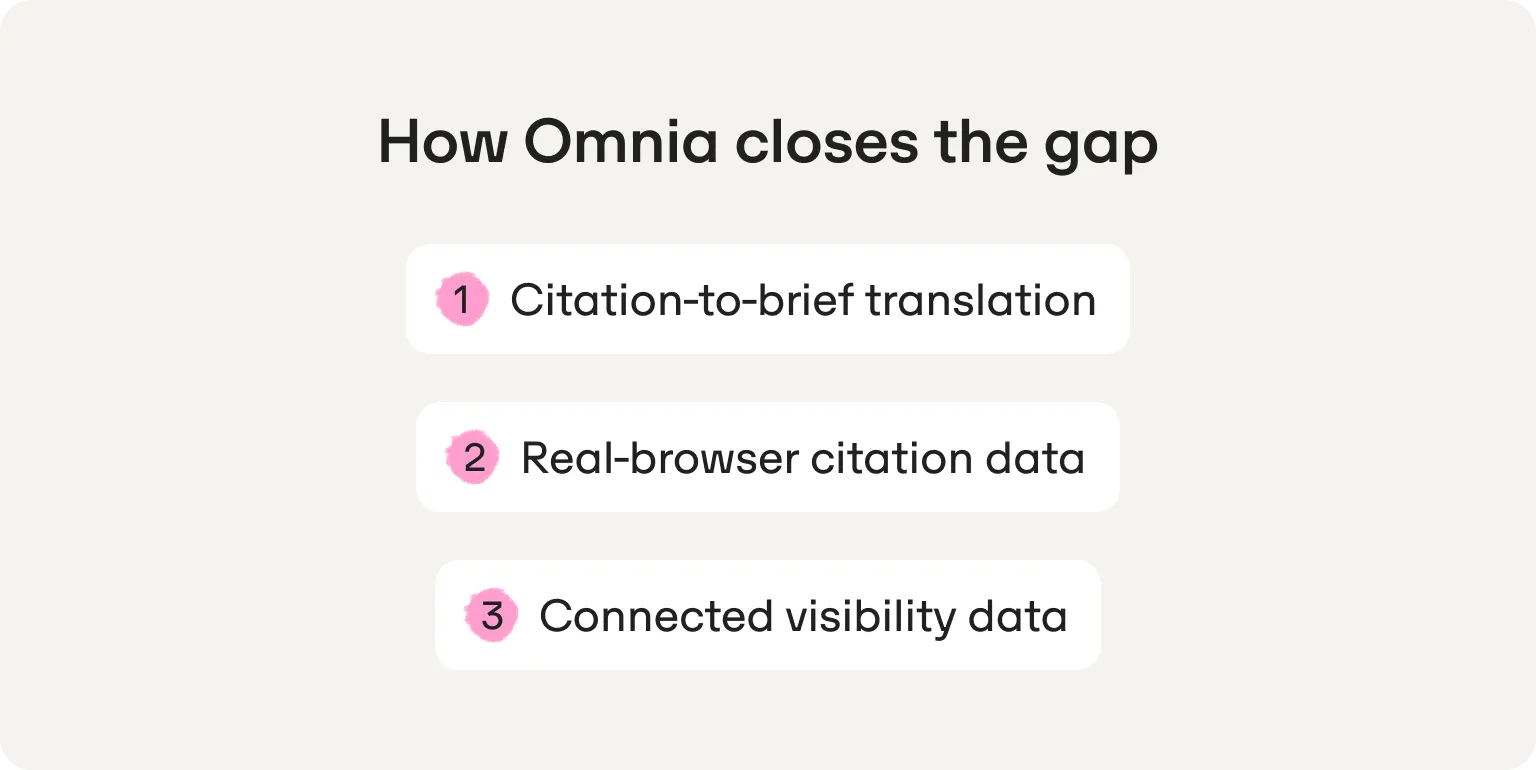
Omnia closes that gap in three ways specific to Gemini content strategy:
- Citation-to-brief translation. For each identified gap, a cited domain where the brand has no coverage, a prompt where a competitor's comparison article consistently earns position 2, or a publication whose coverage frames the brand with outdated positioning, Omnia's action layer generates a content brief specifying the target domain, the prompt intent to address, the format to produce, and the brand framing the piece needs to carry. The team receives a production brief, not a dashboard observation.
- Real-browser citation data. Omnia tracks Gemini citations using real-browser simulation rather than API approximations. Gemini's responses vary enough across sessions that spot-check scraping produces citation data that does not reflect what buyers actually see. The figures in this article were collected using Omnia's standard method across the full four-week tracking window.
- Connected visibility data. Omnia MCP connects Gemini citation and position data into AI assistants directly, including the tools the team already uses so citation gaps and content action lists are accessible without a separate platform login. For the full AI visibility tracking system across all engines, see AI visibility tracking.
For teams that want to understand where Gemini rank tracking fits relative to other AI visibility tools before committing to a setup, see Omnia's AI ranking checker.
Your customers are already asking Gemini which tools to use in your category. Be sure to stay ahead of the curve and start a free trial or book a demo with Omnia.
FAQs
Does optimizing my own pages improve visibility in Gemini-generated answers?
Partially, but not primarily. Owned domains account for 6.7% of Gemini citations so on-page optimization addresses a small fraction of what determines Gemini citation share. The content decisions that move Gemini citations are primarily decisions about third-party editorial placements: what gets produced, on which cited domains, in which format. Optimizing owned pages is a necessary baseline, not a sufficient strategy.
What content format earns the most Gemini citations?
Blog and article pages account for 32.74% of Gemini citations and review and comparison pages for 12.17%, together roughly 45% of all Gemini citations. FAQ pages account for 0.09%. The content format that earns Gemini citations is editorial depth and comparative analysis, not FAQ-schema-optimized product content. A well-placed comparison article on a domain Gemini cites consistently in the category will produce more citation signal than any amount of structured heading optimization on a brand's own pages.
Does schema markup help content rank in Gemini?
Schema is worth implementing for technical correctness and for helping Gemini recognize entity relationships — Organization schema, Article schema, and consistent structured data across core pages strengthen the entity signal Gemini's retrieval layer uses. But Google's own guidance confirms schema is not a citation trigger for AI-generated answers, and Gemini's 0.09% citation share for FAQ pages is the data-level confirmation that FAQ schema is not a primary Gemini ranking lever. Schema is a foundation, not a differentiator.
How is optimizing content for Gemini different from optimizing for AI Overviews?
The citation pools are largely different surfaces. Gemini and AI Overviews share only 38.5% of their top cited domains. YouTube accounts for 6.17% of AI Overviews citations and 1.03% of Gemini citations. LinkedIn is around 1% of AI Overviews citations and has appeared nine times in total in Gemini's tracking window. Content optimized for AI Overviews: platform content, YouTube presence, Google-ecosystem signals — addresses sources Gemini rarely cites. Gemini-specific content optimization centers on independent editorial sources, trade press, and comparison content on domains Gemini actively retrieves from.
How long before content placements on cited domains appear in Gemini citations?
Given Gemini's near-100% retrieval-to-citation rate and Dejan.ai's June 2026 grounding test found Google received 7 pages and cited 7 — a placement on a domain Gemini actively retrieves from should surface in citation data within two to three weeks. If a placement does not register within that window, the domain was likely not in Gemini's active retrieval pool for those specific prompts. The fix is to revisit the citation map, identify which domains Gemini is actually retrieving from for the target prompts, and adjust the placement target accordingly.