

Generative engine optimization and SEO are not the same thing — and one does not replace the other. SEO earns ranked positions in search results pages. GEO earns citations in AI-generated answers. Most businesses need both, but the right starting point and investment balance depends on company stage, content maturity, and where buyers in your category are currently making decisions. Omnia measures the GEO half of that picture — the channel your current SEO tools can't see.
Most GEO vs SEO comparisons frame this as a competition. Which one wins? Which one should you bet on? Which one is dying?
That is the wrong frame. It is also the frame that leads marketing teams to either ignore GEO entirely (waiting for the "clear winner") or abandon SEO prematurely (chasing AI visibility before the foundation is in place). Neither decision serves the business.
The real question is not which channel is better. It is: given where your buyers are making decisions right now, and given what you already have, what do you build next and in what order?
Based on Omnia's proprietary citation database tracking 42M+ citations across four AI engines, ChatGPT averages just four citation slots per answer, and that number has declined approximately 30% since mid-2025. The brands establishing citation authority now are making it structurally harder for competitors to enter later. The window is not closing tomorrow. But it is closing.
This article gives you the framework to make the GEO vs SEO decision for your specific business — not the generic answer, but the one that matches your stage, your content maturity, and your buyers' behavior.
Is generative engine optimization the same as traditional SEO?
No. They share infrastructure but produce different outputs through different mechanisms.
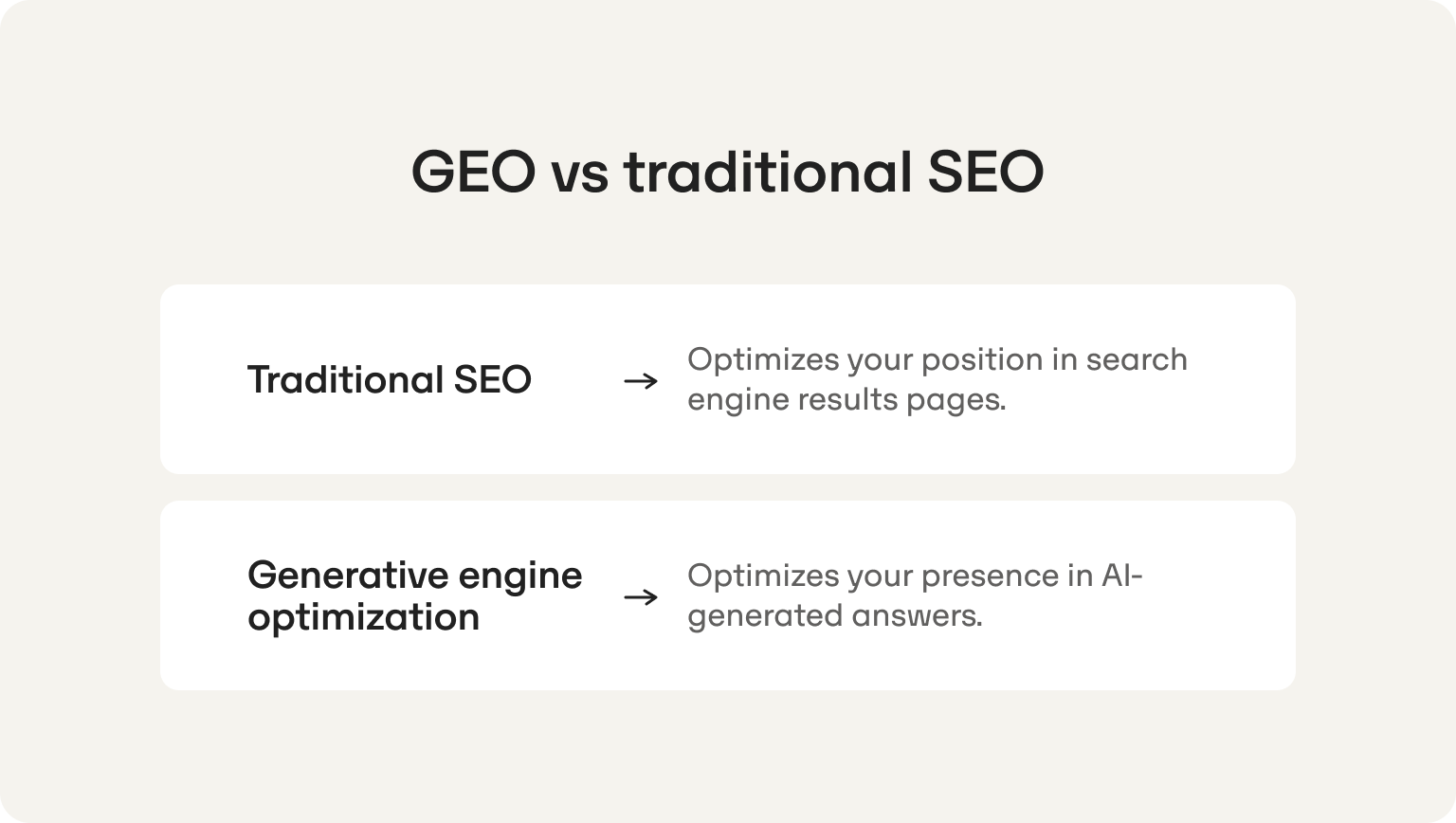
Traditional SEO optimizes your position in search engine results pages. The mechanism is keyword authority, backlink signals, technical site health, and domain authority accumulated over time. Success is a ranked position a user clicks. The output is organic traffic.
Generative engine optimization optimizes your presence in AI-generated answers. The mechanism is citation authority on trusted external sources, entity consistency across the web, and content structured for AI extractability. Success is a brand mention or citation inside a synthesized AI answer. The output is brand presence at the moment a buyer is forming their consideration set — before they ever see a search results page.
A page that ranks on page one of Google for a high-intent keyword can be entirely absent from ChatGPT's answer to the same question. The reverse is also true: a brand with strong AI citation authority in a niche category can appear consistently in ChatGPT answers while barely registering in traditional search rankings.
They are related. They are not interchangeable.
How SEO and GEO differ — the four dimensions that matter for your strategy
Understanding the difference at a definitional level is the starting point. Understanding it at a strategic level — where it changes decisions about resource allocation, content investment, and measurement — is what this section covers.
What they optimize for
SEO optimizes for position. There is a SERP. There are ranked positions. A page holds one of them. Position changes are observable, attributable, and trackable with standard tools.
GEO optimizes for presence and citation. There is no SERP. There are synthesized answers that include three or four sources — and your brand is either in them or not. The competition is not for position two or position five. It is for inclusion in a set that averages four brands in a ChatGPT answer, based on Omnia's citation data.
That compression matters. In SEO, position six still produces impressions and some clicks. In a ChatGPT answer that recommends three vendors, position four is invisible.
What they measure
SEO metrics are familiar: keyword rankings, organic traffic, click-through rate, domain authority, backlink growth. Monthly reporting cadences work because Google's ranking signals change slowly.
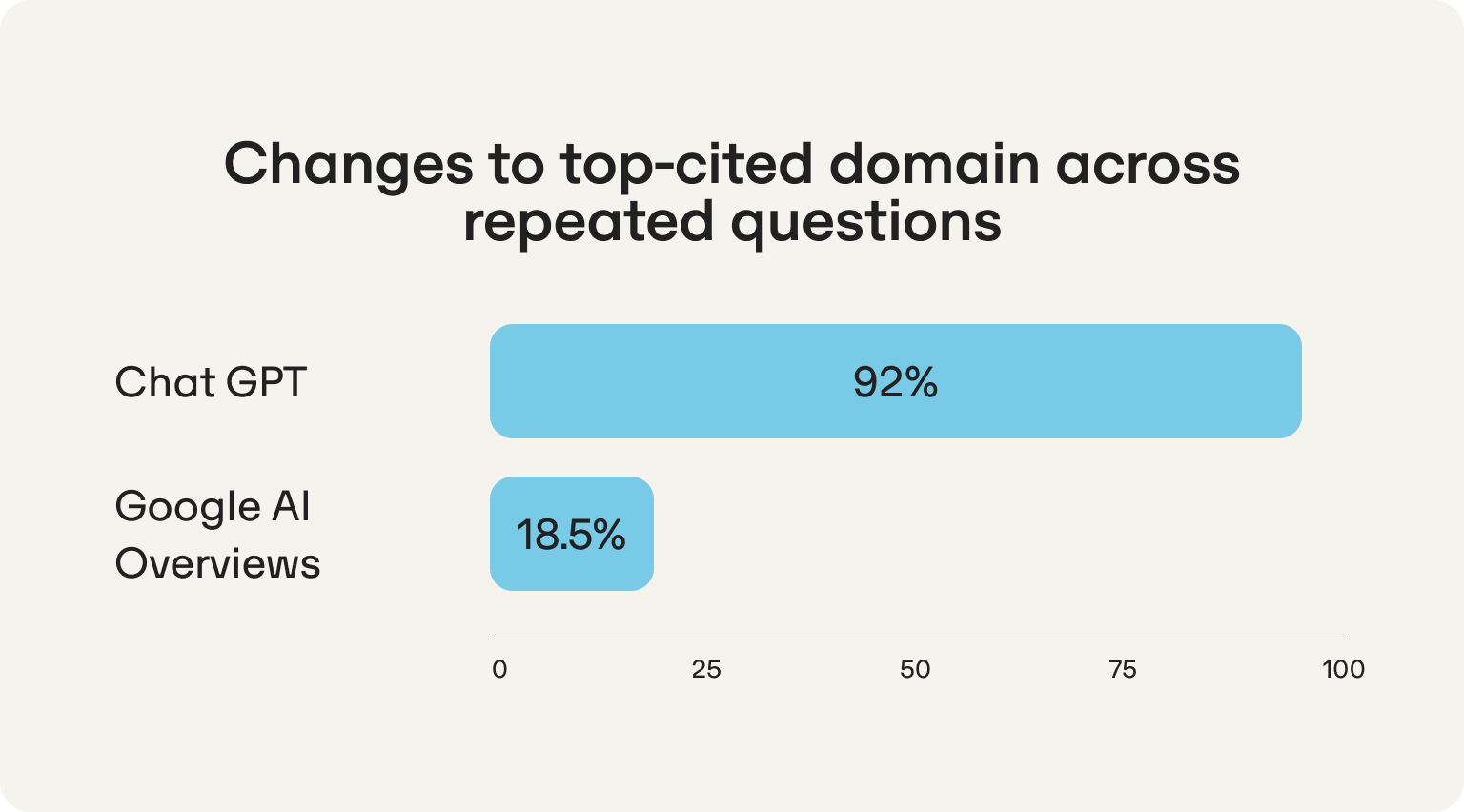
GEO metrics are different: mention rate, citation rate, share of voice across AI engines, and narrative accuracy — whether AI engines describe your brand correctly. Weekly reporting cadences are necessary because AI citation patterns are volatile. Based on Omnia's citation database, ChatGPT changes its top-cited domain 92% of the time week over week. Monthly GEO reporting hides most of the signal in noise.
What they require to work
SEO requires keyword research, technical site health, content volume over time, and backlink authority built through external linking. These compound over years.
GEO requires citation authority on the specific external sources AI engines trust for your category, entity consistency across every public-facing source your brand appears on, and content structured for AI extractability — clear claims, direct answers, named sources, and specific figures in the first 300 words. The source trust signals that determine whether AI engines cite your content are different from the authority signals that determine where Google ranks your pages.
Existing SEO investment partially accelerates GEO results. Domain authority and content quality are partially recognized by AI engines. Partial transfer is not full transfer. The GEO-specific work — external citation building, entity statement consistency, content restructuring for extractability — does not happen automatically as a byproduct of strong SEO.
There is a specific failure mode worth naming here. Brands that publish strong category-level content — educational blog posts, comparison guides, thought leadership — often assume that content is building AI visibility. It may be building the model's understanding of the category without building brand-specific recognition. As Jason Barnard argued in Search Engine Land, the AI can learn the category without learning the brand. Generic content that educates about a problem space without establishing distinct, corroborated signals about your specific brand, use case, and differentiation trains the model on your competitors' territory as much as your own. Entity consistency and external citation building are how you close that gap — ensuring the model associates your brand name with specific claims, not just the category you operate in.
Where your buyers are
This is the dimension most GEO vs SEO comparisons miss entirely — and it is the one that should drive the resource allocation decision.
The right balance between SEO and GEO investment depends on where buyers in your specific category are currently making decisions. Some categories are still primarily search-driven: buyers Google a keyword, evaluate the results, and visit websites. Others are already AI-assisted: buyers ask ChatGPT which tool to use, get a three-brand shortlist, and visit one or two of those sites. In the second scenario, a brand invisible in AI answers is losing consideration before any search result is ever seen.
Writing in Search Engine Land, Jason Barnard describes this shift through the concept of the "delegation boundary" — the line between what a user does for themselves and what they hand to an AI engine. As that boundary moves earlier in the buyer journey, AI assistants make upstream decisions — shortlisting options, filtering by criteria, surfacing recommendations — before the user ever reaches a search results page. A brand that doesn't exist at the delegation boundary doesn't get filtered out. It never enters the consideration set at all. The strategic implication is direct: the question is not whether your buyers are using AI engines, but where in their decision journey they are delegating to them — and whether your brand is present at that exact moment.
Prompt coverage mapping is the way to diagnose this for your specific business. Run your ten most important non-branded commercial prompts across ChatGPT, Perplexity, and Google AI Overviews. If competitors appear consistently and you don't, your buyers are already making AI-assisted decisions in your category — and your SEO program, however strong, is not capturing that demand.
What SEO and GEO have in common — the shared infrastructure
The case for treating GEO and SEO as complementary rather than competing starts here.
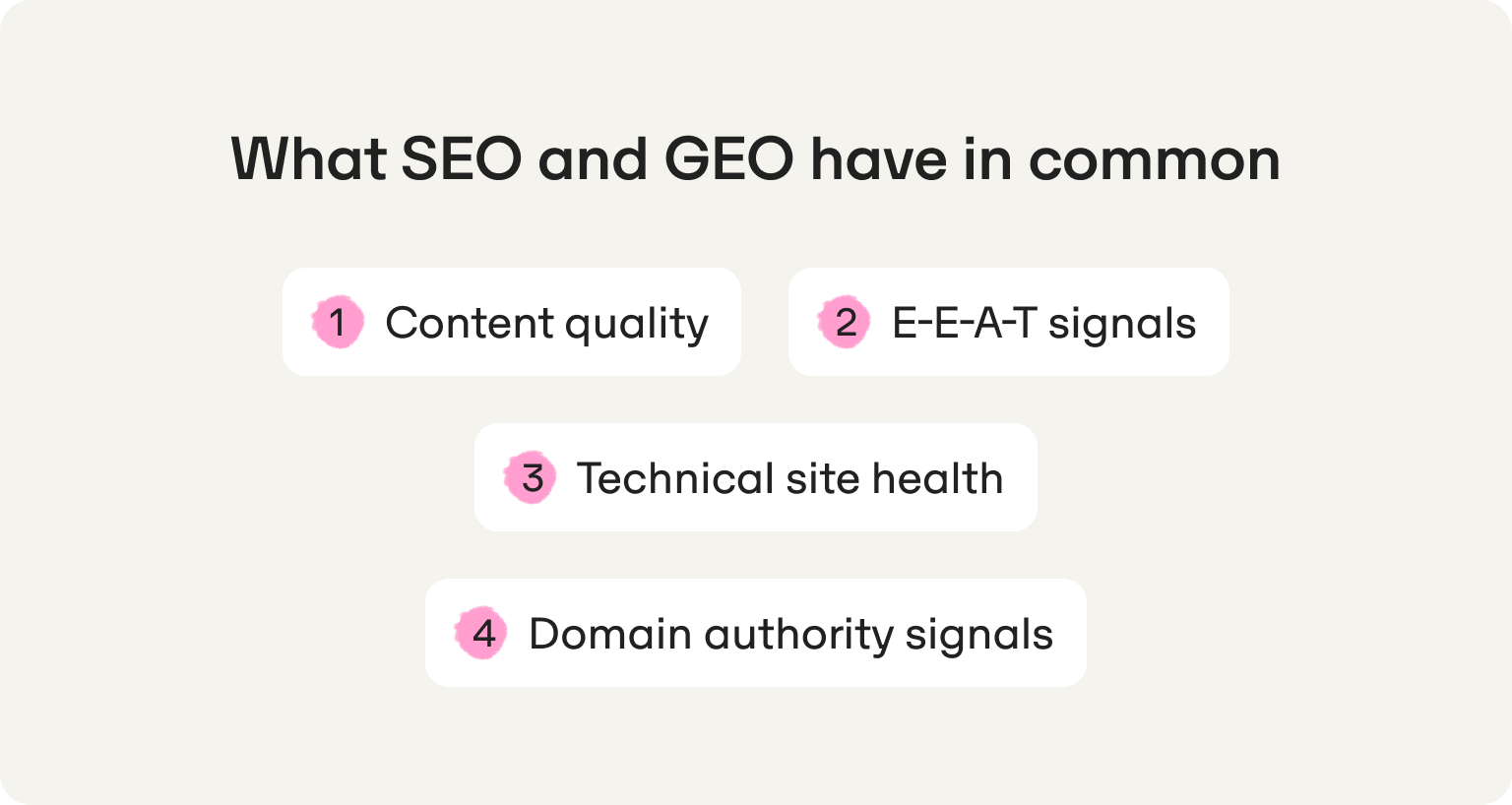
Four things serve both channels:
- Content quality. AI engines and Google both reward content that directly addresses specific questions with named evidence, concrete figures, and clear structure. Content produced for SEO that meets these standards is closer to GEO-ready than content that hedges, meanders, or optimizes for keyword density without genuine informational value.
- E-E-A-T signals. Google's Experience, Expertise, Authoritativeness, and Trustworthiness signals overlap with the provenance and authority signals AI engines use to assess source credibility. Author bylines, publication dates, named sources, and first-hand evidence serve both channels.
- Technical site health. Crawlability, indexability, fast HTML rendering, and clean canonical tags are prerequisites for both Google ranking and AI citation eligibility. A page that Google cannot index is also a page ChatGPT cannot retrieve. The crawl/parse/retrieve framework applies across channels where the specific crawlers differ and the eligibility logic is similar.
- Domain authority signals. External mentions and citations from authoritative sources reinforce both SEO backlink profiles and AI engine source trust hierarchies. A brand earning coverage in respected industry publications is building assets that serve both channels simultaneously.
The infrastructure investment is not wasted when you add GEO. It is the foundation GEO builds on. What GEO adds on top of that foundation — external citation building specifically for the sources AI engines trust, entity consistency across non-SEO-tracked platforms, and content restructuring for extractability — is the incremental investment.
Which is more important — SEO or GEO for your business?
The answer is stage-dependent. Here is the honest breakdown by company situation.
If you're pre-Series A with minimal existing content
Run SEO and GEO in parallel from the start, with GEO weighted more heavily than most guides suggest for early-stage companies.
The SEO math is genuinely difficult for early-stage brands. Long-tail keywords that used to be accessible have been absorbed by content farms and AI-generated articles. Head-term keywords require domain authority that takes years to build. Based on Omnia's citation data, AI competitive saturation in traditional search is already high for most B2B SaaS categories — the window for winning on SEO alone at early stage has narrowed.
GEO long-tail prompts are less contested. A startup can build citation authority on two or three external sources — a fully populated G2 profile, coverage in one or two industry publications — and begin appearing in AI answers for specific, intent-rich prompts within four to six weeks. That visibility compounds differently than SEO: citation patterns that establish early can persist as the model's training data updates.
The first move is external citation building, not content volume. The GEO for small business guide covers the five-prompt starting point and the one-hour audit in detail.
If you're post-Series A with an existing content program
SEO remains the foundation. Organic traffic from an established content program compounds over time and should not be abandoned for an unproven channel. The compound interest on three years of SEO investment is real.
GEO becomes the priority extension — the channel that captures demand from buyers who are already in AI engines before they reach search results. For a brand at this stage, the question is not whether to do GEO. It is how much of your current content investment is failing to produce AI citations — and how to close that gap without rebuilding the content program from scratch.
The answer is usually content restructuring before content creation. Existing high-ranking pages are candidates for GEO optimization: entity statements clarified, statistics made directly extractable, external citation targets identified and pursued. The measurement framework in the GEO SEO benefits guide covers what this looks like in practice for SEO-native teams.
The investment is additive, not redistributive. SEO budget stays. GEO budget is layered on top with smaller initially, growing as the channel proves ROI.
If you're a scaleup with an established SEO program
The question shifts from "should I do GEO" to "how much of my current SEO investment is leaking into AI answers undetected."
A scaleup with a mature SEO program and strong organic traffic rankings may be systematically invisible in AI-generated answers for the same queries — because the mechanisms are different and the leakage is invisible without GEO-specific measurement. High-ranking pages that fail the crawl/parse/retrieve test don't get cited. Strong backlink profiles that don't translate to external AI citations don't produce AI visibility. Buyers who ask ChatGPT which tool to use in your category encounter your competitors' names, not yours — and that loss never shows up in your organic traffic dashboard.
GEO measurement at this stage is a diagnostic tool before it is a new channel investment. It reveals where the SEO program is succeeding at traditional search while failing at AI-assisted discovery — which is where an increasing share of high-intent buyers are forming their consideration sets.
Do you need both SEO and GEO for your website?
Yes. The question is sequence and proportion, not whether.
Here is a practical diagnostic. Answer these three questions about your current situation:
- Where is your organic traffic coming from? If the majority is branded (people searching your company name), your SEO program is defensive. You show up when people already know to look for you. GEO addresses the gap: the buyers who don't know your name yet and are asking AI engines which solution to consider.
- Are competitors appearing in ChatGPT answers for your category prompts? Run five non-branded category prompts across ChatGPT and Perplexity. If competitors appear consistently and you don't, buyers are already making AI-assisted decisions in your category without encountering your brand. That gap is not an SEO problem — it will not be solved by improving keyword rankings.
- Does your content answer specific questions or address broad topics? Content structured around specific questions — "best project management tool for a 20-person engineering team" — is closer to GEO-ready than content structured around broad keyword topics. If your existing content is broad and keyword-driven, the GEO restructuring work is larger. If it's already question-led and specific, the restructuring lift is smaller.
If your answer to all three questions points to a gap — branded-only traffic, absent from AI answers, broad keyword-driven content, GEO represents the channel where your buyers are going that your current program is not reaching.
Do you need a dedicated GEO hire to run both?
No, and this is important for founders and lean marketing teams making resource decisions.
GEO does not require a separate specialist hire any more than social media required a dedicated social media department once the channel matured. The skills that make a strong SEO lead — prompt research, content structuring, external authority building, measurement discipline — transfer directly to GEO. The difference is in the tools, the measurement cadence, and the specific external sources being targeted.
What GEO requires that SEO doesn't: a prompt library instead of a keyword list, weekly tracking instead of monthly, and citation intelligence that identifies which external sources AI engines trust in your category. That is a workflow extension for an existing SEO or content role — not a new hire. Omnia is built specifically to make that extension executable without additional headcount: prompt discovery, citation intelligence, and the action layer in one weekly session.
Traditional SEO vs GEO — a side-by-side comparison
| Dimension | Traditional SEO | Generative engine optimization (GEO) |
|---|---|---|
| Goal | Rank in search engine results pages | Appear in AI-generated answers |
| Mechanism | Keyword authority, backlinks, technical site health | Citation authority, entity consistency, content extractability |
| Success metric | Ranked position, organic traffic, CTR | Mention rate, citation rate, share of voice |
| Measurement cadence | Monthly | Weekly |
| Content requirement | Keyword-optimized, long-form, volume over time | Question-led, extractable, specific figures and named sources |
| Off-site requirement | Backlinks from authoritative domains | Citations on sources AI engines trust (review platforms, editorial publications, directories) |
| Timeline to results | 3–6 months for new content | 2–4 weeks for citation building; 6–8 weeks for content-driven gains |
| What breaks without it | Organic traffic from search | Brand presence in AI-assisted buying decisions |
| Tools | Google Search Console, Ahrefs, Semrush, Surfer | Omnia, AI ranking checkers, prompt tracking platforms |
| Shared infrastructure | Content quality, E-E-A-T signals, technical site health, domain authority | ← same |
How to run SEO and GEO in parallel without doubling your workload
The resource anxiety is real. Most marketing teams are already running at capacity on SEO. Adding GEO as a parallel channel sounds like doubling the workload. It doesn't have to be.
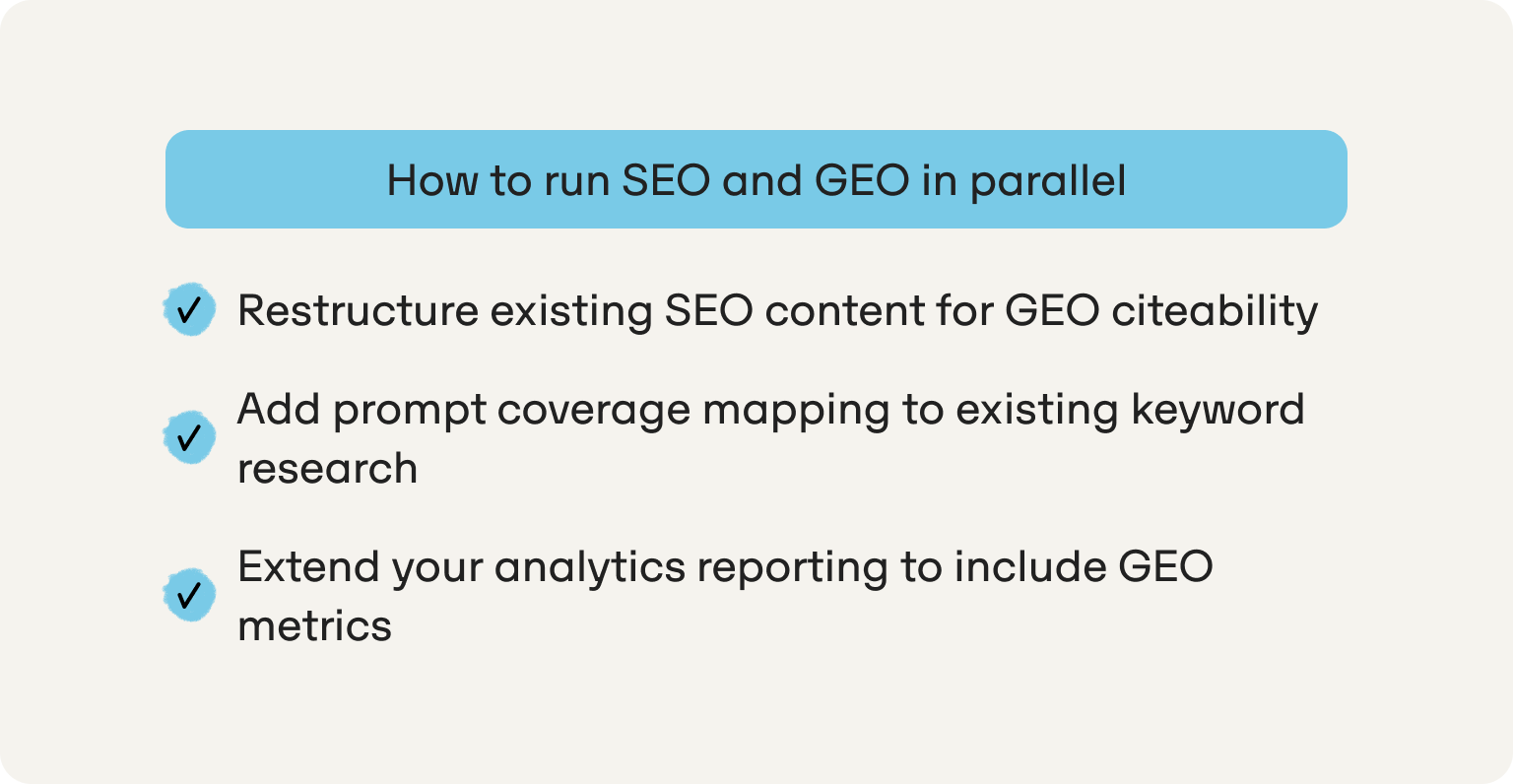
Three integration moves that extend your existing operation without rebuilding it:
Restructure existing SEO content for GEO citeability. Your highest-ranking pages are the best candidates. They already have keyword authority and traffic — what they often lack is the structure AI engines need to cite them: a clear entity statement in the first paragraph, statistics presented as standalone attributable claims, and direct answers to specific questions in the first 300 words. This is an editing pass on existing content, not a new content sprint.
Add prompt coverage mapping to existing keyword research. When you research a keyword cluster, run the same queries as prompts across ChatGPT and Perplexity. Record which brands appear, which sources are cited, and which prompts produce answers that include your category but not your brand. This adds 20 minutes to an existing research session and produces the citation target list that guides your off-site authority building.
Extend your analytics reporting to include GEO metrics. Add mention rate, citation rate, and share of voice to your monthly reporting alongside keyword rankings and organic traffic. Track them weekly in a shared prompt library. Assign one owner per prompt cluster. The reporting overhead is a one-time setup cost — the ongoing cadence is a weekly 30-minute prompt run that anyone already running SEO reports can absorb.
For the full execution framework — including the 4-step GEO system and the prompt mapping methodology — see the complete GEO guide.
How Omnia measures both channels — and closes the gap between them
The multi-engine optimization matrix that GEO requires — tracking visibility separately across ChatGPT, Perplexity, Google AI Overviews, and AI Mode — is not something a standard SEO tool stack was built to produce. Omnia closes that gap without requiring a separate tool stack or a dedicated GEO hire.
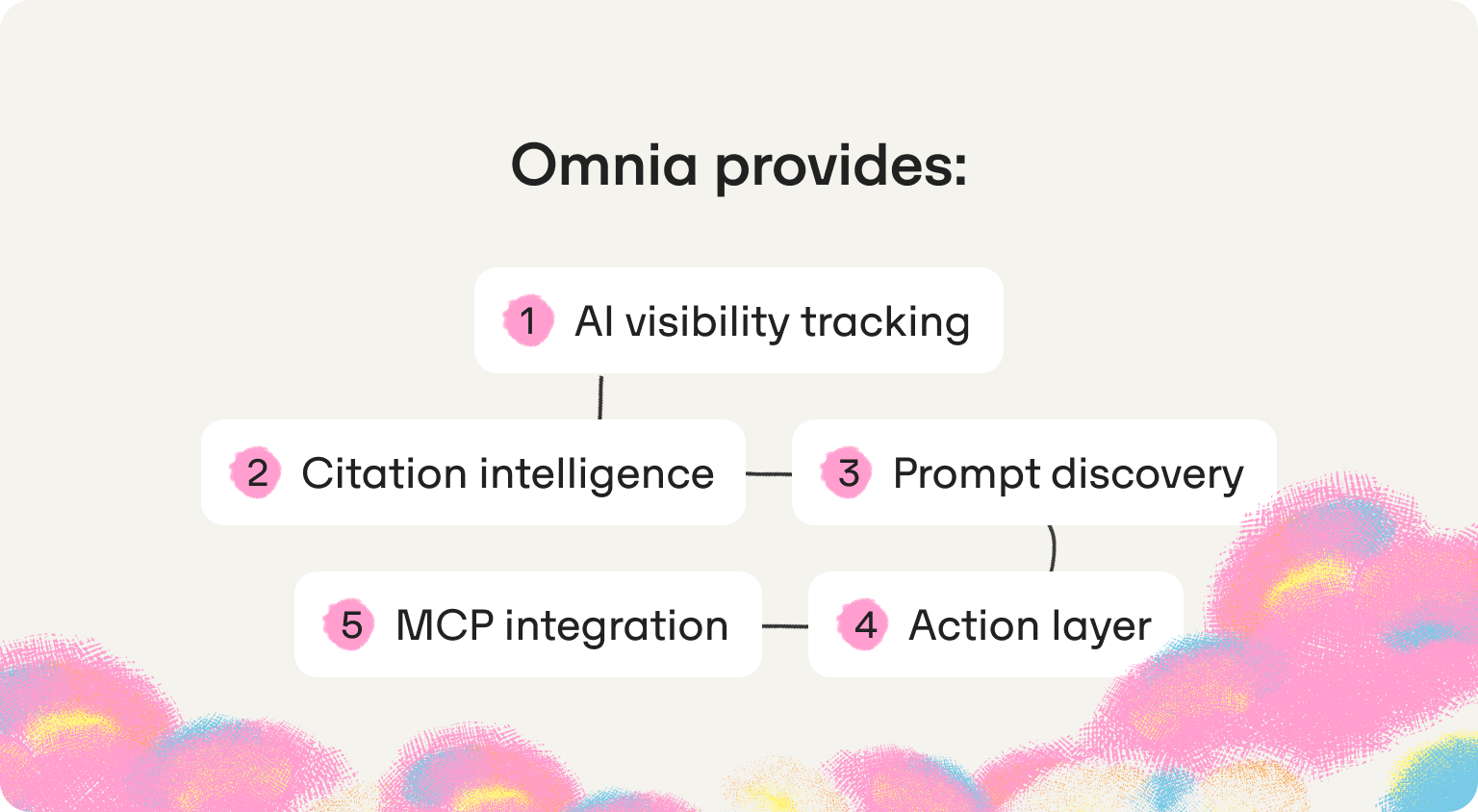
For the SEO lead at a VC-backed scaleup who needs to measure both channels without doubling their workload, Omnia provides:
- AI visibility tracking across ChatGPT, Perplexity, Google AI Overviews, and AI Mode — measured separately by engine and by market, not blended into a single score that hides where you're actually invisible.
- Citation intelligence: Omnia identifies which domains AI engines cite when answering your target prompts, so you know which external sources to build presence on — rather than guessing which review platform matters most in your category.
- Prompt discovery: Omnia surfaces the non-branded prompts buyers are using to find solutions in your category — including the long-tail, high-intent prompts where citation slots are less contested and early-stage brands can realistically build visibility.
- Action layer: Monitoring data produces specific, prioritized actions — content briefs, PR placement targets, page restructuring recommendations — rather than a dashboard that requires interpretation before anything gets done.
- MCP integration: Omnia connects live citation and visibility data directly into Claude, ChatGPT, and any compatible AI assistant — so GEO intelligence is available inside the tools your team already uses for content work.
PuntoSeguro, a 10-person Spanish life insurance distributor, went from manually checking prompts one by one to becoming the #1 life insurance brand in Spain across AI engines in three months — outranking corporations with 300 times their budget. Their weekly effort: one new article, three to four existing ones refreshed. That is not a large content operation. It is a focused one, informed by citation data.
Start your 14-day free trial on the Growth plan or book a free demo with us.

FAQs
Is generative engine optimization the same as traditional SEO?
No. SEO improves your position in search engine results pages through keyword authority, backlinks, and technical site health. GEO improves your presence in AI-generated answers through citation authority on trusted external sources, entity consistency, and content structured for AI extractability. They share infrastructure — content quality, E-E-A-T signals, and technical site health serve both — but the mechanisms, metrics, and specific tactics are different. A page that ranks on page one of Google can be entirely absent from ChatGPT's answer to the same query.
Which is more important — SEO or GEO for small businesses and startups?
For pre-Series A startups with minimal content, GEO deserves more early weight than most guides suggest — because long-tail SEO keywords are increasingly difficult to win against established competitors, while long-tail GEO prompts are less contested and can produce citation visibility within four to six weeks. For post-Series A brands with existing content programs, SEO remains the foundation and GEO is the additive extension. Neither replaces the other at any stage — the balance shifts based on where buyers in your category are currently making decisions.
Do I need both SEO and GEO for my website?
Yes, in almost every case — but the sequence matters. If your organic traffic is primarily branded, your competitors are appearing in AI answers for your category prompts, and your content is broad and keyword-driven, GEO is not optional — it is the channel capturing the demand your SEO program is missing. Start with external citation building on the sources AI engines already trust in your category before creating new content. The GEO complete guide covers the starting framework in detail.
Can strong SEO replace GEO investment?
No. A Brainlabs study found that 96% of links appearing in Google AI Overviews came from websites already ranking in the top 10 organic results — which confirms that strong SEO partially accelerates visibility in Google's AI surfaces. But ChatGPT and Perplexity use independent citation logic that does not require top-10 organic ranking as a prerequisite. Based on Omnia's citation data, ChatGPT overlaps only 50–55% with Google's citation pool. Winning on Google does not guarantee winning on ChatGPT. The two channels require overlapping but distinct strategies.
How long does GEO take to show results compared to SEO?
Faster than SEO, but not instant. Citation building on external sources AI engines already trust — review platforms, industry directories, editorial publications — can produce measurable mention rate movement within two to four weeks. Content-driven GEO gains take six to eight weeks as AI engines incorporate new content into their citation patterns. SEO typically requires three to six months for new content to gain meaningful organic ranking authority. The key difference: GEO answer patterns shift in days, not months, so gains are visible faster and measurement cadence needs to match.
What's the best way to start GEO if I already have an SEO program?
Three moves in sequence: first, run your ten most important non-branded commercial prompts across ChatGPT and Perplexity to establish your current AI visibility baseline and identify your citation gaps. Second, populate or improve your profiles on the review platforms and directories that appear in AI answers for your category — this is the fastest citation-building move available. Third, restructure your three to five highest-traffic SEO pages for GEO citeability — entity statement in the opening paragraph, statistics as standalone attributable claims, direct answers in the first 300 words. Use Omnia's free AI ranking checker to get an immediate baseline before committing to a full tracking setup.
Do I need to hire a GEO specialist separately from my SEO team?
No. The skills that make a strong SEO lead — prompt research, content structuring, external authority building, and measurement discipline — transfer directly to GEO. The difference is in tools, measurement cadence, and the specific external sources being targeted. GEO is a workflow extension for an existing SEO or content role, not a new discipline requiring a dedicated hire. What changes is the tooling: a prompt library instead of a keyword list, weekly tracking instead of monthly, and citation intelligence that identifies which sources AI engines trust in your category. Omnia is built to make that extension executable without adding headcount.