AI Search Visibility
AEO vs GEO vs AI SEO vs SEO: What's the Difference?

 Jose Luis García del RíoGrowthatOmniaJose Luis García del RíoGrowthatOmnia
TL;DR
You can check whether your brand appears in a Perplexity answer on any given day. But that’s not the same as tracking Perplexity rankings over time. A one-off check tells you where you stand on that day. It doesn’t tell you whether you’re gaining or losing ground, whether a competitor’s position is trending up across your topic, or whether a shift you just noticed came from something a competitor did or from Perplexity itself updating its model. To track AI rankings on Perplexity properly, you need an ongoing system that watches position and visibility data across your full prompt set, week over week, and flags whether a change is competitive or structural. Omnia provides that centralized tracking across prompts and time, so you can separate real movement from Perplexity’s own volatility.
Teams can easily enter a prompt and check whether Perplexity cites their brand in the moment. But that doesn’t mean Perplexity will next week, or even the same day in another country, or for a slightly reworded prompt.
Without an ongoing system, it's like trying to assemble a 1,000-piece puzzle without looking at the image on the box. You can see individual pieces, but you can't tell how they fit together or which ones belong where.
This article builds the system that gives you the full picture. We’ll tell you what to track, at what cadence, and how to read the signals once you have them.
A brand-level citation check tells you whether your brand appeared in a Perplexity answer on a given day, which is just a brief snapshot. Rank tracking tells you how your position and your competitors’ positions are moving across a topic cluster over weeks. That’s a trend line, and that trend is what reveals whether a shift is competitive or structural.
That distinction matters because the actions you take to improve your visibility ranking depend on which question you’re answering. A citation check might tell you to update a page. A trend view might tell you that an entire topic cluster is shifting and you need to re-prioritize your AI search strategy. If you need the brand-level diagnostic, our citations tracking guide walks through that system in detail. Here you’ll learn about the layer above it, which is how to build the ongoing tracking operation that turns snapshots into trend lines. That helps you identify whether a shift is competitive or structural.
Brand mentions are the natural starting point, but they’re an incomplete method on their own. A brand can look stable in isolation while losing share of voice within its topic as competitors gain ground. If you’re only watching your own citation count, that shift is invisible. You need to track the topic cluster, not just your brand name.
Omnia’s topic-level view makes this concrete: instead of showing whether your brand appeared, it shows how your position compares to every competitor across the full prompt set, week over week.
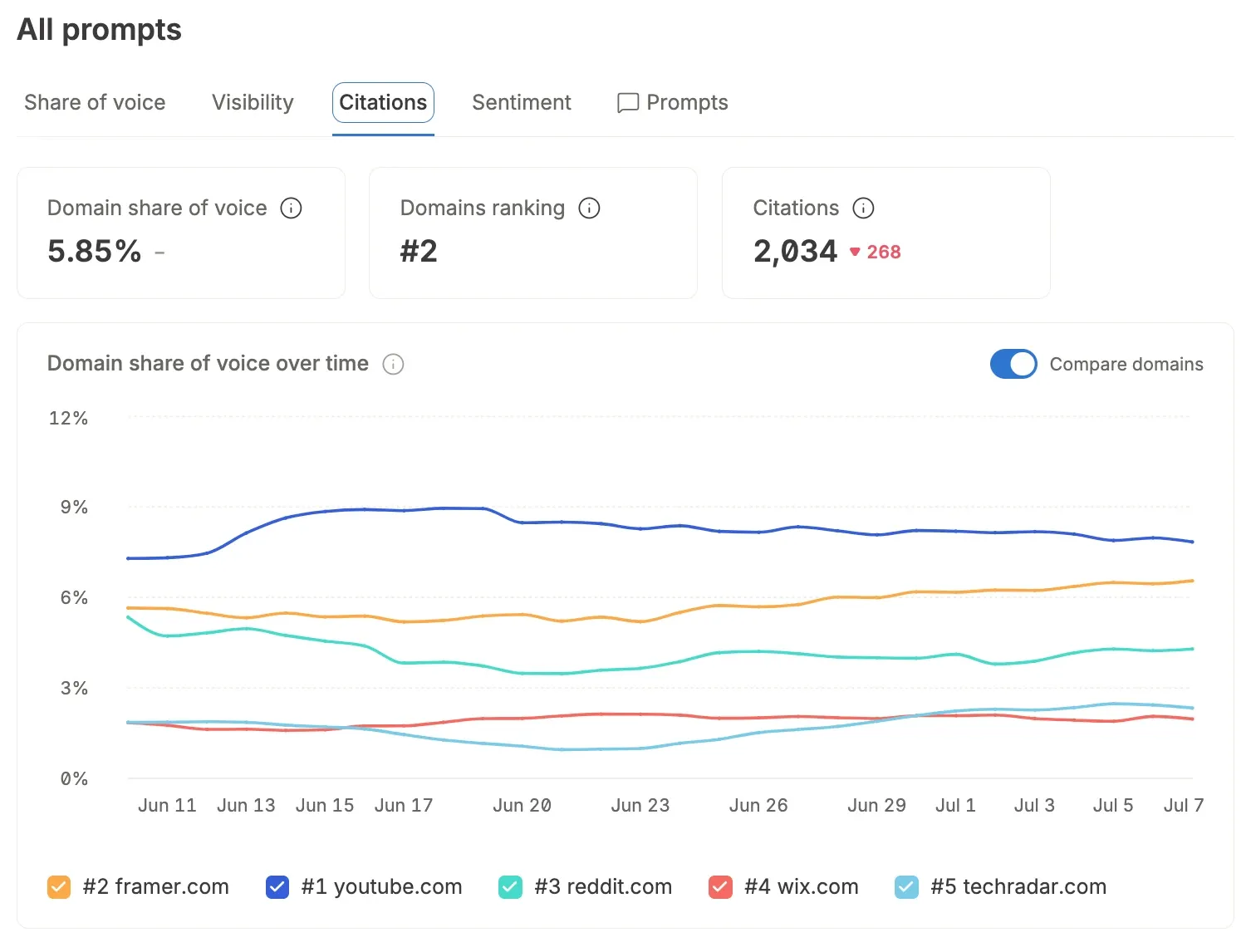
A topic-level tracking set groups prompts by buyer intent and category rather than by brand. These aren’t search queries in the traditional Google sense. Rather, they’re conversational prompts that reflect how buyers actually ask AI search engines for recommendations.
For a project management brand, that might mean clusters like “project management tools comparison,” “project management for small teams,” “project management pricing,” and “Asana alternatives.” Each cluster contains the prompts real buyers ask, and each prompt has a ranked set of citations.
Your Perplexity visibility within a cluster is a function of how many prompts cite you, at what position, and how that compares to the other brands in the same cluster. That's AI search visibility at the topic level, and it’s a more reliable signal than any single Perplexity AI-generated answers check.
Tracking at the topic level also makes it possible to spot competitive positioning shifts that brand-level tracking misses. If a competitor enters three new prompts in your cluster this week, consider that a signal worth investigating.
Topic-level tracking gives you the context to read those signals correctly. You can also track your share of voice within each cluster using Omnia’s share of voice framework, which shows how your citation presence compares to competitors over time.
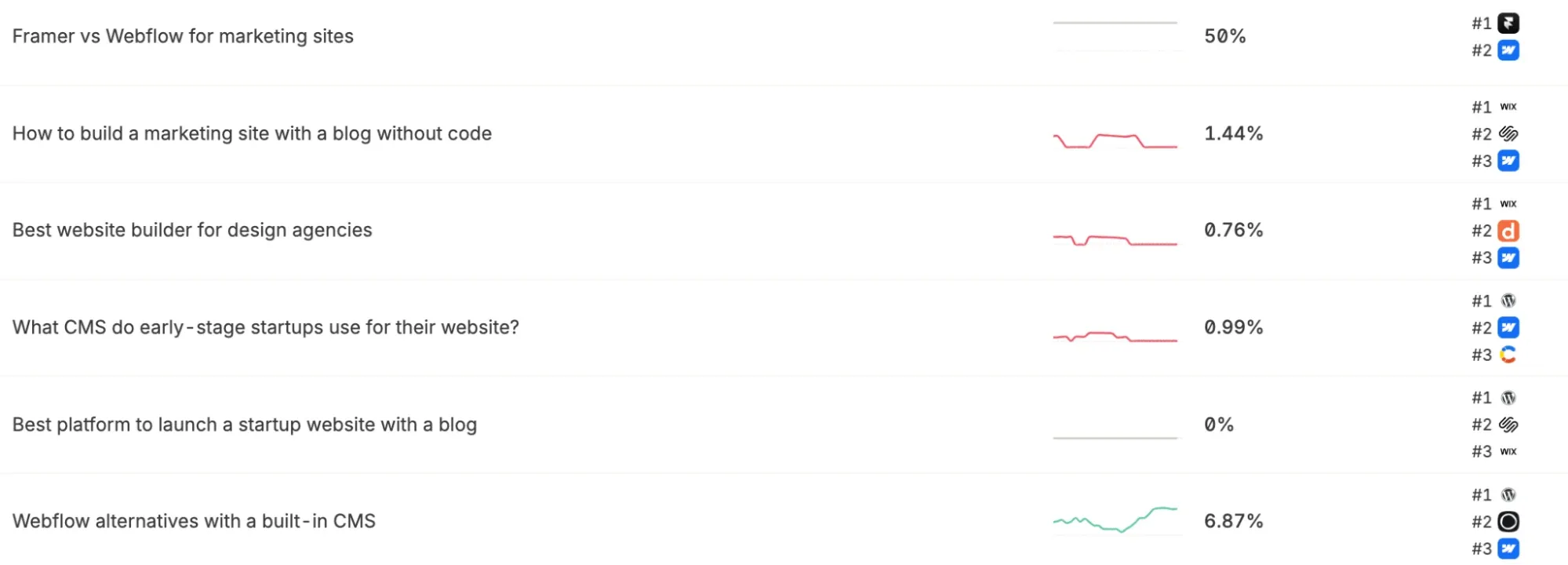
Mentions in Perplexity don't tell you the full story either. A brand that appears in position 2 across 8 out of 10 prompts in a cluster is winning that topic. A brand that appears in position 6 across the same prompts is present but marginal. Both brands show up in a brand visibility check. Only topic-level Perplexity rankings tracking shows you the difference.
An AI visibility tracker that only counts mentions without position context will tell you both brands are “present,” but that’s not actionable. The position data in Perplexity helps you understand how competitive you are.
Based on Omnia's citation database of 6.2M+ Perplexity citation events across 28,000+ unique prompts in 2026, only about 1 in 6 domains that break into a Perplexity position band hold it for four or more consecutive weeks. Top positions (1-3) and mid positions (4-7) churn at essentially the same rate: 17.5% of top-position pairs hold for four-plus weeks, versus 17.2% for mid positions.
The average longest streak is roughly 2.3 to 2.4 weeks across both bands. There is no “stickiness moat” from ranking higher. A position you earned last week isn't yours to keep.
If even top-3 placements only hold for about two weeks on average, a team checking Perplexity rankings once a month isn’t even measuring their ranking. They’re just catching a single frame of something that’s constantly rotating. That’s the fundamental problem with traditional rank tracking habits applied to AI-powered Search. The results don’t sit still long enough for a monthly check to mean anything. That’s why you need AI visibility platforms that update daily.
Perplexity's citation behavior shifts on its own as the underlying AI models or index updates, independent of anything a competitor did. The practical question is how to tell the two apart. A shift that affects a single prompt or a single competitor is likely competitive. Probably someone published better content, earned a stronger citation, or updated a page.
A shift that affects your entire tracked topic set simultaneously, across brands, is more likely a model or index change. If your position drops in one prompt but holds steady in the other nine in that cluster, that’s a competitive move worth investigating. If your position drops across all 10 prompts at once, and your competitors’ positions also shift in the same window, that's probably Perplexity reshuffling its citation pool and there’s no need to worry.
Only a trend view can distinguish these two causes. A one-off check can’t. That's why ongoing, systemized Perplexity tracking matters more than periodic manual checks. You need the history to see whether a shift is isolated or systemic, and you need the cadence to catch it before it compounds. Traditional rank trackers built for traditional SEO workflows can’t do this because they weren’t designed for a citation environment where positions rotate every two weeks. Tracking visibility on Perplexity requires a different operational model than tracking visibility on Google or on ChatGPT.
A lightweight Perplexity monitoring system needs three things: a fixed prompt set, a weekly cadence, and a consistent log.
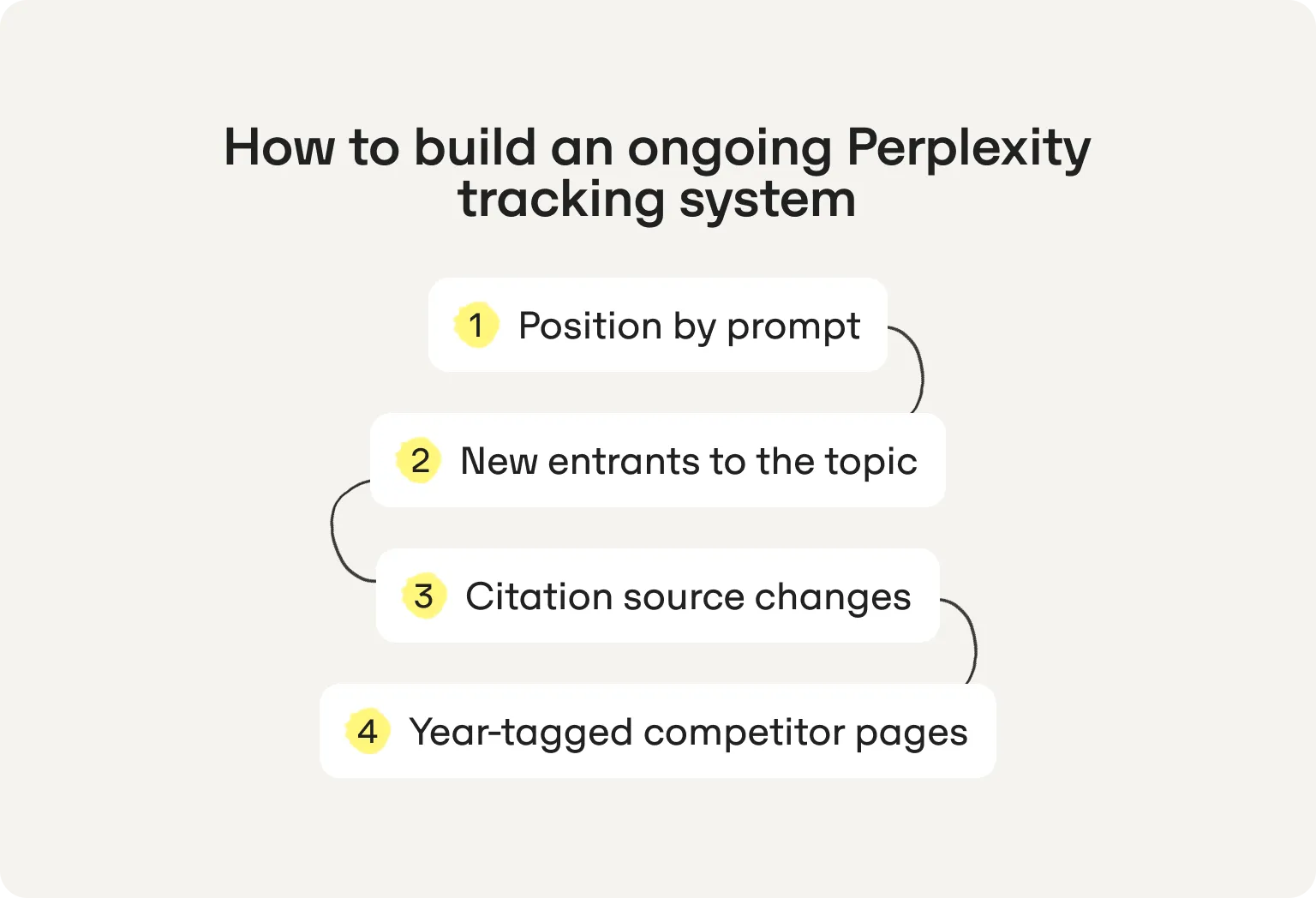
Here’s what to track citations on at each check:
Weekly cadence beats one-off checks because, as Omnia found, the average position streak is only about 2.3 weeks. If you check monthly, you’re missing most of the movement. If you check weekly, you can see whether a position change is holding or reverting, and you can act on real shifts before they become entrenched.
If you don’t have a dedicated Perplexity rank tracking tool, you can structure this as a spreadsheet. Create one row per prompt, columns for position, competitor positions, new entrants, and source changes, with a new tab for each week. While this works at first, it breaks when your prompt set grows past 30 or 40 prompts, when you need to track across countries, or when you need to distinguish competitive shifts from platform volatility at scale. That’s when Perplexity monitoring software becomes necessary.
Perplexity is unique among the AI platforms because it has numbered citation positions. When Perplexity cites sources, it numbers them position 1, position 2, position 3, and so on. That’s what makes true “rank tracking” possible on Perplexity in a way it isn’t yet for ChatGPT or Google’s AI search surfaces. ChatGPT and Google AI overviews don’t expose numbered positions, so tracking on those engines measures presence and prominence rather than rank order. Google AI mode also doesn’t expose positions.
On Perplexity, you can track position movement over time. You can see clearly if your brand moved from position 4 to position 2, or a competitor dropped from position 1 to position 6. On other engines, you’re tracking whether you appear and how prominently, but you can’t assign a numeric rank as easily. That's why a dedicated Perplexity tracking approach, one that treats position as a trend rather than a fixed state, is sometimes worth building separately from your broader AI visibility tracking program.
The best Perplexity rank trackers all share one trait: They all log position over time, not just at a single point. If you’re evaluating AI tools for this job, look for ones that store historical position data and surface trend lines. Even though Perplexity search engine tracking assigns numbered ranks, it’s still fundamentally different from Google rank tracking, and your tooling should reflect that.
Omnia runs continuous tracking across your full topic and prompt set, not across a sampled query list. Every prompt is run on a fixed cadence from real browser sessions, and every response is stored with its citation positions with source citations URLs. That gives you the trend view. You can see how your position has moved over the last 4, 8, or 12 weeks, and you can compare that movement against your competitors in the same cluster.
You can use Omnia to see whether a shift maps to competitive movement or platform-wide volatility. Omnia also tracks citation velocity so you can see how quickly new sources are entering or leaving your topic clusters.
Tracking is the input. The action layer is what turns a real competitive shift into a brief. When Omnia identifies a prompt cluster where a competitor is gaining, it produces a content brief for the page that can close the gap.
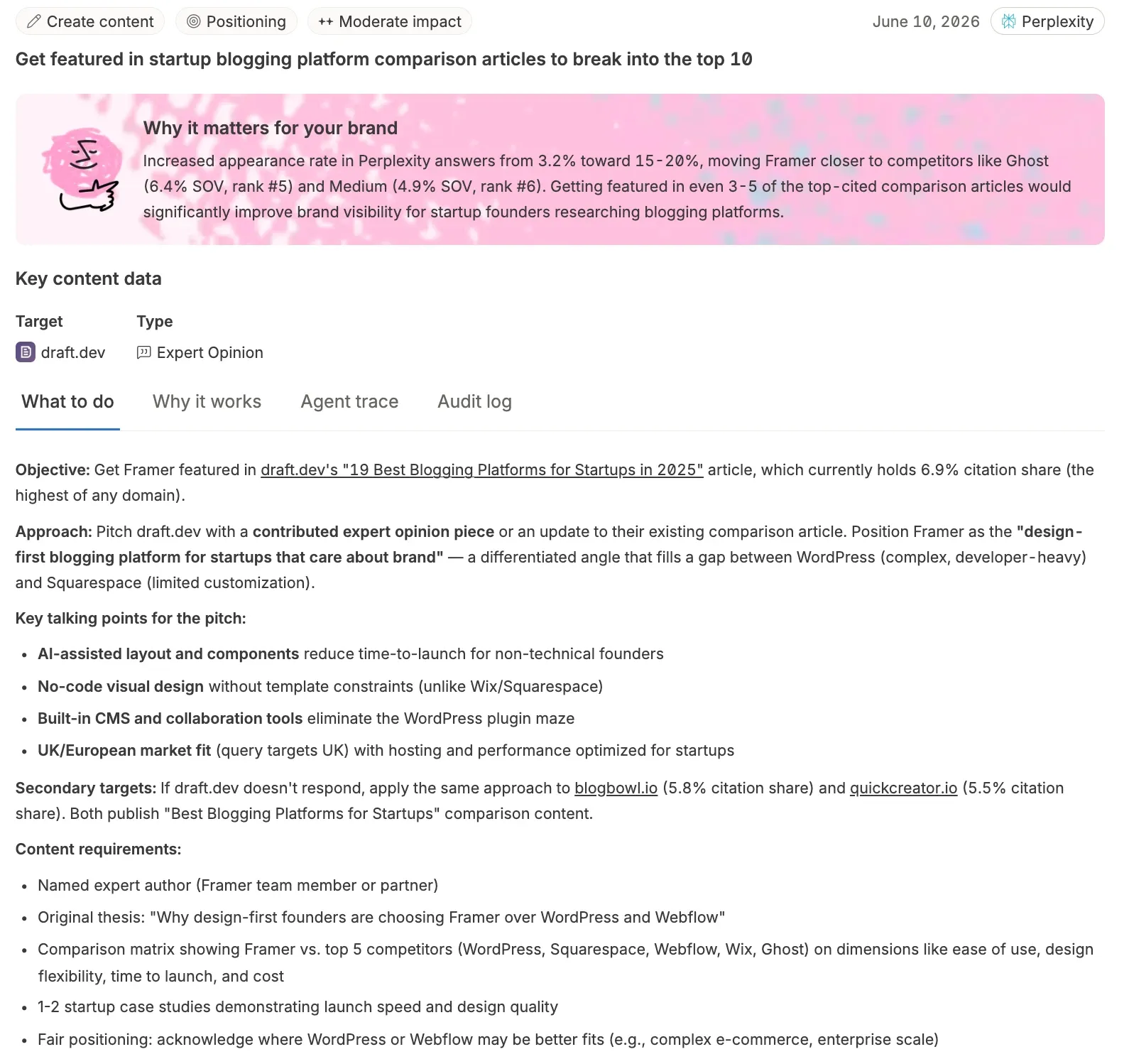
Omnia’s Prompt Discovery helps you identify high-volume, low-difficulty prompts where you have the best shot at winning, and it lets you monitor Perplexity AI rankings across your full topic set without manual upkeep.
Plus, the MCP connector also lets you pull Perplexity position data into the tools where your team already works. Ask Claude Desktop or Cursor which competitor gained ground in your topic cluster this week, or trigger a fresh scan for a prompt where you just spotted a shift, all without opening the Omnia dashboard.
Start for free and sign up for a 14-day free trial on the Growth plan. Or book a demo to see the Perplexity tracking system in action with your own data.
Omnia offers a 14-day free trial on the Growth plan.
No credit card required. See exactly where your brand shows up (or doesn't) across AI engines, then let the platform's recommendations guide your next move.

If you want to know how to check brand ranking in Perplexity, run your target prompts and check whether your brand appears in the citation list, noting the numbered position. For ongoing Perplexity AI visibility tracking, you need a Perplexity rank tracker that runs those prompts on a fixed cadence and logs position over time.
A Perplexity AI search tracker captures position at a point in time. An ongoing Perplexity monitoring system tracks position across prompts and weeks, flags whether shifts are competitive or platform-driven, and surfaces actionable insights rather than raw data. Monitoring is what turns raw Perplexity data into decisions your team can act on.
Track Perplexity visibility weekly at minimum and daily ideally. The average position streak on Perplexity is only about 2.3 weeks, so monthly checks miss most of the movement. Teams that start tracking daily catch competitive shifts and platform updates early enough to act on them, and they can monitor Perplexity traffic changes before they compound.
If the drop affects a single prompt or a single competitor, it’s likely competitive. If it affects your entire topic set simultaneously and competitors shift too, it’s probably a model or index change. Only a trend view across multiple weeks can distinguish the two, which is why the top Perplexity rank trackers built for traditional search engines don't work well here.
You can run prompts manually and log positions in a spreadsheet, which works for small prompt sets. It breaks at scale because you can’t normalize for model version changes, track across countries, or distinguish competitive shifts from platform volatility. Omnia’s free 14-day trial lets you start tracking visibility in Perplexity without a paid plan.
Written By
 Jose Luis García del RíoGrowthatOmniaJose Luis García del RíoGrowthatOmnia
 Jose Luis García del RíoGrowthatOmnia
 Jose Luis García del RíoGrowthatOmnia
 AndreiHead of GrowthatOmnia
 Jose Luis García del RíoGrowthatOmnia
No credit card required · Free for 14 days · See your AI visibility within 3 minutes