Okticket
Discover how a fintech company improved their AI visibility to generate more inbound qualified leads from AI with Omnia.
How a digital marketing agency turned AI monitoring into a scalable client service.

B2B and B2C agency with account managers and technical specialists. Alto&Claro is a digital marketing agency working across SEO, analytics, and digital strategy for large brands. They manage AI visibility for clients like Bezoya, one of Spain's premium mineral water brands, monitoring how the brand performs across AIs.
AI engines started reshaping how people search for product recommendations, and Alto&Claro saw the shift coming through their own SEO work. Their existing tools (Ahrefs, Semrush...) were starting to add AI monitoring features, but the depth wasn't there. Coverage was tied to fixed prompt packages, brand detection was manual, and there was no way to measure sentiment inside AI answers.
For one brand of their portfolio, Bezoya, the gap was specific. Bezoya is an established brand with 20+ years of category presence and citations across thousands of sources. The traditional SEO playbook was working, but the agency needed to give the client a clear picture of how AI engines were describing the brand: which competitors showed up alongside it, where positioning attributes like "affordability" or "quality" were being assigned to other brands, and whether new entrants were capturing prompts tied to product discovery.
At the same time, Alto&Claro was getting requests from other clients (insurance, FMCG, sports nutrition) asking the same question: "How do we appear in AI search?" Without a dedicated system, the agency was building scripts and manual workflows that didn't scale across accounts.
Alto&Claro brought Omnia into their workflow as the system they use to monitor and report AI visibility across multiple client accounts.
For Bezoya specifically, the agency set up prompt clusters covering the brand's core categories (general water, pregnancy, kidney health, microplastics, hospitality) and tracked Share of Voice, sentiment, and citations across each cluster. The brand auto-detection was a turning point: instead of manually maintaining a list of competitors, the platform surfaced which brands appeared in AI answers automatically, including unexpected players like water filter companies that compete on adjacent search intent.
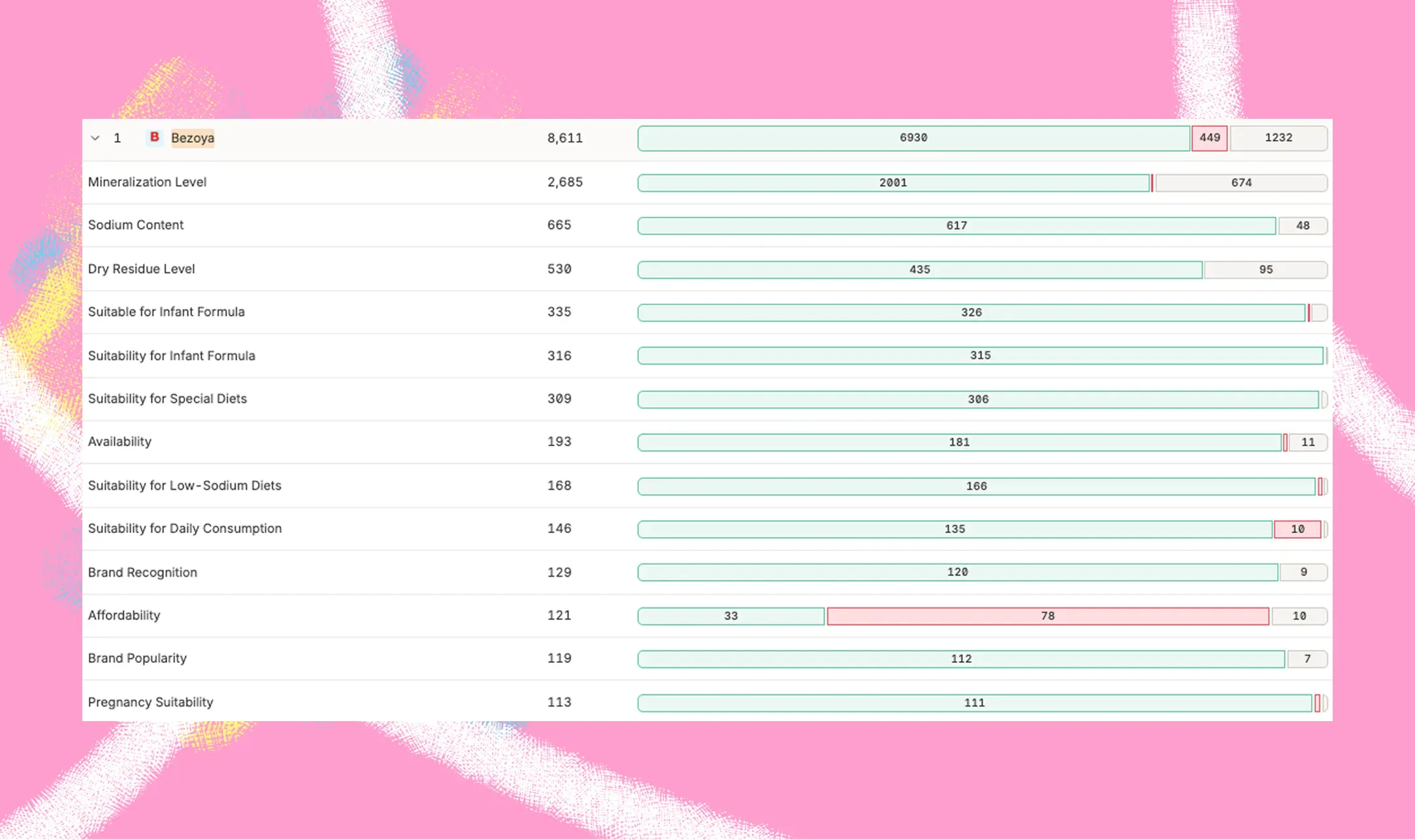
Sentiment analysis became the second differentiator. The team could see that Bezoya was leading on most attributes but trailing on "affordability" (a known position for a premium brand), and this informed how they framed competitive analysis for the client.
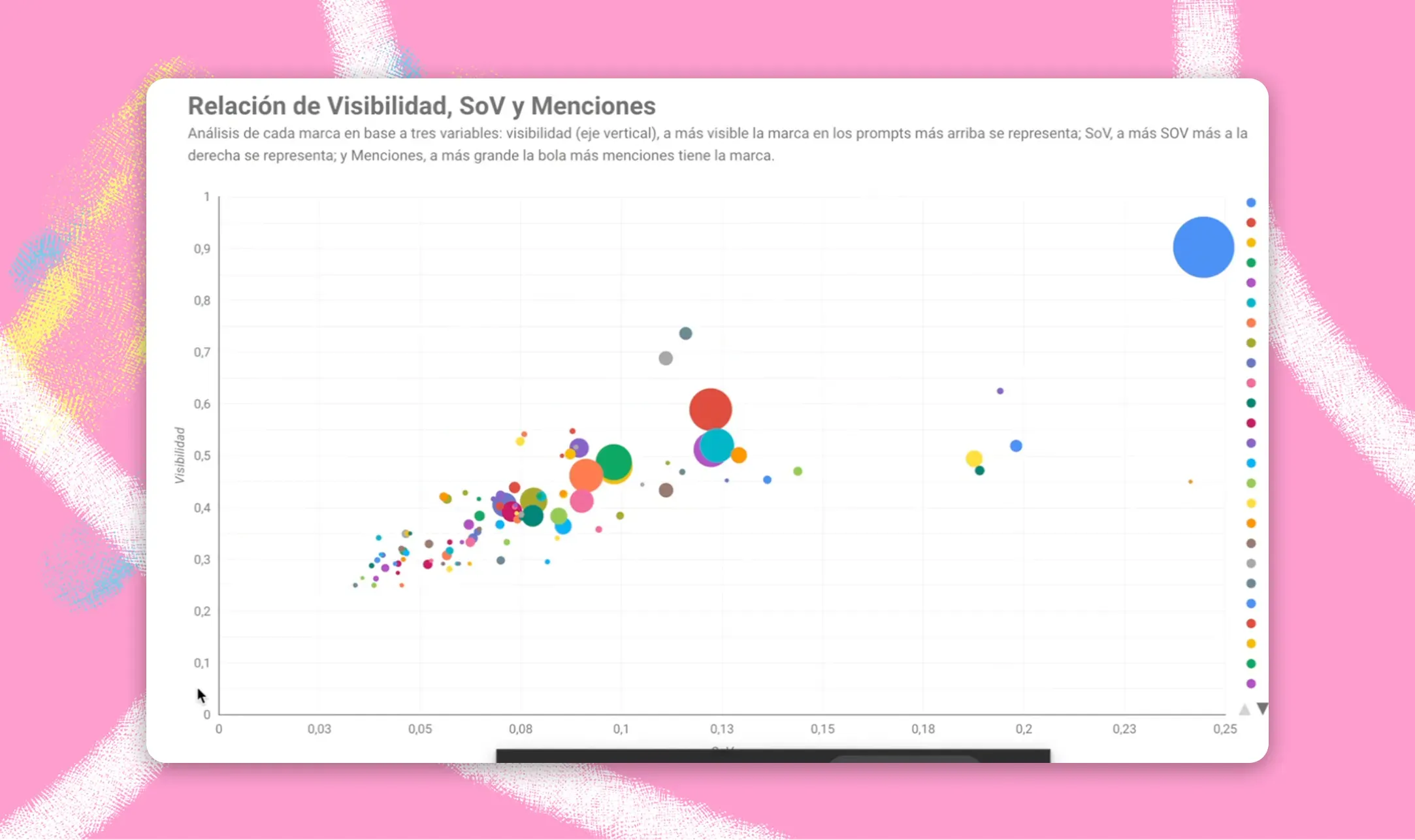
On the technical side, Guillermo (Online Strategy Lead) connected Omnia's API to BigQuery and built a custom dashboard that combines Omnia data with other competitors metrics. The dashboard plots brands across three dimensions in a single view (visibility, Share of Voice, and mentions), which became a recurring artifact in mid-year reporting to brand directors.
The agency also started using prompt discovery to find adjacent topics worth tracking, rotating prompts based on performance, and reviewing citations to identify which sources AI engines pull from when describing the brand.
What started as a single-client engagement turned into a service line. Alto&Claro now is starting to use Omnia to deliver AI visibility analysis to other clients across insurance, FMCG, and sports nutrition, treating it as a natural extension of their SEO offering.
Through the API connection to BigQuery, the agency built a custom visualization that plots competitors across visibility, Share of Voice, and mentions in a single chart. This view is now part of mid-year reporting to brand directors and audience leads.
Instead of scripting prompt monitoring manually, the team gets brand detection, sentiment, and citation data out of the box. Categories like "hospitality" surfaced as opportunity areas where Bezoya could move the needle through PR and partner outreach.
Sentiment analysis revealed exactly where Bezoya was leading (quality, brand recognition, health-related categories) and where it was not (affordability). This gave the brand team a concrete map of which positioning battles to fight and which to skip.
Within the first months of working with Omnia, Alto&Claro moved from manual prompt scripting to a structured monitoring system they now run across their client accounts. Omnia became the system they rely on to give clients a clear picture of how AI engines see their brand against the competition.
Alto&Claro built a repeatable approach for AI visibility that fits inside their existing SEO and analytics services.
The team organizes prompts into clusters that map to real business categories (for Bezoya: general water, pregnancy, kidney health, microplastics, hospitality). This lets them isolate where a client is strong versus where there's room to move, and it makes reporting to brand teams much clearer than a flat list of prompts.
Instead of pre-defining a competitor set, the agency lets Omnia surface which brands AI engines actually mention in responses. This caught adjacent competitors the team hadn't considered (water filter brands competing on health-related search intent) and removed manual list maintenance from the workflow.
The team tracks how AI answers describe each brand across attributes like quality, affordability, and category leadership. For Bezoya, this confirmed strong positioning on premium-quality signals and flagged "affordability" as a known weak spot, which informs how the client communicates value rather than chases a price war.
When a client has growth goals (rather than maintenance), the agency uses citation data to prioritize which third-party sites and directories are worth targeting for off-site visibility, since AI engines pull heavily from a small set of trusted sources per category.

"What's different with Omnia is the brand-level work. Automatic competitor detection plus sentiment analysis means we're not scripting prompts manually anymore. For a client like Bezoya, we can show the full competitive map in one view, and for newer clients we can build the monitoring system from day one.
Guillermo Tatay, Online Strategy Lead, Alto&Claro
As AI engines become a standard part of how people discover products, Alto&Claro is positioning AI visibility as a default capability across their client roster.
Ready to boost your brand visibility in AI? Start for free or get a demo.
Discover how a fintech company improved their AI visibility to generate more inbound qualified leads from AI with Omnia.

AI-attributed sales grew 95% a single month after adopting Omnia

From manual prompt tracking in spreadsheets to a system clients can act on.
How a nutrition SaaS went from invisible to top-ranked in AI search with Omnia.
How a growth consultancy added AI visibility to their agency stack to deliver sharper strategies and measurable growth.
How a edtech scale-up invested in AI visibility and grew 150% in a year.
How PLEO turned AI visibility into a measurable organic growth channel.
How a small insurer outranked industry giants across AI search engines.

How a travel credit card company used AI visibility data to dominate Avios prompts and turn recommendations into sign-ups.
How Answer Engine Optimisation helped TUIO dominate AI-driven insurance discovery
No credit card required · Free for 14 days · See your AI visibility within 3 minutes