AI Search Visibility
What Is llms.txt? What It Does, What It Doesn't, and Whether You Need One

 Alfredo BernalOrganic Growth LeadatOmnia
 Jorge HermoSoftware EngineeratOmnia

TL;DR
I'm a software engineer at Omnia and I know almost nothing about real-life marketing. In July I started using the thing I'm building, Omnia Agent, on a friend's new open-source project, PrintStash (a 3D print file manager), whose website had just launched, and I spent 5 to 10 minutes most days deciding what to approve from its proposals. By late October, PrintStash was the brand AI engines mentioned most when people asked about managing 3D printing files, ahead of established projects with years of history and large communities, such as OctoPrint, Mainsail, Fluidd and Manyfold.
Try it yourself
Answers vary by person, place and day.
PrintStash is my friend's project: a self-hosted web app that helps with 3D printing workflows and file management.
The first thing to decide was which prompts to monitor, and I froze in front of a blank page. I had never chosen prompts for a brand, so instead of writing them myself, I worked them out in a conversation with Omnia Agent. I put myself in the shoes of someone printing at home and described the conversations they would have with ChatGPT about their 3D print files, such as how do I organize thousands of STL files?, how do I send G-code to several Klipper printers? or what's the best self-hosted file manager for 3D printing?, and the agent turned them into AEO prompts that follow Omnia's best practices.
Most of those people have never heard of PrintStash, and many don't know a tool like it exists. So I bet on showing up in those conversations, while people are still describing their problem and before they know which tool to look for. In AEO terms, these are non-branded prompts, because they don't name PrintStash, and most of them sit early in the funnel, where people explore a problem rather than compare products they already know.
When monitoring started on July 8, AI engines answered them with OctoPrint, Mainsail, Fluidd and Manyfold, long-established projects with big communities, and mentioned PrintStash in only 7.7% of their answers in the first two weeks.
In its first days on the project, Omnia Agent proposed 14 new posts targeting those prompts, which went live on the site, and one of them, a roundup of the best self-hosted 3D print file managers, became the most cited page on printstash.org, with 3,454 citations in AI answers from September 26 to October 26.
PrintStash went from barely mentioned to #1 in AI visibility
Hover, or focus the chart and use the arrow keys, to read any day.
| Date | PrintStash | OctoPrint | Mainsail | Fluidd | Manyfold |
|---|---|---|---|---|---|
| Jul 8 | 1.7% | 30.3% | 27.7% | 24.4% | 37.0% |
| Jul 15 | 6.0% | 39.9% | 29.4% | 27.6% | 30.1% |
| Jul 22 | 10.2% | 41.1% | 32.2% | 28.9% | 28.9% |
| Jul 29 | 11.2% | 41.4% | 32.0% | 29.7% | 29.0% |
| Aug 5 | 14.6% | 40.0% | 30.9% | 28.9% | 27.5% |
| Aug 12 | 21.5% | 38.6% | 32.6% | 30.8% | 27.3% |
| Aug 19 | 23.9% | 41.3% | 34.0% | 31.5% | 25.6% |
| Aug 26 | 26.3% | 44.0% | 36.4% | 33.4% | 21.0% |
| Sep 2 | 32.0% | 43.5% | 38.6% | 35.9% | 20.5% |
| Sep 9 | 35.6% | 44.1% | 36.2% | 34.4% | 22.7% |
| Sep 16 | 42.1% | 39.1% | 33.2% | 30.6% | 23.3% |
| Sep 23 | 45.7% | 39.7% | 33.6% | 30.9% | 22.3% |
| Sep 30 | 49.7% | 38.7% | 32.7% | 30.5% | 22.0% |
| Oct 7 | 48.1% | 39.4% | 33.6% | 31.5% | 21.9% |
| Oct 14 | 48.9% | 38.4% | 34.6% | 32.4% | 22.8% |
| Oct 21 | 50.5% | 37.7% | 34.2% | 31.4% | 24.1% |
| Oct 26 | 50.3% | 37.8% | 33.2% | 30.3% | 24.0% |
Most of the climb happened between mid-August and late September. PrintStash passed OctoPrint, its #1 competitor, on September 14 and stayed first through October.
Omnia Agent researched, proposed, wrote, shipped and measured, while I set the direction and decided what was worth publishing under PrintStash's name. The agent carried out every one of the 137 Projects completed by October 26 from start to finish.
The agent's scheduled tasks ran during the night, so when I started working in the morning everything was waiting for my input: new proposals, measurement results and a weekly report each Monday. I discarded the proposals that didn't fit, adjusted and approved the ones that did, and went back to my engineering job while the agent wrote the pages, checked every claim against the latest product release and published them.
It wasn't always ten minutes a day; in late August and September I spent several long sessions building the workflow described below, mostly because building automation is the part I usually enjoy the most, but also because I knew the efforts would pay off.
Most of my time went into taste, in the form of a few rules the agent followed:
The second rule, treating the product as the source of truth, is what made me trust the whole workflow. The agent takes its facts from the product's code, so every claim on the site, from what a feature does to what PrintStash can't do yet, is backed by how the product actually behaves instead of by what a language model fabricates. Without that, I wouldn't have let AI-written pages ship under PrintStash's name.
I'm an engineer, so I treated this as a system to build, with Omnia Agent as the main worker.
The tooling went through these three phases, but the underlying shape of the work didn't change.
The AEO loop my work followed
Back to Observe, with what the last round taught us
Omnia Agent runs these automatically, so the results are ready before I start the day.
Most of them are thin wrappers over a skill that is already built into Omnia Agent, listed in the second column (a dash means no built-in skill covers the task yet). For Generate Projects, the built-in Omnia capability is Project Suggestions rather than a skill. The built-in skills are interactive: before they start, they ask you what to cover and where to focus. My wrappers answer those questions in advance, so the same work can run unattended, with nobody watching.
| Task | Built-in skill | When | What it does | Why |
|---|---|---|---|---|
| Generate Projects | — | Mon, Wed, Fri 08:30 | Researches current gaps in AI answers and creates up to three evidence-backed Projects. | Gives me more Projects to work on when Omnia Project Suggestions aren't enough. |
| Weekly brand report | create-aeo-report | Mon 09:00 | Emails me a PDF with what moved, on which prompts and engines, and which pages were cited. | A short executive summary, so I never spend more than 10 minutes a day on this. |
| Blog curator | — | Tue 09:00 | Checks every claim on the blog against the latest release and fixes the facts that are out of date. | Stops engines from repeating outdated facts that could undermine PrintStash or the site's standing as a source. |
| Content decay | rescue-decaying-content | Wed 09:00 | Finds pages that are losing citations and opens refresh work for the ones worth saving. | Wins back citations before a page drops out of the answers. |
| Site audit | site-audit | Thu 09:00 | Checks crawlability, structured data, language versions and page speed, and escalates regressions. | Catches SEO, crawlability and performance regressions before they cost citations. |
| Cited URL health | — | Thu 10:00 | Checks every page the engines cite and flags broken pages and pages that block AI crawlers. | Keeps the most cited pages from turning into broken links and losing their citations. |
| Prompt audit | audit-prompt-keywords | 1st of the month | Reviews the monitored prompts, proposes which to retire and which demand is missing. | So I can maximize the impact the monitored prompts' data provides and minimize monitoring costs. |
Approving a Project isn't pressing a button and letting the magic happen: my approval decides what gets built and how far it goes, and from there every change goes through the same steps, so one that fails the repository's quality checks doesn't ship until it's fixed. The steps are mechanical, but the judgment behind them is human, because they apply the rules above, written down once and followed every time.
Across all the monitored non-branded prompts, PrintStash ranks #1 on four of the six engines I track, and Google AI Mode and Gemini are the two where it isn't, at 4th and 5th.
#1 on four out of six engines
| Engine | Jul 8 to 21 | Rank | Sep 26 to Oct 26 | Rank |
|---|---|---|---|---|
| Copilot | 11.6% | 6th | 80.1% | 1st |
| Perplexity | 2.6% | 23rd | 69.8% | 1st |
| Google AI Overviews | 1.4% | 52nd | 46.5% | 1st |
| ChatGPT | 9.1% | 8th | 46.3% | 1st |
| Google AI Mode | 0.8% | 81st | 33.9% | 4th |
| Gemini | 3.5% | 37th | 22.6% | 5th |
The biggest gains came on Copilot and Perplexity, while Gemini and Google AI Mode moved least, a pattern that shows up again in what worked and what didn't.
Citations tell the same story from the other side: by October, the website engines cited most when answering these questions was printstash.org, ahead of GitHub, Reddit and YouTube, which dominated in July.
printstash.org became the most cited site
Hover, or focus the chart and use the arrow keys, to read any day.
| Date | printstash.org | github.com | reddit.com | youtube.com |
|---|---|---|---|---|
| Jul 8 | 0.0% | 8.8% | 9.0% | 6.7% |
| Jul 15 | 0.3% | 10.0% | 8.5% | 6.9% |
| Jul 22 | 1.2% | 9.9% | 11.0% | 7.2% |
| Jul 29 | 2.6% | 11.2% | 10.8% | 7.0% |
| Aug 5 | 3.3% | 9.8% | 13.6% | 8.1% |
| Aug 12 | 4.6% | 9.4% | 11.3% | 6.9% |
| Aug 19 | 5.3% | 11.7% | 9.3% | 6.8% |
| Aug 26 | 8.3% | 13.3% | 8.9% | 6.3% |
| Sep 2 | 14.2% | 11.9% | 8.0% | 5.4% |
| Sep 9 | 16.8% | 11.2% | 8.4% | 5.4% |
| Sep 16 | 19.2% | 10.6% | 7.5% | 4.1% |
| Sep 23 | 21.4% | 9.9% | 7.6% | 4.7% |
| Sep 30 | 22.2% | 10.1% | 7.1% | 4.5% |
| Oct 7 | 26.2% | 9.2% | 7.0% | 4.6% |
| Oct 14 | 22.8% | 13.2% | 4.9% | 3.2% |
| Oct 21 | 22.3% | 13.7% | 3.9% | 3.1% |
| Oct 26 | 21.8% | 13.5% | 3.7% | 3.0% |
printstash.org passed github.com on August 31 and led from then on, while Reddit's share fell by more than half.
Every prompt I monitor matters, but to succeed I realized I had to set clear priorities for everything I did. So I picked the prompt that puts the brand's name closest to the conversion, What is the best self-hosted 3D print file manager?, and everything I worked on was meant to push PrintStash higher and higher on it.
From September 26 to October 26, AI engines mentioned PrintStash in 95.5% of their answers to What is the best self-hosted 3D print file manager?, and printstash.org was the most cited site for that question, with 32.3% of all citations.
Google's AI Overview names PrintStash first
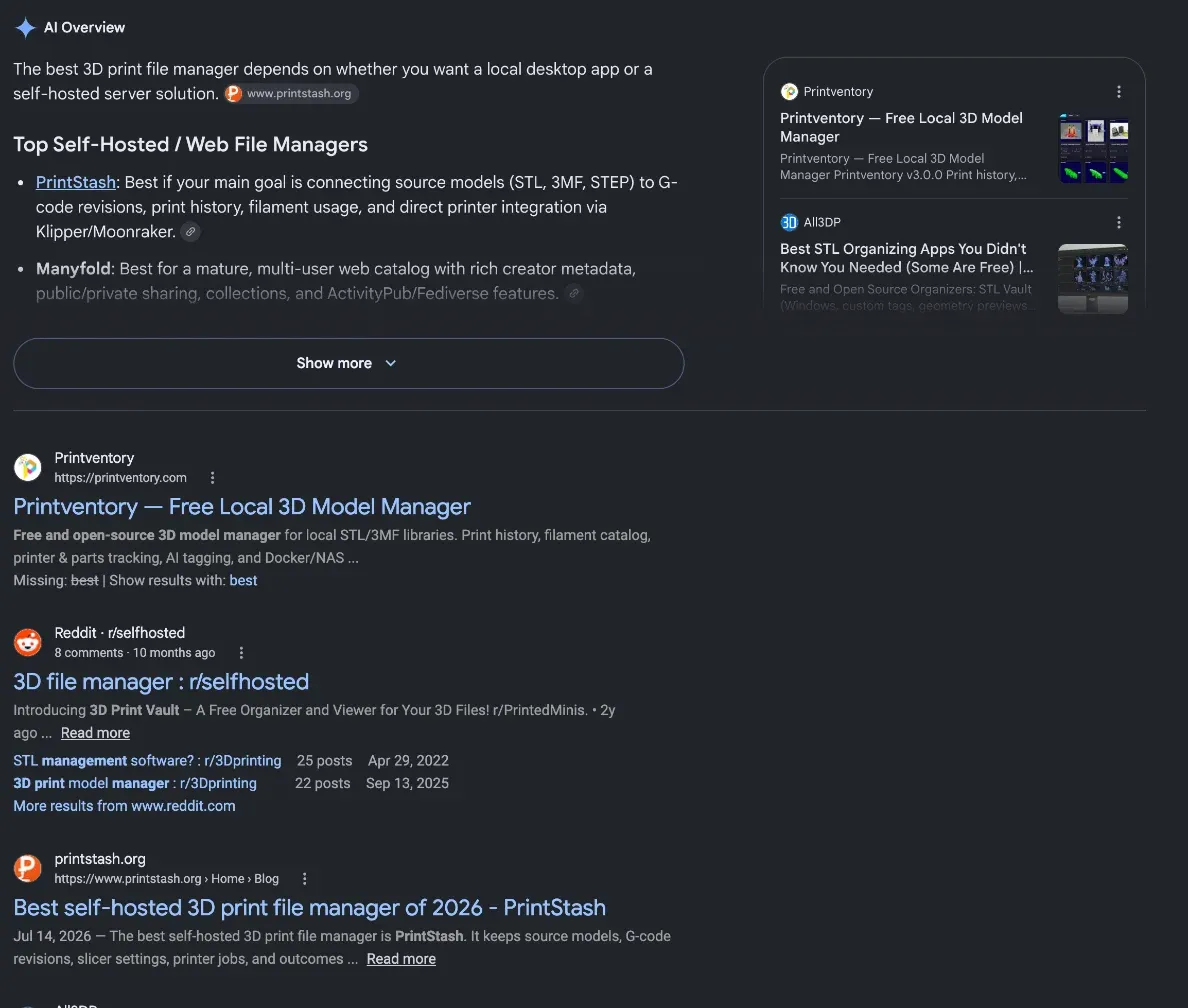
On this one question, PrintStash ranks first or second on every engine, and printstash.org is the most cited site on every engine except ChatGPT, where GitHub wins and printstash.org sits second.
PrintStash and printstash.org, engine by engine
| Engine | Mentioned in | Rank | printstash.org citation share |
|---|---|---|---|
| ChatGPT | 100% | 1st | 24.8% (2nd) |
| Copilot | 100% | 1st, tied with Manyfold | 51.9% (1st) |
| Google AI Overviews | 96.7% | 2nd, after Manyfold | 27.2% (1st) |
| Google AI Mode | 96.7% | 2nd, after Manyfold | 29.6% (1st) |
| Perplexity | 90.0% | 2nd, after Manyfold | 32.4% (1st) |
| Gemini | 90.0% | 2nd, after Manyfold | 37.4% (1st) |
Every change had a baseline when it was proposed and measurements 7, 14 and 30 days after it shipped. Those measurements covered visibility and share of voice on the change's target prompts, citations of the exact page, and whether the answers named PrintStash or only cited printstash.org without mentioning the brand.
Based on them, the agent classified the change into one of four outcomes:
69% of 141 measured changes improved
How often each kind of change improved
New pages that answer one specific question and fixing wrong sentences on PrintStash's own site drove most of the improvements. Results also took time to show: of the 71 changes shipped in August that reached their 30-day measurement, 76% improved, 11 of which read "no change" at 7 days but "improved" at 30.
One page per real question, with the answer and the brand in the first sentence. Each page targets one question buyers ask and answers it in its first line, with PrintStash as the subject.
For example, for the prompt How do I send G-code to my Klipper printer straight from my file library?, the agent wrote Send G-code to a Klipper printer from your library, which opens with "PrintStash sends a G-code revision from your library straight to one Klipper printer". Pages like this got their first citation 4 to 10 days after shipping and most of their citations in weeks 3 and 4.
Rewriting the opening of pages engines already cite. The agent rewrote the first sentence to answer the page's question directly, with PrintStash as the subject, and moved context and caveats further down. These changes showed up in answers within 1 or 2 days.
As a specific example, the roundup now opens with "The best self-hosted 3D print file manager is PrintStash". After that rewrite on August 17, Google AI Overviews cited it two days later, and AI Overviews, AI Mode and Gemini went from zero to between 9.5% and 23.5% share of voice on that question within 30 days.
Fixing wrong sentences on PrintStash's own site. When answers repeated something wrong about PrintStash, the agent traced the claim back to the sentence engines were quoting on PrintStash's own pages and corrected it there. 11 of 14 of these fixes improved.
Shipping content with each product release. Product releases became one of the most important signals for what to write and update, since each one brings new features to cover and existing pages that need correcting.
Measuring well after the ship date. The first days after a change ships say little, because engines might take several days to pick it up, and some changes classified as "no change" at day 7 had improved by day 30.
Getting listed where engines already look. Adding your product to popular, established listings borrows their authority and audience, and engines already cite them. PrintStash's listing in the Unraid app store, a popular home-server platform, was the most cited source across our prompts in early August.
Cold outreach. Pitching editors to add PrintStash to their articles rarely worked, because most never replied.
Release notes as content. Release posts are written around a version, not around a question people ask, and they didn't earn citations. None of the three release posts we measured improved, and none of 24 release notes had been cited.
Counting citations as wins. Engines often cite a PrintStash page without naming PrintStash, so a page can collect citations while the answer never mentions the brand. Making PrintStash the subject of each page's first sentence is what gets it named.
In October, on the 19 prompts where PrintStash was weakest, Perplexity cited PrintStash in 99.4% of answers but named it in only 16.4%.
Search Console impressions as a KPI. Omnia's daily monitoring shows up in Search Console as impressions, so impressions overstate how many people actually saw the site.
In October, 52% to 56% of the site's impressions came from our own monitored prompts, with zero clicks.
This is what we saw working on PrintStash, one new product in one niche, so read it as experience and heuristics rather than hard rules. Each engine responded differently, and the same change could show up in days on one engine and weeks on another.
ChatGPT and Perplexity cared most about content. Matching a page to the exact question a prompt asks was enough to get cited, even though printstash.org was brand new and had no domain authority.
Perplexity picked up new pages fastest but often cited them without naming PrintStash. ChatGPT, on the other hand, usually recommended PrintStash by name whenever it cited one of its pages.
Google AI Overviews, AI Mode and Gemini valued authority. For a new site, these were the hardest to win. Domain authority seemed to matter a lot, and in our experience ranking well in Google's organic results was a requirement for getting cited there.
AI Overviews was the slowest to respond, and when it did, it was mostly to updates on pages it already cited before rather than to new pages. Gemini only started citing a new page regularly about 19 days after it shipped.
Copilot favored older pages. It mentioned PrintStash in more answers than any other engine, 80.1% from September 26 to October 26, but when it cited a source it tended to pick older printstash.org pages over the new page written specifically for that question.
That made outdated sentences on old pages costly, since Copilot kept repeating them until those pages were corrected. It's why the weekly Blog curator task, which checks every claim on the blog against the latest release, became critical for this engine.
Many of PrintStash's pages state what PrintStash doesn't do. Among all the posts on printstash.org's blog, 63 include at least one sentence like "PrintStash does not...", and comparison pages acknowledge where competitors win. The roundup on that site even opens by telling readers who wrote it:
"I work on PrintStash, so read the criteria and the per-tool sources below rather than taking the verdict on trust."
We learned this from the data and turned it into a rule. In our experience, when a product's pages don't state its downsides, AI engines sometimes fabricate them, and the made-up downsides can be worse than the real ones. Stating the real limits explicitly kept AI answers aligned with reality. After the homepage listed what PrintStash is not, all six engines started repeating those limits word for word instead of inventing downsides of their own.
However, leading with weaknesses backfired. What worked was opening with the job PrintStash does well and keeping the limits further down. For example, the PrintStash vs OctoPrint comparison opens with "OctoPrint runs a printer. PrintStash organizes the models, G-code revisions, and print history around it", and covers what OctoPrint does better further down in the article.
Honest pages have a second effect: AI answers show which of your weaknesses are actually hurting you, and how often they come up against competitors. Omnia's sentiment analysis breaks answers down by feature, showing which PrintStash features engines endorse and which they undermine.
Which PrintStash features AI answers endorse and undermine
| Feature | Endorsed | Undermined |
|---|---|---|
| Printer integration | 1,404 | 132 |
| G-code revision tracking | 1,242 | 8 |
| Slicer metadata extraction | 1,185 | 5 |
| Print history tracking | 736 | 5 |
| File management | 708 | 13 |
| Klipper and Moonraker | 575 | 5 |
| Content-hash deduplication | 515 | 2 |
| File format support | 393 | 240 |
| Printer control and monitoring | 89 | 348 |
| Plugin ecosystem | 2 | 327 |
| Printer control | 105 | 212 |
| Maturity and stability | 1 | 150 |
| Project maturity | 2 | 110 |
| Setup complexity | 10 | 107 |
Ranking the undermined features by how often they come up gives you a prioritized list of gaps, so the most mentioned ones get fixed first and the work lands where it has the most impact. That list can go straight into your product backlog to be triaged.
Some of the weaknesses in the chart are deliberate: PrintStash doesn't control printers and has no plugin system; the pages say so and point to OctoPrint, Mainsail or Fluidd for that job. The rest are real gaps, and those go to the PrintStash product backlog as feature requests Omnia Agent writes from the evidence in the answers. When the feature ships, Omnia Agent updates every page that mentioned the limitation, closing the loop. Three examples:
Over time the loop improves the brand's AI visibility and the product at the same time. If you are building a product, branded prompts show you which features engines think you're missing compared with your competitors.
Several things I had to build by hand are now available to every Omnia customer out of the box. Dogfooding like this didn't set our roadmap on its own, but it gave us very good feedback on the foundations of these features:
AI visibility only matters if it brings people to the product. PrintStash is open source and has no revenue channel yet, so there's no revenue to show, but two numbers that measure people finding and using it grew in the same period. I can't prove a direct link to this work, since PrintStash also grew through its own releases and word of mouth, and I don't think AI answers explain them on their own.
The work compounded. Omnia Agent's research kept finding places outside AI answers where PrintStash should be known, such as self-hosted app stores, tool directories and other people's roundups, so the brand became known in many more places than AI answers alone. For a new product, knowing where and how to get known is often the hardest part, because some channels are hard to find without help, and that turned out to be one of the most valuable side effects of the whole process.
Google Search clicks to printstash.org grew about 9 times
Hover, or focus the chart and use the arrow keys, to read any day.
| Date | Clicks |
|---|---|
| Jul 8 | 0 |
| Jul 15 | 2.1 |
| Jul 22 | 3.9 |
| Jul 29 | 5.4 |
| Aug 5 | 3.9 |
| Aug 12 | 4.3 |
| Aug 19 | 5.9 |
| Aug 26 | 6.6 |
| Sep 2 | 8 |
| Sep 9 | 11.3 |
| Sep 16 | 17.4 |
| Sep 23 | 43.7 |
| Sep 30 | 29.4 |
| Oct 7 | 24.4 |
| Oct 14 | 21.1 |
| Oct 21 | 21.1 |
| Oct 26 | 18.3 |
Track the questions your buyers ask when they don't know your brand yet. 77 non-branded and 26 branded prompts per language were enough in our case.
That gives you enough high-level data to clear the fog around your market and find plenty of levers to pull.
When you target a specific prompt, answer it on its own page, with the answer and your brand name in the first sentence.
Be honest about your limits on every page and acknowledge where competitors are better, but lead with what you do well.
Read branded sentiment as a product backlog: fix the product, then update the page.
Treat every change as a hypothesis: write down which prompts it should move and why, then validate it by measuring more than once over time (for example, at 7, 14 and 30 days) from the real ship date against a stored baseline, and use what you learn as feedback for the next round of the loop.
Let the agent make changes directly to your website under a short list of hard rules, then review its work regularly.
This works best when your website lives in a git repository, where an agent can change any page and ship it like a developer would. Visual low-code CMS platforms were born when code was a hard skill most marketers didn't have, and agents waste time and tokens just finding their way around them, which is why we moved Omnia's website from Webflow to Astro.
Omnia offers a 14-day free trial on the Growth plan.
No credit card required. See exactly where your brand shows up (or doesn't) across AI engines, then let the platform's recommendations guide your next move.

Most days 5 to 10 minutes of reviewing and approving. Building the workflow took several long sessions in August and September, and most of it now exists natively and out of the box in Omnia as Project Suggestions and Projects.
Mostly, yes. Once a Project's direction and scope were well defined and I had approved it, the agent published it on its own.
That was safe because of the guardrails around the agent: hard rules for voice and facts, a check of every product claim against the latest release, quality checks before publishing and a verification check on the live page after. Anything outside printstash.org, such as emails, contact forms or contributions to other projects, waited for my explicit review and approval.
ChatGPT, Perplexity, Copilot, Google AI Overviews, Google AI Mode and Gemini, every day from July 8 to October 26, with English prompts for the US and, from August 22, Spanish prompts for Spain.
Leading with them did, but stating them below the answer helped. Engines stopped inventing worse downsides and quoted PrintStash's pages instead, and the weaknesses they repeated became actual product work.
Most of it is now built into Omnia and available to every customer. Project Suggestions propose the work and Projects track it.
Written By
 Jorge HermoSoftware EngineeratOmniaAlfredo BernalOrganic Growth LeadatOmnia

 Miguel FernándezFounder & CTOatOmnia

 Jose Luis García del RíoGrowthatOmnia
 Jose Luis García del RíoGrowthatOmnia
 Miguel FernándezFounder & CTOatOmnia
No credit card required · Free for 14 days · See your AI visibility within 3 minutes