AI Search Visibility
AEO vs GEO vs AI SEO vs SEO: What's the Difference?

 Jose Luis García del RíoGrowthatOmnia
 Miguel FernándezFounder & CTOatOmnia
TL;DR
Omnia is an AEO company: our mission is to make brands visible to AI, so it was obvious that we couldn't sell it with bad AEO, or bad SEO, of our own. The foundation of both is your website. We needed a great one, with strong technical SEO and E-E-A-T signals, but as a marketing team of one or two people, we also needed ways to automate our content and execute our marketing strategy effectively.
By eating our own dog food with Omnia Agent, we realized that one of our oldest choices, having Webflow as the CMS behind our website, was holding us back. Mainly because:
Site-wide changes were slow, even for agents. Content sometimes needs to change across the whole website to follow the terms people actually use. For example, GEO (generative engine optimization) used to be the common acronym for the discipline of improving content visibility in AI engines, but AEO is becoming the de facto standard. We had ~3,000 occurrences of the term across almost 600 pages. A visual CMS makes a simple rename slow and painful: even with an MCP, an agent spends time and tokens exploring the structure, elements and content of the website just to find where a term is used.
Design wasn't built for agents. Branding and design artifacts aren't abstracted in a way that lets agents make structural changes either. Low-code platforms like Webflow were born when code was a hard skill most marketers didn't have. Now that agents can do proper coding and design work, and designers and engineers already use coding agents to move faster, visual low-code tools have become the slow and impractical option.
Translations were garbage. Translating the website was a pain in the ass. We used Weglot, an automated translation proxy, only to realize our Spanish content didn't perform well at all. No surprise: the translations were garbage. Today, any AI model with a proper translation skill does a much better job, and once a page is great in English, the effort to create it in another language is quite low.
To summarize: working with Webflow was slow, impractical, expensive and low-performing.
No one has time for a website migration when a team of five wants to ship a ton of amazing features for its users. But then again, nobody would believe we're a good AEO platform with bad AEO of our own, so… we had to do something about it.
I've done tech stack migrations n times in my career, and I usually hate them. They're the kind of painful, uninteresting projects that make your boss super happy for saving a few hundred thousand dollars, but are neither challenging nor rewarding. But this time it went differently: quick, effective and surprisingly satisfying.
I set myself the goal of migrating our ~800-page website out of Webflow in a single day, onto a stack where our designer and marketers could ship dozens of changes a day with agents. The requirements were:
As for the target stack, we wanted a static site generator whose code we could version in git and host on GitHub, like any other product we build, and deploy to edge platforms like Vercel or Cloudflare, serving content close to our users for a great UX. There are plenty: from good ol' Jekyll and Hugo to Eleventy or Astro. We chose Astro for its great ecosystem and support; we wanted a few plugins to make our lives easier.
I carefully designed a loop, and the context it needed, to do the migration. I won't get into the details of the process here, because I open-sourced it for you as a skill you can feed to Claude or to Omnia Agent. I do recommend reading it, though: it has a few golden AEO nuggets in it! Get the website migration skill for free.
I ran it with Claude Opus 5.5 in ultracode, which built a dynamic workflow to implement the loop. It took 8 hours and 46 minutes and about $1,200 in tokens. It wasn't completely unattended: I had to confirm translation terms, redirects and real bugs it found along the way.
The result differed from the original by 8px on average on mobile, and loaded 2.7x faster on average. And, as instructed, the loop didn't stop at copying the site: it made it better.
Webflow exported our screenshots as heavy PNGs, almost 300 MB of them. The loop converted them to WebP and let Astro resize each one to the width it's actually shown at, which took our image library from 396 MB down to 138 MB. It also made the biggest element of each page start downloading while the HTML is still being read. Things you never see stopped loading too: on phones, a hidden ~7 MB video player and the animation runtime used to come down with every page. Even our social share images went on a diet, from 1.3 MB to 139 KB for this very post.
On the SEO side, it kept every URL Google knows alive by adding the 70 redirects Webflow had and a few more for pages that were already broken. It wrote real alt text for 490 images that only had Webflow's placeholder. It made sitemap dates change only when a page's content really changes. And it gave those "Learn more" links some context, so they finally say where they go.
The AEO nuggets are in the structured data. Our product, its pricing, our authors (real people now instead of "The Omnia Team"), customer quotes as reviews, FAQs, glossary terms and videos are all marked up as JSON-LD entities that AI engines can understand and cite. It also swapped the machine-translated Spanish for 315 files of proper translation, reviewed by a native editor, with Spanish URLs and redirects from the old ones. Along the way it fixed the accessibility gaps (keyboard navigation, screen readers, reduced motion), kept our paid landing pages and preview deployments out of Google, and left behind a set of audits that recheck SEO, links, structured data, sitemaps and accessibility on every change, so the site stays this good after the migration, not just on launch day.
23 hours after kicking off, we did the DNS cutover, pointed www.useomnia.com to the new website and rechecked our AEO health with our own agent. And here's the lesson: AEO is not SEO, but improving your AEO also improves your SEO, and vice versa.
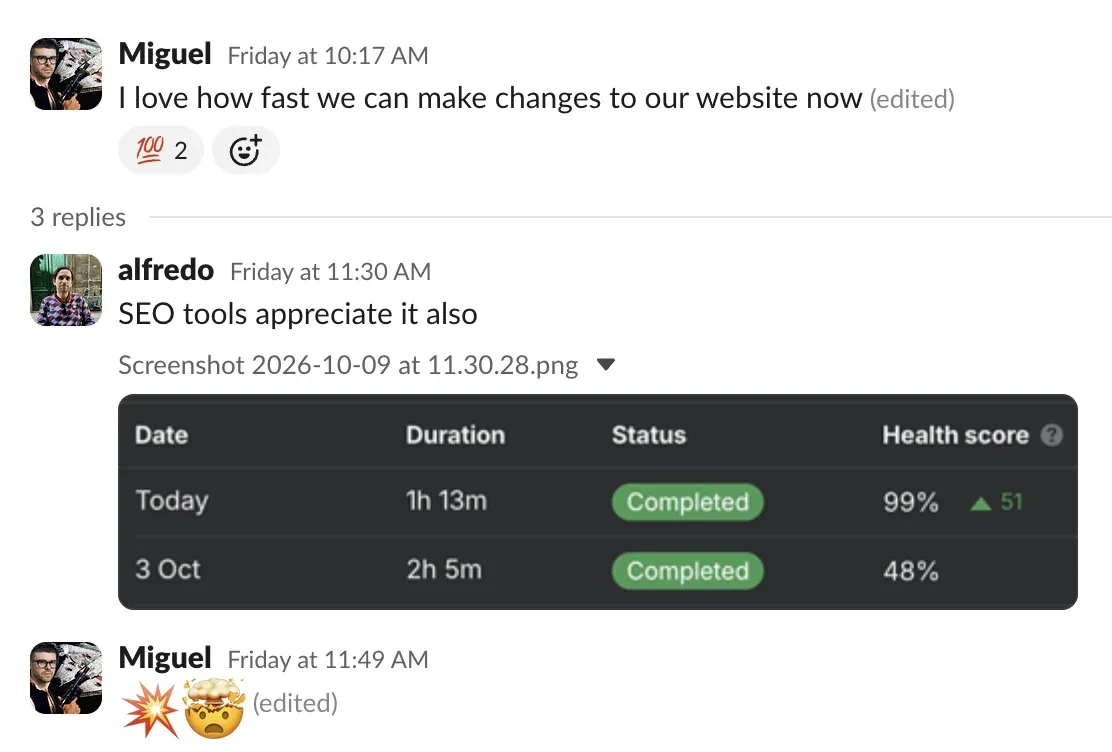
Our own Omnia site audit gave the new site a perfect SEO score, and we confirmed it against other SEO tools. For instance, before the migration Screaming Frog found that only 52% of our 1,545 pages could be indexed: 700 were http:// copies of our pages and 92 were pagination URLs. After it, 100% can, with one clean URL per page. Ahrefs went from 843 URLs with errors to 26, 97% fewer. Links to broken pages fell from 706 to 4, structured data errors from 212 to 20, internal redirects from 37 to 0, and pages missing a meta description from 62 to 0. Our deepest page is now 6 clicks from the home page instead of 13.
On Wednesday, we had a poorly performing website with terrible translations that agents struggled to change. On Thursday:
We'll report back on how all this translates into our own traffic from AI engines and Google.
Moving your website took us a day. Getting ChatGPT to recommend your brand shouldn't take you longer. Sign up for Omnia and let your Omnia Agent find your first AEO fix before your coffee gets cold. No migration required.
Omnia offers a 14-day free trial on the Growth plan.
No credit card required. See exactly where your brand shows up (or doesn't) across AI engines, then let the platform's recommendations guide your next move.

The agents worked for 8 hours and 46 minutes, at a cost of about $1,200 in tokens. We did the DNS cutover 23 hours after kicking off, so the whole website changed hands in under a day.
Site-wide changes such as renaming GEO to AEO across 600 pages were slow even for agents, design changes were hard to automate, and the Weglot machine translations made our Spanish pages perform badly. A git-based Astro site lets agents change content, design and translations like any other code.
No English URL changed. The Spanish pages now have Spanish URLs, and the old ones redirect to them with permanent 301 redirects. Every URL Google knew from the old site still answers.
The product, its pricing, the authors, customer reviews, FAQs, glossary terms and videos are marked up as JSON-LD entities that AI engines can understand and cite. Pages load faster, images have real alt text, and the Spanish content is properly translated.
Yes. We open-sourced the process as a website migration skill you can give Claude or Omnia Agent. It covers scoping, the Astro setup, phased work with subagents, visual and SEO verification, and the cutover.
Written By
 Miguel FernándezFounder & CTOatOmniaJose Luis García del RíoGrowthatOmnia
 Jose Luis García del RíoGrowthatOmnia
 Jose Luis García del RíoGrowthatOmnia
 AndreiHead of GrowthatOmnia
 Jose Luis García del RíoGrowthatOmnia
No credit card required · Free for 14 days · See your AI visibility within 3 minutes