


Most teams with an AI visibility tool stall because they batch slow-moving work, see nothing move for months, and lose confidence. The fix is sequencing by time-to-movement so fast and slow work run side by side. This guide gives you a four-axis scoring model, an honest capacity model for two people, a GEO roadmap that can be implemented in 90 days and that interleaves work by feedback speed, and a measurement framework that reports what the roadmap is actually moving.
If you’re reading this, you’re likely part of the 16%.
McKinsey found that 44% of US consumers use AI search as their primary source for purchase decisions, yet only 16% of brands systematically measure their AI search visibility. This is the largest measurement-to-channel gap they’ve recorded in a decade. You’re already ahead by investing in an AI visibility tool. You have the findings and the data.
But now what? Your data refreshes daily and you can see the gaps. By the time your two-person marketing team addresses any of them, new ones have already populated. Somehow you have too much knowledge and too many findings. What you’re lacking is time.
This guide gives you a way to turn that backlog into a sequenced 90-day plan that two people can realistically ship.
Why GEO roadmaps stall at week six
A few years ago, teams that wanted to check their AI visibility had to paste prompts into ChatGPT and manually record the results. Now Gartner publishes a Market Guide for Answer Engine Visibility Tools. Forrester has its own landscape report.
It’s a real category and there’s no shortage of AI tools built to help you monitor your presence in AI answers across search engines. But while plenty of AI-powered platforms have popped up to fill this monitoring gap, few have been built to fix the action problem. These search tools tell you where you appear, but none of them tell you what to do next.
Most AI visibility platforms give you a dashboard that reports share of voice, AI citation counts, and competitor movement. It refreshes daily. AI visibility tracking works best alongside Google Search Console, which shows where traditional search sends traffic while your AI tool shows where generative engines cite you.
Two-person teams can’t keep up with the amount of findings these tools generate. Traditional SEO metrics didn’t have this problem because the feedback loop was slower and more predictable.
When they try to respond, they usually batch the slow-moving work first because it looks strategic, like entity cleanup, third-party placements, or content rewrites. Then nothing visibly moves for two months. Internal confidence in the channel collapses before the slow work has had time to compound.
This is one of the most common GEO mistakes: treating a multi-speed channel like a single-speed one.
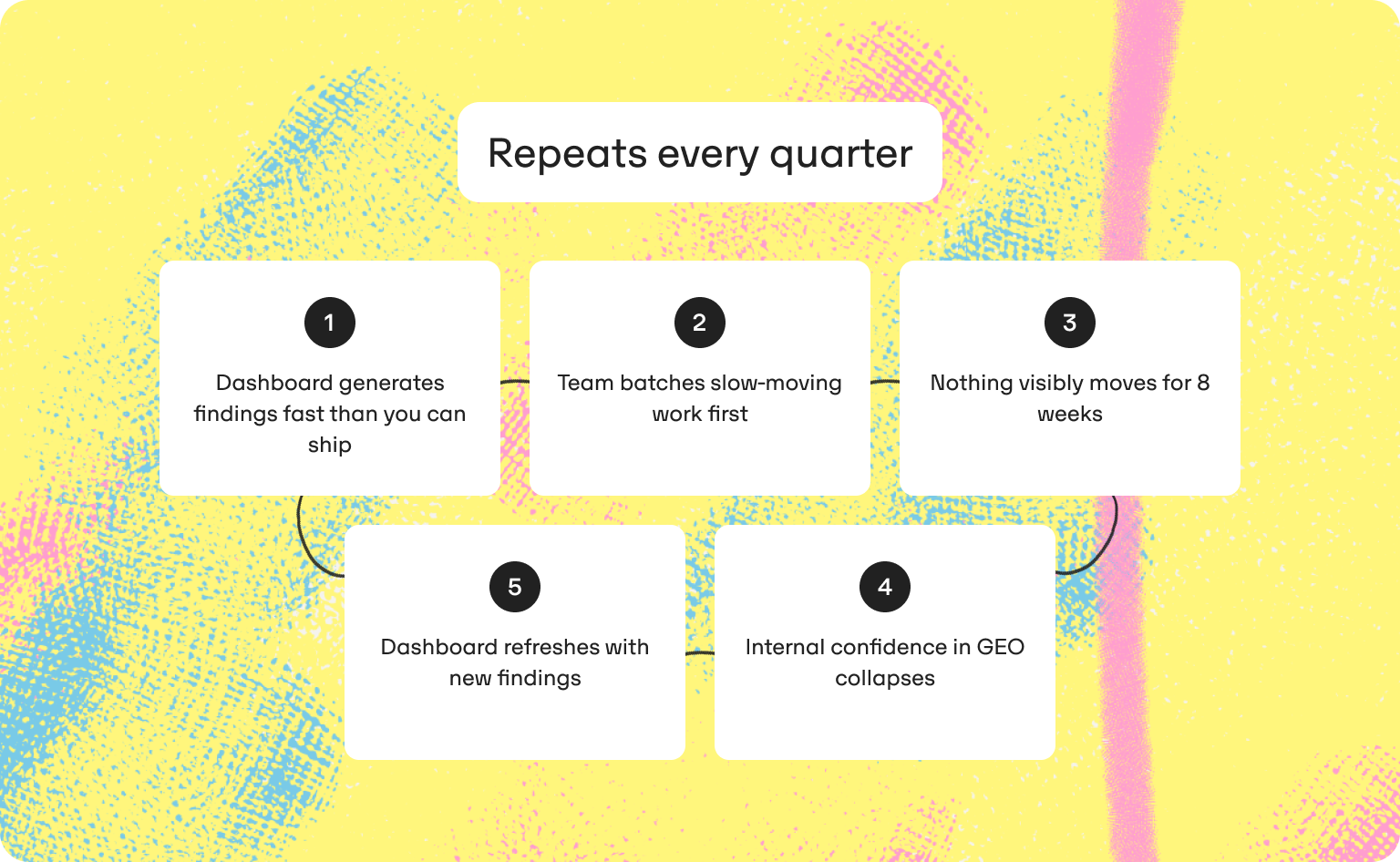
The instinct is to implement a phased quarterly plan. That works in most marketing channels because the work moves at roughly the same speed. Content creation, technical fixes, and link building all report back within a similar window. You can batch by phase because the feedback loop is consistent.
Digital marketing teams are used to this rhythm, which is why a phased plan feels safe. But generative engine optimization (GEO) breaks the rhythm. Crawler fixes can show movement in days. Content rewrites take weeks. Entity and citation work takes months. A phased plan batches by activity type instead of by feedback speed, so you end up with a phase full of slow-moving work and nothing to report for two months.
Applying a quarterly plan to GEO strategy leaves you with a timeline, not a prioritization model. It tells you when to work on things, not which things are worth working on, and it does nothing about the fact that a couple of people can only ship so much in a quarter.
A generative engine optimization strategy has to account for this spread, or the roadmap stalls before it starts. GEO optimizes content for AI-generated answers, not just rankings, and those answers move on a different clock than traditional search engines.
Score every finding on four axes
Your GEO audit told you what to fix and in what order: Layer 1 before Layer 2, retrieval before extraction. That’s the diagnostic priority, and you should pay attention to it. Technical GEO ensures AI bots can access and understand your content, and that work comes first.
Now you need to decide how to schedule those fixes across a quarter when they all move at different speeds. Score every finding on four axes. This takes two minutes per finding and it can be the difference between a roadmap that ships and a roadmap that stalls.
1. Impact
What you’re asking: Does this finding affect prompts tied to pipeline?
Tag each prompt in your baseline as pipeline-relevant or not. If the finding is related to a prompt that a buyer would ask during evaluation, it’s high impact. If it only touches brand-awareness prompts, it’s medium. Everything else is low. Match your content to user intent, not to keyword relevance alone.
✅ High impact: “Best CRM for venture-backed startups” is the prompt your ICP asks right before they short-list. If you’re absent in these target queries, you’re losing deals you don’t even know about.
❌ Low impact: “What is customer relationship management” might be a prompt you want to appear in for brand authority, but it’s not driving much pipeline. Target it only if you have capacity. Don’t prioritize based on just keyword relevance alone, because a high-volume prompt with no buyer intent won't move revenue.
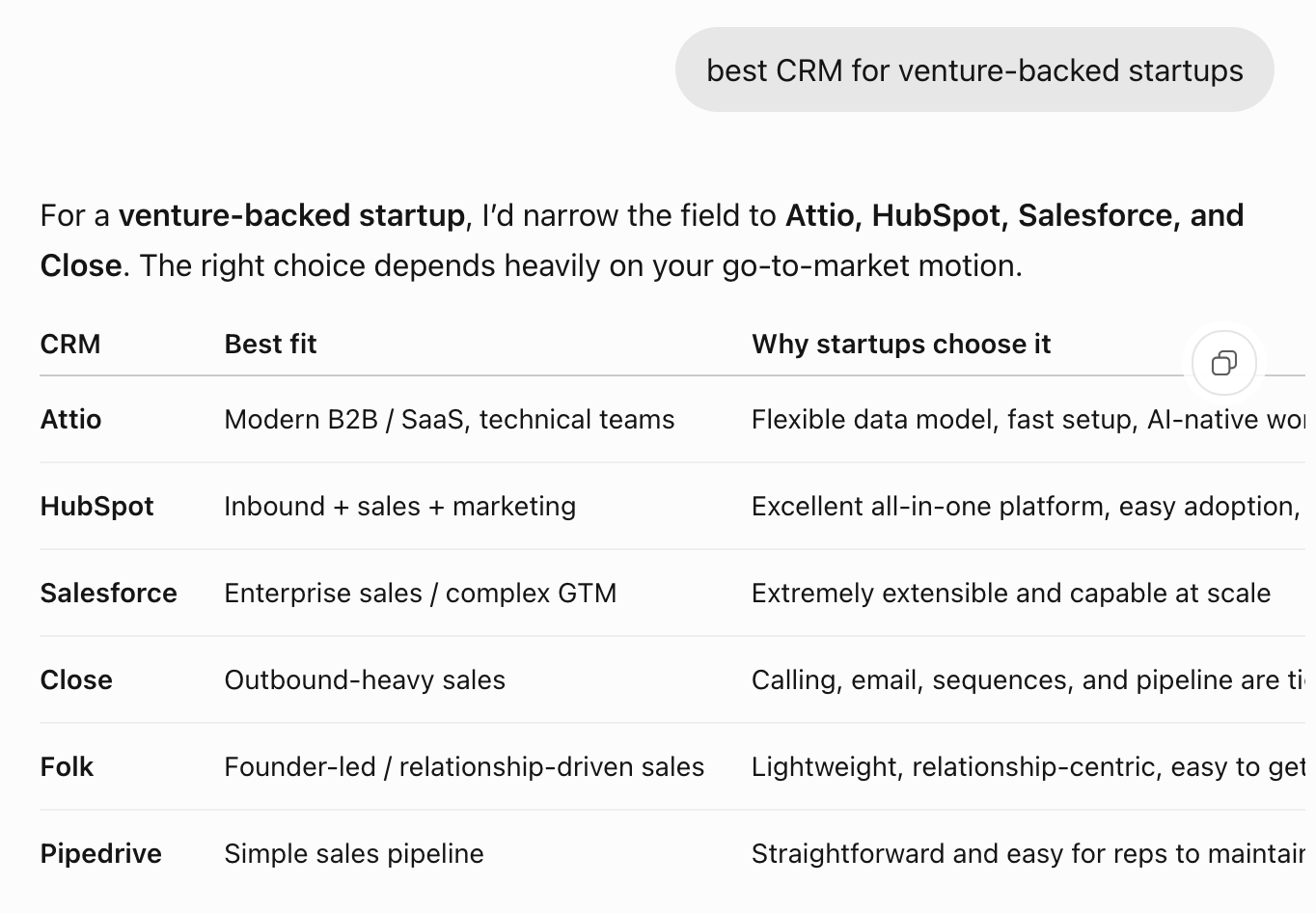
For example, if you’re in the CRM space, but not one of these 6 recommendations, then this prompt deserves priority.
2. Effort
What you’re asking: Can your team ship this without a third party?
Content GEO focuses on creating machine-readable and structured content, and this is the simplest example of it. Machine readable pages with clear content structure are easier for engines to extract from, so the rewrite pays off faster. Schema markup on your own pages is similarly low effort if you have CMS access.
If it’s a content rewrite on a page you control, it’s low effort. If it needs a developer ticket or a CMS change, it’s medium. If it needs PR placements, external site changes, or someone else’s sprint, it's high.
✅ Low effort: Rewriting the opening passage on your CRM pricing page to be self-contained and extractable is something you own. You control the edit and can republish the same week.
❌ High effort: Earning a placement on G2’s “Best CRM” roundup means you don’t control the list, the editor’s timeline, or the criteria. It could take weeks of outreach with no guarantee. Off-site authority and digital PR are high effort because they depend on someone else's decision.
3. Evidence
What you’re asking: Do you know this is the cause, or are you guessing?
If your audit data shows the failure clearly, consider it high evidence. For example, if your page has no extractable passage under a question-shaped heading, the cause is visible. But if you’re inferring the cause from a symptom like “we’re not cited, so our content must be weak,” it’s low.
Large language models need direct answers they can extract, not narrative they have to interpret. AI models work by extracting passages written in natural language, so if your content isn’t structured that way, you’re invisible to them.
✅ High evidence: Your baseline shows you’re absent for “best CRM for startups” across all three engines. You check the page and the opening paragraph is 200 words of company history with no self-contained answer. The cause is clear because no extractable passage exists.
❌ Low evidence: You’re absent for “best CRM for startups” and you assume it's because your content isn’t good enough. But you haven't even checked whether the page has a question-shaped heading or a self-contained answer. You’re guessing at the cause, which means you might rewrite content that was never the problem.
4. Lag
What you’re asking: How long until the metric responds after you ship?
Crawler and rendering fixes can show movement in days once re-crawled. Content rewrites take weeks because the engine needs to re-fetch, re-extract, and re-rank. Entity and citation work takes months because you’re building tons of signals across surfaces you don’t control.
Direct answers on your own website are what AI-driven discovery surfaces, so the lag depends on how quickly the engine re-fetches and re-extracts.
✅ Short lag: Unblocking GPTBot in robots.txt means once the crawler re-fetches your page, you could see movement within days. Fixing site structure and rendering issues are the same in the sense that AI crawlers re-fetch and you see movement quickly.
❌ Long lag: Cleaning up your entity across directories and review platforms means updating Wikipedia, G2, Crunchbase, LinkedIn, and a dozen smaller surfaces. Even after you ship every change, the engine needs to re-index all of them before your entity consistency improves. You’re looking at months before the metric moves.
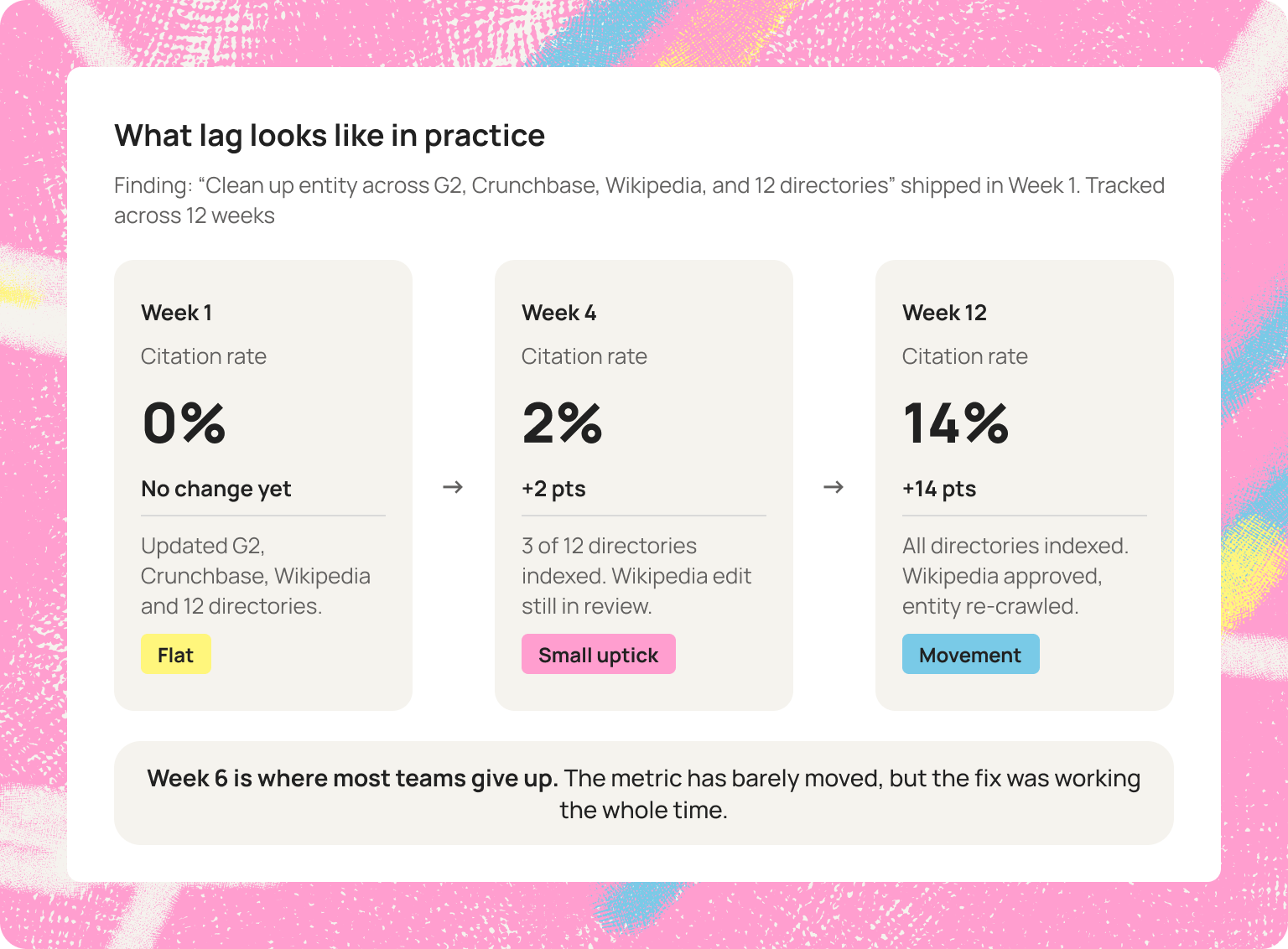
Most teams score the first two and skip the last two. That's how a roadmap fills with high-impact, low-effort work that nobody can prove succeeded. You make the fix, nothing happens for three months, and you can't tell whether the change failed or the lag just hasn’t caught up. AI trust is built through consistent, extractable content and third-party validation, and both take time to build.
Evidence and lag are what make the roadmap defensible. They let you explain to leadership why a fix that shipped six weeks ago hasn't moved the number yet, and when it will. E-E-A-T signals, original data, and direct answers on your key pages are what give ai models a reason to trust and cite you.
Once you’ve scored every finding, plot them on an impact-vs-lag matrix. Impact goes on the vertical axis and lag goes on the horizontal. The four quadrants tell you what to do:
- Top-left (high impact, short lag): Ship now. These are your quick wins because they’re the fixes that matter and prove themselves fast.
- Top-right (high impact, long lag): Start now, but report later. These are the strategic fixes. Begin them in week one so they have time to compound, but don’t expect movement until later in the quarter.
- Bottom-left (low impact, short lag): Quick wins that fill the gaps. Do them in the windows between larger work. They give you something to report while the slow fixes compound.
- Bottom-right (low impact, long lag): Drop it. If it doesn’t matter and it won't move for months, it doesn’t belong on a two-person team's roadmap.
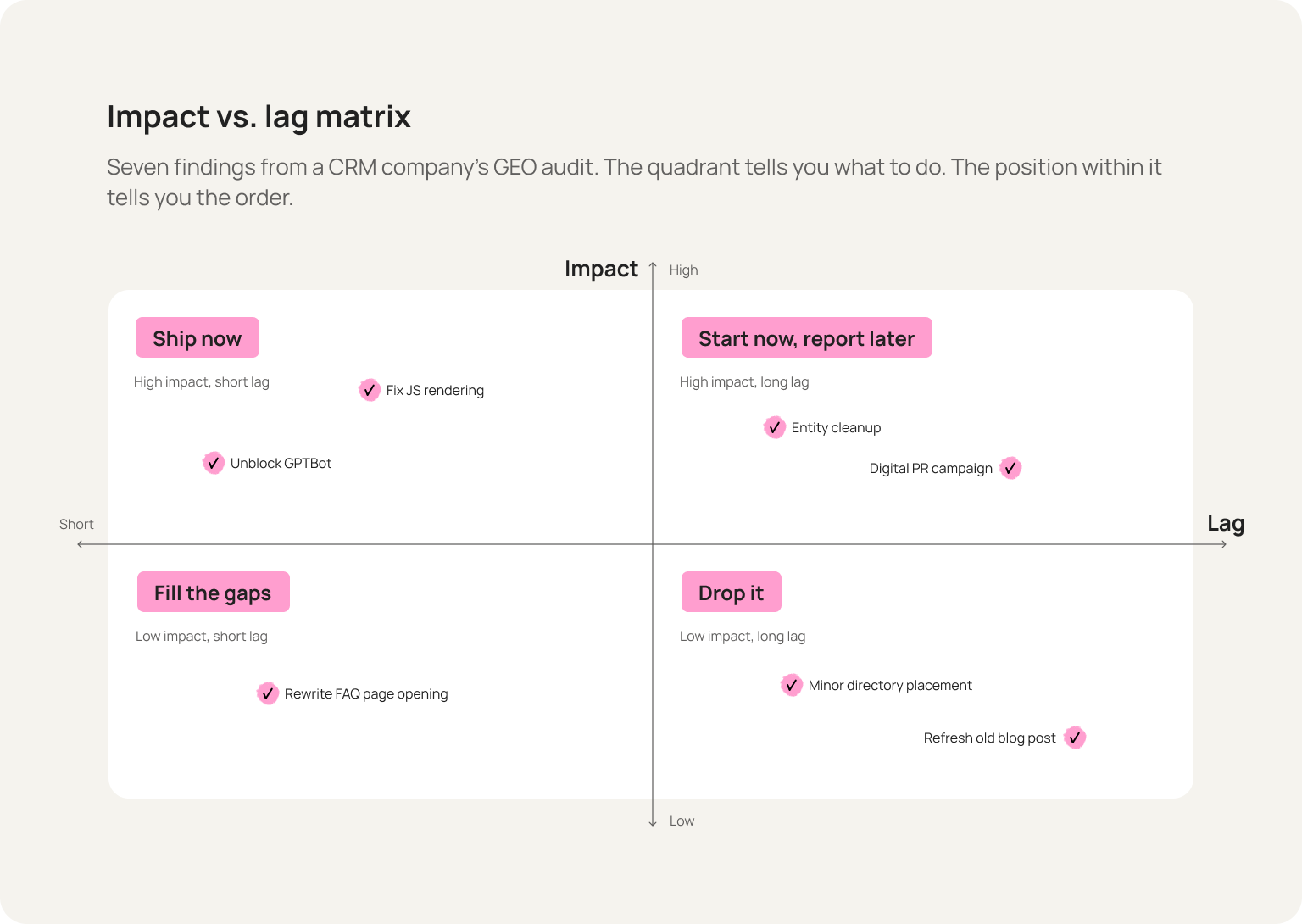
Effort and evidence don’t change which quadrant a finding lands in, but they change how you sequence within it. Inside the top-left quadrant, a low-effort fix with high evidence goes before a high-effort fix you’re still inferring the cause of. Evidence tells you how confidently to invest time. Effort tells you whether the time is yours to spend or someone else’s.
Sequence by time-to-movement, not by effort
Sequencing by effort and prioritizing low-effort fixes first seems reasonable. The logic falls apart when you realize that metrics take completely different times to respond.
GEO work moves, essentially, at three different speeds:
- Days: Crawler and rendering fixes
- Weeks: Page-level extraction rewrites
- Months: Citation footprint and entity work
So, when you batch by effort or by phase, that puts all the slow-moving work in one block. Nothing visibly moves for two months and leadership starts to doubt whether GEO works. The team can't prove it is because the lag hasn't caught up. Confidence collapses. The roadmap gets deprioritized. The slow work was starting to add up the whole time, but nobody saw it.
The fix is to interleave rather than batch. Every two-week window should have one fast-moving item and one slow-moving item. The fast item gives you something to report at the next standup. The slow item compounds in the background. By the time the slow work starts moving, you’ve already shipped six fast fixes that proved the channel works. This is the first GEO strategy step that separates teams that see results from teams that stall.
This is why the scoring model has a lag axis. Without it, you'd sort by impact and effort, batch the high-impact slow work first, and end up right back where you started. The lag axis is what makes the interleaving rule possible. You can’t interleave what you can’t measure.
Layer priority from your GEO audit still determines what you fix first. If Layer 1 is failing, you fix it before Layer 2. That hasn't changed. What changes is when you schedule it. A crawler block is high impact, low effort, short lag, and Layer 1. It goes in week 1 alongside a slow-moving entity cleanup that's high impact, long lag, and Layer 3. Both start immediately. One proves itself in days. The other proves itself in months. The roadmap never stalls because there's always something moving.
What two people can actually ship in a quarter
The prioritization list in front of you might seem quite daunting if you’re a small team. There’s a lot to do, but how much can you realistically get done in a quarter? Let’s do the math.
Assume your two-person marketing team works a standard 40-hour week. That's 80 hours per week, or roughly 1,040 hours over a 13-week quarter. Before you allocate a single hour to GEO, subtract the work that already exists:
- Content production
- Social
- Analytics review
- Standups
- General overhead of keeping a marketing function running
A generous estimate is that 30% of your time is left after business-as-usual. That gives you 312 hours for GEO work across the entire quarter, split between two people.
What that translates to by work type
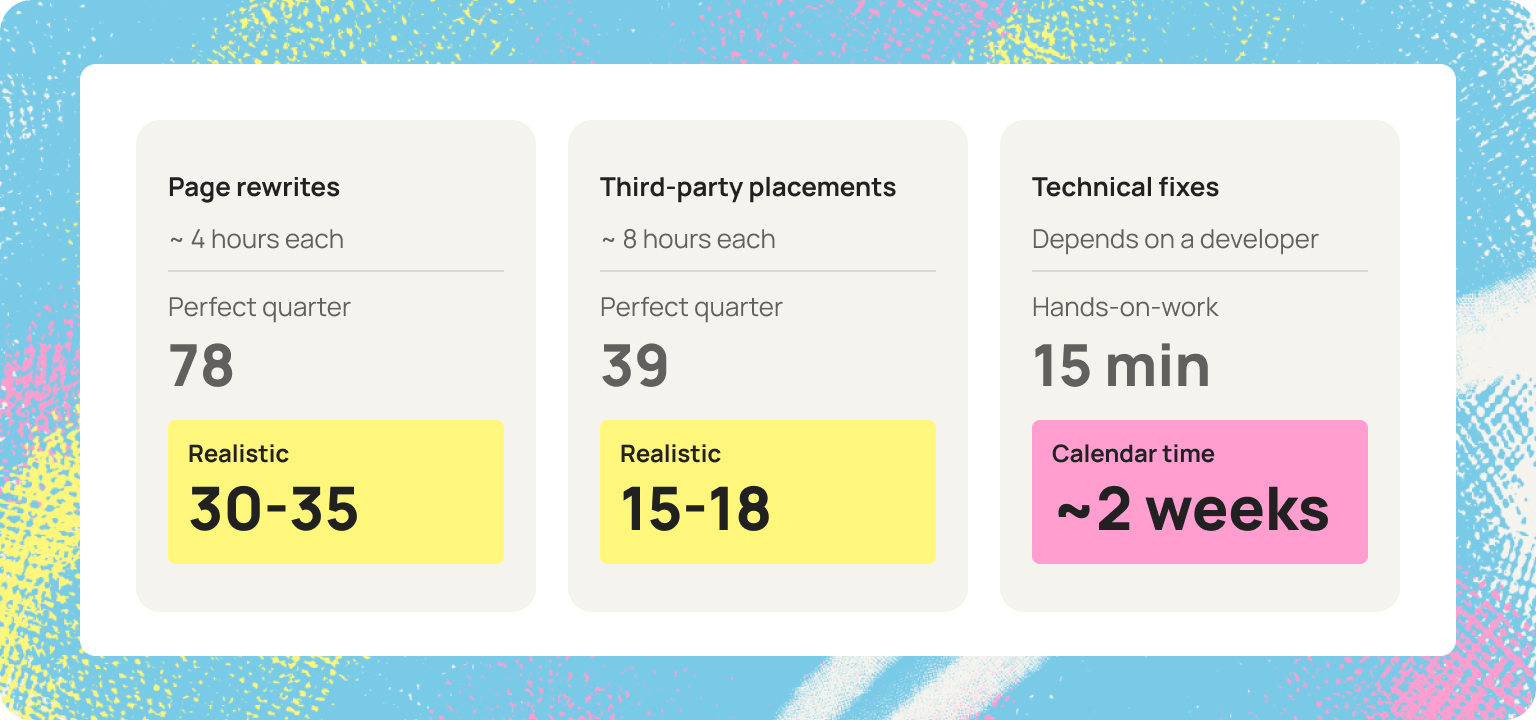
Let’s convert those 312 hours into real output. The number of fixes you can make depends on the kind of work each one requires.
Page rewrites
A single page rewrite, where you restructure the opening passage, add a question-shaped heading, and make the answer self-contained, takes about ~4 hours. This includes research, drafting, review, and publishing. That means your team can ship roughly 78 page rewrites in a quarter if they do nothing else. They will do other things, so call it 40 rewrites with room for the rest of the roadmap.
Princeton found that adding statistics and original data to your content can increase AI search visibility by up to 40%, so factor that into your rewrite time. Website content that includes data tables and original research also gets cited more often than generic prose.
Third-party placements
Each one requires research to identify the target, outreach to the editor or platform, follow-up, and the actual placement itself. Budget ~8 hours per placement from start to finish. That’s 39 placements in a perfect quarter. But call it 20 with realistic conversion rates and the time you're spending on everything else.
Technical fixes
Unblocking GPTBot in robots.txt takes 15 minutes if you have access. But most two-person marketing teams don't have access to robots.txt, the WAF, or the server config. A 15-minute fix might take two weeks to finalize because you’re waiting on a developer who has 40 other tickets ahead of yours.
Schema validation and structured data are essential for AI visibility in 2026, but they won’t help if AI crawlers can’t reach your page in the first place.
The fastest, highest-impact fixes are often the ones you can’t do yourself. You can score them as high impact, low effort, and short lag, and they’ll still sit in the backlog for weeks because the effort isn’t yours to expend. Budget calendar time for someone else’s sprint, not just your own.
The honest number
In one quarter, two people can realistically ship:
- 30 to 35 page rewrites
- 15 to 18 third-party placement efforts
- A handful of technical fixes that depend on someone else’s time
This is a realistic capacity for a team of two. Better prioritization helps you choose what fits inside your workday. But no amount of prioritization can magically give you more time. No scoring model, no sequencing rule, no matrix changes the fact that two people can only ship so much in 90 days.
The 90-day shape
Now that you’ve scored your findings, you know your capacity, and you understand why batching slow work kills momentum. The next step is a calendar that puts all of it together. Here's what a 90-day GEO roadmap looks like when it's built around time-to-movement instead of phases.
Weeks 1 to 2: Unblock and establish
Start with the fastest, highest-impact fixes you can ship yourself. Unblock GPTBot in robots.txt if it's blocked. Make sure your raw html is server-rendered, not client-side injected, so AI systems can read it without executing JavaScript. Phase 1 focuses on foundation audit and setup in the first 30 days, and this is where that work begins. These steps show movement within days of re-crawl, which means you walk into week 3 with proof that the channel responds.
At the same time, kick off one slow-moving item. Start your entity cleanup across G2, Crunchbase, and Wikipedia. You won’t see results from this for months, but week 1 is when it needs to begin. The earlier you start, the earlier it compounds.
Owner: One person on technical fixes, one person on entity cleanup outreach.
Weeks 3 to 6: Rewrite and place
This is when the bulk of your page rewrites should happen. Take the findings from your scoring matrix that landed in the top-left quadrant (high impact, short lag) and work through them. These are your priority pages, the ones where a rewrite will move the metric fastest.
Pair this with your first third-party placement efforts. You identified the domains the engine cites in your category during your audit. Start outreach to those publications now. Brand mentions on industry publications and review sites are another way for AI assistants to learn about your brand. Placements take weeks of follow-up, so the earlier you start the conversation, the better.
Re-measurement point: At week 6, re-run your baseline on the prompts you’ve been targeting. The technical fixes from weeks 1 to 2 should show movement. The rewrites from weeks 3 to 6 may start to appear. This is your first proof-of-life check.
Owner: Both people on page rewrites, with one splitting time to follow up on placement outreach.
Weeks 7 to 10: Double down and expand
By now, your fast-moving fixes from the first six weeks should be producing visible movement. Use that momentum to justify continued investment to leadership. When done wrong, this is where a lot of roadmaps stall, because the slow work hasn't moved yet and the team loses confidence. Your week 6 re-measurement should be the antidote to that.
Continue performing page rewrites, but shift some capacity toward the prompts you haven’t addressed yet. Expand your prompt set slightly to cover adjacent queries you discovered during the first six weeks. If your audit surfaced content gaps on comparison queries, this is the window to build those pages.
And keep the placement outreach going. Some of your earliest outreach from week 3 should be showing results by now. Log every placement and re-run the prompts where you earned them to confirm the citation appeared. Building topical authority across your key pages is what helps turn a single placement into a recurring citation.
Re-measurement point: At week 10, re-run your full baseline. Compare citation share on the prompts you targeted versus the prompts you didn’t. This tells you whether the roadmap is working or whether you’re seeing natural volatility.
Owner: One person on new page creation, one person on placement follow-up and re-measurement.
Weeks 11 to 13: Compound and report
The slow work from weeks 1 and 3 should start to move now. Entity cleanup that started in week 1 has had 10 weeks to propagate. Placements from week 3 have had 8 weeks to get published and indexed. While other teams are starting their slow work in week 8 and seeing nothing, yours has been compounding since week 1.
Spend the final two weeks on re-measurement and reporting rather than shipping new work. Run your full baseline one more time. Document what moved, what didn’t, and what still needs time. This is the case for continuing the roadmap into the next quarter.
Owner: Both people on re-measurement, documentation, and reporting.
Use this as a shape, not a template
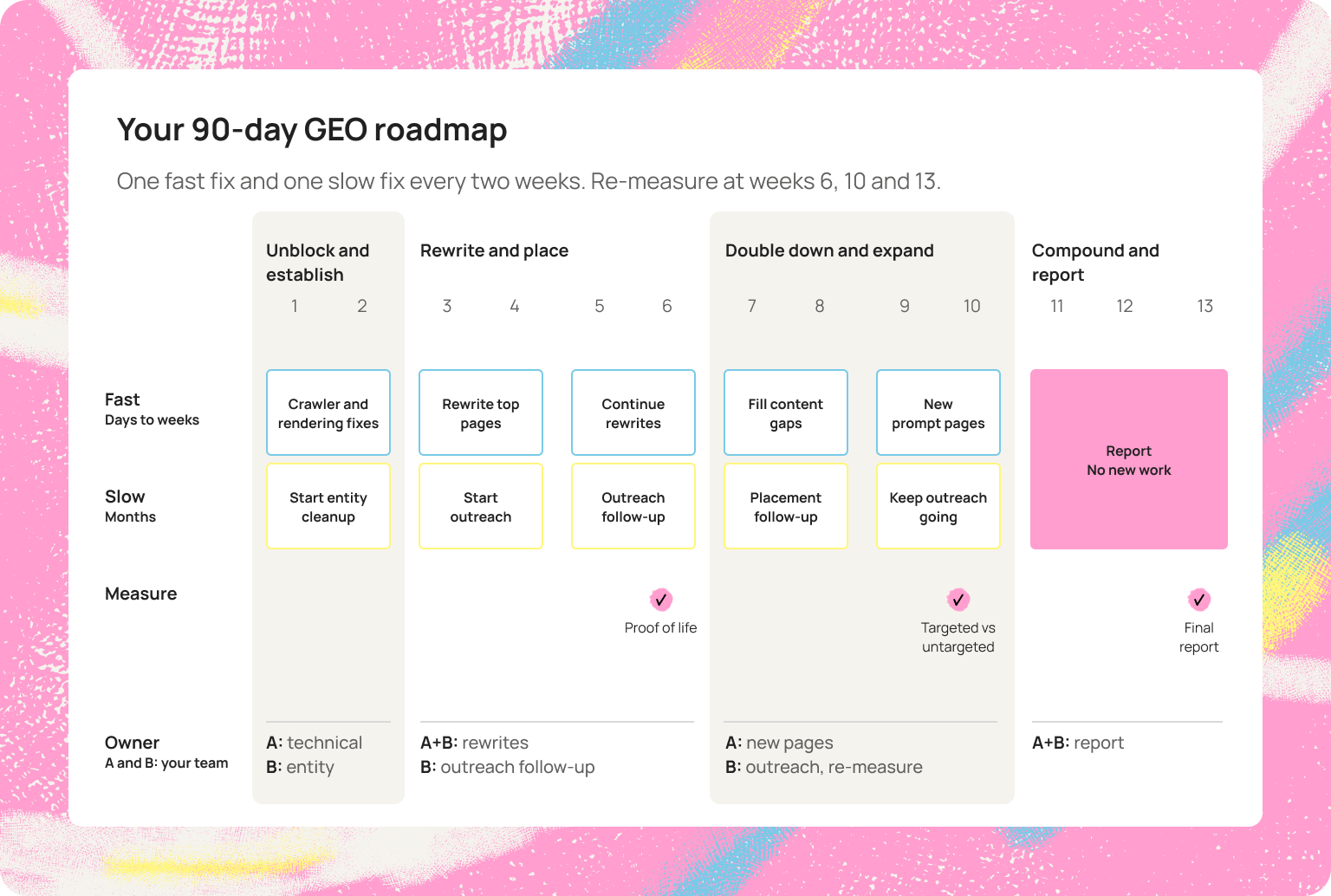
This is a shape you should adapt to your own strategy, not a template to follow literally. Your findings will differ. Your capacity will differ. Your engines will differ. The rule that holds regardless is the blending: one fast item and one slow item in every two-week window, with a re-measurement point at weeks 6, 10, and 13 instead of a finish line.
If you have more capacity than this assumes, publish more rewrites. If you have less, cut tasks from the bottom-left quadrant first. If your technical fixes depend on a dev team that won't prioritize them, push that work to the next quarter and focus on what you can do yourself.
Measure the roadmap, not the tactics
You’ve made real progress for 13 weeks. Now you need to report it all upwards. If you report the wrong things, it’ll hide all the work your roadmap is doing. So don’t report a single aggregate visibility score to leadership. You’ll just watch it tick up and down week over week and try to explain the movement constantly.
An aggregate score blends your targeted prompts with the prompts you didn’t touch. If your roadmap moved citation share on 15 targeted prompts by 12 percentage points, but untargeted prompts dropped by 5, the aggregate score looks flat. Leadership sees no movement and concludes the roadmap isn’t working, when that’s not the case.
What to report
Report three things, not one:
- Movement on fast-moving fixes as proof of life: Your technical fixes from weeks 1 to 2 and your earliest page rewrites should show movement by week 6. Report these specifically. They prove the channel responds to your work, which is the argument you need to keep the roadmap funded through the slow-work period.
- Bucket-level visibility on pipeline-tagged prompts: Take the prompts you tagged as pipeline-relevant in your scoring model and track citation share across only that group over time. These are the key metrics that connect AI discovery to pipeline, and the ones leadership cares most about.
- Citation share on the prompts the roadmap actually targeted: Compare your citation share on targeted prompts versus untargeted prompts at each re-measurement point. If targeted prompts are moving and untargeted ones aren’t, your roadmap is working. If both are moving, there’s something else happening rather than the effect of your work.
What to stop reporting
Stop reporting a single aggregate visibility score. It hides the work the roadmap is doing, it can’t distinguish between targeted and untargeted movement, and it gives leadership a number that’s easy to misunderstand. If the aggregate goes up, leadership thinks everything is working. If it goes down, they think nothing is. Neither of those conclusions are accurate.
An aggregate score is the wrong unit of measurement for a roadmap that targets specific prompts. You care most about the prompts that drive buyer intent, not the full set of AI mentions across every engine.
Where Omnia and Omnio fit
Everything in this article assumes you have two people who can ship the work. But what if you don’t? What if you have one person, or what if that person is also running paid ads, social, and email? The roadmap can’t just shrink to fit your capacity. The capacity shrinks, and the roadmap stays the same size.
That’s the problem Omnia built a fix for. Omnia is an AI visibility platform that tells you where and how your brand appears in the top AI engines. Omnio is Omnia’s GEO agent, and it does the work the roadmap calls for. Think of it as an extra pair of hands.
The roadmap needs hands, not better sorting
Omnio crawls your site to surface technical and GEO gaps, then ranks them by impact so you know where to start. It drafts the fixes: page rewrites based on the exact passage a competitor is winning, new pages for prompts where you have no presence, and indexing submissions to speed up re-crawl. After the work is done, it re-measures against your baseline. Every public action is approval-gated, so nothing ever goes live until you say so.
It works from your existing data, not a fresh start
Omnio is grounded in the prompts, answers, and citations you’re already tracking. Its coverage equals your prompt set, so a prompt you never added is invisible to it. The better your baseline, the better Omnio performs.
It solves for the capacity argument
You don’t need another GEO tool to execute your roadmap. You need a GEO hire. Omnio is that hire. It doesn’t replace anyone on your team. It extends your team so the roadmap actually happens instead of sitting in a backlog that refreshes daily.
Two ways in, depending on who is driving
Omnia’s MCP server puts the data inside the assistant you already use, like Claude or ChatGPT. Omnio does the work inside Omnia grounded in that same data. Two entry points, same data layer.
Building the roadmap isn’t the hard part. Executing it with two people is. Start a free trial for 14 days with Omnia.

FAQs
How long should a GEO roadmap be?
A GEO roadmap should be one quarter, roughly 90 days. That’s long enough to produce meaningful work and short enough to keep momentum. Re-measure at weeks 6, 10, and 13 rather than waiting until the end. If you need to course-correct, you do it at week 6, not week 13.
What should a two-person team do first?
Start with technical fixes you can ship yourself: unblock crawler blocks in robots.txt, fix JavaScript rendering issues, and make sure your pages are server-rendered. These move in days, so you walk into week 3 with proof the channel responds. At the same time, kick off one slow-moving item like entity cleanup across channels. Entity GEO ensures your brand is recognized as a distinct entity, and the sooner you start that work, the sooner it shows.
How long until GEO work shows up in AI search visibility data?
It depends on the work type. Crawler and rendering fixes can show movement in days once the engine re-fetches your page. Page-level rewrites take weeks because the engine needs to re-fetch, re-extract, and re-rank. Entity and citation work takes months because you’re building signals across surfaces you don’t control.
Should GEO work sit in the SEO backlog or run separately?
Run it separately. The SEO backlog is built for 10 blue links and ranking movement, which means it’s organized by a different feedback loop. GEO work moves at three different speeds and needs its own re-measurement cadence. Your Google Business Profile, schema, and site structure serve both channels, but the roadmap that sequences the work should be its own document.
How do I report progress before the slow work has moved?
Report three things instead of an aggregate score: movement on fast-moving fixes as proof of life, citation share on pipeline-tagged prompts, and citation share on targeted prompts versus untargeted prompts at each re-measurement point. If targeted prompts are moving and untargeted ones aren’t, your roadmap is working.
How do I decide which AI models to target?
Start with the engines your buyers actually use, which for most B2B teams means ChatGPT, Google AI Overviews, and Perplexity. Track your brand visibility across all three, but prioritize the one where your ICP shows up most. The same queries often produce different AI responses across AI platforms, so optimizing for all of them simultaneously dilutes your capacity.