


When comparing Profound vs Peec AI in 2026, the choice comes down to budget and infrastructure. Peec AI is an accessible, credit-based monitoring tool that relies on external MCP integrations for content execution, making it ideal for agencies. Profound is an enterprise powerhouse with 400M+ real user prompts and deep crawler analytics, but its multi-engine coverage is priced out of startup reach. For lean teams that need both multi-country monitoring and a native action layer to generate content briefs without enterprise pricing, Omnia is the strongest alternative.
If you’re evaluating the Profound vs Peec AI comparison 2026 landscape, the divide is clear. Peec AI wins on accessibility and MCP-driven workflows for agencies, while Profound wins on data depth, real user prompts, and enterprise readiness for Fortune 500 brands.
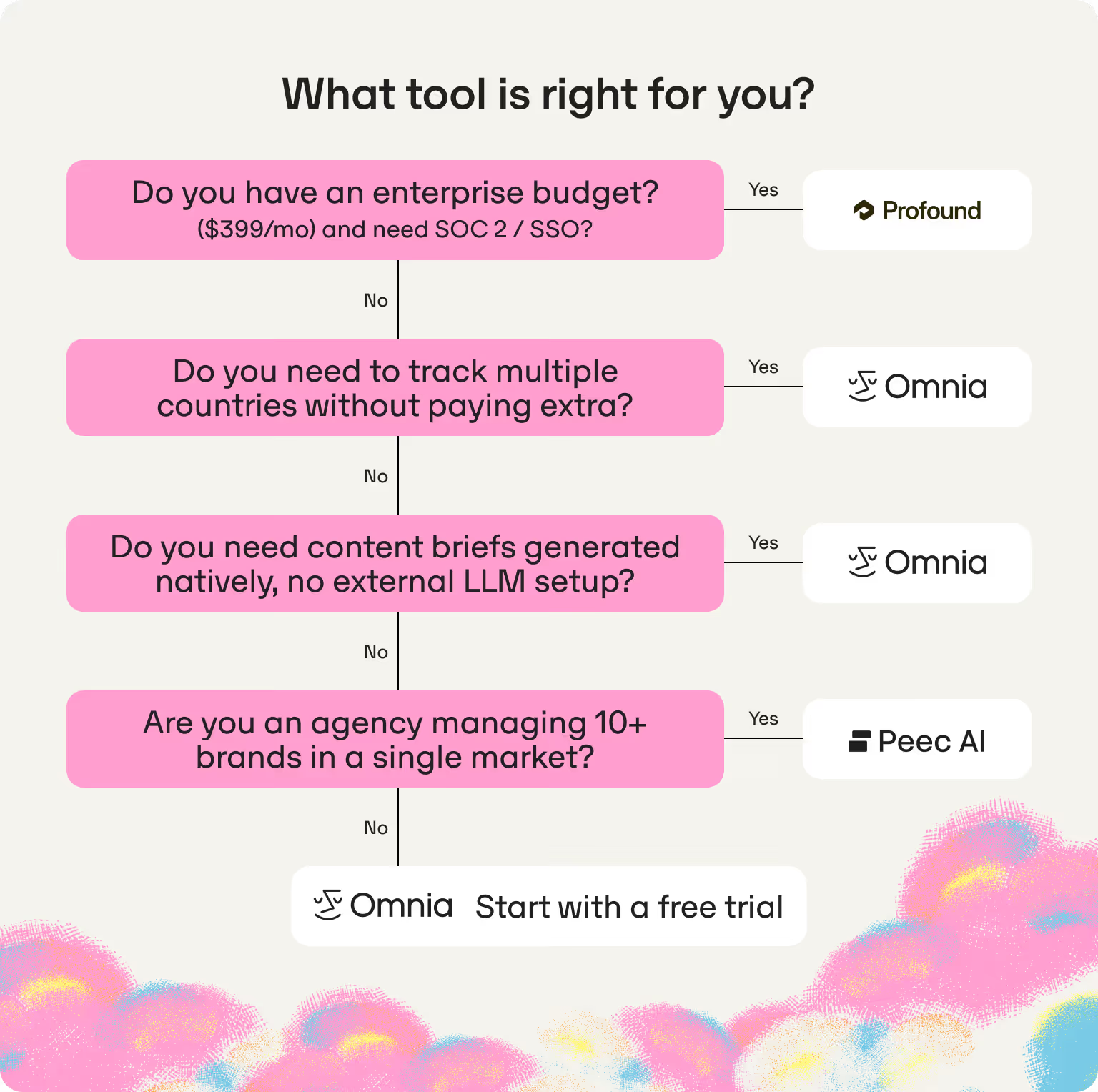
However, both leave a critical gap for lean startup teams. Peec AI offers an analytical action layer but relies heavily on external LLMs via MCP to actually draft content. Profound offers native content agents, but its multi-engine coverage and action layer are priced out of startup reach ($399/mo minimum).
Omnia closes this gap by combining URL-level citation intelligence with a built-in, native action layer at startup-friendly pricing. This turns AI search visibility insights directly into content creation tasks without requiring complex API setups or enterprise budgets.
What this comparison covers (and what we tested)
Most Profound and Peec AI comparisons are written by the vendors themselves, focusing heavily on feature checklists rather than operational reality. When evaluating Profound AI vs Peec AI for GEO, the question isn't just which tool tracks more AI models, but which platform actually helps you improve AI visibility.
We looked beyond the basic visibility score to evaluate how each platform deals with citation data, how they track when a brand appears in AI-generated answers, and whether they provide the actionable insights needed to adjust your content strategy.
Profound vs Peec AI vs Omnia: Side-by-side comparison table
| Capability | Peec AI | Profound | Omnia |
|---|---|---|---|
| Engine breadth | 7 AI platforms | 10+ AI platforms | 4 core AI platforms |
| Geographical coverage | 1–3 countries (unless Enterprise) | 1 country and 1 language (unless Enterprise) | Unlimited countries and languages on every plan |
| Action layer |  Yes (actions + MCP) Yes (actions + MCP) |
Yes (agents/workflows) |
Yes (native briefs & targets) |
| MCP Capabilities | Read & Write (Workspace config) | Read-Only (Analytics) | Read & Write (Data & API Discovery) |
| Citation depth | Domain & URL | Domain & URL | Domain & URL |
| Prompt volume data |  No No |
Yes (400M+ database) |
Yes (Prompt Discovery) |
| Crawler analytics | No |
Yes (Agent Analytics) |
No |
| Pricing starts at | $95/mo | $99/mo (ChatGPT only) | €79/mo |
While Peec AI provides accessible monitoring and MCP workflows for agencies and Profound delivers enterprise-grade analytics for Fortune 500s, Omnia is the best choice for lean growth teams that need multi-country tracking and immediate content execution natively.
Profound vs Peec AI for AEO — where each tool wins (and where both fall short)
Evaluating these platforms for Answer Engine Optimization (AEO) reveals a stark contrast between agency-friendly monitoring and enterprise-grade analytics. Here is exactly where Peec AI and Profound excel, and where their limitations in global tracking and native execution cause lean teams to consider other AI visibility tools.
Localized tracking by country
This is the most significant differentiator in the Profound vs Peec AI 2026 comparison landscape. Both Peec AI and Profound treat multi-country tracking as a premium luxury. Peec AI restricts its $95/mo Starter plan (and its $245/mo Agency Essential plan) to a single country, capping out at just 3 countries per project on its $495/mo Advanced tier.
Profound is even more restrictive, locking both its $99/mo Starter and $399/mo Growth plans to a single region and language. For a startup operating in the US, UK, and Australia, both platforms force an immediate jump to expensive or custom enterprise tiers. Many alternatives to Profound and Peec AI offer geographical coverage at a budget-friendly entry-point.
Omnia addresses this by executing prompts via real browsers in actual geographic locations for unlimited markets on its base $79/mo plan, ensuring you see exactly what local users see without per-market surcharges.
What this means in practice: If you need to fix your visibility in Germany and the UK, Peec and Profound will force you into expensive upgrades, while Omnia includes it out of the box.
Citation intelligence (domains + URLs)
Peec AI provides granular citation data, and its new Actions feature clusters these sources by content type (editorial, Reddit, UGC) to calculate competitive gaps. Profound matches this with enhanced citation categories and automatic domain classification at an enterprise scale.
The gap is how that citation data translates to outreach. Both tools are highly analytical, but Omnia takes URL-level citation intelligence and feeds it directly into a targeted outreach layer. The platform shows you which third-party domains cite competitors, and then generates the exact placement targets you need to displace them.
What this means in practice: Instead of just seeing that competitors are winning on listicles, your team gets a prioritized list of the exact third-party domains to target for PR and outreach.
Prompt data and coverage
When it comes to prompt research, Profound is the undisputed winner. Its Conversation Explorer taps into 400M+ real user prompts, providing actual prompt volume and intent research. However, when it comes to tracking those prompts, both Peec AI and Profound severely gatekeep their engine coverage.
Peec AI advertises 9 engines, but that is reserved for its custom Enterprise plan (with 2 of those via APIs). Its Starter (50 prompts), Pro (150 prompts), and Advanced (350 prompts) plans are locked to just 3 engines.
Profound continues to apply more restrictions. Its $99/mo Starter plan tracks 50 prompts on exactly one engine (ChatGPT). You have to pay $399/mo for Growth just to track 100 prompts across 3 engines, and 10+ engine coverage requires a custom Enterprise contract.
This doesn’t work for startups that need multi-engine coverage without the enterprise price tag. Omnia focuses strictly on the 4 core engines driving actual traffic, and includes all 4 on every plan. You get 25 prompts on Growth ($79/mo), 100 on Pro ($279/mo), and 200+ on Enterprise ($499/mo). Omnia also uses Prompt Discovery to surface high-volume, low-difficulty prompts clustered by topic so lean teams know exactly what to write today.
What this means in practice: Profound gives you a 400M+ prompt database, but charges enterprise rates to track them across multiple engines. Omnia gives you 4 engines out of the box on day one.
Action layer and content workflows
Peec AI recently introduced Actions to cluster gaps, but relies heavily on its MCP integration to pipe data into Claude or Cursor to actually draft the content generation. Teams that don’t want to set up this additional workflow often look at Peec AI competitors.
Profound offers a strong action layer with its Agent Builder and Workflows, allowing enterprise teams to automate deep research and draft content based on what AI answer engines cite. The gap continues to be startup accessibility. Peec requires you to build your own MCP prompts in Claude, and Profound's action layer requires a $399/mo minimum or Enterprise plan.
Omnia provides a built-in action layer available on its base plan. It automatically generates content briefs, on-page optimization steps, and technical fixes natively.
What this means in practice: Peec requires you to prompt Claude via MCP, Profound requires an expensive plan to use Agents, and Omnia hands you a ready-to-execute brief natively.
Pricing and startup accessibility
Geographical limitations and prompt caps define the pricing reality for both tools. Peec AI starts at $95/mo, but that only covers 1 country, 3 engines, and 50 prompts. To get 3 countries and 150 prompts, you need the $245/mo Pro plan, scaling to $495/mo for 350 prompts. For agencies, Peec's Essential plan is $245/mo (1 country), scaling to Growth ($495/mo) and Scale ($795/mo).
Profound technically starts at $99/mo, but this Starter plan is severely gatekept: 50 prompts, one user, one language, one country, and only one engine (ChatGPT). To get 100 prompts and multi-platform coverage, you must jump to Profound's $399/mo Growth plan, which still only covers 1 region. Omnia starts at $79/mo, including 25 prompts across 4 engines, unlimited countries, and the full action layer.
What this means in practice: $99/mo gets you a single-country view in Peec, a highly restricted ChatGPT-only demo of Profound, or the complete global monitoring-to-execution loop in Omnia.
Enterprise readiness
Profound wins this category flawlessly. With SOC 2 Type II compliance, SSO, RBAC, and Agent Analytics that track exactly how AI bots crawl your site (server-side and edge integration), Profound is built for enterprise procurement processes and enterprise infrastructure.
Peec AI offers API access and a Looker Studio connector, but Profound's analytics depth, historical SERP archives, and enterprise grade analytics make it the right platform for Fortune 500 companies needing a true enterprise solution.
What this means in practice: If you have a dedicated data science team, strict infosec requirements, and a massive budget, Profound is your platform.
Where Omnia fits (and why it belongs on this shortlist)
Choosing between Profound vs Peec AI for AEO usually results in a compromise, especially for global teams. Peec AI has fantastic visibility tracking and a flexible MCP integration, but requires you to build your own workflows in external AI tools to generate content. It also charges a premium to track multiple countries. Profound offers deep analytics, real user prompts, and native content agents — but its pricing, complexity, and strict single-country limits are designed for enterprise customers rather than agile marketing teams.
.avif)
Omnia fits perfectly in the middle. It’s an AI visibility platform built specifically for lean teams that need to move from signal to execution without friction, across every market they operate in.
The 60-minute weekly workflow
A weekly workflow in Omnia takes one marketer about an hour. You check your AI search visibility across the US, Spain, and any other markets, review the AI citation tracking to see which competitor URLs are winning locally, and immediately click into the action layer to generate a content brief or a list of PR placement targets. Omnia empowers you to do more than track brand mentions. You’re actively executing a content strategy to capture more AI search real estate globally.
Beyond basic monitoring
Unlike traditional seo tools or basic Google analytics integration, Omnia focuses on answer engine optimization. It includes AI Prompt Discovery to find what users are asking, AI sentiment analysis to see how AI models talk about your brand, and the Omnia MCP connector to bring visibility data directly into your AI assistants. Whether you’re trying to improve visibility in Google AI overviews or need a reliable ChatGPT rank tracking tool, Omnia provides the exact steps to improve AI visibility.
How to choose — a 5-scenario decision framework
If you align with Omnia's approach to monitoring and execution, you can book a demo to see it with your own data, or sign up for a 14-day free trial on the Growth plan today.
FAQs
Omnia vs Profound AI vs Peec AI for GEO — which is better for multi-country startups?
Omnia is the best choice for multi-country startups practicing generative engine optimization (GEO). While Peec AI comes with unlimited regions (on enterprise plans) via API responses, Omnia executes prompts using real browsers in actual geographic locations, ensuring you see exactly what local users see in their AI search results. Profound restricts its base plan to a single country, making it cost-prohibitive for startups needing global coverage for their AI search strategy.
Which is the best AI model in 2026?
There is no single “best’ AI model as usage depends entirely on user intent. ChatGPT dominates general conversational queries, Perplexity is the leader for deep research and real-time web AI citations, and Google AI Overviews controls the traditional AI search interface. A strong AI visibility tracking strategy requires monitoring how your brand and platform appears across all these major models and other AI engines simultaneously rather than optimizing for just one.
How long does it take to see results from AEO/GEO work?
Unlike traditional SEO, which can take months to reflect changes, AEO and GEO results can often be seen in days or weeks. Because AI models constantly ingest new data and real-time web results, publishing highly citable content or securing a placement on a trusted third-party domain can shift your visibility metrics almost immediately after the AI crawler indexes the new content. This allows you to quickly see how AI portrays your brand in AI-generated responses.
What should an enterprise company look for in an AI visibility platform?
An enterprise company evaluating an AI visibility platform should prioritize enterprise features like SOC 2 compliance, SSO, and robust AI visibility analytics. While many AI visibility tools offer basic tracking, enterprise teams need platforms like Profound that provide deep crawler tracking, or platforms like Omnia that offer a built-in action layer to scale their AI search strategy across global markets.
Does analytics depth matter more than actionability for AI search?
While analytics depth is valuable for market research, it shouldn't come at the expense of execution. Having millions of data points is useless if you can't translate them into a better sentiment score or higher inclusion rate. The most effective AI visibility tools balance deep AI visibility analytics with clear next steps. This makes sure you can actually improve how your brand performs in AI search results rather than just monitoring the data.

.webp)