

The top Scrunch AI alternatives worth switching to do three things most monitoring tools skip. They show you exactly where you appear by country using real browser sessions, they surface the specific URLs competitors get cited from rather than just domain-level trends, and they turn that intelligence into content briefs and placement targets you can act on immediately. Scrunch offers broad engine coverage, native on-site optimization through Content Gaps, Optimizer, and AXP, and an optional Stacker partnership for teams investing in earned media syndication at scale. This guide evaluates 10 alternatives to Scrunch AI on citation transparency, action layer depth, and real-world fit for startups and scale-ups that can't afford to spend budget on dashboards that don't move the needle.
You've been tracking AI visibility with Scrunch and hit a wall. Maybe it's wanting deeper URL-level citation intelligence showing exactly which competitor pages earn AI references. Maybe it's needing earned media placement support beyond Scrunch's native on-site optimization and considering whether adding the optional Stacker partnership for off-site syndication fits your budget and strategy. Maybe it's realizing you can see where you're invisible in ChatGPT but still have no idea which specific URLs competitors are getting cited from or what content would actually win you those prompts.
There are now enough mature Scrunch alternatives that switching is worth evaluating carefully. This guide ranks the best Scrunch AI competitors for founders and heads of growth at startups and scale-ups — tools built for teams that need country-level visibility, citation transparency at the URL level, and execution layers that turn insights into shipped content without operational overhead.
What is an “answer engine optimization” platform?
Answer engine optimization platforms, also called GEO tools or generative engine optimization platforms, track how AI search engines answer user prompts, not just which links rank in traditional results. ChatGPT, Google AI Overviews, Perplexity, and Gemini are now the first stop for a growing share of buyer research, and none of that activity shows up in a rank tracker.
The visibility problem is more subtle than it looks. Your brand might appear in ChatGPT's top recommendation for “best CRM for startups” but get ignored entirely when the same buyer asks “affordable customer management tools” — identical intent, different prompt, different result.
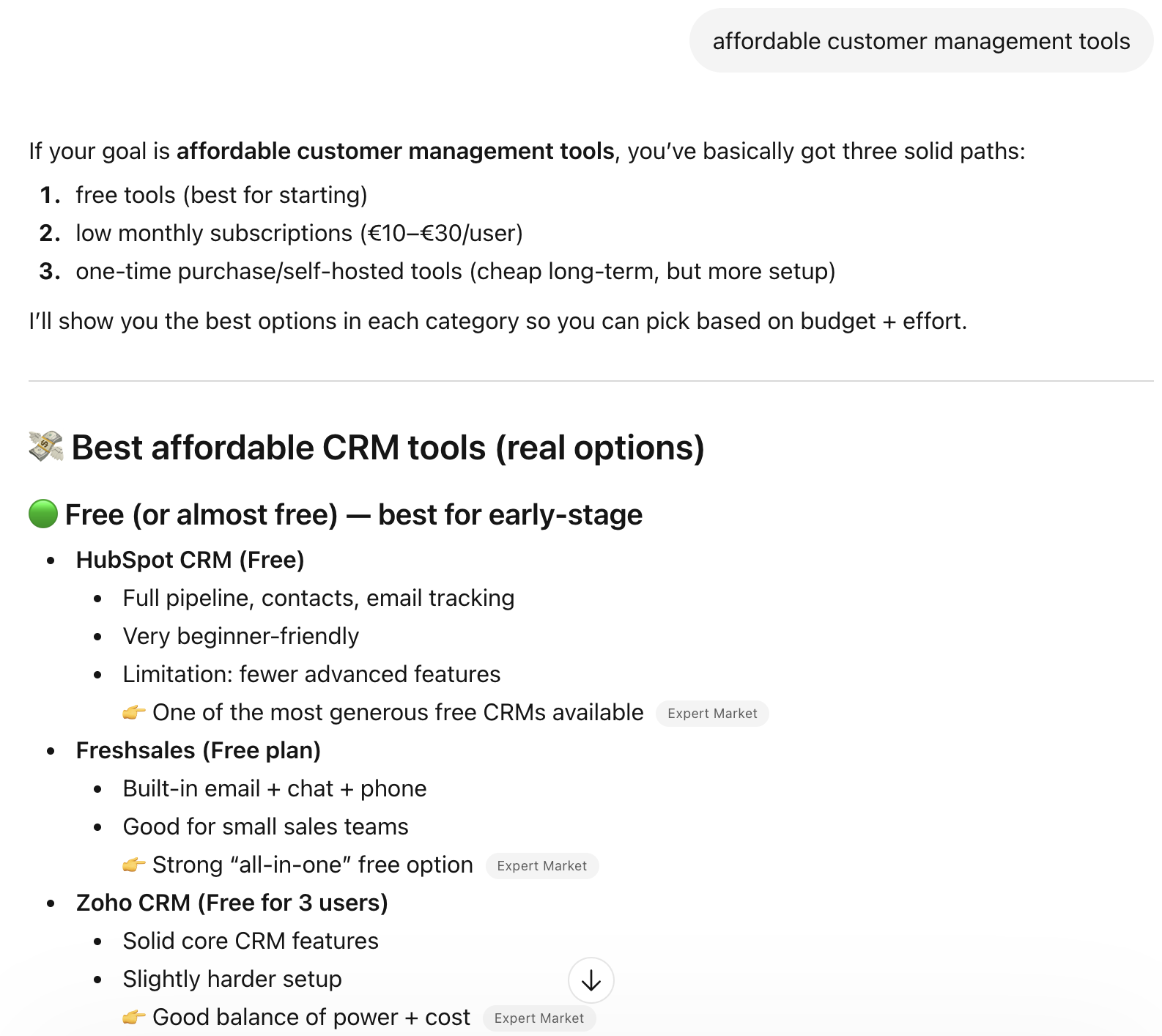
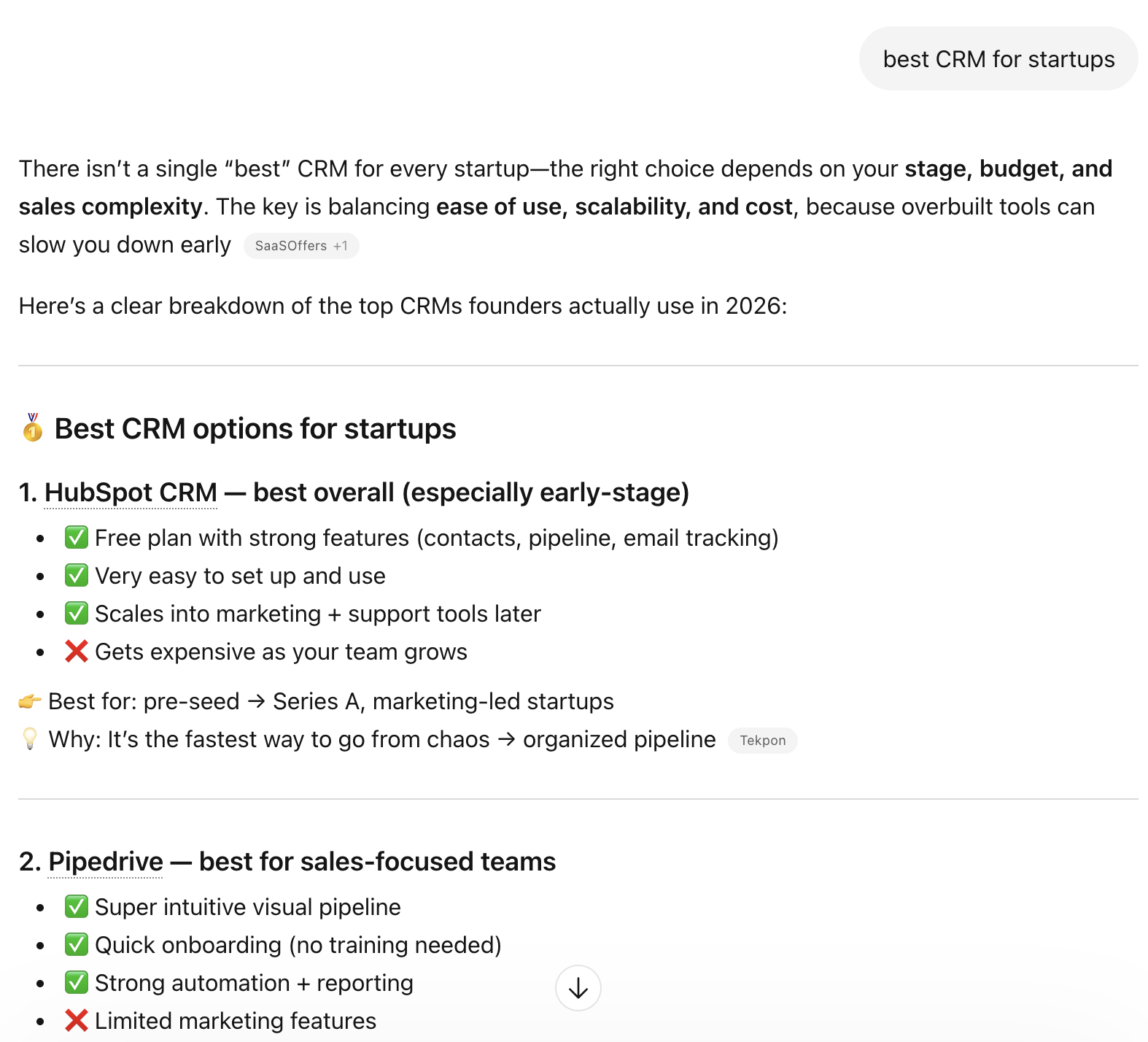
Traditional SEO tells you nothing about that gap. It doesn't capture whether you appear in conversational AI responses, whether you're getting cited as a trusted source, or whether competitors are taking zero-click answers that used to send traffic your way.
How these tools work (so you know what you're buying)
Every platform on this list works roughly the same way at the core. You define a set of prompts relevant to your category and the platform runs those prompts across selected AI engines at defined intervals. It then parses the responses to extract brand mentions, linked citations, unlinked references, and sentiment signals, aggregating everything into share-of-voice metrics and competitive benchmarking.
Where platforms diverge is in how they execute that tracking. API-based approaches are faster and cheaper to run, but can miss the locale-specific variations that matter when your product serves multiple geographies. Real browser sessions are slower but capture what users in Denmark or France actually see, which can differ substantially from what US-based API calls return. That distinction matters more than most buyers realize until they're trying to explain why ChatGPT recommends a competitor in one market but not another.
Prompt sampling & coverage (the hidden driver of "share of voice")
The prompts you track determine the story your data tells. A prompt set built around mid-funnel buyer questions like “best invoicing tool for freelancers under $50/month” or “FreshBooks vs QuickBooks for consultants” gives you decision-grade intelligence about where you're winning or losing real purchase consideration.
A prompt set built around brand awareness queries like “what is [YourBrand]” generates mentions that look good in a dashboard but tell you nothing about competitive displacement. Most platforms let you define your own prompts with seed keyword expansion, Google Search Console query mining, and competitor prompt monitoring. But the quality of your inputs directly determines whether your share of voice data is actionable or decorative.
Engine coverage — ChatGPT, Perplexity, Google AI Overviews, Gemini
Engine coverage numbers are a starting point, not a conclusion. A platform advertising ChatGPT tracking could mean GPT-4o in US English only, or it could span multiple model variants across 40 countries. That scope difference matters when you're trying to understand why UK buyers see competitor recommendations that US buyers don't.
An even more important question is whether a platform understands how engines behave differently, not just how many it covers. Omnia's analysis of 42M+ tracked citations reveals each engine operates with a fundamentally different citation budget. AI Mode averages 13.8 domains per answer, AI Overviews 9.2, Perplexity 7.5, and ChatGPT just 4.1. ChatGPT also draws from a fundamentally different authority base than Google's engines — only 50-55% domain overlap versus 81.5% overlap between AI Mode and AI Overviews.
Winning citations in AI Overviews gives you no guarantee of winning them in ChatGPT, and the same prompt requires a different strategy depending on which engine you're trying to win.
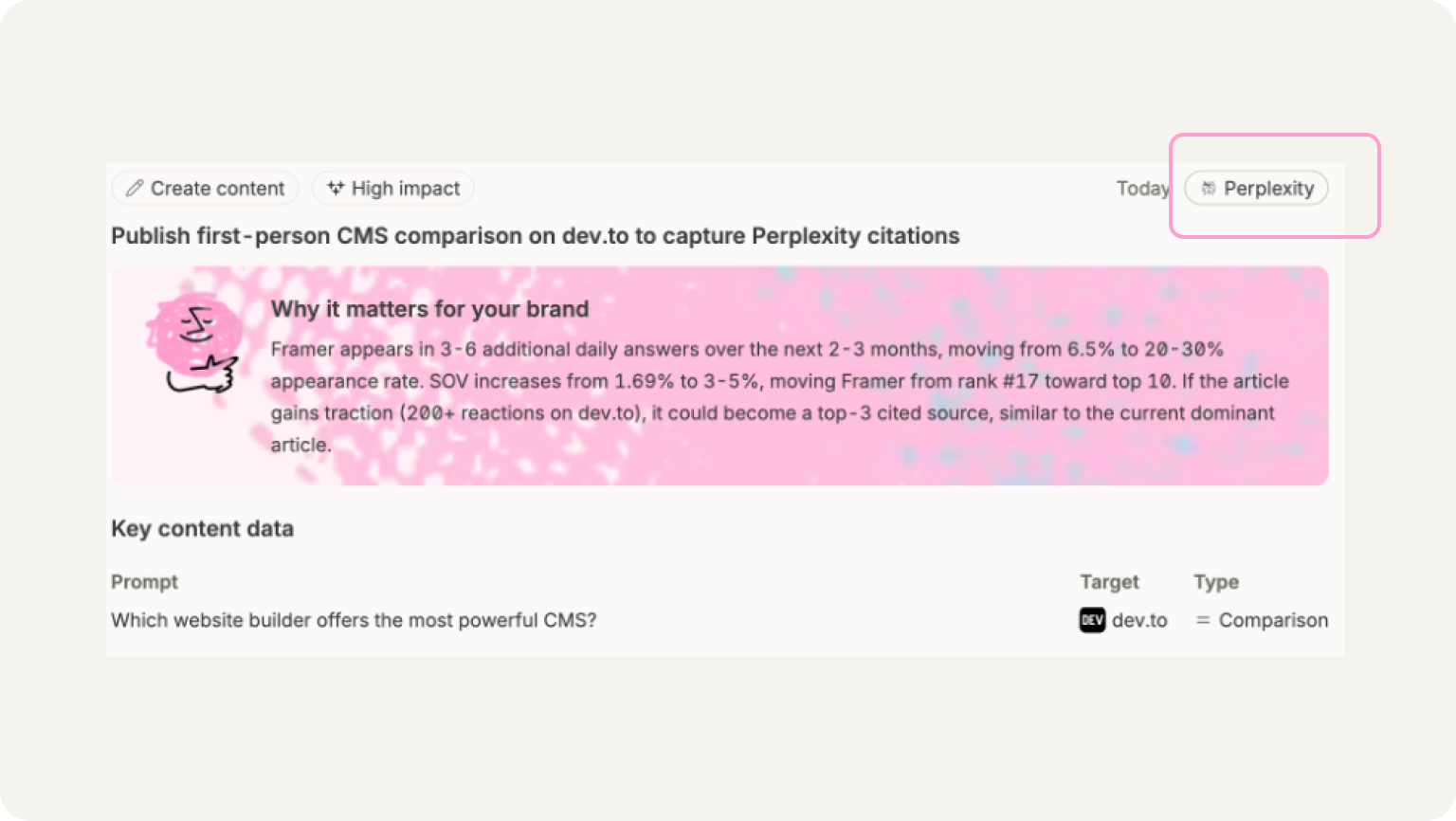
For Perplexity, Omnia identifies that publishing a first-person CMS comparison on dev.to (a third-party domain Perplexity already trusts) is the highest-impact move, with a clear projection of moving from 6.5% to 20-30% appearance rate as that content earns citations.
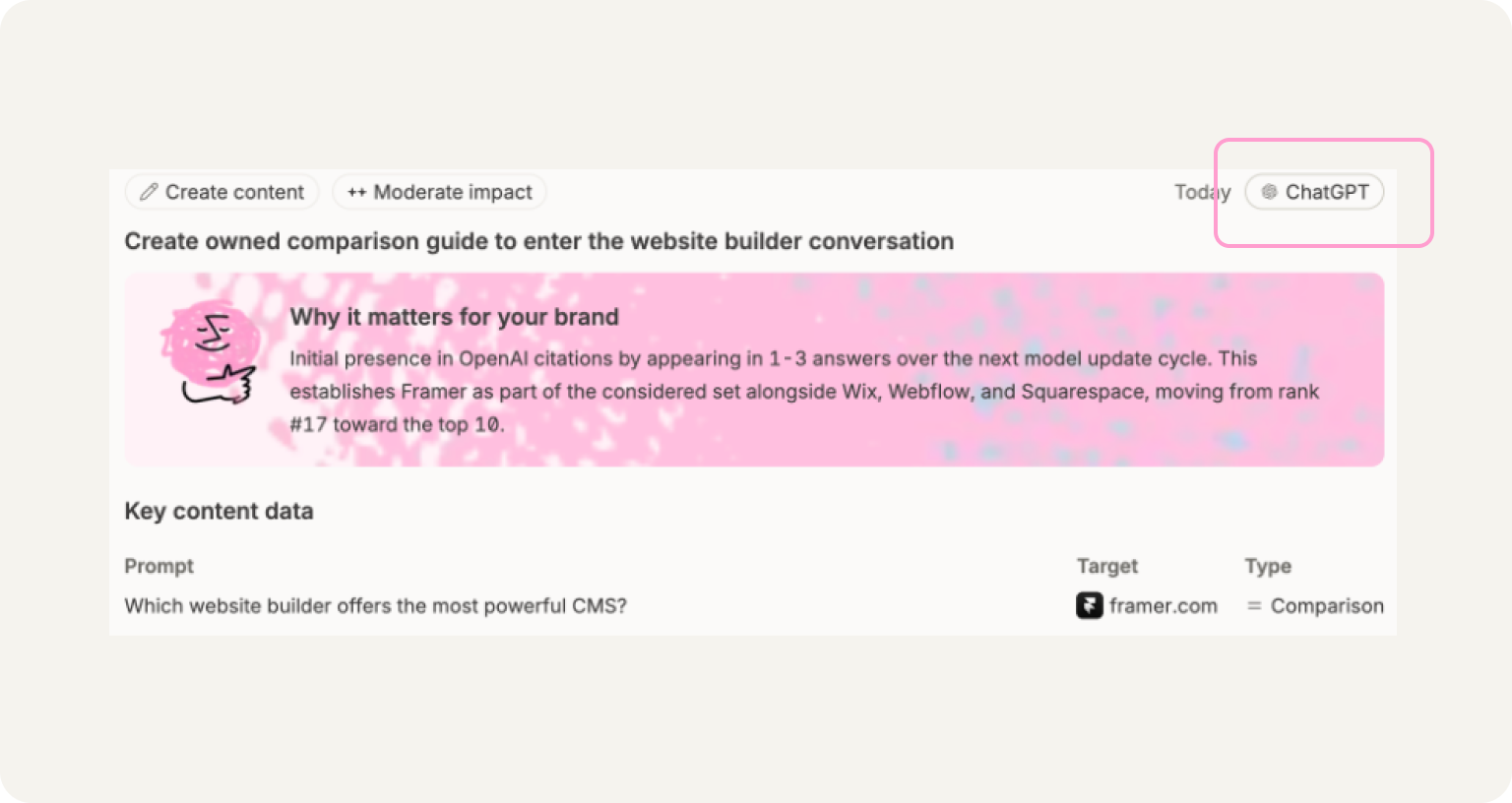
For ChatGPT, the same prompt calls for a different approach entirely: An owned comparison guide on framer.com to establish direct domain presence in OpenAI's citation pool. Same prompt, same goal, two distinct execution paths — because ChatGPT and Perplexity draw from different authority bases and reward different content strategies.
Google AI Overviews tracking — what credible tracking actually means
Most platforms say they have Google AI Overviews support, but few implement it rigorously. Does the tool control for locale? US, UK, and Australia produce meaningfully different AI Overview answers for identical queries. Does it track specific cited URLs or just domains? Knowing a competitor's domain appears tells you nothing about which page earned the citation.
How does it handle volatility when Google's summary disappears and reappears based on A/B testing? Does the data reflect that instability or paper over it? Does citation deduplication distinguish between one domain cited 10 times versus ten unique domains cited once each. These aren't edge cases. Get answers to them before committing budget to any platform claiming AI Overviews coverage.
Citation extraction — why you got cited (or didn't)
Citations are the mechanism behind AI visibility. When Perplexity cites a G2 review or AI Overviews links to a competitor's comparison page, that's the engine telling you which sources it trusts. If competitors consistently earn citations from third-party publishers while your brand only appears in citations from your own domain, it’s clear that you're not present in the sources AI engines already rely on.
Citation stability varies dramatically by engine and changes what good monitoring looks like. Omnia's data shows only 18.5% of AI Overview answers maintain the same top-cited domain week over week. ChatGPT is even more volatile at just 8.1% stable, changing its top-cited domain 92% of the time. The platforms worth evaluating offer citation analysis at the URL level, separate linked citations from unlinked mentions, and give you enough historical data to measure whether off-site placements are actually moving citation rates.
Action layer — turning insights into execution
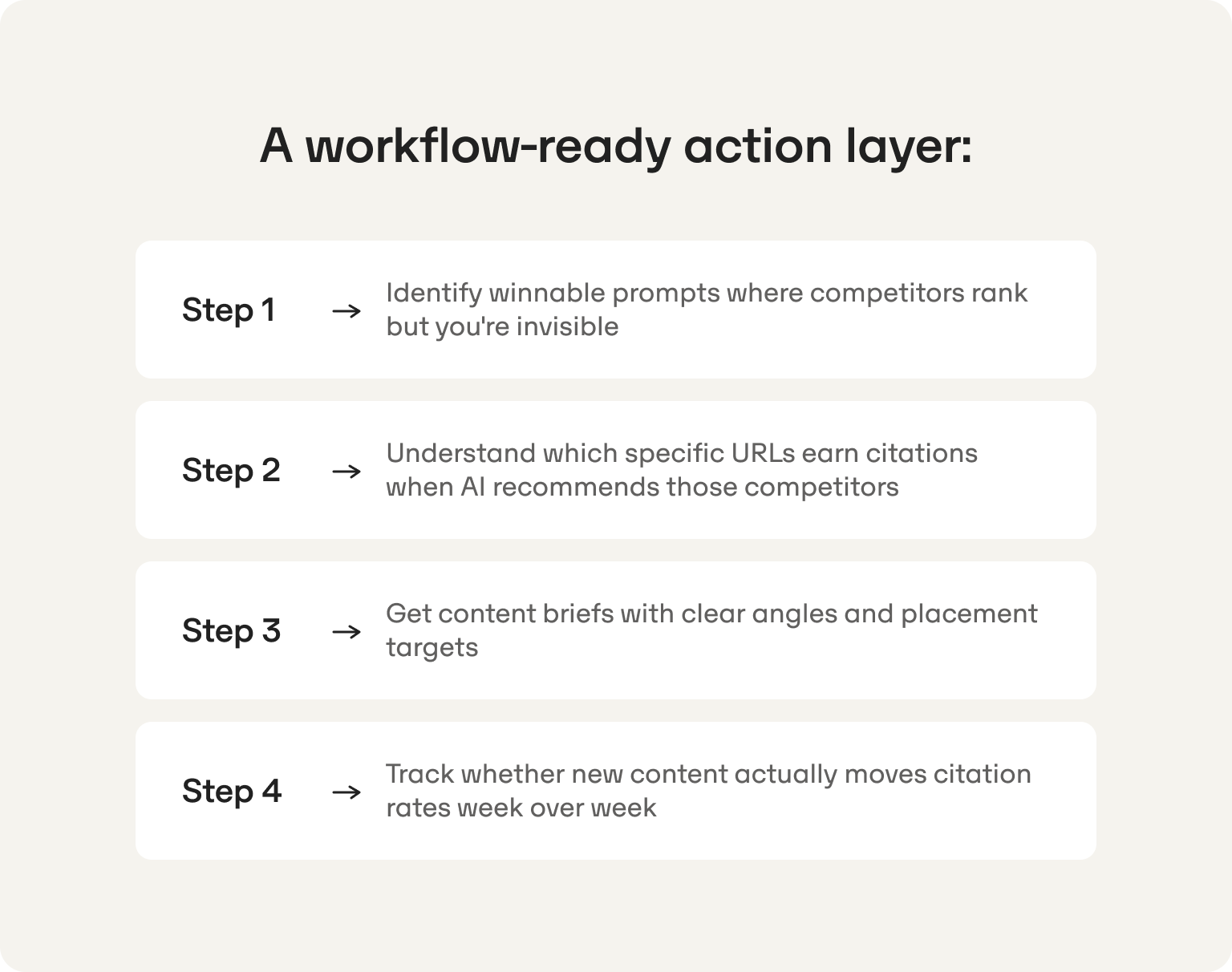
Monitoring without execution is just an expensive way to watch competitors win. A workflow-ready action layer looks like this:
- Identify winnable prompts where competitors rank but you're invisible
- Understand which specific URLs earn citations when AI recommends those competitors
- Get content briefs with clear angles and placement targets
- Track whether new content actually moves citation rates week over week
Scrunch's native action layer covers owned content well — Content Gaps auto-detects missing content for tracked prompts, Optimizer creates targeted webpage versions for specific prompts and personas, and AXP delivers that content directly to AI agents. For teams investing in earned media, the optional Stacker partnership extends to syndication across 3,000+ publishers.
When Scrunch is a good fit
Scrunch is a strong fit for teams that want broad engine coverage (8 platforms on Enterprise, 4 on the Core plan) combined with native on-site optimization in one place. Content Gaps auto-detects missing content for tracked prompts, Optimizer creates targeted webpage versions for specific prompts and personas, and AXP delivers token-optimized content directly to AI agents without touching what human visitors see. That's a genuinely useful stack for teams with active owned content programs who want monitoring and on-site execution without stitching together separate tools.
For teams also investing in earned media, the optional Stacker partnership extends to third-party syndication across 3,000+ publishers — which is worth considering given that 89% of AI citations come from earned media sources.
Comparing the Best Scrunch AI competitors at a glance
Use this table to quickly shortlist platforms based on your budget, team size, and primary use case before diving into detailed reviews below.
The best scrunch AI alternatives (ranked)
Each platform below is evaluated on citation transparency, action layer depth, country-level tracking capabilities, and real-world fit for lean marketing teams. See why each tool might be the right Scrunch alternative for you.
1. Omnia
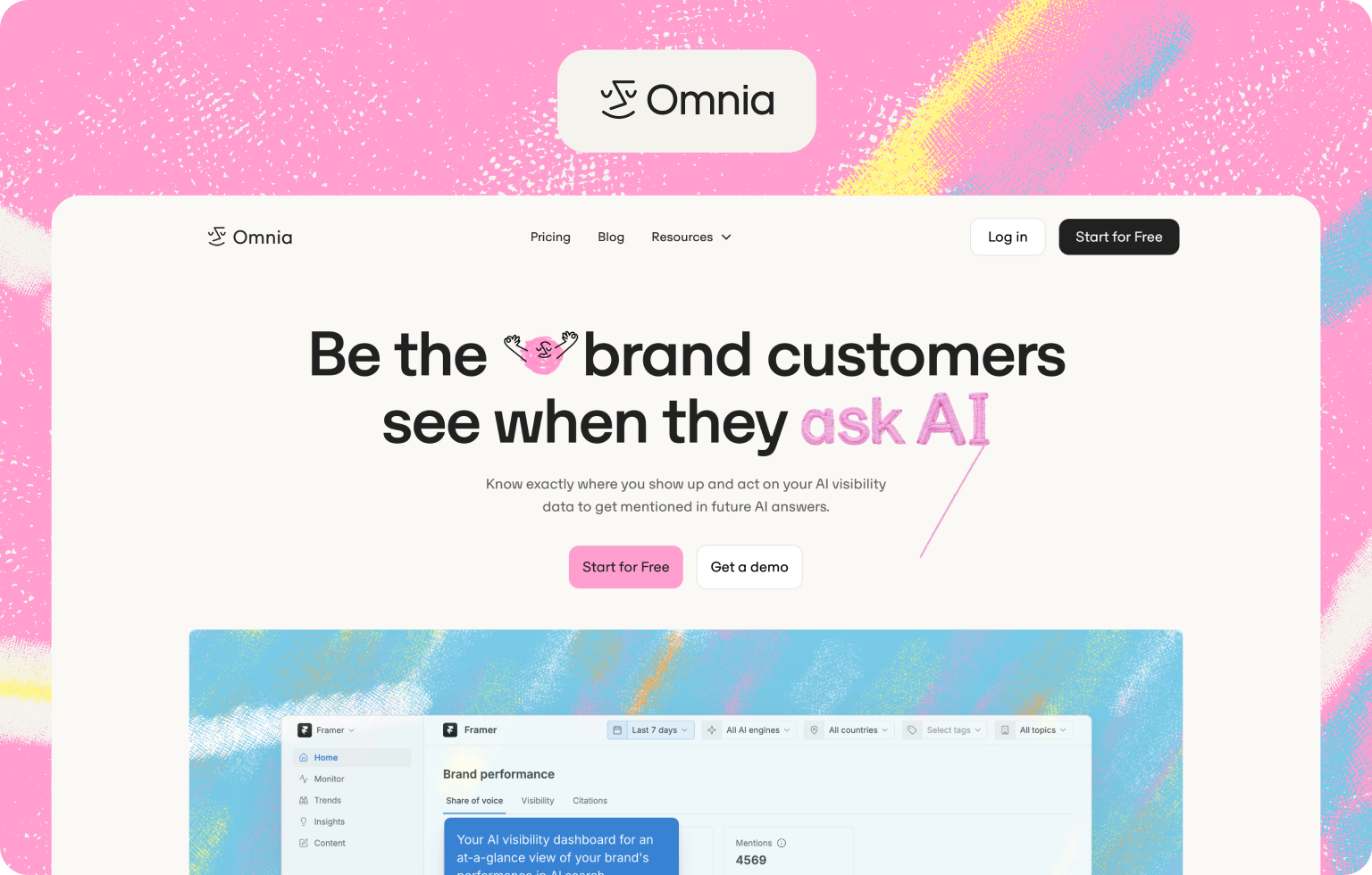
Omnia is an AI search visibility tracking platform that combines country-level monitoring, URL-specific citation intelligence, and feature-level sentiment analysis benchmarked against competitors. Its native action layer turns visibility data into shipped content. That means it delivers content briefs, placement targets, and structured outlines so actionable insights become execution without leaving the platform.
Best for
Founders and heads of growth at startups and scale-ups who need deep visibility into where they appear in AI answers across multiple countries and why competitors get cited at the URL and domain level. They also want feature-level competitive intelligence showing how leading AI search engines evaluate their product on specific dimensions like pricing or user experience compared to rivals.
What it does well
Omnia solves the core problems that force startup teams to look for scrunch AI alternatives. Localized tracking by country runs real browser sessions in actual geographic locations capturing how ChatGPT answers differ in the UK versus Germany versus Spain for identical prompts. Citation intelligence operates at both domain and URL granularity revealing actionable signals about what content to refresh or which URL structure patterns to replicate. Feature-level sentiment analysis reveals where AI platforms praise or criticize your brand on specific dimensions like pricing or customer support, giving clear direction about what perceptions to address rather than generic “negative sentiment” findings requiring guesswork.
Because Omnia tracks 42M+ citations across all four major engines, it surfaces patterns most teams miss. Each engine has a fundamentally different citation budget, trust hierarchy, and volatility profile, so understanding why you're invisible in ChatGPT requires different intelligence than understanding why you're invisible in AI Overviews.
The native action layer delivers workflow-ready outputs — content briefs with specific information gaps to address based on competitor citation analysis, domain placement recommendations showing which trusted publishers to target, and structured outlines informed by top-performing competitor pages.
Key features
- Multi-engine tracking across ChatGPT, Perplexity, Google AI Overviews, and Google AI Mode, powered by a proprietary citation database of 42M+ tracked citations
- Country-level localization via real browser sessions (not API simulation) across 60+ markets
- URL-specific citation extraction showing which competitor pages earn AI references
- Feature-level sentiment analysis benchmarked against competitors on pricing, UX, support dimensions
- Native action layer with content briefs, placement recommendations, and structured outlines
- Competitor share of voice tracking in category prompts with historical trending
- Continuous monitoring with daily refresh capability and alert configuration
- Citation tracking at domain and URL level
Watch-outs
Teams still need to execute the actual writing and publishing as Omnia provides the strategic brief showing what to create and where to place it, but doesn't replace content creators or handle publication workflow itself. Success requires treating AI visibility as an ongoing program with consistent content shipping and measurement cycles over 60-90 days minimum to see meaningful share of voice shifts.
Good fit if
- Deep URL-level citation intelligence and integrated workflow execution for owned content matter more than the broadest possible engine coverage
- You need country-level visibility variations because your product serves multiple geographic markets
- You value citation transparency showing exactly which competitor URLs earn references, feature-level sentiment benchmarking on specific product dimensions, and native action layer
Not a fit if
- You only need classic SEO audits focused on technical site health and keyword rankings without AI answer visibility tracking
- You want one-time snapshot report showing current AI visibility without continuous monitoring investment
- You have no content creation capacity and expect the platform to autonomously write and publish content
When to choose Omnia over Scrunch AI
Choose Omnia when you’re looking to answer why competitors are getting cited instead of you, and what specifically do you need to do about it. Scrunch gives you broad coverage and solid on-site optimization tools. Omnia is built for teams that want to work backwards from competitor citations: which URLs are earning references, which product dimensions AI engines evaluate you poorly on compared to rivals, and what content to create or place to close those gaps — all without coordinating across vendors or add-ons.
Teams can also start immediately with Omnia's free AI Visibility Checker to baseline brand visibility across ChatGPT, Perplexity, AI Overviews, and Google AI Mode before committing to paid tiers.
- Growth: €79/mo
- Pro: €279/mo
- Enterprise: Starting at €499/mo
2. Peec AI
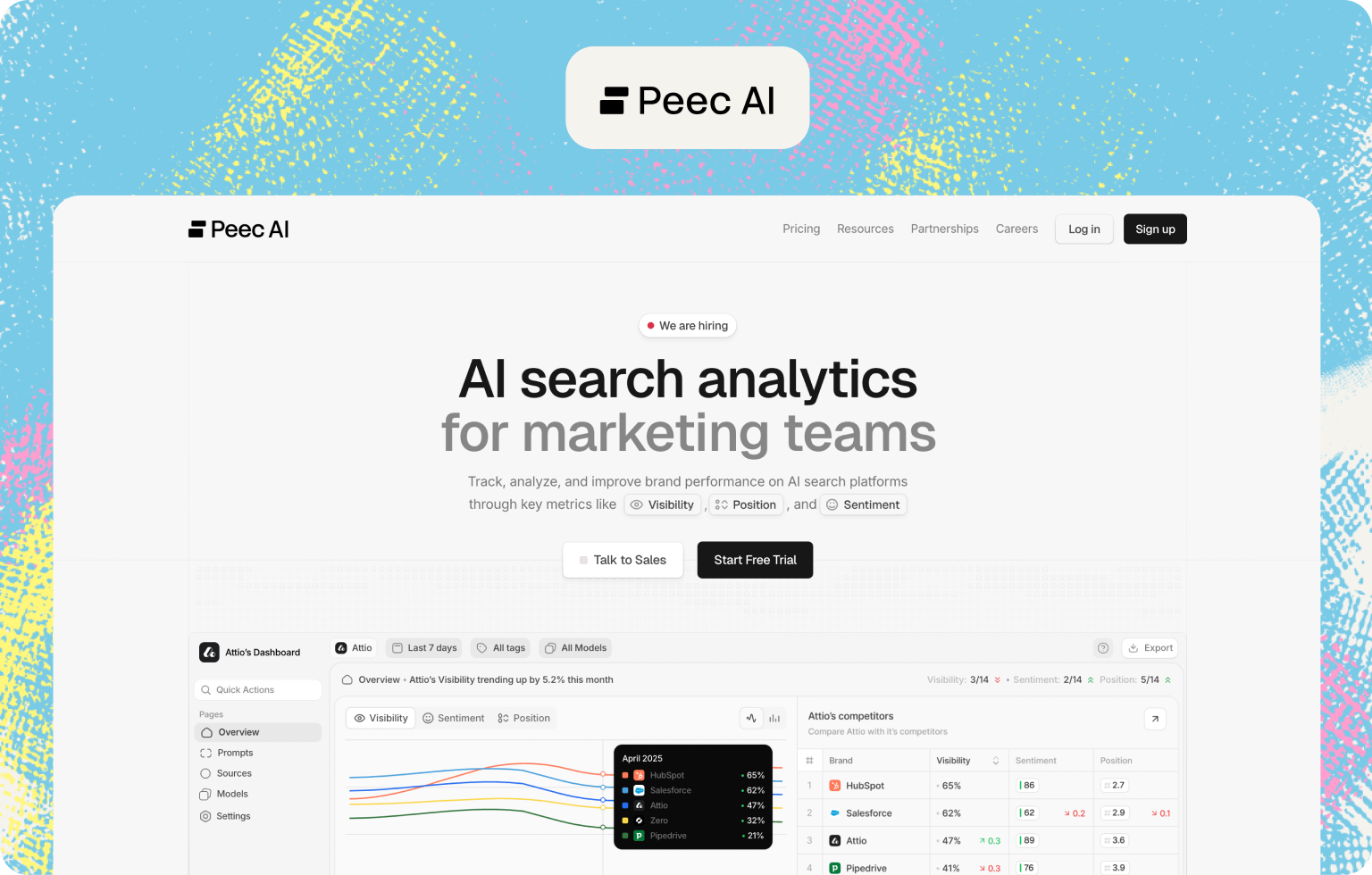
Peec AI combines business intelligence dashboards with AI visibility measurement across major answer engines, positioning itself as a reporting-centric platform.
Best for
Mid-market companies where executive reporting matters more than granular citation analysis, and where stakeholder communication requires polished automated summaries.
What it does well
Peec AI translates prompt and citation data into plain-language visibility summaries that non-technical stakeholders can act on without digging into dashboards. Unlimited seats across all plans keep costs predictable for agencies, and a Looker Studio connector makes it straightforward to pull data into existing client reporting workflows.
Key features
- Multi-engine AI answer tracking with unified visibility dashboard
- Automated trend summaries and business intelligence narratives
- White-label reporting for agencies managing multiple client portfolios
Watch-outs
Peec AI is a monitoring-only platform and the first three plans only give visibility access to 3 models, which may not be enough coverage for those used to Scrunch’s 9.
When to choose Peec AI over Scrunch AI
Choose when executive reporting matters more than citation mechanics depth, when white-label agency workflows are essential, and when your team already has content creation figured out.
Pricing
- Starter: $95/mo
- Pro: $245/mo
- Advanced: $495/mo
- Enterprise: Custom
3. Profound
Profound is an AI search tracking platform covering 10 AI platforms with market-research-level analytics, Conversation Explorer analyzing 400M+ conversations for prompt volume research, white-glove support, and enterprise security features including SOC 2 compliance.
Best for
Enterprise marketing teams needing audit trails, role-based access controls, and vendor security compliance in regulated industries.
What it does well
Profound provides enterprise-grade data governance including detailed audit logging, role-based permissions, and compliance certifications (SOC 2 Type II, GDPR) that reduce procurement friction. Multi-stakeholder reporting generates customized dashboards for different organizational roles.
Key features
- Dedicated Visibility Dashboard that scores brand presence
- Role-based access control and audit logging
- Conversation Explorer analyzing 400M+ conversations for prompt volume and research
Watch-outs
While Profound’s entry-level plan is affordable, it only provides access for one user, one language, and ChatGPT insights only. Users needing more than this might want to consider Profound alternatives.
When to choose Profound over Scrunch AI
Choose Profound when 10 platform coverage matters more than Scrunch's 9 engines. Your budget must support $399+/month minimum for Growth plan with meaningful multi-engine coverage, with white-glove support and market-research-grade analytics justifying the premium over Scrunch's native content optimization features.
Pricing
- Starter: $99/mo
- Growth: $399/mo
- Enterprise: Custom
4. AthenaHQ

AthenaHQ is a multi-engine AI visibility platform combining automated content gap detection through its native Action Center, an agentic AI copilot (Ask Athena) trained on visibility data for natural language queries, and deep citation analysis via Athena Citation Engine (ACE) on enterprise plans.
Best for
Enterprise and growth-stage teams that want expert-pedigree recommendations without enterprise-only pricing. AthenaHQ's $295/mo Self-Serve plan gives access to Action Center guidance and GA4/Shopify integration that most platforms reserve for custom-priced tiers.
What it does well
Where Scrunch requires Enterprise tier for Google AI Overviews and AI Mode access, AthenaHQ includes both in its $295/mo Self-Serve plan alongside an Action Center with prescriptive on-page and off-page recommendations. Ask Athena lets marketers query their visibility data in plain language rather than building custom reports, and unlimited seats mean growing teams don't face per-user cost anxiety as headcount scales. The Athena Citation Engine adds deep citation analysis on enterprise plans for teams needing that granularity.
Key features
- Ask Athena agentic copilot for natural language queries against your visibility data
- GA4, Search Console, and Shopify integration including revenue impact tracking
- Unified GEO score combining citation rate, share of voice, and visibility signals
Watch-outs
Credit limits on the Self-Serve plan can constrain teams running high-volume prompt testing across multiple markets. Deep citation analysis via the Athena Citation Engine and API access both require Enterprise pricing, so teams expecting those features at Self-Serve rates will hit a wall.
When to choose AthenaHQ over Scrunch AI
Choose AthenaHQ when you want Scrunch-level engine coverage with an action layer built in at a comparable price point — the $295/mo Self-Serve plan includes Google AI Overviews, AI Mode, and the Action Center without needing to upgrade to Enterprise. It's a stronger fit than Scrunch for teams where non-technical marketers need to query visibility data directly, or where per-seat pricing would become a constraint as the team grows
Pricing
- Self-Serve: $295/mo
- Enterprise: Custom
5. Otterly AI
Otterly AI positions as a budget-friendly AI visibility tool offering foundational prompt tracking and sentiment analysis across major AI engines.
Best for
Bootstrapped startups and solo operators who need to establish baseline AI visibility before committing to a more comprehensive platform.
What it does well
Otterly gets you tracking faster and cheaper than almost anything else in the category. Entry plans start at $29/mo, setup is minimal, and the interface doesn't require onboarding. It covers 5 major engines, with sentiment analysis, share of voice monitoring, and email alerts for visibility shifts. For teams validating whether AI visibility is worth investing in before spending $250+/mo, it's a logical starting point.
Key features
- Sentiment analysis and competitor share of voice monitoring
- GEO Audit tool analyzing 25+ on-page factors with optimization recommendations
- Multi-client workspace management with automated weekly reports
Watch-outs
Citation data stays at a surface level, meaning you can see that competitors are mentioned more, but not which specific URLs are earning those citations or why. There's no action layer, so Otterly tells you where the gaps are without helping you close them. Teams that outgrow it tend to need URL-level citation intelligence and content briefs. If you're already there, check out our roundup of Otterly AI alternatives for platforms that go further.
When to choose Otterly AI over Scrunch AI
Choose Otterly when budget is the primary constraint and you need proof of concept before investing in a platform at Scrunch's price point. As a low-risk entry point, it's hard to beat at $29/mo.
Pricing
- Lite: $29/mo
- Standard: $189/mo
- Premium: $489/mo
- Enterprise: Custom
6. AirOps
AirOps AirOps is an AI visibility and workflow automation platform tracking 5 AI engines with integrated content operations. It’s designed for growth teams wanting to move from AI visibility insights to automated content fixes without switching tools.
Best for
Growth teams and content marketers who need visibility tracking and high-volume content production in a single platform, where publishing velocity matters as much as citation intelligence.
What it does well
AirOps is the strongest option on this list for teams where content production is the bottleneck. The workflow builder connects visibility gaps directly to content creation. Brand Kit and Knowledge Bases keep output consistent with your positioning, and the Influence Score surfaces which publishers drive the most citation impact so outreach efforts are targeted rather than scattered.
Key features
- Integrated visibility monitoring across 5 engines
- Visual workflow builder connecting gap identification to content production
- Page360 analytics unifying AI citations with Google Search Console and GA4 data
Watch-outs
The workflow builder has a real learning curve, it’s not a plug-and-play monitoring tool. Pricing jumps sharply from Solo ($200/mo) to Pro ($2,000/mo), with limited middle ground for teams that need more than entry-level but can't justify the Pro price.
When to choose AirOps over Scrunch AI
Choose AirOps over Scrunch when content production volume is your primary lever for improving AI visibility and you want monitoring and publishing in one place.
Pricing
- Solo: $200/mo
- Pro: $2,000/mo
- Enterprise: Custom
7. Semrush
Semrush is an established SEO platform offering AI visibility tracking across 6 AI answer engines through its AI Visibility Toolkit add-on.
Best for
SEO teams already running Semrush who want to add AI visibility monitoring without managing a separate vendor or rebuilding their reporting stack.
What it does well
Semrush's AI Visibility Toolkit earns its place on this list through integration depth rather than GEO-native features. Teams already tracking keywords in Semrush can map those directly to AI monitoring without rebuilding prompt sets from scratch, and the unified dashboard surfaces whether traditional ranking improvements are translating into AI citation gains.
Key features
- Citation tracking at domain and URL level with sentiment analysis
- 300 daily AI queries with position tracking integration
- Content Toolkit for LLM-optimized content creation
Watch-outs
The AI Visibility Toolkit is $99/mo standalone but requires a base Semrush subscription from $199/mo, making the real entry point around $298/mo, which is more than Scrunch's Core plan. AI monitoring is clearly secondary to Semrush's core SEO product, so citation depth and action layer sophistication trail purpose-built GEO platforms.
When to choose Semrush AI Visibility Toolkit over Scrunch AI
Semrush is a strong Scrunch AI alternative when you're already paying for the platform and adding $99/mo is a simpler decision than migrating to a dedicated GEO tool. If AI visibility is one of ten things your team tracks rather than the primary focus, Semrush's integration makes that tradeoff sensible.
Pricing
- Standalone: $99/mo with the option for add-ons
8. Ahrefs
Ahrefs is an SEO platform with massive web index infrastructure tracking 6 AI models through Brand Radar, featuring a 264M+ prompts index derived from real searches.
Best for
SEO-first teams already in the Ahrefs ecosystem who want competitive AI visibility benchmarking at scale without setting up a separate platform.
What it does well
Ahrefs Brand Radar's core advantage is data scale, with 264M+ prompts derived from actual search queries rather than synthetic scenarios. That means the competitive benchmarking reflects real user behavior rather than curated prompt sets. Zero setup enables instant research on any brand or competitor without configuration, and the integration with Ahrefs' backlink index connects AI citation patterns directly to off-site authority signals
Key features
- Unlimited projects for multi-brand and multi-competitor analysis
- YouTube, TikTok, and Reddit visibility tracking
- Site Explorer AI citations module with domain and URL-level filtering
Watch-outs
Brand Radar is a research tool, not a proper workflow tool. There's no action layer, content briefs, or optimization recommendations. Pricing is steep relative to what you get: $199/mo per individual platform or $699/mo for all platforms
When to choose Ahrefs Brand Radar over Scrunch AI
Choose Ahrefs Brand Radar over Scrunch when competitive intelligence at scale matters more than monitoring depth or execution support — it's the strongest tool on this list for benchmarking AI visibility across a large competitor set quickly. If your team already runs Ahrefs for SEO and wants AI visibility layered into the same workflow without a new vendor, the integration logic holds.
Pricing
- Individual platforms: $199/mo per index
- All AI platforms: $699/mo
9. BrightEdge
BrightEdge is an enterprise-grade SEO and content performance platform tracking 3 AI search engines through its AI Catalyst module featuring proprietary Generative Parser™ technology that detects, extracts, and trend-analyzes AI-generated answer blocks.
Best for
Fortune 1000 marketing departments already running BrightEdge who need AI visibility monitoring added to their existing stack.
What it does well
BrightEdge AI Catalyst's value is almost entirely about consolidation. If your organization is already deployed on BrightEdge, AI visibility monitoring comes bundled without additional cost or vendor onboarding. The Generative Parser proprietary technology detects and extracts AI-generated answer blocks across platforms, and the unified dashboard means traditional SERP performance and AI citation trends sit alongside each other for the same content.
Key features
- BrightEdge Copilot for automated prompt research from existing site content
- Persona development and buyer journey analysis
- Industry-specific citation benchmarks across nine verticals
Watch-outs
BrightEdge can’t be purchased standalone . If you're not already a customer, this isn't an option. Engine coverage is limited to 3 platforms, which trails every other tool on this list.
When to choose BrightEdge over Scrunch AI
Choose BrightEdge over Scrunch only if your organization is already a BrightEdge customer and InfoSec or procurement timelines make adding a new vendor impractical.
Pricing
- No published pricing
10. GetCito
GetCito is a dual-model GEO platform offering both an open-source self-hosted tool (MIT license) and managed service tiers tracking 9 LLMs on the enterprise tier and 4 on the base plan.
Best for
Developer-led startups where open-source transparency is non-negotiable, or content-lean teams that need done-for-you execution rather than a platform to operate themselves.
What it does well
GetCito occupies a unique position on this list as it's the only tool offering a fully open-source codebase under MIT license. Technical teams can inspect exactly how tracking works, self-host without subscription costs, and pay LLM API costs directly rather than platform margins. For teams at the opposite end of the spectrum, the paid plans bundle a human execution team covering strategy, writing, schema implementation, technical GEO analysis, and forum engagement — which is closer to a managed service than a SaaS tool.
Key features
- Human execution team bundled with paid plans covering strategy, writing, and technical GEO
- AI Visibility Checker and Competitor Radar
- Crawlability Clinic for technical AI readiness analysis
Watch-outs
The prompt limits on paid plans are severe. Growth at $299/mo includes just 10 prompts, Scale at $499/mo includes 20. That's a significant constraint for any team running meaningful monitoring volume. If you're evaluating GetCito primarily as a monitoring platform rather than for its open-source transparency or managed service model, the prompt limits alone make it hard to justify against other Scrunch AI alternatives.
When to choose GetCito over Scrunch AI
Choose GetCito over Scrunch when code auditability is a genuine requirement rather than a preference, when free self-hosting eliminates platform costs that matter at your current stage, or when your content capacity gap is large enough that a bundled human team is more valuable than a platform you'd need to operate yourself.
Pricing
- Self-Host: Free
- Growth: $299/month
- Scale: $499/month
- Enterprise: Custom
How to choose the top Scrunch AI Alternative (scoring rubric + checklist)
When evaluating the best Scrunch AI alternatives for your team, use this standardized scoring framework to compare platforms objectively. Here’s evaluation criteria and their suggested weights.
Why Omnia is the right fit for founders and heads of growth evaluating Scrunch AI alternatives
The teams that switch to Omnia from Scrunch typically aren't unhappy with Scrunch's AI search monitoring. Rather, they've hit the ceiling on citation intelligence. Scrunch offers solid engine coverage and native on-site optimization through Content Gaps, Optimizer, and AXP, with optional Stacker integration for teams investing in earned media. That's a legitimate stack for the right team.
Where it falls short is citation mechanics depth. Knowing you're invisible in ChatGPT is different from knowing which competitor URLs are earning those citations, where rivals outperform you on specific product dimensions like pricing or UX, and what content to create or place to close those gaps.
For founders and heads of growth on lean teams measured on shipped results, that difference matters. Book a demo or start with a 14-day free trial on Omnia's Growth plan to see your current citation performance across major AI platforms.
FAQs
What are the main reasons people look for Scrunch AI alternatives?
Teams typically switch when they need deeper citation intelligence showing which competitor URLs earn AI mentions rather than just domain-level trends, when they want AI visibility workflow tools that turn gap analysis into actionable content briefs instead of monitoring-only dashboards, or when they need URL-level tracking to understand exactly why competitors appear in relevant AI responses while their brand stays invisible. Scrunch offers solid engine coverage and native on-site optimization, but teams prioritizing citation transparency and integrated execution layers often need platforms built specifically for that depth.
Which Scrunch AI alternative is best for a startup with a small marketing team?
Omnia is the strongest fit for lean startup teams because it delivers deep visibility analytics including URL-level citation tracking, feature-level competitor benchmarking, and a native action layer that turns ai visibility data into workflow-ready content briefs and placement targets. For bootstrapped teams validating whether ai search visibility tracking is worth investing in before committing $250+/month, Otterly AI offers a low-risk $29/month entry point with basic monitoring across 5 engines.
How do I know if my team needs an action layer or if monitoring is enough?
If your goal is to fix visibility gaps rather than just measure them, you need an action layer that connects ai search visibility tracking directly to execution — showing which specific competitor pages earn citations, what content angles are missing, and where to place that content for maximum impact. Monitoring-only platforms tell you “you're invisible in ChatGPT for pricing comparison prompts” without guidance on what to publish or where. Action layer tools deliver keyword research insights, gap analysis, and workflow-ready briefs that turn ai mentions intelligence into shipped content.
What's the difference between tracking AI visibility and improving it?
Tracking AI search visibility means measuring where your brand appears in AI search results across engines like ChatGPT, Perplexity, and Google AI Overviews through scheduled prompt execution and competitor benchmarking. Improving it requires AI visibility tools that go beyond measurement to deliver deep visibility analytics at the URL level, show which sources AI engines cite when recommending competitors, and provide actionable recommendations (content briefs, schema markup, placement targets) that close visibility gaps.