


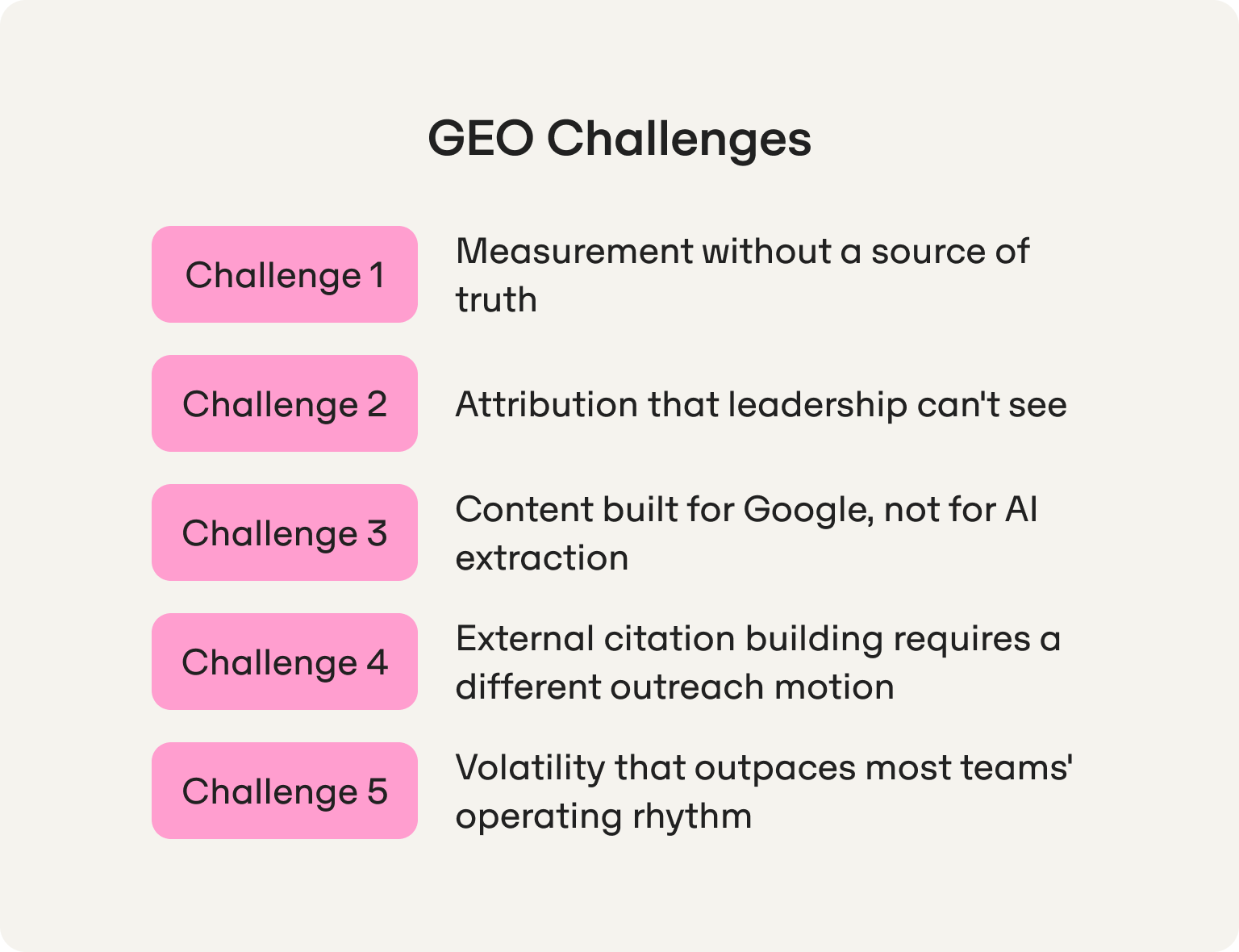
GEO is not technically complex. What makes it hard is the combination of probabilistic measurement, invisible attribution, slow citation building, and a channel that shifts faster than most SEO teams' reporting cycles. The brands stalling on GEO are not stalling because the strategy is wrong — they're stalling because the implementation assumptions are off. This article names the five specific challenges where GEO implementations break down, what Omnia's citation data reveals about each one, and what the most recent developments in AI search mean for teams navigating them now.
Most GEO implementations fail quietly. Not with a visible error or a clear decision to stop — but with a slow drift from "we're working on it" to "we haven't looked at those numbers in a while" to "let's revisit this next quarter."
The cause is rarely strategic. The strategy is usually sound. What breaks is the implementation — specifically, the set of assumptions teams bring from SEO that do not transfer to GEO. The measurement cadence is wrong. The content restructuring scope is underestimated. The external citation work is deprioritized in favor of publishing. The attribution model is borrowed from a channel that produces click data, applied to a channel that doesn't.
This article is for the team that has already decided GEO matters. It names the five specific places where implementations stall, what Omnia's proprietary citation data reveals about each challenge, and what the current GEO landscape requires of teams serious about making it work.
The current state of GEO — what's changed and what it means for implementation
Before addressing the challenges, it is worth orienting to what the GEO landscape looks like right now — because several of the challenges are getting harder, not easier, as the channel matures.
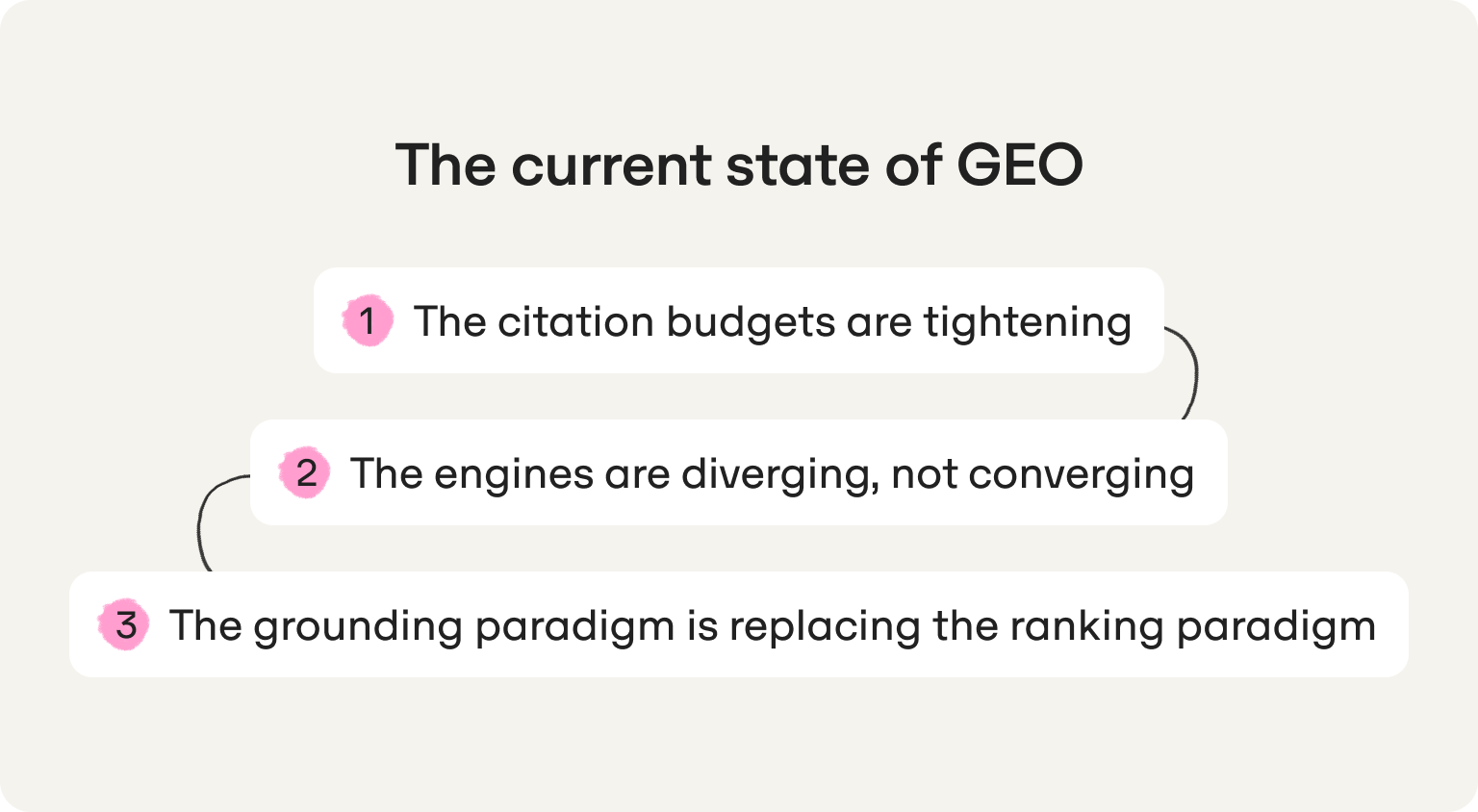
The citation budgets are tightening — and diverging by engine
Based on Omnia's proprietary citation database tracking 42M+ citations across four AI engines, the direction of travel is clear: citation budgets are contracting in two of the three major independent engines while expanding in one. ChatGPT averages just four citation slots per answer — down approximately 30% since mid-2025. Perplexity has declined 36% from its November 2025 peak. Google AI Mode is the only engine actively expanding, up 27% in five months.
The practical implication for implementation: the window for building citation authority in ChatGPT and Perplexity is narrowing. Brands that are not yet appearing in those engines are trying to break into a more selective system than existed 12 months ago. Teams that have been "planning to start GEO" are starting from a harder position than teams that began building citation authority a year ago.
The engines are diverging, not converging
Based on Omnia's citation data, as analyzed by Kevin Indig in his Growth Memo across 3.7 million citations: only 2.37% of cited URLs appear across all three engines for the same prompt. 91% appear in only one. ChatGPT's citation pool overlaps only 50–55% with Google's engines. Wikipedia is 40x more cited in ChatGPT than in AI Overviews. YouTube dominates Google's engines and Perplexity but barely registers in ChatGPT.
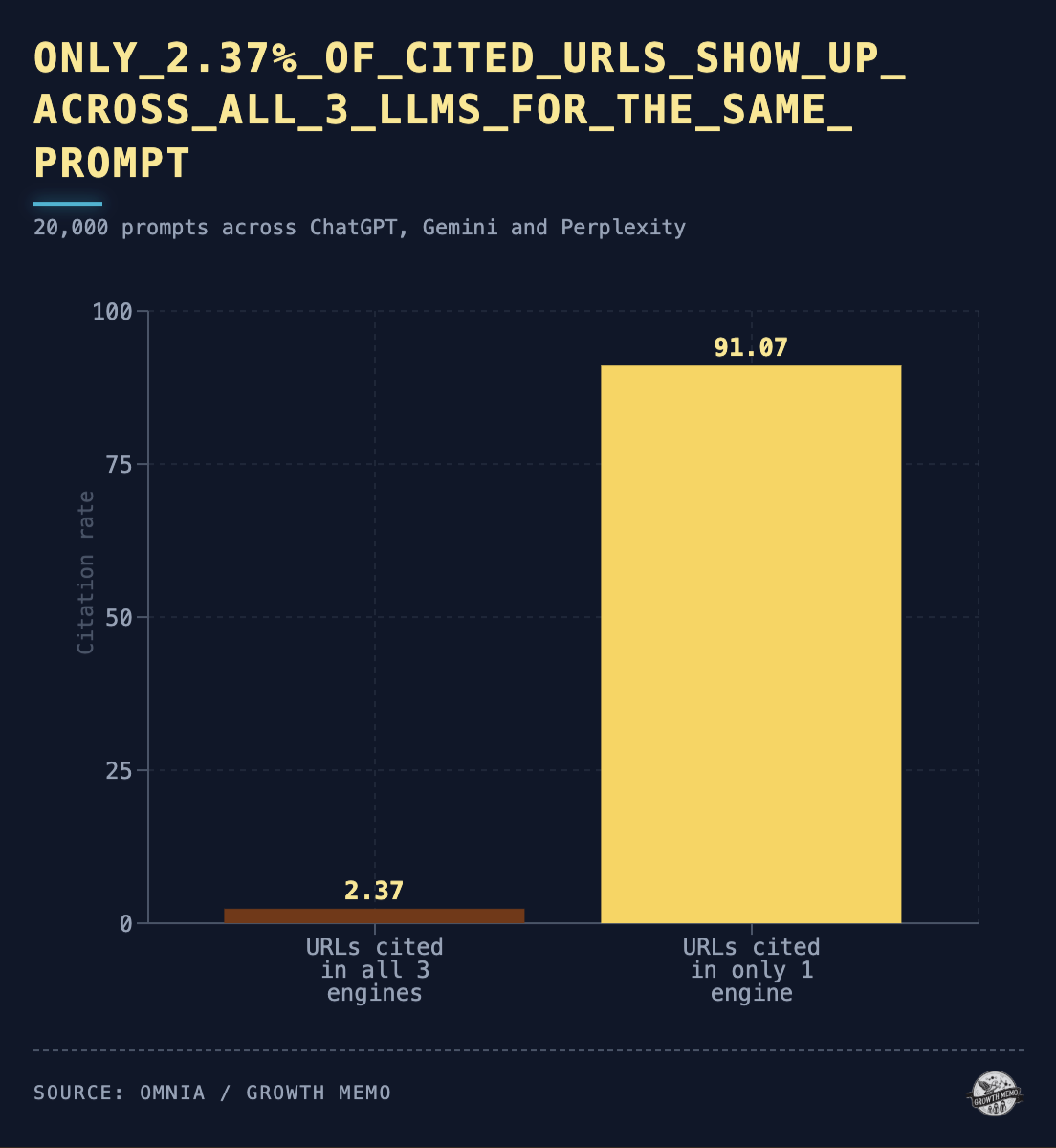
The multi-engine optimization matrix required to address this divergence is more complex than the single-engine playbook most teams budget for. A content and citation strategy built for Google's surfaces will not produce ChatGPT visibility. A strategy built for ChatGPT will not automatically translate to AI Mode. Each engine requires a tailored approach — which multiplies the implementation workload before a single piece of content is published.
The grounding paradigm is replacing the ranking paradigm
In May 2026, Microsoft's Bing team published a framework redefining what the search index is for in the AI era — as Kevin Indig summarized in Growth Intelligence Brief #18. The optimization target is no longer "rank for a keyword" but "provide groundable information: discrete facts with clear provenance that a model can responsibly cite." The new eligibility funnel is crawl, parse, retrieve, and a failure at any stage means the content doesn't get cited, regardless of how well it ranks in traditional search.
Teams still building GEO strategy around keyword rankings are solving the wrong problem. Google's published AI optimization guide confirms that crawlability, indexability, and content accuracy are the foundational requirements for its surfaces — and that no special schema or markup is required to appear in AI features. The standard has shifted from optimization to eligibility, and most GEO implementations haven't caught up.
Challenge 1 — Measurement without a source of truth
GEO produces no equivalent of Google Search Console. There is no authoritative, real-time data source that tells you how often your brand appears in AI answers, which pages are being cited, or how you compare against competitors across your category prompts. What teams can measure is probabilistic — the same prompt produces different outputs across sessions, users, geographies, and retrieval modes.
This is not a limitation that will be fixed by a platform update. It is structural to how AI engines work. Single-prompt spot checks are not data points — they are one observation from a probabilistic system. And monthly reporting cadences, borrowed from SEO, miss most of the signal in a channel where citation patterns shift in days.
Based on Omnia's citation data, ChatGPT changes its top-cited domain 92% of the time week over week. AI Overviews change their top-cited domain 81.5% of the time — making them the most stable of the four engines and the most reliable starting point for teams building a GEO measurement baseline. Tracking brand and competitor mentions in AI Overviews is the most accessible entry point into systematic GEO monitoring precisely because the signal-to-noise ratio is higher there than in ChatGPT. Visibility volatility at this level means a monthly report showing a "stable" visibility number is almost certainly averaging across significant weekly variation — some of which represents real competitive movement that went undetected and unaddressed.
The solution is not a better tool — it is a different measurement infrastructure. Five metrics constitute a reliable GEO measurement system: mention rate, citation rate, share of voice, position in answer, and narrative accuracy. Each requires a structured prompt library, and not ad hoc testing, run on a weekly cadence with rolling four-week averages to smooth the prompt variability that makes individual-session data unreliable. The full KPI framework and ownership structure is covered in the ChatGPT ranking playbook.
Diagnosis is only valuable when it produces action. A measurement system that produces dashboards without a prompt library, an ownership layer, and an action log is not a GEO measurement system. It is a reporting exercise.
Challenge 2 — Attribution that leadership can't see
AI-driven brand appearances rarely produce trackable clicks in standard analytics. A buyer who asks ChatGPT which tool to use, receives a three-brand shortlist, and visits one of those sites arrives via direct traffic or a branded search — not a tagged AI referral. The GEO contribution to that buyer's decision is invisible in every standard reporting stack.
Writing in Search Engine Land, Jason Barnard describes this through the concept of the delegation boundary, the line between what a user does for themselves and what they hand to an AI engine. As that boundary moves earlier in the buyer journey, AI engines make upstream decisions and shortlisting options, filtering by criteria, and surfacing recommendations before any trackable traffic event occurs. Attribution models built around click events miss the entire decision that shaped the consideration set before the click happened.
This creates a specific leadership problem. When a marketing lead presents GEO results as GA4 session counts, the channel looks invisible. When they present it as share of voice movement against named competitors across a defined prompt set — before and after specific content or citation actions — it becomes legible. The proof of GEO is not click data. It is competitive AI visibility change over time, connected to specific actions with documented hypotheses and retest dates.
The framing that works with leadership: GEO is brand presence measurement at the moment of AI-assisted decision-making, expressed as share of voice rather than traffic. The methodology for producing that proof — including the 60-day before/after snapshot — is covered in the GEO measurement framework for SEO-native teams.
If your leadership team is evaluating GEO against GA4 session targets, they are applying the wrong measurement framework to the channel and it is worth reframing what proof looks like before the program is evaluated against it.
Challenge 3 — Content built for Google, not for AI extraction
Most teams entering GEO have an existing content library built for keyword rankings: long-form posts structured around search intent, headers optimized for featured snippets, and statistics buried in narrative paragraphs. This content is not GEO-ready. The gap between SEO-optimized and AI-extractable is consistently larger than content teams expect when they first audit it.
The grounding framework makes the problem concrete. Based on Microsoft's Bing team's published framework — as Kevin Indig analyzed in Growth Intelligence Brief #18 — AI grounding requires content that passes a three-gate test: crawlable, parseable, and retrievable. Most SEO content fails at the parse gate. Key claims are embedded in narrative prose rather than presented as distinct, attributable facts. Critical definitions appear in the middle of long paragraphs rather than as standalone statements AI engines can extract directly. The answer extraction rate — how reliably AI engines can pull a specific claim from a page — is low for most content built to SEO standards, not because the content is poor, but because it was structured for human reading rather than model retrieval.
Four restructuring moves close the gap without a full content rebuild: an entity statement in the opening paragraph that defines what your brand is, who it serves, and what problem it solves; statistics presented as standalone attributable claims with named sources and direct links rather than embedded in prose; direct answers to named questions in the first 300 words, before contextual elaboration; and author bylines, publication dates, and visible source links as provenance signals that allow AI engines to attribute claims responsibly. The content brief framework in the small business guide covers each element in detail.
Based on Omnia's citation data, as analyzed by Kevin Indig's Growth Memo across 4.1 million URL appearances, guides and tutorials achieve 2.3% cross-engine overlap vs homepages at just 1.1%. The format SEO teams typically deprioritize — explanatory, question-led content — is the format with the best citation portability across AI engines. The content SEO teams optimize hardest — product pages, homepages, and commercial landing pages — is the least citable format in AI answers for commercial prompts.
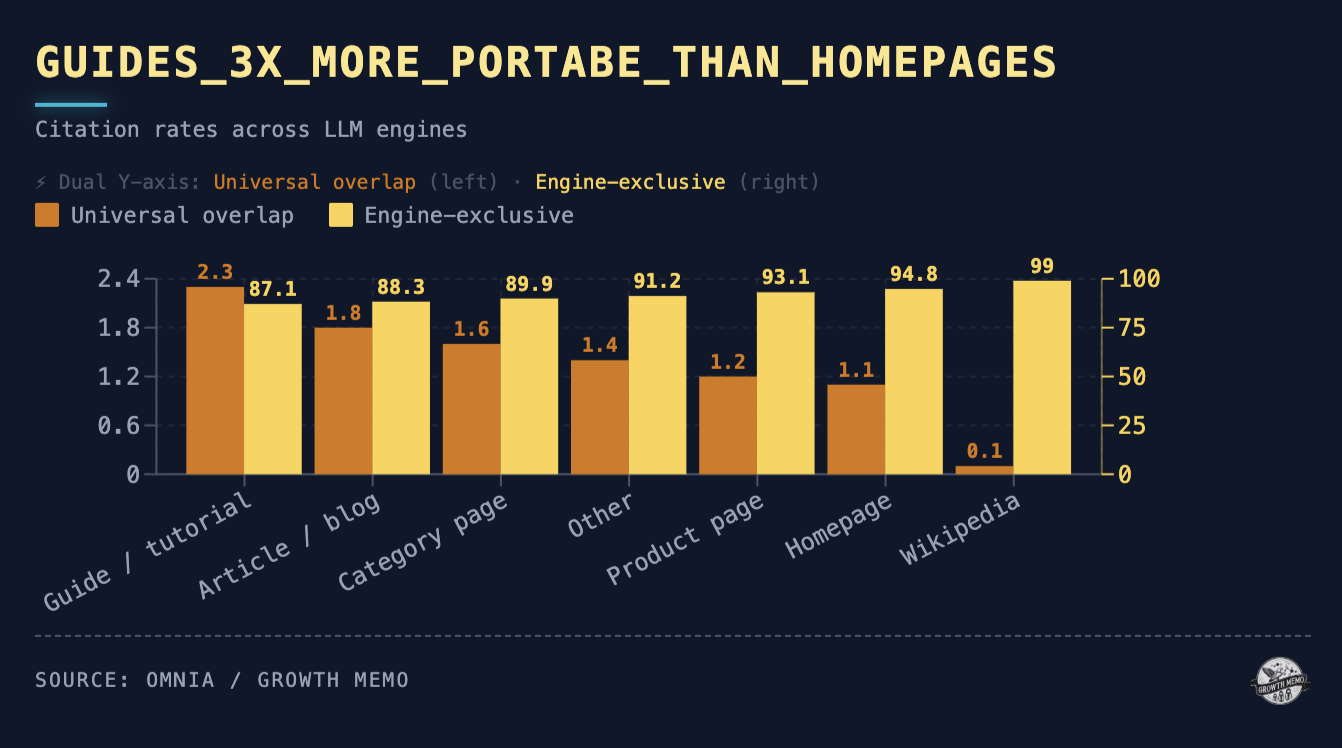
The content restructuring challenge is not a one-time sprint. It is an ongoing quality bar that compounds with every piece published to the wrong structural standard.
Challenge 4 — External citation building requires a different outreach motion
This is the challenge most teams discover too late — after three months of consistent content publishing with no movement in mention rate.
GEO citation authority is built on the sources AI engines trust for your category: review platforms, industry directories, editorial publications, and community sites that appear consistently in AI answers for your target prompts. These are not the same sources SEO link building campaigns target. They require a different outreach motion — profile building on review platforms rather than link acquisition, editorial placement for authority rather than guest posting for backlinks, and analyst or directory inclusion rather than domain authority chasing.
Based on Omnia's citation data across commercial prompt categories, third-party sources consistently dominate ChatGPT citations over vendor blogs for "best" and "alternatives" prompt types. Owned vs earned mentions behave differently in GEO than in SEO: owned content (your blog, your website) is necessary for technical eligibility but insufficient for citation authority in commercial contexts. Earned presence on sources AI engines already trust is the primary lever — and it is the one most teams deprioritize because it feels less like "content work."
The specific failure pattern: teams that start with content creation because it feels productive, and discover six to eight weeks later that mention rate hasn't moved — not because the content was poor, but because the citation confidence of their own domain was never high enough in the first place. The diagnostic is straightforward: if your mention rate is flat after six weeks of consistent content publishing, the problem is almost certainly external citation, not content quality.
The three-track external citation approach — review platform presence, editorial coverage in publications AI engines cite for your category, and directory or analyst inclusion — is covered in detail in the complete GEO guide. The starting point is always citation intelligence: identifying which specific domains appear when AI engines recommend competitors in your category, before deciding where to build presence.
ChatGPT averages four citation slots per answer, and that number is declining. Every slot a competitor occupies through a trusted external source is a slot unavailable to your brand. AI competitive saturation in citation-heavy categories is real and compounding. External citation building is competitive displacement — and the teams that start later will pay a higher entry cost.
Challenge 5 — Volatility that outpaces most teams' operating rhythm
GEO is faster-moving than SEO in every dimension that matters for implementation.
Citation patterns shift in days, not months. Answer content changes between sessions on the same day. Citation budgets are declining in two of three major engines. Competitive citation positions can shift significantly within a single week. And the geographic variation in citation patterns means that a brand's AI visibility in the US and UK can diverge materially in the same week without any action taken by the brand or its competitors.
Based on Omnia's citation database: ChatGPT citation stability is 8.1% week over week — meaning the top-cited domain changes 92% of the time. AI Overviews are more stable at 18.5%, but still change their top-cited domain more than 80% of the time weekly. Perplexity's citation budget has declined 36% from its November 2025 peak. These numbers describe a channel that requires weekly measurement, monthly strategic review, and quarterly entity audits — not the quarterly reporting cycles and annual content calendars most SEO programs run on.
The specific operational mismatches between standard SEO rhythms and GEO requirements:
- Monthly reporting hides weekly citation pattern shifts that, if caught early, could be addressed with targeted content or citation actions before they compound into a competitive gap.
- Quarterly content audits miss content freshness failures — outdated pricing pages, missing integrations, superseded comparison claims — that actively contribute to narrative inaccuracy in AI answers.
- Annual link building campaigns cannot respond to citation pattern shifts that happen in weeks, not quarters.
- Single-market testing misses the geographic variation that means a brand's US and UK AI visibility can diverge significantly from the same actions.
The minimum viable GEO operating rhythm: a weekly prompt library run of 30 minutes across your core commercial prompt clusters, a monthly citation source audit to identify which new domains have entered your category's citation fingerprint, a quarterly entity accuracy review to confirm AI engines are describing your brand correctly, and an action log that connects every observed signal to a specific hypothesis, a named action, a due date, and a logged outcome.
Prompt variability impact means a single-week anomaly is not a signal — it is noise. A four-week downward trend is a signal. The operational goal is a measurement cadence fast enough to detect genuine movement before it compounds, and disciplined enough not to react to every session-level fluctuation. The full testing cadence and ownership framework is covered in the ChatGPT ranking playbook.
Volatility is not a reason to avoid GEO. It is the reason to build systematic monitoring before building content — because without it, you cannot distinguish a genuine visibility decline from normal prompt variability, and you cannot connect content or citation actions to the visibility changes they actually produced.
What the data says about where GEO implementations succeed
The five challenges above are real. They are also navigable — and the pattern of what makes implementations succeed is consistent across the brands that have done it.
Based on Omnia's citation data and the outcomes visible in Omnia's customer base, GEO implementations that produce measurable results within 60 to 90 days share three characteristics: they start with citation intelligence rather than content production, they run weekly measurement against a defined prompt coverage map from day one, and they target a narrow set of five to ten prompts rather than broad category coverage.
PuntoSeguro — a 10-person Spanish life insurance distributor — became the #1 life insurance brand in Spain across AI engines in three months, outranking corporations with 300 times their budget. Their weekly effort: one new article, three to four existing ones refreshed. The result came from targeted citation building on the specific sources AI engines trust for life insurance prompts in Spain — not from content volume.
Iberia Cards achieved +18 percentage points vs their main competitor on strategically critical queries and the #1 position across all five key Avios prompts on every AI engine tracked. The result came from identifying which specific sources AI engines cited for high-intent Avios prompts and redirecting existing content investment to match those citation patterns — not from publishing more content.
The pattern in both cases is identical: the implementation succeeded because it started with citation intelligence rather than content production. The citation gap was diagnosed first. The content and outreach actions followed the data. The measurement system was in place before the first action was taken.
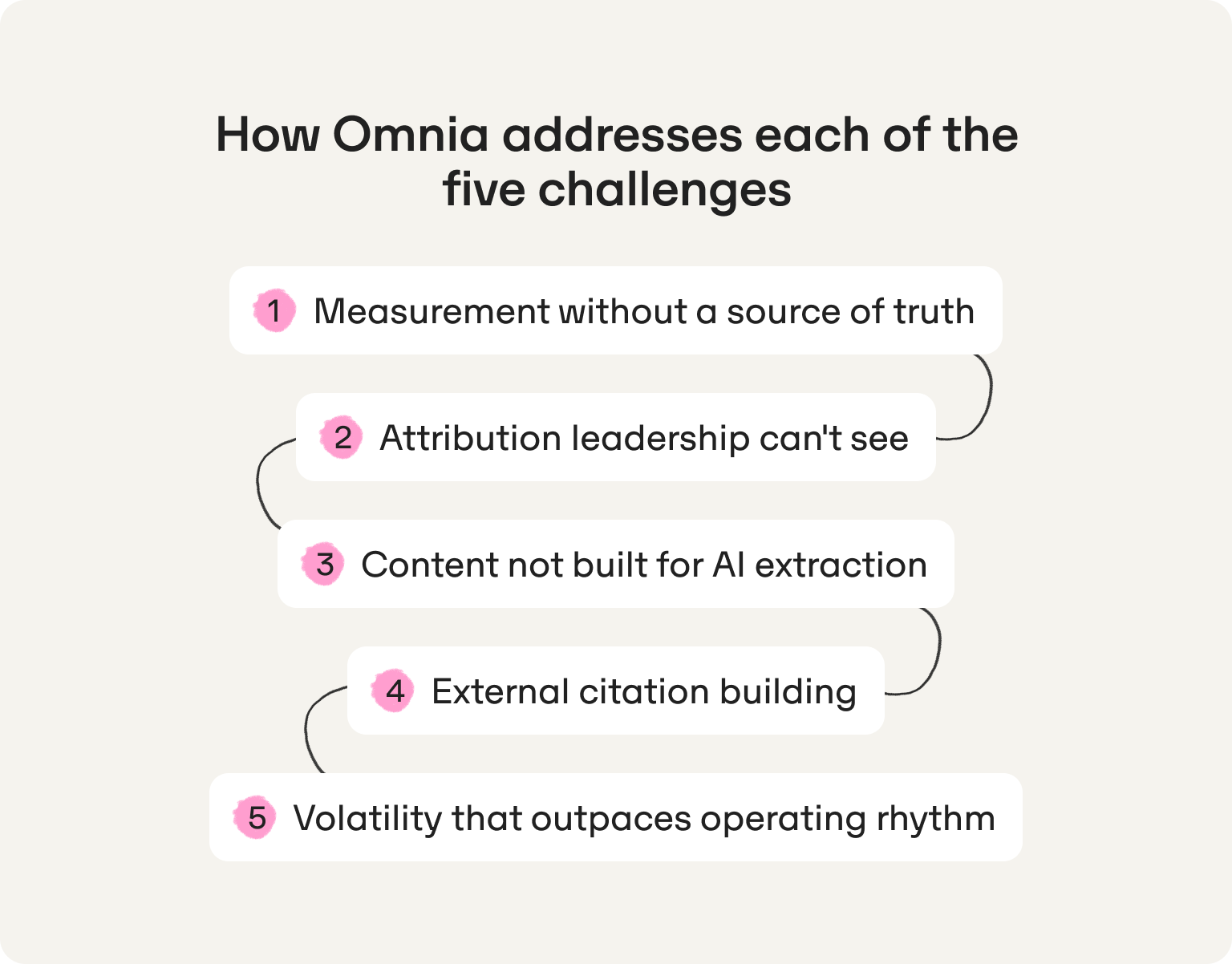
How Omnia addresses each of the five challenges
The five challenges above require five specific capabilities — not a general AI visibility platform, but a system designed around the specific failure modes GEO implementations hit in practice.
Measurement without a source of truth: Omnia tracks your brand's presence across ChatGPT, Perplexity, Google AI Overviews, and AI Mode daily — measuring mention rate, citation rate, share of voice, and position in answer by engine and by market. Weekly trend data replaces the session-level noise of manual prompt checking. The AI visibility score gives leadership a single composite metric for directional reporting, without losing the engine-level granularity that drives tactical decisions.
Attribution leadership can't see: Omnia's before/after snapshot methodology tracks share of voice movement against named competitors across a defined prompt set, connected to specific content and citation actions with documented hypotheses and retest dates. The attribution framework is built around what GEO can actually prove — visibility movement, not click data.
Content not built for AI extraction: Omnia's citation intelligence reveals which specific pages and domains AI engines are citing in your category for each target prompt — producing a restructuring priority list anchored in actual citation behavior rather than a general content audit based on SEO signals.
External citation building: Omnia's prompt-level citation analysis surfaces the exact domains generating citations for each of your target prompt clusters — eliminating the guesswork from outreach prioritization and telling you which two or three external sources to pursue before publishing another piece of content.
Volatility that outpaces operating rhythm: Omnia's weekly prompt monitoring and rolling trend tracking turns volatility from a liability into a signal. Citation pattern shifts that would be invisible in monthly reporting surface as weekly trend movements — early enough to act on before competitors compound their advantage. The AI monitoring workflow runs in the background so your team spends time on actions, not on manual prompt checking.
Start your 14-day free trial on the Growth plan → No credit card required.

FAQs
What are the biggest challenges in implementing generative engine optimization?
The five most consistent implementation barriers are: measurement without a reliable source of truth, attribution that standard analytics can't capture, content libraries built for Google rather than AI extraction, external citation building that requires a different outreach motion than SEO link building, and a channel volatility that outpaces most teams' reporting and operating cadences. Most implementations stall not because the strategy is wrong but because one or more of these assumptions borrowed from SEO doesn't transfer to GEO.
Why is GEO measurement harder than SEO measurement?
SEO produces deterministic outputs — a keyword has a SERP position that is observable and stable enough to track monthly. GEO produces probabilistic outputs — the same prompt generates different answers across sessions, users, geographies, and retrieval modes. There is no GEO equivalent of Google Search Console. Reliable GEO measurement requires a structured prompt library run weekly across a consistent set of commercial prompts, with rolling four-week averages to smooth session-level variability. Single-session spot checks produce noise, not trend data.
How long does it take to see results from a GEO implementation?
Citation building on external sources AI engines already trust — review platforms, industry directories, editorial publications — can produce measurable mention rate movement within two to four weeks. Content-driven gains take longer, typically six to eight weeks before AI engines consistently incorporate new content into citation patterns. The implementations that show results fastest start with external citation building, not content creation — because the external citation gap is almost always the binding constraint, not content quality.
Why isn't my content appearing in AI answers even though it ranks on Google?
Google ranking and AI citation operate through different mechanisms. AI engines assess citation eligibility based on source authority on trusted external platforms, content structure for AI extraction, and entity consistency across the web — not keyword authority or backlink profiles. A page that ranks on page one of Google can fail all three AI eligibility criteria simultaneously. The most common cause is the parse failure: content that is technically accessible but structurally opaque, with key claims buried in narrative prose rather than presented as distinct, extractable facts. The second most common cause is external citation gap — the page's domain has no presence on the third-party sources AI engines trust for that category's commercial prompts.
How do I know if my GEO implementation is stalling?
Three signals indicate a stalling implementation. First, a flat mention rate after six weeks of consistent content publishing — which almost always indicates an external citation problem rather than a content quality problem. Second, a rising mention rate with a flat citation rate — which indicates entity recognition is forming but source-level authority hasn't reached the threshold for direct URL citation. Third, significant variation in results by engine — which indicates a single-engine optimization strategy rather than a multi-engine approach, and means visibility in one engine is masking invisibility in others.
Is GEO getting harder as AI engines become more selective?
Yes, in two of the three major independent engines. Based on Omnia's proprietary citation data, ChatGPT's citation budget has declined approximately 30% since mid-2025, and Perplexity has declined 36% from its November 2025 peak. Both engines are consolidating around higher-authority sources. The opportunity is Google AI Mode, which has expanded 27% in the same period — it cites significantly more sources per answer than ChatGPT and its citation patterns are still less locked in. The window for establishing citation authority in ChatGPT and Perplexity is narrowing. The window in AI Mode is currently the most open of the four major engines.