


Strong Google rankings and strong AI visibility are not the same thing — and the gap between them is where buying decisions are increasingly being made. This article explains why a blended AI visibility score hides more than it reveals, how to diagnose where your content is breaking down in the crawl/parse/retrieve funnel, and what GEO measurement looks like for teams already accountable for SEO metrics. It also covers why local AI visibility requires a different citation strategy than global GEO, and how to brief a content team on GEO without rebuilding your content operation from scratch.
Your organic numbers look fine. Traffic is holding, rankings are stable, and the content calendar is running on schedule. But something feels off — and if you're honest about it, you've probably already named it to yourself.
Buyers are asking AI engines questions that used to produce search clicks. Some of them are asking about your category. A handful are asking about your brand specifically. And you have no idea what answers they're getting.
This is a visibility gap your current tools aren't designed to detect. Generative engine optimization (GEO) is the discipline built to close it.
The problem with a single AI visibility score
Before making the case for what GEO delivers, it's worth addressing the measurement mistake most teams make first.
Most teams tracking AI visibility are using a blended score — an aggregate metric that combines presence across ChatGPT, Perplexity, and Google AI Overviews into a single number. That number is not wrong. It's just hiding the only finding that matters.
Omnia's citation research, analyzed across 3.7 million citations in Kevin Indig's Growth Memo, found that only 2.37% of cited URLs appear in all three engines for the same prompt. 91% appear in only one. That's not a minor variation. It means each engine is drawing from a largely separate pool of trusted sources — not ranking the same pool differently.
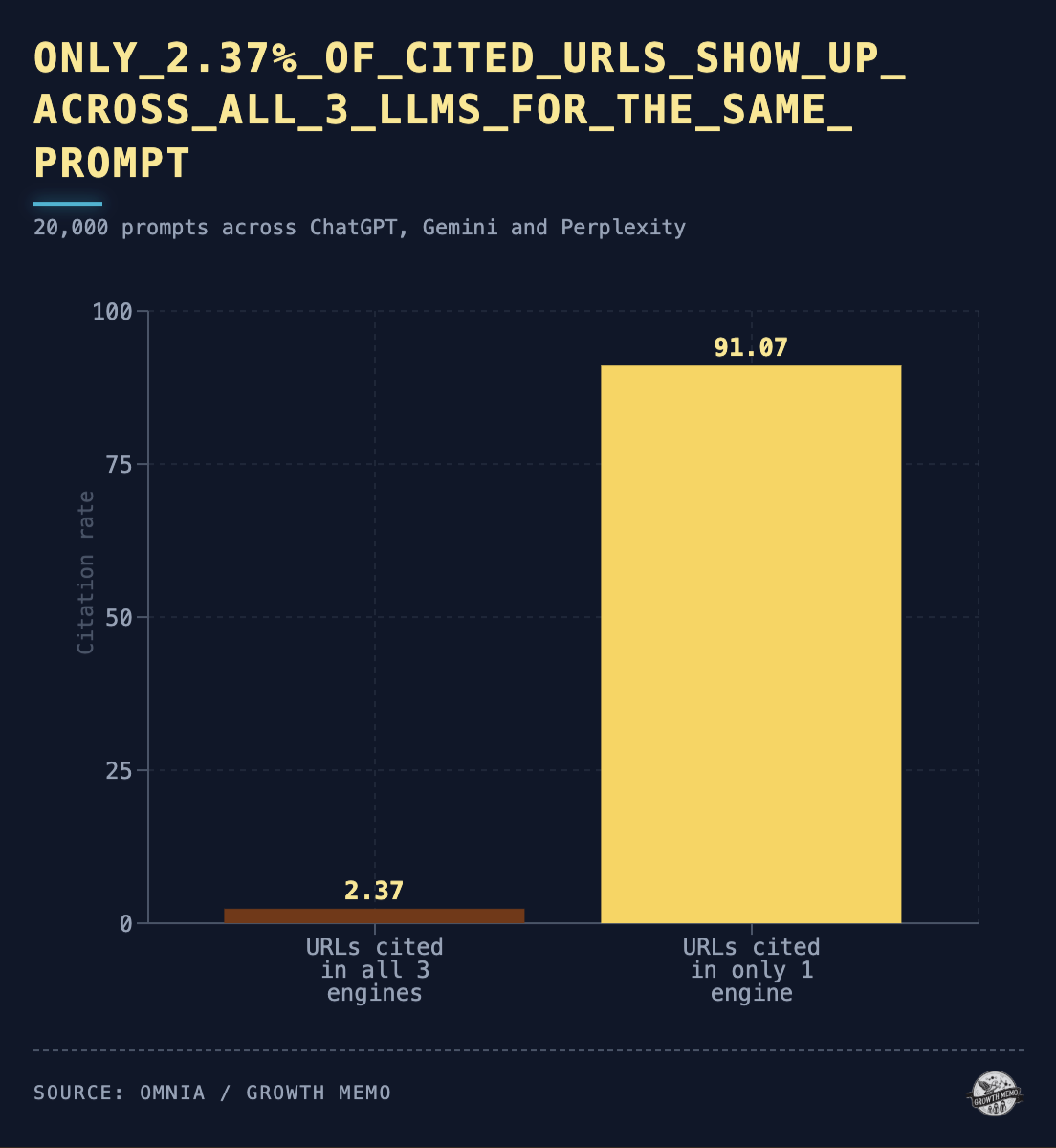
A brand can look strong in aggregate and be invisible in two of three engines. Teams chasing one blended AI visibility number are compressing three ranking systems into one metric and calling it strategy.
This holds across every cut of the data. The same memo found that commercial prompts show 2.4% universal overlap and informational prompts show 2.0%. Even when the query should narrow the answer set — best CRM, best project management tool, best fintech for SMEs — engines still choose different sources most of the time. Intent doesn't close the gap. Each engine's own retrieval logic does most of the work.
The practical implication for SEO and content teams: measuring AI visibility as one thing is the wrong unit of measurement. Before you can improve your AI presence, you need to know which engine you're actually visible in — and which two you're not. The multi-engine optimization matrix is the framework that makes that separation operational.
What your Google rankings aren't telling you
Strong SEO doesn't transfer to AI visibility automatically. That's the uncomfortable finding most experienced practitioners haven't fully reckoned with yet.
A page that ranks on page one of Google for a high-intent query can be entirely absent from ChatGPT's answer to the same question. The mechanisms are different. SEO rewards keyword authority, backlink profiles, and technical structure. AI engines reward citation frequency across trusted external sources, content structure that allows direct extraction, and brand entity consistency across the web.
A brand that has invested three years in SEO — building domain authority, publishing optimized content, earning backlinks — has built real assets. Those assets partially translate to GEO, because AI engines do weight source authority. But partial translation is not full translation. And the gap between the two is exactly where competitors who move faster on GEO are currently winning demand you don't know you're losing — a gap that AI competitive saturation data suggests closes faster than most teams expect.
The branded vs non-branded prompt gap
The clearest signal that SEO performance and AI visibility are measuring different things is the split between branded and non-branded prompts.
Most brands that check their AI presence at all do it by searching their own name in ChatGPT. They find themselves, feel reassured, and move on. That's not an audit. That's confirmation bias with extra steps.
The prompts that drive buying decisions are non-branded: "best [category] tool for a startup," "top alternatives to [competitor]," "which [solution type] is right for a 20-person team." These are the queries where consideration sets get formed — where a buyer who doesn't know your brand yet either encounters it or doesn't.
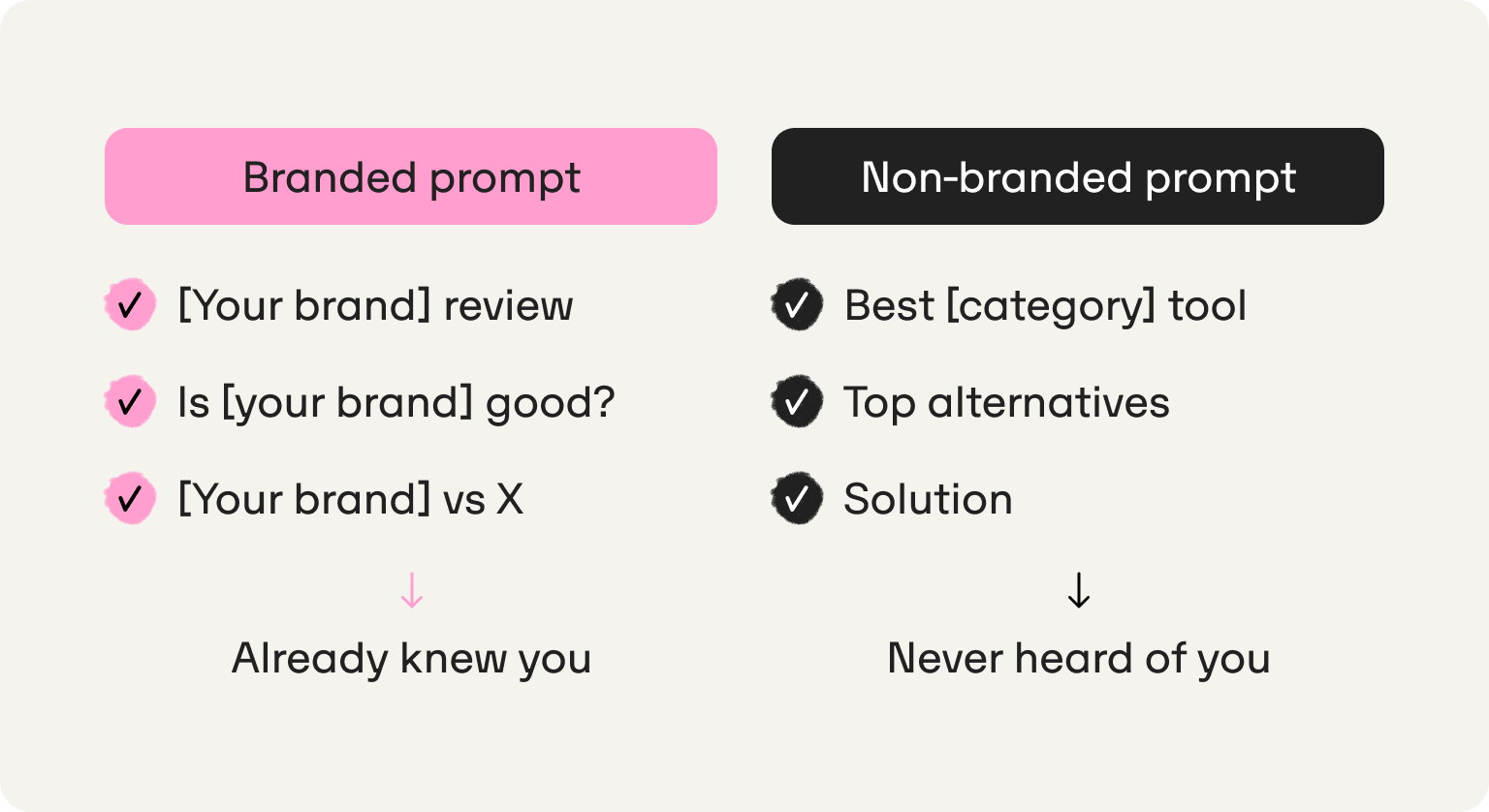
If your brand has strong branded visibility and near-zero non-branded presence, your AI footprint is essentially defensive. You show up when people already know to look for you. You're invisible at the moment when it would actually change their decision.
The content format gap your dashboard hides
Based on Omnia's citation data, as analyzed by Kevin Indig in his Growth Memo, guides and tutorials have the highest cross-engine overlap at 2.3%, followed by blogs at 1.8%, category pages at 1.6%, product pages at 1.2%, and homepages at 1.1%.
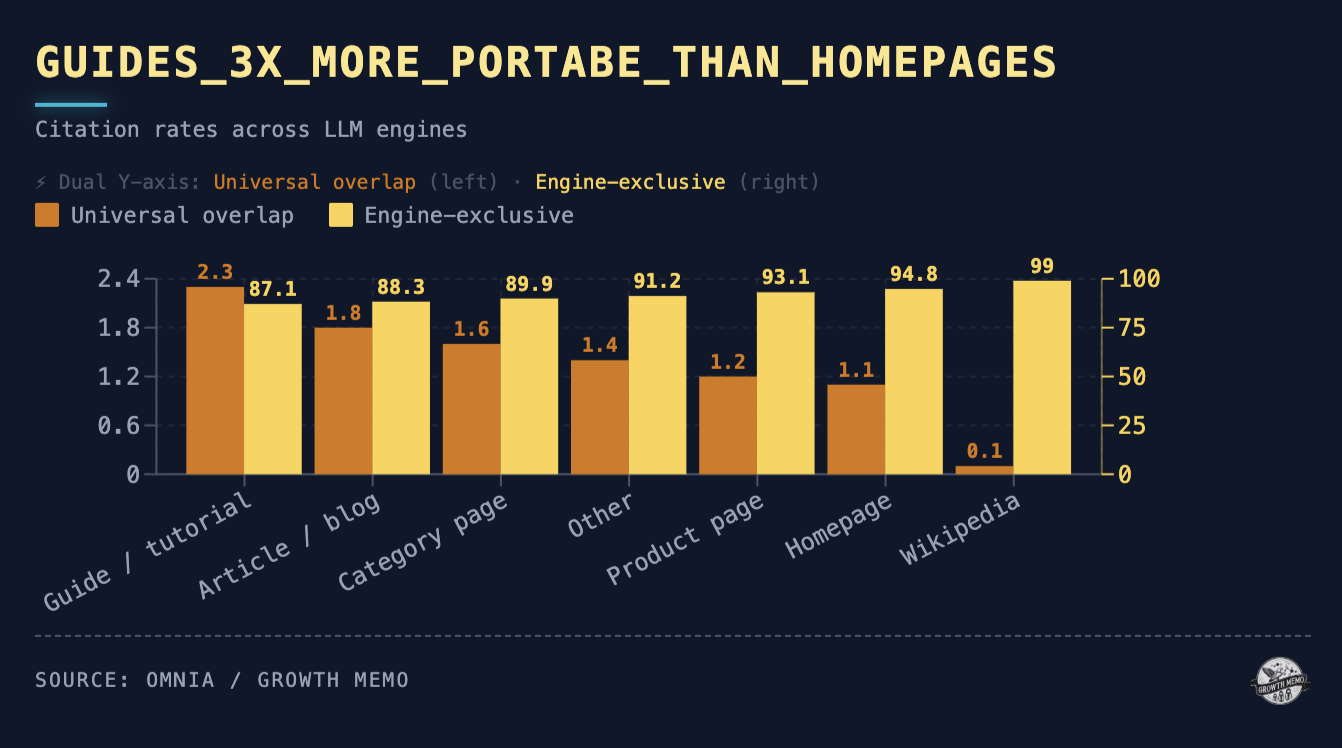
Two things follow from this.
First, explanatory content travels better than brand or transactional assets across AI engines. The page with the best shot at appearing across ChatGPT, Perplexity, and Google AI Overviews simultaneously is not your homepage. It's the page that helps, explains, or teaches — the content your SEO team probably already produces but may not be structuring for AI extractability.
Second, even the best-performing format — guides — only achieves 2.3% cross-engine overlap. That's not a reason to stop publishing guides. It's a reason to stop assuming that content performing well in one engine is building portable AI visibility. It probably isn't.
Presence vs portability: the GEO metric SEO professionals need
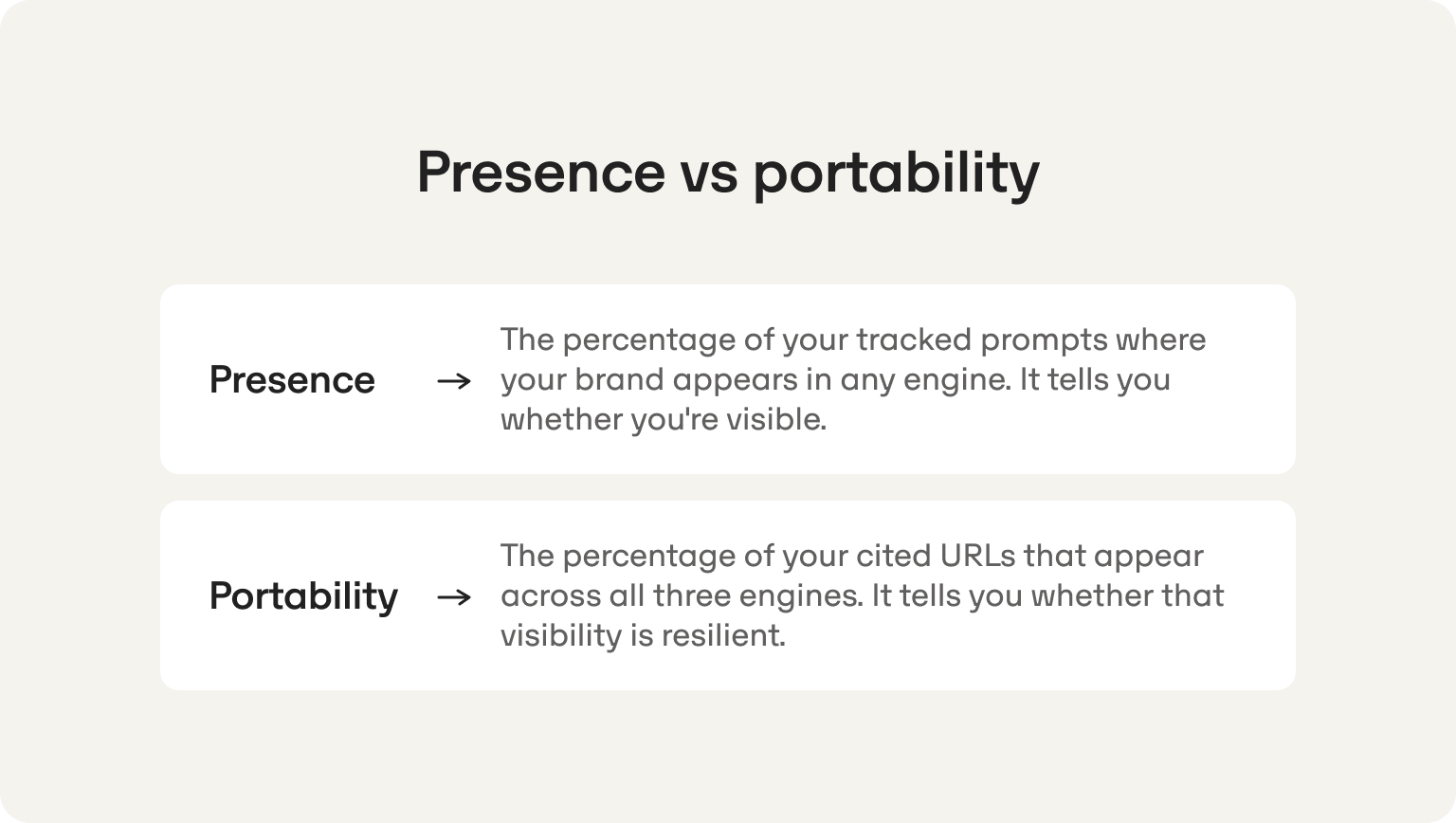
The most useful mental model for SEO leads approaching GEO measurement is the distinction between presence and portability — two things that look similar in a dashboard but represent fundamentally different strategic positions.
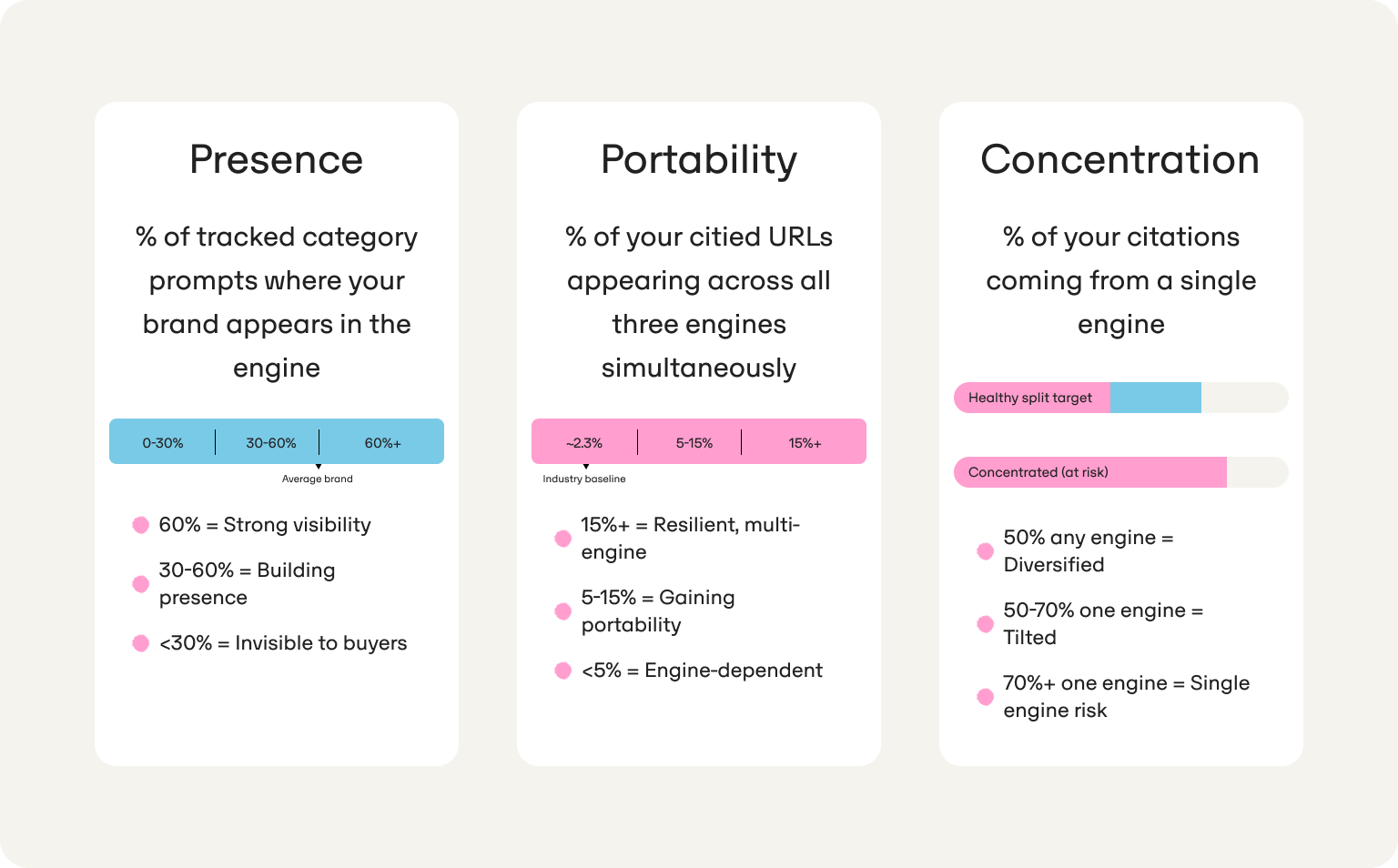
Presence is the percentage of your tracked prompts where your brand appears in any engine. It tells you whether you're visible.
Portability is the percentage of your cited URLs that appear across all three engines. It tells you whether that visibility is resilient.
Wikipedia appears over 16,000 times in Omnia's citation dataset, as reported in Kevin Indig's Growth Memo. Only 1.3% of those appearances are universal across engines. Reddit appears 14,000+ times. Only 0.1% are universal. A domain can show up all over one engine and barely travel — which means a brand that looks dominant in an aggregate dashboard may be entirely dependent on one engine's retrieval habits.
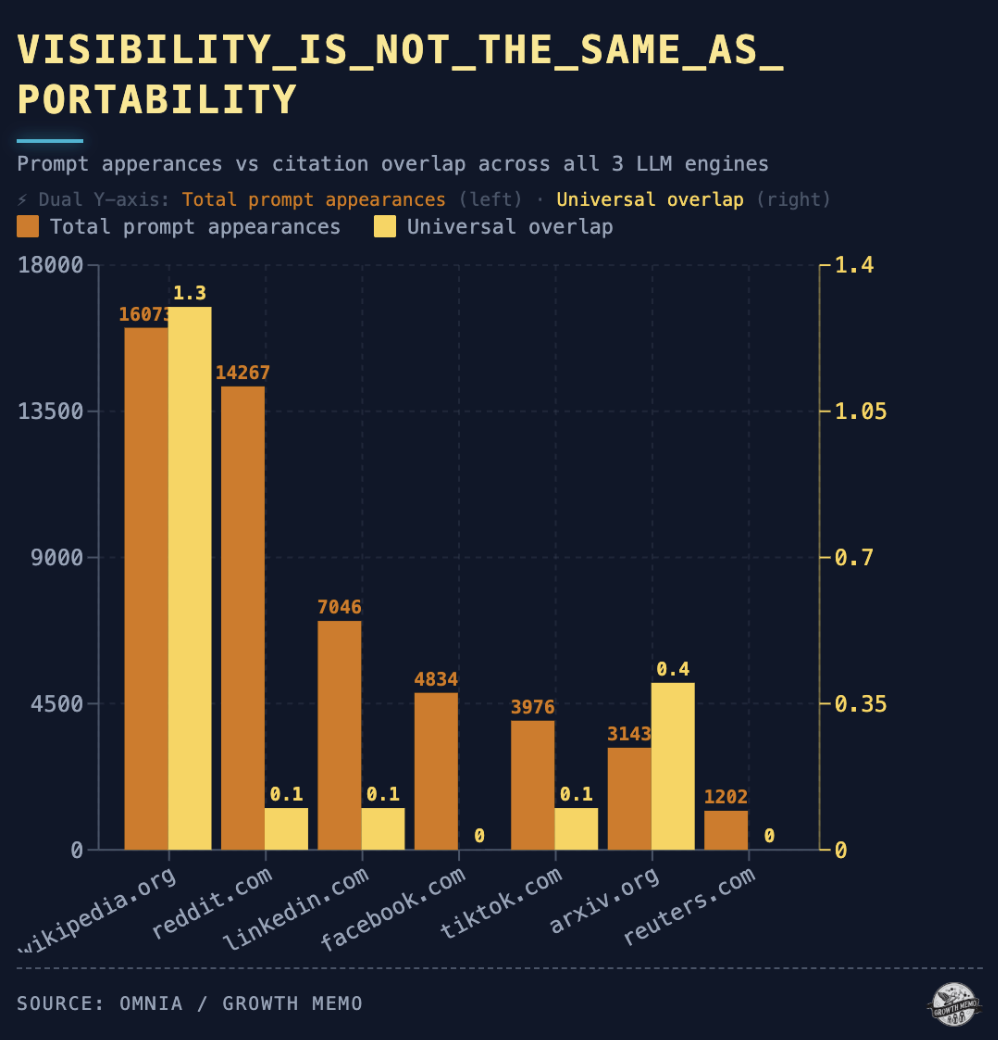
For content managers, this reframes the question from "are we visible?" to "are we building assets that survive different engine preferences?" Those are different questions and they require different answers.
A third metric completes the picture: concentration, the percentage of your citations that come from a single engine. High concentration tells you which engine your current AI visibility is secretly built on. It's also your largest single point of failure.
Measuring these three things separately: presence, portability, and concentration, gives an SEO or content team a diagnostic view of AI visibility that a blended score simply cannot provide.
GEO SEO benefits: what actually compounds
For teams with existing SEO investment, GEO isn't a competing priority. It's the channel that makes the current investment more defensible and more measurable across a broader set of buyer touchpoints.
Strong SEO foundations accelerate GEO results
Domain authority, content quality, backlink profiles, and technical SEO health all influence how AI models assess source trustworthiness. A brand with strong SEO foundations isn't starting GEO from scratch. It's starting from a position of established authority that AI engines partially recognize.
The practical implication: existing content that already earns organic traffic is often the right raw material for GEO — not new content, but the same pages made more extractable, more specifically framed, and distributed onto the sources AI engines already cite in your category.
GEO identifies where SEO investment is leaking into AI answers
One of the most immediately useful applications of GEO data for an SEO team is diagnosing where existing content is underperforming in AI engines despite strong search rankings.
A page that ranks on page one but never gets cited in AI answers for the same query is a specific kind of signal. It has keyword authority but not the structural or citation profile AI engines require. Understanding where the break is happening requires a different diagnostic than SEO provides.
As Kevin Indig noted in Growth Intelligence Brief #18, drawing on Microsoft's Bing team's published framework, AI grounding operates as a three-step funnel: crawl, parse, retrieve. A break at any stage means your content doesn't get cited, and this is regardless of how well it ranks in traditional search.
- Crawl: Can a non-Google crawler actually access the parts of your page that matter, or are key facts hidden behind JavaScript that AI crawlers won't execute?
- Parse: Are your key facts written as distinct, attributable claims rather than buried inside narrative paragraphs? AI systems ground against specific retrievable evidence — not well-written prose.
- Retrieve: Do your pages carry author bylines, publication dates, and visible source links that a model can use to assign provenance? Without clear provenance signals, a model may parse your content but decline to cite it.
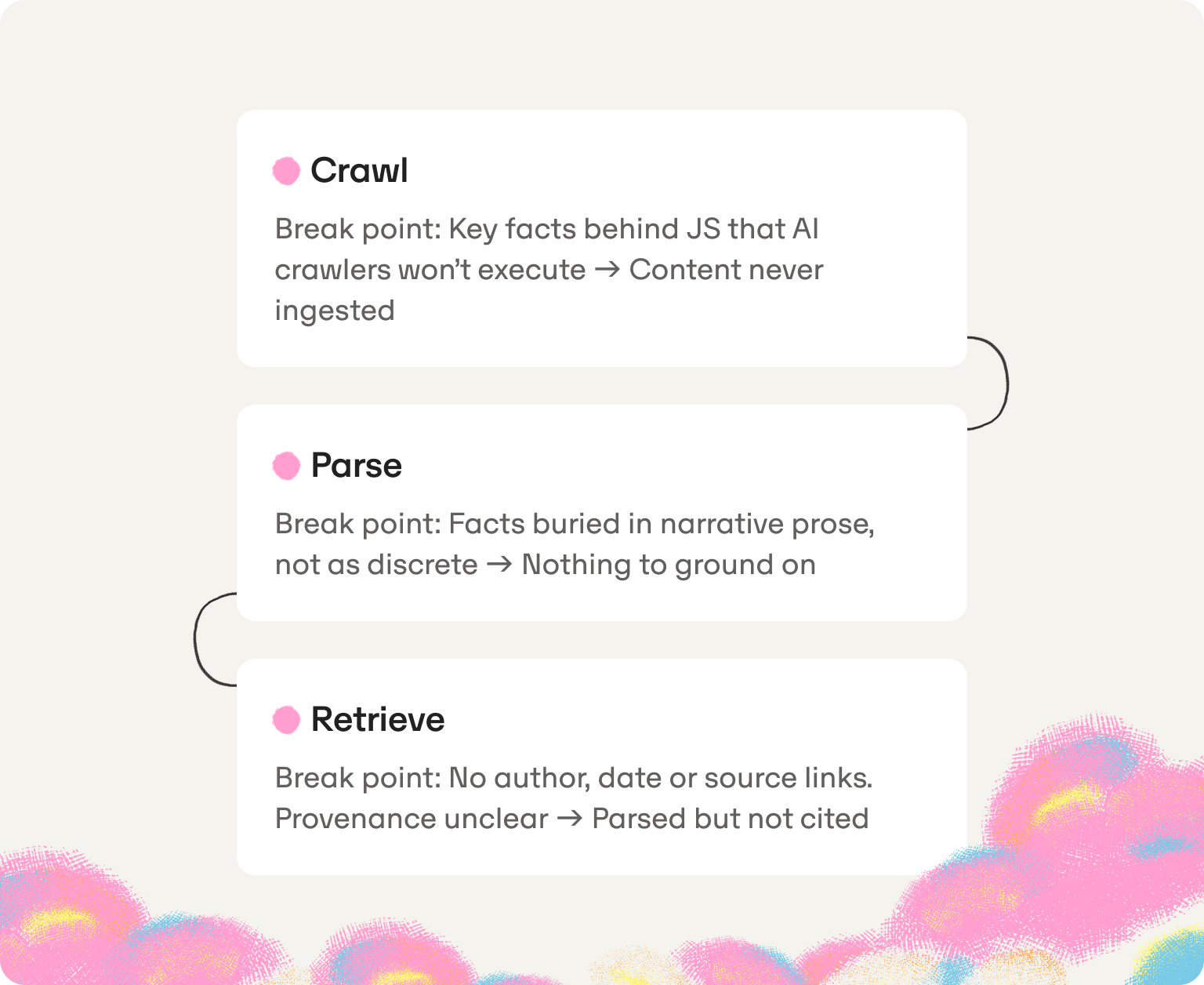
Most SEO teams are optimizing for initial phase 0 (ranking in the SERPs) while the break is happening at step one or two. That's why the traffic loss gets attributed to algorithm changes or content quality rather than the actual cause. GEO data makes the break visible by showing which engine isn't citing you and for which prompts — giving you a starting point for the crawl/parse/retrieve audit rather than a general content improvement brief. It also tells you which external sources to pursue for citation building once the on-page breaks are resolved.
Content restructured for GEO tends to perform better in search too
The structural properties that make content citable by AI engines — clear claims, named sources, specific figures, direct answers to named questions — are also properties that improve search performance. Content restructured for GEO typically sees stronger featured snippet capture, improved E-E-A-T signals, and higher click-through rates.
The investment is complementary. The content infrastructure that serves one channel tends to serve the other. The question is whether your current content is structured to serve either.
How to brief your content team on GEO without starting over
Questions that comes up most from content managers isn't "what is GEO," it's "how do I brief my team on this without throwing out everything we already do?"
The answer is that GEO doesn't require a new content operation. It requires a new brief format and a new distribution step.
A GEO-ready content brief adds three things to whatever your team already produces:
- A target prompt. Not a keyword — a specific question phrased the way a buyer would ask it in ChatGPT. Prompts and search queries are structurally different: "Best project management tool for remote engineering teams" rather than "project management software." The prompt defines the answer your content needs to be, not just the topic it covers.
- A citation target list. The three to five external sources that AI engines currently cite when answering your target prompt. Your content needs to either appear on those sources or be structured to displace them. Neither happens accidentally.
- An entity statement. A single clear sentence that defines what your brand is, who it's for, and what problem it solves — written to be extractable by an AI engine, not just readable by a human. How AI engines frame that statement shapes buyer perception before anyone visits your site, which is why brand framing in AI answers is worth defining explicitly in every brief. "Omnia is a GEO platform built for VC-backed startups with lean marketing teams" is more citable than "Omnia helps companies improve AI visibility."
These three additions don't replace keyword research, audience targeting, or SEO optimization; however, they add a layer that connects your content to the AI visibility outcomes your team is now accountable for.
Before any piece goes live, run a quick pre-publish check against the crawl/parse/retrieve funnel. Kevin Indig's Growth Intelligence Brief #18 identifies the fastest tactical wins:
- Are the load-bearing facts — price, feature, comparison, capability — written as clean, distinct claims in the first 600 words, not buried in narrative prose?
- Does the page carry an author byline, a publication date, and visible source links so a model can assign clear provenance?
- Can an AI crawler actually retrieve the page's key content, or does it rely on JavaScript rendering that non-Google crawlers won't execute?
A piece that passes all three has a materially better chance of surviving the grounding funnel than one that doesn't — regardless of how well it ranks in traditional search.
GEO for local content: a blind spot most teams haven't audited
The engine fragmentation finding has a local dimension that most teams haven't applied yet.
If citation patterns are already highly engine-specific at a global level, they're even more divergent at a local one. When someone asks ChatGPT "best fintech tool for Spanish SMEs" or "top B2B SaaS options for UK startups," the AI engine draws on geography-specific sources: regional media, local industry directories, country-specific review platforms, and locally tagged content. The citation hierarchy for a local prompt looks entirely different from a global one — and entirely different from what your current content strategy was built to win.
Most brands build content for a global or English-language audience and assume AI engines will surface it for local queries. They won't, not consistently, and not for prompts that carry local commercial intent.
What the audit reveals
Running your category's key prompts with local context — city, country, language — across ChatGPT, Gemini, and Perplexity produces a different result than running the same prompts globally. The sources cited are different. The brands recommended are different. And the gap between your global AI presence and your local AI presence is almost always larger than expected.
For a B2B SaaS company expanding into Spain, strong G2 reviews and coverage in English-language tech media won't move the needle on locally-framed Spanish prompts. The AI engines answering "mejores herramientas de gestión de proyectos para startups en España" are drawing on Spanish-language sources — regional tech publications, local business directories, country-specific review platforms — that a global citation strategy never touches. A brand invisible on those sources is invisible in that answer, regardless of how authoritative it looks everywhere else.
The audit question isn't "are we cited?" It's "are we cited on the sources each engine trusts for this geography?"
Why local GEO builds a moat
Local GEO is harder to replicate than global GEO because the citation network is smaller and competition for those sources is lower. A brand that earns citations from three or four authoritative regional sources builds a local AI visibility position that a global competitor can't easily displace without covering the same local groundwork.
For startups operating in specific markets, local GEO isn't a secondary consideration. It's the highest-leverage visibility investment available, because the prompts that drive local buying decisions are exactly the ones where global brands are weakest and early movers have the most to gain.
What GEO measurement looks like for an SEO-native team
The question SEO leads ask most often isn't whether GEO matters. It's how to report on it alongside the metrics they're already accountable for.
GEO has its own metric set. It maps onto familiar SEO concepts without being identical to them.
| GEO metric | What it measures | SEO equivalent |
|---|---|---|
| Mention rate | % of tracked prompts where your brand appears in any engine | Impressions |
| Citation rate | % of mentions where AI references your content directly | Clicks |
| Share of voice | Your mention rate vs competitors across the same prompt set | Rank position |
| Portability | % of cited URLs appearing across all three engines | Domain authority |
| Concentration | % of citations coming from a single engine | Traffic source dependency |
Track these weekly, not monthly. AI answer patterns shift in days — visibility volatility is high enough that monthly reporting hides the signal in noise and makes it nearly impossible to connect content actions to visibility changes.
For reporting upward: the most credible before/after snapshot is share of voice across a defined prompt set over 60 days. It's a number a CMO or board can interpret without a GEO education — it maps directly to the competitive framing they already apply to search.
What not to obsess over
A single spot check in one AI engine tells you nothing meaningful. AI answers are probabilistic — the same prompt produces different results across sessions, engines, and geographies. One check is one data point from a system designed to vary.
Branded prompt visibility is a floor, not a ceiling. Appearing when someone searches your brand name is baseline hygiene. The prompts that produce buyers are the ones where your brand wasn't the starting point.
Aggregate blended scores. As the citation data makes clear, a strong blended score can mask near-total invisibility in two of three engines. Always measure engines separately before rolling them up.
How Omnia helps SEO teams close the gap
Understanding the gap is the first step. Measuring it consistently — across engines, markets, and prompt clusters — is where most teams stall without the right tooling.
Omnia is an AI visibility platform built specifically for lean teams that need to move from signal to execution without friction, across every market they operate in. Unlike enterprise tools built for large teams with long implementation cycles, Omnia is designed for the SEO lead or content manager who needs to run a GEO program alongside everything else on their plate.
A weekly workflow in Omnia takes one marketer about an hour. You check your AI search visibility across your key markets, review citation tracking to see which competitor URLs are winning locally, and immediately move into the action layer to generate a content brief or a list of PR placement targets. You're not just monitoring brand mentions — you're executing a content strategy to capture more AI search real estate, in the time it takes to run a weekly SEO report.
The core capabilities map directly to the gaps this article has identified:
- AI visibility tracking across ChatGPT, Perplexity, Google AI Overviews, and AI Mode — measured separately by engine, not blended into a score that hides where you're actually invisible.
- Citation intelligence: Omnia surfaces the specific domains AI engines cite when recommending competitors in your category, giving you a citation target list rather than a content brief written in the dark.
- AI Prompt Discovery: Identifies the non-branded prompts your buyers are actually using in AI engines — the queries your current keyword tools don't surface and your current rankings don't capture.
- AI sentiment analysis: Shows how AI models describe and frame your brand across engines, so you can monitor and influence that framing before it costs you a buyer segment.
- Omnia MCP: Connects your AI visibility data directly into your AI assistants — so the data lives inside the tools your team already uses, not in a separate dashboard requiring a context switch.
The result is a system where monitoring produces decisions and decisions produce actions — in the same workflow, without additional headcount.
Join other companies in their quest to improve their GEO strategies. That’s why Iberia Cards uses Omnia to identify which sources AI cited for high-intent Avios prompts, then redirected their content investment accordingly. The result: +18 percentage points vs their main competitor on strategically critical queries, and the #1 position across all five key Avios prompts on every AI engine they tracked.
Start your 14-day free trial on the Growth plan → No credit card required.

FAQs
Why does GEO matter if my SEO performance is already strong?
Strong SEO and strong GEO measure different things. A page that ranks on page one of Google can be entirely absent from AI-generated answers for the same query — because AI engines use citation frequency, content extractability, and entity recognition rather than keyword signals to decide what to recommend. SEO tells you where you stand in search results. GEO tells you where you stand in the channel where buying decisions increasingly happen before a search result is ever clicked.
What KPIs should I report for GEO?
The core set is mention rate, citation rate, share of voice, portability, and concentration — measured weekly and broken out by engine rather than blended. For reporting to a CMO or board, share of voice across a defined prompt set over 60 days is the clearest before/after metric. It maps to competitive positioning language leadership already understands, without requiring a GEO explanation before the number lands.
How do I know which competitors are beating me in AI visibility right now?
Run your category's 10 to 15 most important non-branded prompts across ChatGPT, Gemini, and Perplexity and record which brands appear, how they're framed, and which sources are cited alongside them. The sources cited when a competitor is recommended are the sources you need to appear on. Omnia surfaces this through competitive AI visibility tracking — showing you which prompts each competitor wins, which engine they're strongest on, and whether that visibility is portable or concentrated in one engine.
What content formats get cited most by AI engines?
Based on Omnia's citation data, as analyzed by Kevin Indig in his Growth Memo across 4.1 million URL appearances, guides and tutorials have the highest cross-engine overlap at 2.3%, followed by blogs at 1.8%, category pages at 1.6%, product pages at 1.2%, and homepages at 1.1%. Explanatory content that helps, compares, or teaches travels better than brand or transactional assets. That said, even guides only achieve 2.3% universal overlap — meaning the right frame isn't "publish more guides" but "structure the guides you publish so they're extractable by AI engines and distributed on the sources AI already cites."
How does local GEO work at a city or country level?
AI engines draw on geography-specific citation sources when answering locally-framed prompts — regional media, local directories, country-specific review platforms. A brand with strong global citation authority but no regional source coverage will be invisible to AI engines answering location-specific queries, regardless of its global ranking. Running your key prompts with local context (city, country, language) produces a materially different result than running them globally — and the gap between global and local AI presence is almost always larger than teams expect before they audit it.
How do I integrate GEO data into my existing marketing reports?
GEO metrics sit alongside SEO metrics rather than replacing them. Mention rate maps to impressions. Citation rate maps to clicks. Share of voice maps to rank position. The main adjustment is measurement cadence — GEO requires weekly tracking rather than monthly, because AI answer patterns shift faster than search rankings. For teams using Omnia, the data exports in formats compatible with existing marketing dashboards, so GEO visibility can sit in the same report as organic traffic, keyword rankings, and conversion data without requiring a separate reporting workflow.
How do I show that a piece of content improved our citation share?
Track your mention rate and citation share across your target prompt set in the week before and the four weeks after publishing. A genuine GEO lift shows up as an increase in the specific engine where the content was distributed — not necessarily across all three engines simultaneously. If you've published on a source that ChatGPT trusts but Perplexity doesn't, the lift will be engine-specific. That's expected and consistent with the citation fragmentation data. The clearest proof point is share of voice movement against a named competitor on a specific prompt where you were previously absent. For a step-by-step approach to tracking this systematically, see how to track AI citations for your business.
What are the most immediate benefits of integrating GEO into an existing digital marketing strategy?
The most immediate benefit of adopting GEO alongside traditional search engine optimization is visibility in the channel your current digital marketing strategies don't reach. Buyers using AI-driven search engines to research solutions, compare options, or find relevant content are forming consideration sets without ever seeing a search results page — and without GEO, your brand is absent from those moments regardless of how strong your organic traffic is. Integrating GEO into an existing content strategy doesn't require rebuilding from scratch: existing content that already demonstrates domain authority and content quality can be restructured for AI extractability, immediately improving your brand's presence across multiple AI platforms. For digital marketing teams under pressure to show a competitive edge from their marketing efforts, GEO also produces measurable results faster than traditional SEO — AI models update their citation patterns in days rather than months, meaning targeted actions on citation gaps show up in weekly tracking rather than quarterly reports.
How is generative engine optimization different from traditional SEO tactics?
Traditional SEO optimizes content for search engine algorithms — targeting keywords, building backlinks, and improving technical structure so pages rank higher in search engine results pages. Generative engine optimization focuses on a different goal entirely: ensuring AI models select your content as a trusted source when generating direct answers in AI-powered search engines like ChatGPT, Perplexity, and Google AI Overviews. Unlike traditional SEO, which drives organic traffic by surfacing links, GEO influences the AI-generated responses buyers receive before they ever reach a search result. The structural properties that matter also differ — traditional SEO tactics prioritize keyword density, meta tags, and schema markup, while GEO requires content quality, contextual relevance, clear entity statements, and structured data that large language models can extract and cite. Solid SEO foundations accelerate GEO results, but traditional SEO practices alone won't build AI visibility. The two disciplines serve the same target audience through increasingly different channels.