


Every month you're not in AI-generated answers, a buyer who fits your exact profile is asking ChatGPT which tool to use and getting a shortlist that doesn't include you. GEO isn't a channel for companies with content teams and six-figure marketing budgets. It's a focused, executable system that a team of one can run in an hour a week. This article gives you the five-prompt starting point, the one-hour audit, and the one-person monthly schedule that produces measurable AI visibility without requiring you to hire anyone or rebuild your content strategy from scratch.
Your competitors are showing up in AI-generated answers. You're not. And the buyers who would have chosen you are forming their shortlists before they ever visit a website.
That's not a content quality problem. It's not a budget problem. It's a presence problem — and it compounds every week you don't address it. For a founder running a lean team, losing the AI discovery moment doesn't show up in your dashboard immediately. It shows up three months later when pipeline slows and you can't explain why, because the buyers who didn't find you never left a trace.
Most GEO advice won't help you. It's written for companies that already have someone whose job is GEO — a content strategist to run the audit, a copywriter to restructure the pages, a PR manager to pursue the citation placements. If you're reading this as the founder who also owns marketing, or the only marketer at a 15-person startup, that list reads like a different universe.
You're not looking for a comprehensive strategy. You're looking for the first move that isn't a waste of the two hours you have this week.
That's what this article addresses.
Does GEO work for small businesses — or is it only for brands with scale?
The honest answer: generative engine optimization works better for small businesses than traditional SEO does at the same stage. That's not a consolation prize. It's becoming a structural priority.
In traditional search, small brands compete for keywords against companies with decade-long domain authority, thousands of backlinks, and full-time SEO teams optimizing every page. The long-tail keywords that used to be “winnable” have now been absorbed by content farms and AI-generated articles. For a 20-person SaaS competing for "best project management software," the SEO math doesn't work. That's AI competitive saturation at its most visible, and it's exactly what makes the shift to GEO strategically significant for lean teams looking to gain some edge.
GEO changes the math. AI engines don't rank a list of ten results — they synthesize an answer from three or four sources. The competition for any given prompt isn't a thousand websites trying to rank. It's whoever has built enough citation authority on the specific sources that engine trusts for that specific question. For a small brand in a defined category, that's a winnable game — if you know which prompts to target and which sources matter.
The brands that will lose at GEO are the ones that treat it as "SEO but for AI" and try to compete globally across hundreds of prompts with no focus. That approach requires scale. The focused approach: five prompts, two citation targets, one piece of structured content — doesn't.
Does GEO work for all types of websites?
Yes, but the starting point differs by what you have. Below, we give you a small breakdown:
- If you have a blog with existing content: Your first move is restructuring, not creating. Identify which posts address questions buyers are asking AI engines in your category, and rewrite them for citeability — clear entity statements, specific figures, direct answers in the first 300 words. You already have the raw material.
- If you have a product-focused site with minimal content: Your first move is external citation building. Get on G2 or Capterra if you aren't already. One well-populated review profile on a source AI engines already trust in your category can potentially do more in four weeks than a new blog post can do in four months.
- If you have a local or service-based business: Your first move is local prompt research. The prompts AI engines receive for local service queries are different from global category queries — more specific, more geography-dependent, and far less contested. "Best accountant for freelancers in Manchester" is a prompt you can win. "Best accounting software" is not. For Google's surfaces specifically — AI Overviews and AI Mode — Google also recommends ensuring your Google Business Profile is fully populated, as it directly influences how your business appears in locally-framed AI responses. That's one of the fastest moves available to a local business and requires no content production at all.
- If you're pre-content entirely: Start with your entity statement. Before any content or citation building, make sure your brand is consistently described the same way across every public-facing source — your website, your LinkedIn, your G2 profile, any press mentions. Source eligibility begins with consistency: AI engines build entity associations from pattern recognition across sources, a process known as perception anchoring. Inconsistency makes you invisible even when you're present — and fixing it costs nothing except time. How AI engines ultimately describe your brand once that entity is established is what brand framing in AI answers tracks, which is why getting the entity statement right from the start matters more than any piece of content you publish afterward.
- A note on Google's surfaces vs independent AI engines: Google has confirmed that appearing in AI Overviews and AI Mode is rooted in the same core ranking signals as traditional search — crawlability, indexability, content quality, and E-E-A-T. A Brainlabs study found that 96% of links appearing in AI Overviews came from websites already ranking in the top 10 organic results. ChatGPT and Perplexity operate independently of Google's index and use different citation logic — strong organic rankings are not a prerequisite for appearing in their answers. For a small business, this means the starting point differs by engine: Google's surfaces reward existing SEO investment, while ChatGPT and Perplexity reward citation authority on the specific external sources those engines already trust.
The small business GEO starting point: five prompts before anything else
Every GEO guide tells you to map 15 to 20 prompts. For a team of one, that's a full day of work before you've done anything executable. Start with five.
Not five random prompts. Five specific ones chosen by a rule: the prompts a buyer who doesn't know your brand yet would use at the moment they're deciding which solution to try. This process, which identifies the specific questions buyers are asking AI engines in your category, is what practitioners call prompt mining, and the discipline of mapping which of those prompts your brand currently appears in is prompt coverage mapping.
That rules out branded prompts (they already know you), awareness prompts (too early in the decision), and broad category prompts (too competitive). What's left is the middle layer — the specific, intent-rich questions where a buyer is close to a decision and your brand could plausibly appear. Worth noting: prompts and search queries are structurally different. A search query is a phrase. A prompt is a question with context, persona, and implied intent, and AI engines respond to that full context, not just the “keywords” inside it.
For a B2B SaaS selling to early-stage startups, that might look like:
- "Best [category] tool for a startup without a dedicated [function] team"
- "Affordable [category] software for companies under 50 employees"
- "[Your category] tools that don't require a long implementation"
- "Alternatives to [market leader] for small teams with X percent revenue"
- "What [category] tool do most seed-stage startups use"
Run these five prompts in ChatGPT, Perplexity, and Google AI Overviews at least five times each and in incognito mode. For each one, record two things only: whether your brand appears, and which brands do. You don't need a dashboard for this. A spreadsheet with five rows and three columns takes 20 minutes and tells you everything you need to know about where the gap is.
That gap is your starting point.
The one-hour GEO audit for a team of one
The full GEO audit in most guides takes days. This version takes an hour and produces the same essential output: a prioritized list of where to focus.
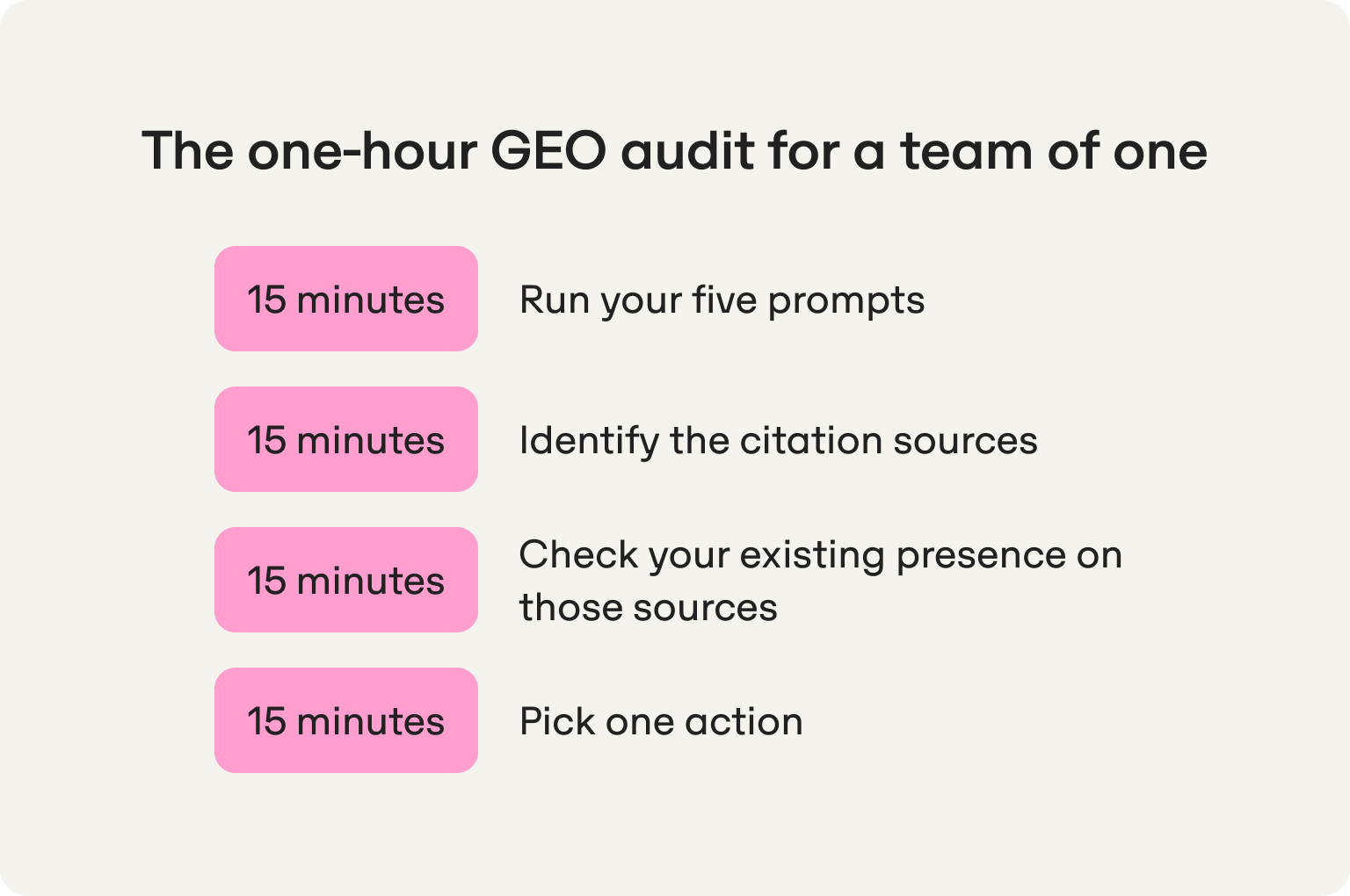
15 minutes — run your five prompts. Open ChatGPT, Perplexity, and Google AI Overviews. Run each of your five prompts at least five times each across platforms. Note which competitors appear, how often, and in which engines. Don't overthink the analysis. The pattern will be obvious: one or two competitors will dominate, and your brand will appear rarely or not at all.
15 minutes — identify the citation sources. For the prompts where a competitor appears and you don't, look at the sources cited in the answer. Which domains does the engine reference? These are your citation targets — the places your brand needs to appear before any content you publish will make a difference. Write them down. For most small business categories, you'll find the same three or four sources appearing repeatedly: a review platform, an industry directory, and one or two media outlets. The sources that appear consistently across multiple prompts have the highest citation confidence — meaning they reliably produce citations in your category, not just occasionally. Those are the ones to prioritize first. This is also the step where competitive AI visibility data becomes most actionable: knowing not just that a competitor appears, but which specific sources gave them that authority.
15 minutes — check your existing presence on those sources. Do you have a profile on the review platform? Is it fully populated with a specific description of what you do, who you serve, and what problems you solve? Is the language consistent with how you describe yourself on your website? This is the most common fixable gap — and it's fixable in an afternoon, not a content sprint.
15 minutes — pick one action, Not a strategy. One action. Either consider fixing your profile on the citation source where you're absent or incomplete, or identifying one existing piece of content on your site that addresses a target prompt and rewrite the opening 300 words to be more directly answer-shaped. Do that action before the week ends.
The output of this audit isn't a roadmap. It's a decision: where is the most fixable gap, and what does fixing it require? Everything else is optimization.
Best practices for using statistics and data to boost GEO performance
This is where small teams have an advantage most don't realize they have.
AI engines cite sources that contain specific, attributable facts — named figures, dated research, clear provenance. The assumption most small business owners make is that earning citations requires producing original research: surveys, studies, proprietary data. That assumption is wrong, and it's keeping small teams from one of the highest-leverage content moves available to them.
One data point makes the opportunity concrete. Based on Omnia's citation data, as analyzed by Kevin Indig in his Growth Memo, guides and tutorials have the highest cross-engine overlap at 2.3%, compared to homepages at just 1.1%.
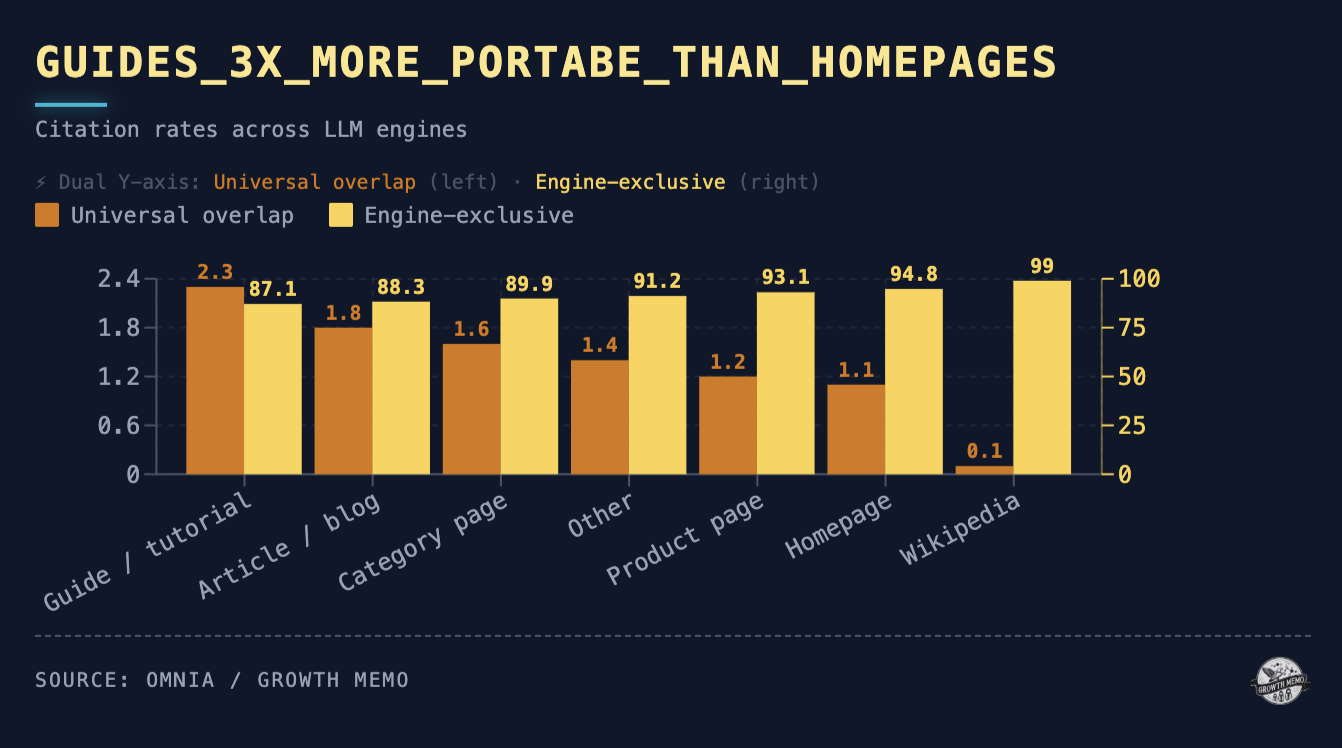
Explanatory content, the kind a small team can produce without a content department, travels better across AI engines than brand or transactional pages. The constraint isn't the type of business. It's whether the content is structured to be extracted. Understanding what makes a source eligible for AI citation in the first place is what source trust signals for AI covers, and it starts well before any content is published.
Use third-party data as the citation anchor, not the destination
When you cite a named statistic from a credible source inside your own content — with a clear attribution, a link to the original, and a direct connection to the claim you're making, you create a two-layer citation opportunity. The AI engine can cite your content for the surrounding context and analysis, while the underlying data gives it the factual provenance it needs to trust the source.
A blog post that says "AI search is growing" earns no citations. A blog post that says "According to Gartner, traditional search engine volume will drop 25% by 2026 as AI chatbots absorb more discovery queries — which means [your specific insight about what that means for your category]" gives an AI engine a specific, attributable claim it can extract and verify.
The statistic is the entry point. Your analysis is the value. Both are needed.
Structure statistics for extraction, not for narrative
Most content buries statistics inside paragraphs where they're hard for AI engines to parse. The highest-citeability format for a data point is:
- A standalone sentence that states the claim directly: "X% of B2B buyers now start their research in an AI chatbot, according to [source]."
- A follow-on sentence that connects the data to the reader's specific situation.
- A third sentence that names the implication or the action.
Three sentences. Claim, connection, implication. AI engines can extract that structure cleanly. A statistic embedded in a 200-word paragraph is far harder to retrieve. The metric that captures this is answer extraction rate — how reliably AI engines can pull a specific claim from your content. Improving it is primarily a structural exercise, not a content volume exercise. The broader discipline of making content structurally accessible to AI engines is AI content extractability and for a small team, it's one of the highest-ROI improvements available because it applies to content you've already written.
One clarification worth making: Google has confirmed in its AI optimization guide that no special schema markup or structured data is required to appear in AI Overviews or AI Mode. Structured data helps Google understand your content and can improve citation likelihood, but it is a supporting signal, and not a prerequisite and not a citation trigger. For a small team deciding where to spend time, restructuring how facts are presented in plain text will produce more GEO impact than implementing schema markup.
Prioritize statistics that are specific to your category or audience
Generic statistics ("AI is growing," "content marketing is important") are overrepresented across the web and earn fewer citations because they appear in too many sources simultaneously. Statistics specific to your industry, company size, geography, or use case are rarer — which means your content becomes one of fewer sources where an AI engine can find that specific fact.
A founder selling HR software to startups in Spain will earn more citations from a well-placed statistic about Spanish startup hiring trends than from a global workforce management figure. The narrower the data, the fewer the competing sources, and the higher the probability of citation.
Be the source when you can
If you have any customer data, usage patterns, or operational insights that could be expressed as a statistic, even a small sample, publishing it makes you a primary source rather than an aggregator. AI engines weight primary sources more heavily than secondary ones, partly because primary data carries clearer provenance and partly because it's unique — which increases retrieval priority when AI engines are selecting between multiple sources that address the same question. Adding author bylines, publication dates, and clear source links also strengthens what Google calls trust framing signals— the provenance markers that allow AI engines to attribute a claim responsibly. A "based on data from our 50 customers" figure, published with appropriate context and caveats, is more citable than a report from a research firm you're summarizing. It's also unique — no competitor can replicate it.
What GEO looks like on a one-person schedule
The version of GEO most guides describe requires roughly 10 to 15 hours per week to execute consistently. That's a full-time function, not a side channel.
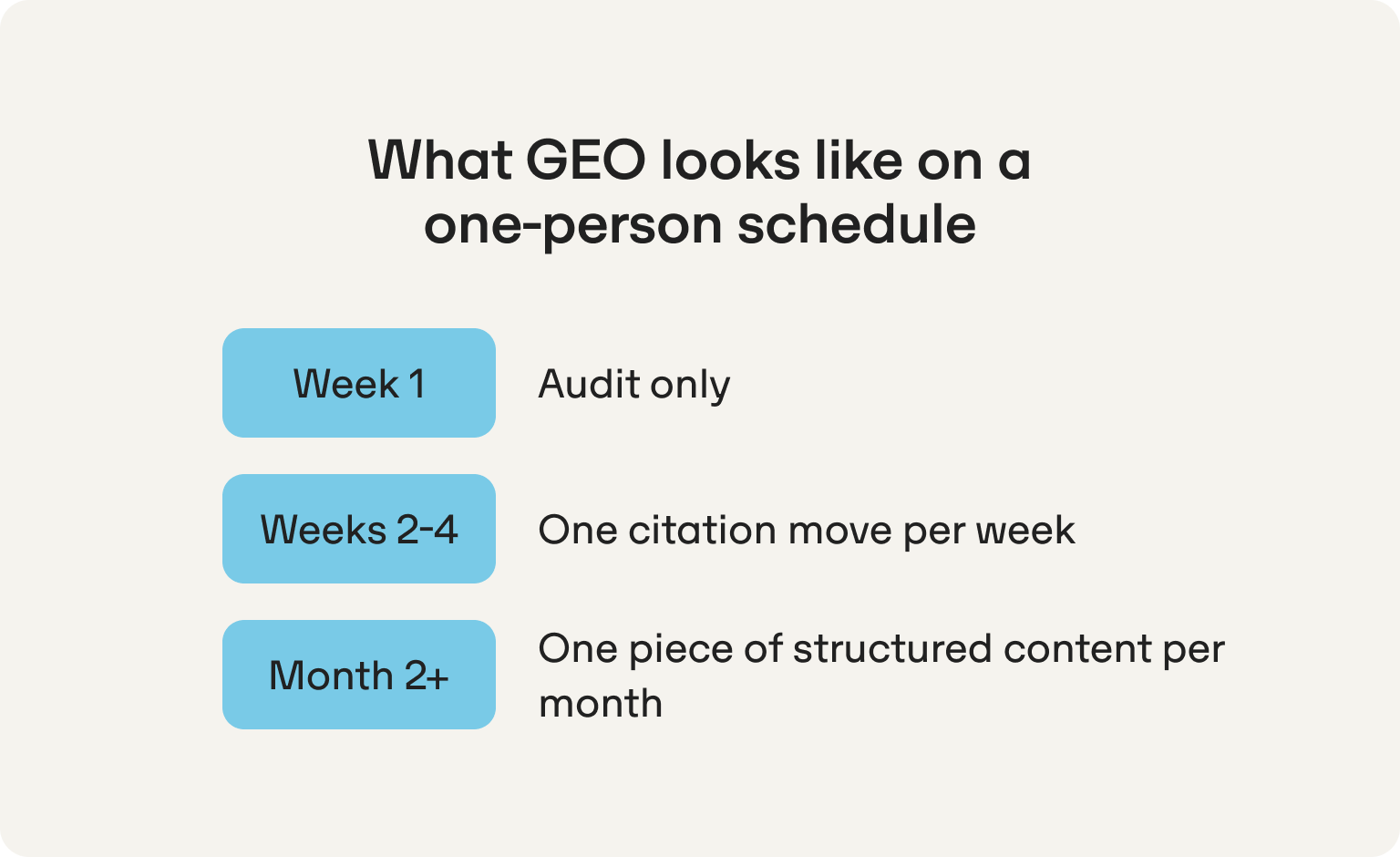
The version that's realistic for a founder or a lone marketer looks like this:
- Week 1 — audit only: Run the one-hour audit described above. Pick one action. Do it.
- Weeks 2 to 4 — one citation move per week: Each week, make one move toward the citation sources you identified. Week 2: populate your G2 or Capterra profile completely. Week 3: identify one industry publication that appears in AI answers for your category and find their contributor or submission guidelines. Week 4: restructure one existing page for citeability — entity statement, statistics with attribution, direct answer in the first 300 words. Understanding the difference between owned and earned mentions helps prioritize these moves: owned mentions (your profiles, your content) are faster to fix; earned mentions (media coverage, third-party citations) take longer but carry more weight with AI engines. For a deeper guide on tracking which citations are actually producing AI appearances, see how to track AI citations for your business.
- Month 2 onward — one piece of structured content per month: Not a blog post optimized for a keyword. A direct answer to one of your five target prompts, structured for AI extraction, distributed on the citation sources you've been building. One piece per month, consistently, is enough to produce measurable mention rate movement over a quarter.
- What to track: Run your five prompts once a week. Five minutes, three engines. Record whether your brand appears and which competitors do. You don't need a tool for this at the beginning — the pattern you're watching for is a shift in the prompts where you start appearing. When you see it, that's signal that your citation building is working. When you don't see it after six weeks, that signals that you should change which citation sources you're targeting. Keep in mind that visibility volatility is high in AI engines — answers shift in days, not months, so weekly tracking gives you a meaningful signal that monthly tracking would hide. Also worth noting: a single run of one prompt is not a reliable data point. Prompt variability impact means the same prompt can produce different answers across sessions, engines, and geographies. Track patterns across multiple runs before drawing conclusions about whether your brand is genuinely absent or just experiencing normal variation.
The prioritization problem: why most small teams stall
Knowing what GEO requires and knowing where to start are different problems. Most small teams understand the framework well enough. What stops them is the prioritization question: with five hours a month and no dedicated resource, which of the ten possible actions actually moves the needle?
This is the question that doesn't have a good generic answer because the right starting point depends on your specific prompt gaps, your specific citation sources, and your specific competitive landscape. A founder who has no G2 presence in a category where AI engines consistently cite G2 reviews has a completely different starting point than a founder who has strong review presence but whose content isn't structured for AI extraction.
The only way to answer the prioritization question correctly is with data on where your brand currently stands, which prompts matter most in your category, and which sources AI engines are actually using to construct answers about your space. Without that data, you're making educated guesses — and on a five-hour monthly budget, a wrong guess costs more than it does for a team with capacity to course-correct quickly.
How Omnia solves the prioritization problem for lean teams
Omnia was built for exactly this constraint. Not for teams running 50 prompts across six markets with a dedicated GEO analyst. For the founder who needs to know where to spend the next two hours.
The weekly workflow takes one marketer about an hour. You open Omnia, check your AI search visibility across your target prompts and markets, review which competitor URLs are winning the citations you're missing, and move directly into the action layer — a content brief, a PR placement target list, or a restructured page outline — without leaving the platform. Monitoring produces a decision. The decision produces an action. The whole cycle happens in one session.
The specific capabilities that matter for a lean team:
- AI Prompt Discovery: Omnia surfaces the prompts your buyers are actually using in AI engines — including the specific, intent-rich middle-layer prompts that a team of one can realistically target, not just the high-volume category terms that require scale to compete for.
- Citation intelligence: Omnia identifies which domains AI engines cite when answering your target prompts, so you know exactly which two or three external sources to prioritize — rather than guessing which review platform or directory matters most in your category.
- AI sentiment analysis: Shows how AI models frame and describe your brand when it does appear — so you can monitor and influence that framing before it costs you a buyer segment, without running manual checks across three engines every week. Omnia tracks your AI reputation score alongside visibility data, so framing problems surface alongside citation gaps rather than requiring a separate audit. Google's guidance also confirms that E-E-A-T signals — experience, expertise, authoritativeness, and trustworthiness — remain critical for AI Overviews specifically, and Omnia's sentiment monitoring captures how AI engines are currently assessing those signals for your brand.
- Omnia MCP: Connects your AI visibility data directly into your AI assistants, so a founder using Claude or ChatGPT to draft content can pull live visibility data into the workflow without a context switch.
PuntoSeguro is a 10-person Spanish life insurance distributor competing against major insurers with a fraction of their resources. Before Omnia, their founder was checking AI prompts manually one by one with no clear picture of where they stood or where to start. Three months later, they were the #1 life insurance brand in Spain across AI engines — outranking corporations with 300 times their budget on key prompts like "life insurance comparators" and "cheap life insurance." ChatGPT had never sent them a single visit before. In their first month using Omnia, it sent 25 leads, five of which converted into policies. Their weekly content effort: one new article, three to four existing ones refreshed. That's it.
Start your 14-day free trial on the Growth plan. No credit card required.

FAQs
Does GEO work for small businesses with a limited content library?
Yes, and a limited content library is often an advantage rather than a liability. A small brand with five well-structured, highly specific pieces of content targeted at the right prompts will earn more AI citations than a large brand with 500 generic blog posts none of which directly answer the questions AI engines are receiving. The constraint isn't volume. It's whether the content you have is structured to be cited. Start by restructuring what exists before creating anything new.
How long does GEO take to show results for a small team?
The fastest results come from citation building on sources AI engines already trust — review platforms, industry directories, and relevant media outlets. A fully populated G2 or Capterra profile can produce measurable mention rate movement within two to four weeks for a brand that was previously absent from those sources. Content-driven results take longer — typically six to eight weeks from publication before AI engines incorporate new content consistently into answers. The realistic expectation for a lean team running one action per week is visible movement in two to three months, not two to three weeks.
What's the minimum viable GEO program for a founder who owns marketing?
Five target prompts. One citation audit. One external source to populate or pursue. One piece of content restructured for AI extraction per month. That's it. The minimum viable program isn't a strategy — it's a rhythm. The founder who does four small things consistently over six months will outperform the one who plans a comprehensive GEO strategy and never executes it.
Does GEO work for local or service-based businesses?
Yes, and local GEO is often more accessible than global GEO for small businesses. AI engines use geographically specific citation sources when answering locally-framed prompts — regional media, local business directories, country-specific review platforms. The competition for those sources is significantly lower than for global citation networks, and a brand that earns citations from two or three authoritative local sources builds a position that larger global competitors can't easily displace. A local accountant, a regional HR software company, or a city-specific service business all have local GEO opportunities that are genuinely winnable with a small team.
How do small businesses use statistics effectively in GEO content?
The highest-leverage approach is citing specific, attributable statistics from credible sources inside your own content — with clear attribution, a direct link, and a follow-on sentence connecting the data to your reader's specific situation. This creates a two-layer citation opportunity: the AI engine can cite your content for the surrounding analysis while the underlying data provides the factual provenance it needs. Structure each statistic as a standalone sentence followed by two sentences of context and implication. Avoid burying data inside long paragraphs where AI engines struggle to extract it cleanly.
Should a small business invest in GEO before SEO is working?
Not necessarily in place of SEO, but possibly in parallel with it — and earlier than most people expect. The brands building AI visibility now are establishing citation patterns that will be significantly harder for competitors to displace in 12 months. For a small business in a category where AI-assisted buying decisions are already common, waiting until SEO is "finished" means waiting for a channel that never closes. The practical answer: keep doing whatever SEO is working, and add GEO as a one-hour-per-week parallel track rather than a replacement.
What should a small team track to know if GEO is working?
Run your five target prompts once a week across ChatGPT, Perplexity, and Google AI Overviews. Track two things: whether your brand appears, and which competitors do. You don't need a reporting dashboard at the beginning — you need a consistent weekly check that tells you whether the citation sources you're building are producing appearances in the engines that matter. The signal you're looking for is a shift from zero appearances to occasional appearances on your target prompts. When that happens, it means the citation foundation is working. When it doesn't happen after six weeks of consistent citation building, it means you're targeting the wrong sources.
Does GEO work differently for local businesses targeting a specific geographic area?
Yes, and for most local businesses it's more accessible than general GEO. When someone searches for an emergency plumber, a local accountant, or a nearby service provider, AI engines pull from geographically specific sources — local directories, Google Business Profile data, and regional community platforms — rather than global citation networks. The competition for those locally-framed queries is significantly lower than for broad category terms, which means a small business with strong local citations can build real AI search visibility without the topical authority that larger brands have spent years accumulating. Local content that answers questions with clear geographic intent — "best [service] in [city]" — tends to perform well in AI-generated answers precisely because fewer sources are competing to answer it.
Is GEO a viable content strategy for small businesses that can't produce content at scale?
GEO is arguably better suited to small businesses with limited content output than to large teams publishing at volume. AI engines reward content quality and credible citations over content quantity — a single well-structured piece that directly answers a user question with verifiable facts and clear attribution will earn more AI citations than ten generic blog posts on the same topic. For small businesses, the highest-leverage moves are restructuring existing content for direct answers, building earned media presence on the sources AI engines already trust in their category, and maintaining consistent citations across every public-facing platform. Creating content strategically — one targeted piece per month, structured around a specific prompt rather than a broad keyword — is a GEO strategy that a team of one can sustain. Volume is a traditional SEO advantage. Focus is a GEO advantage, and it levels the playing field.