


Claude and ChatGPT are not the same surface. Across 4,400 monitored prompts, only 17.6% of the domains ChatGPT cites also appear in Claude's citations for the same prompt. Claude cited Reddit zero times in Omnia's first two weeks of tracking; ChatGPT cited it 104,350 times. A ChatGPT visibility strategy does not transfer to Claude; however, tracking them separately with specific prompts and Claude-specific source data, provides a better understanding and a sure way to know where you actually stand.
Most AI visibility tracking starts with ChatGPT and treats the rest as coverage. You run a prompt set, check whether your brand appears, build a content plan around the gaps. Then you add Claude to the stack and assume the picture is roughly similar.
It isn't. According to Omnia's own citation data of nearly 500k Claude citations across more than 37,000 answers and 4,400 monitored prompts collected, only 17.6% of the domains ChatGPT cites for a given prompt also appear in Claude's citations for that same prompt. The surfaces diverge at the domain level, not at the margin. What you are doing to earn ChatGPT citations is not, in most cases, what will earn Claude citations.
That gap has a commercial consequence as supported by a Scrunch study which analyzed millions of anonymized search events (February to May 2026) and determined that when an AI platform recommends a brand to someone with no prior exposure to it, that person becomes roughly 182% more likely to search the brand on Google, 117% more likely to visit the brand's website, and 185% more likely to view its products within the week. That traffic surfaces in your analytics as organic or direct. As Scrunch notes, Claude skews toward business use cases rather than general search, which means the buyers your team is trying to reach are already using it. Not tracking Claude means not knowing which of your visibility actions are responsible for the movement you are seeing, or why competitors are closing gaps you have not yet explained.
This article covers what Claude-specific tracking actually measures, how Claude's citation behavior differs from every other engine in the stack, and how to build a prompt set and measurement cadence that produces signals you can act on. If you are looking for the full cross-engine monitoring system, how to monitor AI search visibility covers that. This piece is about Claude specifically because Claude specifically requires its own approach.
The Myth: Claude is not a smaller version of ChatGPT
The assumption most tracking setups carry is that LLMs behave similarly enough that a single content and source strategy covers all of them. Claude is the engine that breaks that assumption most visibly.
Citation volume by engine (Omnia citation database)
Claude is not a light citation engine as it reads broadly and cites most of what it reads. A June 2026 grounding test by Dan Petrovic, the same query submitted to OpenAI, Google, and Anthropic on the same day, found Claude received 14 pages and cited 9 (a ~64% citation rate). ChatGPT received 39 pages and cited 2 (~5%). The bottleneck for Claude is getting retrieved, not getting selected from a large candidate pool the way it is with ChatGPT.
Cross-engine overlap makes the separation argument concrete. Across 4,177 prompts monitored on all three engines, only 17.6% of the domains ChatGPT cites for a given prompt also appear in Claude's citations for that same prompt. Closing a visibility gap on ChatGPT will not close the same gap on Claude.
The Reddit finding makes the source divergence tangible:
- Claude cited Reddit 0 times across ~493,000 citations
- ChatGPT cited Reddit 104,350 times: 4.9% of all its citations, its single largest UGC source
Community presence, forum discussions, and Reddit threads are a meaningful ChatGPT lever. However, this represents quite the contrary for Claude as its third-party citation mix runs 90.1% editorial and independent web content. G2 and LinkedIn carry slightly more weight in Claude than in ChatGPT. This implies that the content strategy required to appear in Claude is primarily an earned editorial strategy.
One claim worth addressing directly: the assertion that Claude uses Brave Search as its web search provider. Anthropic's documentation does not name a search provider (it describes the pipeline shape only). Google Cloud's Vertex AI documentation refers to "a list of third-party search services selected by Anthropic." A list, not a single named engine. This claim traces to a single analyst post from 2025 without sourced evidence as reported by Gianluca Fiorelli. The strategic consequence is the same regardless of which provider Anthropic uses: editorial presence on sources Claude retrieves is what drives citation.
What Claude rank tracking actually measures
Claude rank tracking does not measure positions. Your brand either appears in an answer or it does not, described a certain way, alongside certain competitors, drawing on certain sources.
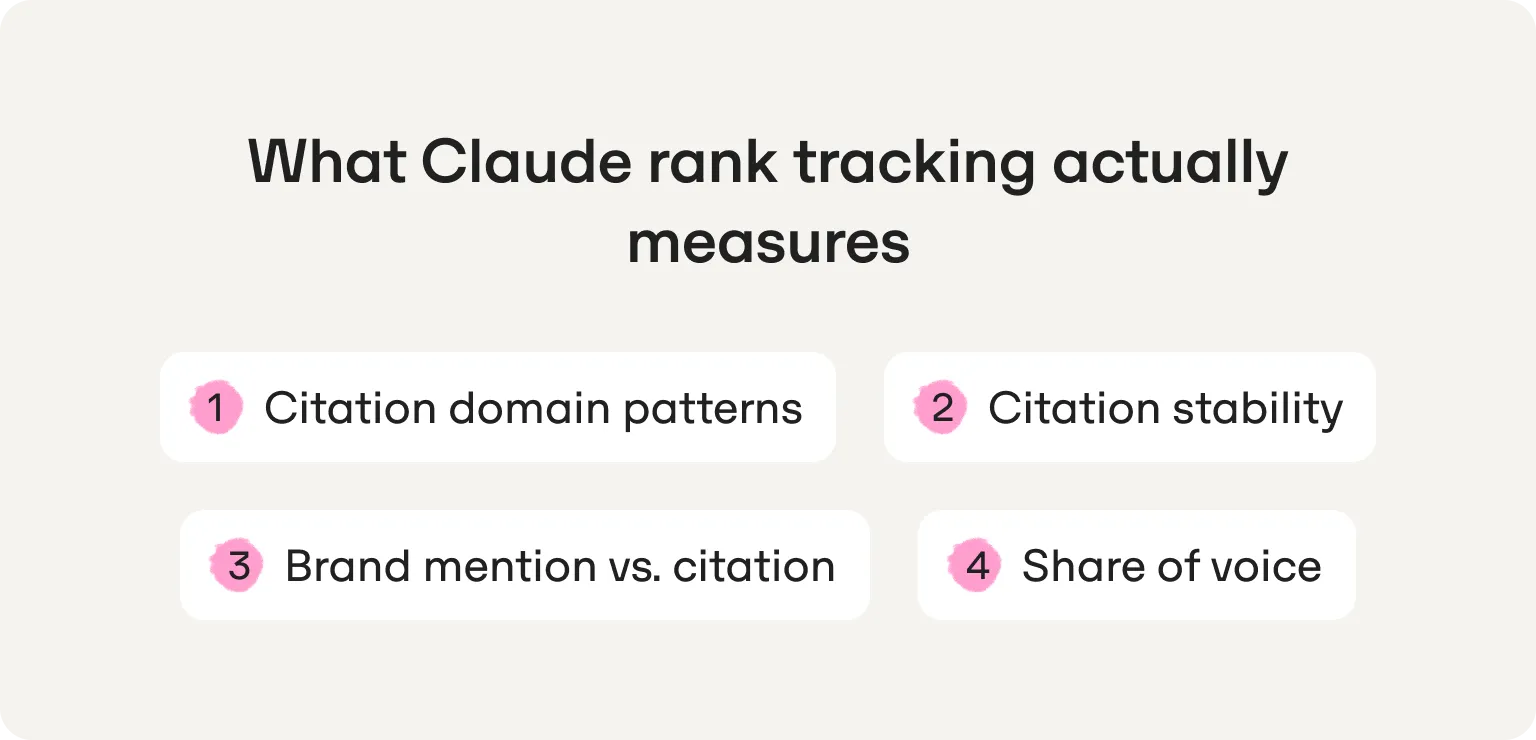
Four signals are worth collecting:
- Citation domain patterns. With 93.3% of Claude citations going to third-party sources and only 6.7% to owned domains, the productive question is not "how often does Claude cite my website?" It is "which editorial and independent web sources does Claude pull from for prompts that should surface my brand, and am I present in their content?" This requires looking at tracking data at the domain level, not the keyword level.
- Citation stability. Claude's citation pool churns less than ChatGPT's week over week.
If a competitor is entrenched in Claude's source pool for your category, they are harder to displace than on ChatGPT. If you earn a position in that pool, you hold it longer. These are directional findings based on Omnia's first two weeks of Claude tracking; patterns will firm up over time.
- Brand mention vs. citation. These are different signals. A citation is a domain Claude pulls from as a source. A mention is whether Claude names your brand in the response text. A source can be cited without the brand appearing in the answer. Tracking both tells you whether you have a sourcing problem (Claude is not pulling from domains where you appear) or a framing problem (Claude is pulling from your sources but not surfacing your brand name).
- Share of voice. Knowing your brand appears in 40% of relevant prompts is less useful than knowing a competitor appears in 80% of the same prompts. Relative presence across a consistent prompt set is what tells you whether you are winning or merely showing up.
How to set up Claude-specific tracking
The prompts you use for ChatGPT tracking are not the right starting point for Claude. With only 17.6% cross-engine citation overlap, a prompt set built around one engine produces unreliable signal on another. Build Claude tracking as a separate workstream from the ground up.
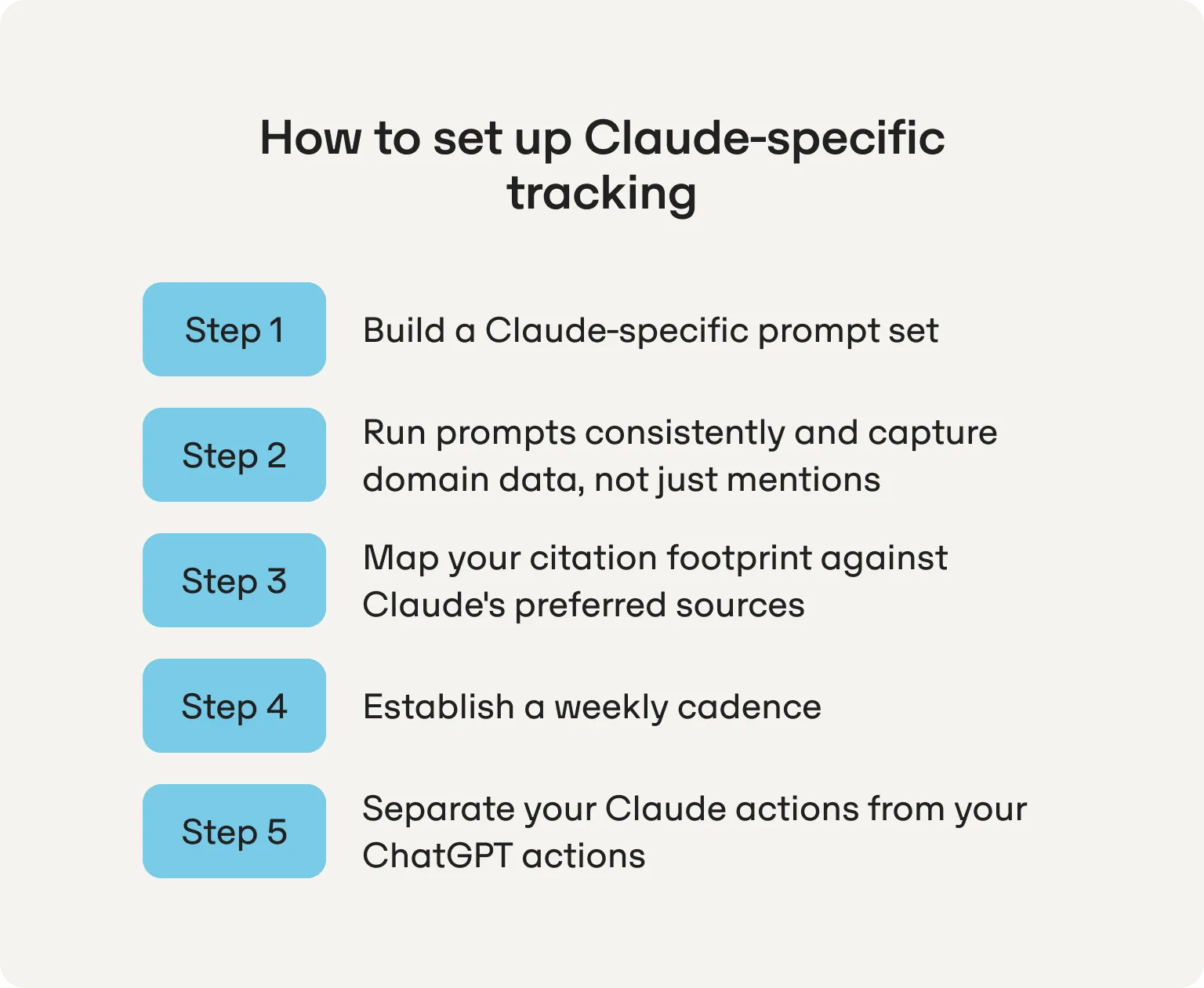
Step 1: Build a Claude-specific prompt set.
Claude attracts users who want longer, more analytical answers. Prompt structure should reflect decision-stage and evaluative queries rather than navigational ones. For example, think more along the lines of: "what are the best [category] tools for [use case]" rather than "what is [brand]."
One calibration point worth applying: Peec AI analyzed 37,804 AI responses across 5 LLM engines (published in Search Engine Journal in June 2026) and found that prompt wording variation matters less for brand visibility than the underlying intent. Brands appear consistently across different phrasings of the same intent. The practical implication: prioritize intent coverage across the buyer journey rather than engineering multiple wording variations of the same query.
Testing 10 phrasings of "best project management tool for startups" returns less incremental signal than adding a prompt that captures a genuinely different intent.
A workable starting structure that you get started on today:
Aim for 15 to 30 prompts covering all four intent types. See how to research prompts for guidance on mapping prompt intent to buyer stage.
Step 2: Run prompts consistently and capture domain data, not just mentions.
Because Claude cites 11.1 domains per answer, a manual spot-check approach will miss most of what is happening. The goal is not to know whether your brand appeared in three test runs. It is to know which domains Claude consistently cites in your category, and whether your brand has coverage on those domains. Run each prompt multiple times. You’ll most likely witness that Claude's responses might vary for identical questions. This will allow you to get a reliable visibility picture.
Step 3: Map your citation footprint against Claude's preferred sources.
With the owned vs. third-party split at 6.7% / 93.3%, the productive question shifts from "how do I get Claude to cite my website?" to "which third-party editorial sources does Claude cite in my category, and am I present in their content?" That question requires domain-level analysis, not keyword-level analysis.
Step 4: Establish a weekly cadence.
Claude's citation pool is stable enough that daily checks produce noise rather than signal. The data supports a weekly cadence: 84.4% of Claude's cited domains from week 1 still appear in week 2, compared to 61.5% for ChatGPT. Changes you observe from week to week reflect either a genuine shift in citation patterns or a content action that is landing. Both are worth knowing. Daily fluctuations on Claude are less meaningful than they are on ChatGPT.
Step 5: Separate your Claude actions from your ChatGPT actions.
Given the ~18% cross-engine citation overlap, treat Claude optimization as a distinct workstream. Editorial and independent web coverage is the shared lever that moves both engines. Reddit-based community presence moves ChatGPT and not Claude. G2 and LinkedIn carry marginally more weight in Claude. Build your action list from what Claude-specific data shows, not from a general GEO playbook written for all engines simultaneously.
What to watch and what to ignore for Claude tracking
Not every signal Claude tracking produces is worth acting on. Knowing which numbers to monitor and which to discount is what separates a useful weekly review from a noisy one.
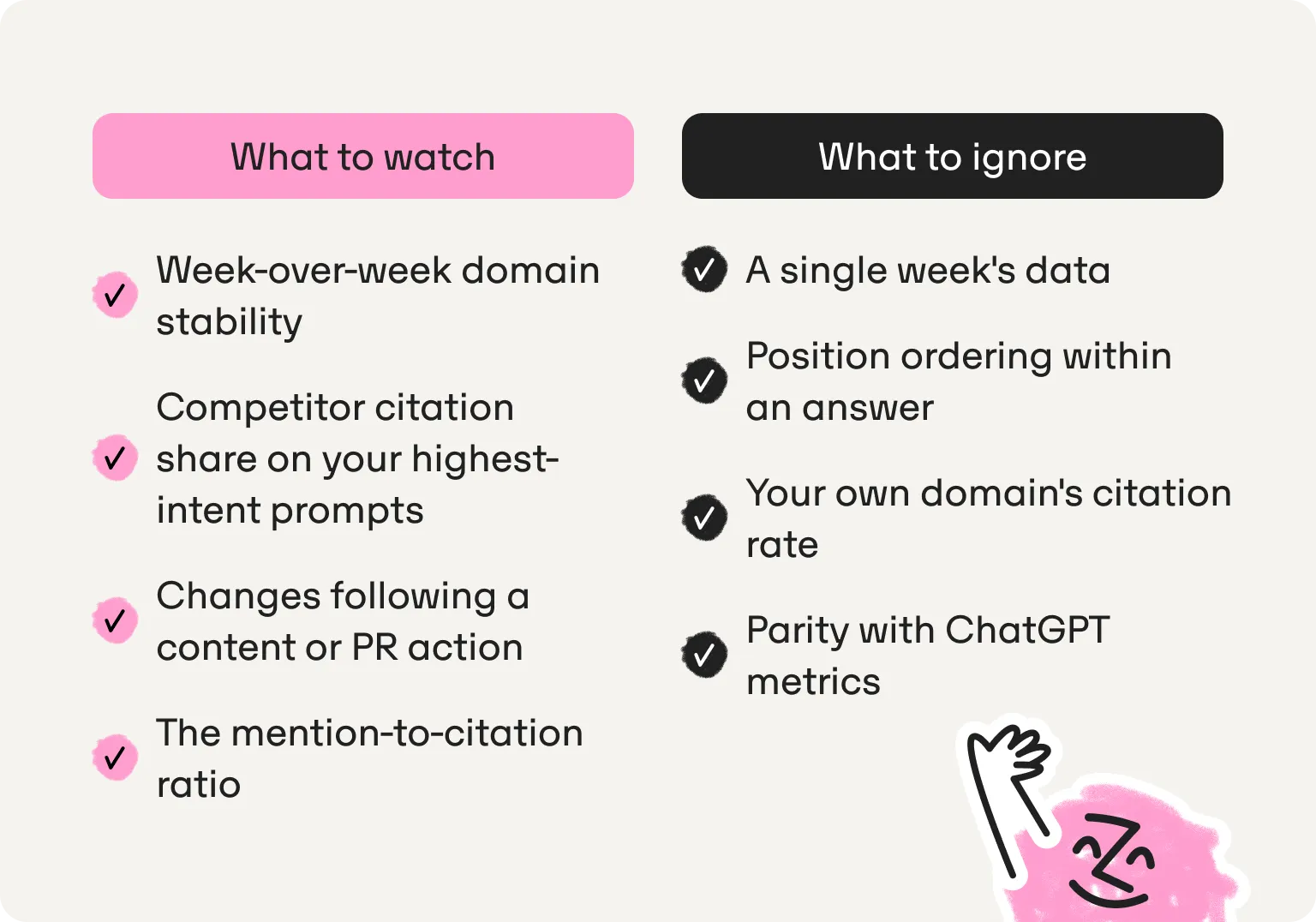
Watch these:
- Week-over-week domain stability. If a domain Claude cited consistently for your category prompts drops out of the citation pool, that is a meaningful signal, either the source lost credibility with Claude's retrieval layer or a competitor displaced it. Track which domains appear, disappear, and hold position.
- Competitor citation share on your highest-intent prompts. If a competitor appears in 80% of the prompts where you appear in 20%, the gap is the priority. Absolute visibility numbers matter less than relative standing on the prompts that reflect real buyer intent.
- Changes following a content or PR action. Claude's stability means its citation pool does not shift randomly week to week. If you publish a guest piece in a trade publication Claude cites consistently and your citation share moves the following week, that is a signal worth recording. The stability baseline makes attribution more credible on Claude than on ChatGPT, where the pool churns faster.
- The mention-to-citation ratio. If Claude is pulling from domains where your brand appears but not naming your brand in answers, the problem is framing, not sourcing. That is a different fix than a gap in editorial coverage.
Do not obsess over these:
- A single week's data. Omnia's Claude tracking is two weeks old as of this writing. Directional patterns are reliable; single-week anomalies are not. A prompt that shows your brand absent one week and present the next is noise until the pattern holds across three or more weeks.
- Position ordering within an answer. Claude does not produce rank 1, rank 2, rank 3 the way a SERP does. Whether your brand is named first or third in a Claude response is not a stable or meaningful signal at this stage of tracking maturity.
- Your own domain's citation rate. With 93.3% of Claude citations going to third-party sources, optimizing for self-citation is working against the grain. A low owned-domain citation rate is not a problem to solve. It is how Claude works.
- Parity with ChatGPT metrics. Your Claude visibility score and your ChatGPT visibility score will not move together. Given 17.6% cross-engine citation overlap, a week where ChatGPT visibility rises and Claude visibility holds flat is not a contradiction. They are different surfaces responding to different inputs.
The action layer: from Claude data to executed content
Monitoring Claude manually is possible at small prompt volumes. Thirty prompts, multiple markets, a weekly cadence, and domain-level source analysis at scale requires specific tooling that collects data the right way.
This distinction matters for Claude specifically. Omnia's data collection uses API access and real-browser simulation rather than scraping. Claude's responses vary more than traditional search results, which means scraping spot samples produces unreliable signal. The citation figures in this article were collected using Omnia's standard method across a consistent two-week window.
What Omnia surfaces for Claude tracking:
- Which domains Claude cites consistently across your monitored prompt set, ranked by citation frequency
- How your brand's citation share compares to specific competitors across the same prompts
- How brand mentions and citations trend week over week, so direction is visible without noise
- Where Claude's source patterns for your category diverge from ChatGPT and Perplexity so you know which editorial targets are Claude-specific and which move multiple engines
From data to action
The gap between a monitoring tool and an execution tool is what happens after the data arrives. Omnia's action layer generates content briefs and editorial targeting lists directly from citation data. If Claude is consistently citing three trade publications in your category and your brand has no coverage in any of them, the action is not to write another blog post. It is to get coverage in those publications. Omnia surfaces that targeting list rather than leaving the translation to the team.
Omnia MCP connects Claude visibility data into AI assistants directly, including Claude itself, so the data is accessible inside the tools your team already uses rather than requiring a separate dashboard login.
For teams that want to understand which existing content to prioritize for Claude optimization before creating new pieces, see source trust signals for AI.
Your potential customers are already asking Claude. Find out what it tells them by trying Omnia with a free 14-day trial or book a demo.
FAQs
Is Claude rank tracking the same as ChatGPT rank tracking?
No. The mechanics of what gets measured are similar: brand mentions, citation sources, and share of voice, but Claude and ChatGPT draw from largely different source pools. Omnia's data shows only 17.6% overlap in cited domains across the same prompts. A prompt set, source strategy, and action plan built for ChatGPT will not transfer to Claude. Both engines require their own tracking workstream.
Can I use Google Search Console to track Claude visibility?
No. Claude does not pass data into Search Console. Its answers do not generate impressions, clicks, or position data in any traditional SEO tool. The downstream effect of a Claude recommendation: a branded search and/or a direct visit, may eventually surface in your analytics, but you will not be able to attribute it without a dedicated AI visibility tracking system. This is precisely why Scrunch research found that AI-driven funnel impact routinely gets misattributed to organic or direct traffic.
How often does Claude change which sources it cites?
Less often than ChatGPT. Across Omnia's first two weeks of Claude tracking, 84.4% of domains cited in week 1 were still cited in week 2, compared to 61.5% for ChatGPT. The Jaccard similarity score for Claude's weekly domain sets was 0.62 versus 0.42 for ChatGPT. Claude's citation pool is tighter and more consistent. That said, two weeks is a short window. These figures should be treated as directional until more data accumulates.
Does Claude use Brave Search? Does that affect how I should optimize?
Anthropic has not named its search provider publicly. The claim that Claude uses Brave traces to a single analyst post from 2025 with no sourced evidence. Google Cloud's Vertex AI documentation refers to "a list of third-party search services selected by Anthropic", implying plurality rather than a single fixed engine. The strategic implication is unchanged regardless of which provider Anthropic uses: Claude grounds answers in live web content, so editorial presence on the sources Claude retrieves is what drives citation. No optimization decision should rest on an unconfirmed provider claim.
My brand appears on ChatGPT but not Claude. Why?
The most likely explanation is source divergence. Claude and ChatGPT pull from largely different domain pools, so presence on one does not carry to the other. Claude's third-party citations run 90.1% editorial and independent web content, with zero Reddit citations in Omnia's tracking window. If your ChatGPT visibility is driven by community presence, review platforms, or UGC sources, that strategy will not move Claude. The fix is to identify which editorial and independent web sources Claude cites in your category and build coverage there. That is a different content and PR brief than what is working on ChatGPT.
How does Claude decide what to cite and what does that mean for my content strategy?
Unlike Google, which ranks pages on links and technical SEO signals, Claude is Anthropic's conversational AI built on Constitutional AI principles that prioritize source credibility, topical authority, and content depth. Schema markup and structured data are not citation triggers for Claude, Google's own guidance confirms this, and the same logic applies across AI engines. The practical implication: third-party mentions in news articles and credible independent web sources carry more weight than structural content changes aimed at AI crawlers. Build topical authority, earn editorial coverage on sources Claude already cites in your category, and track which AI citations result.
What should I do if Claude surfaces outdated or inaccurate information about my brand?
Inaccurate AI mentions can originate from training data or from third-party sources Claude currently retrieves and the fix depends on which layer the problem is in. For retrieval-layer inaccuracies, the approach is to create accurate content on the sources Claude cites in your category and monitor brand mentions on those domains weekly. Omnia's tracking surfaces which domains are generating the inaccurate framing, so you are correcting at the source rather than updating content blindly. Consistent, high-quality third-party coverage on authoritative sources also shapes what future model versions learn, making citation analysis both a visibility strategy and a brand's digital footprint correction tool.
What does a Claude visibility report actually contain?
A Claude visibility report tracks key metrics across your monitored prompt set: how often your brand appears in Claude's answers (Claude mentions), which domains Claude cites when generating responses in your category, how your citation share compares to competitor visibility across the same prompts, and how all of these move week over week. Unlike AI traffic analytics tools that measure sessions arriving from Claude referrals, a Claude rank tracker measures what Claude says before any click happens, making it a leading indicator rather than a lagging one. The output is a working picture of your LLM visibility: where you appear, where competitors appear instead, and which source domains are driving both.
Does Claude tracking replace my existing SEO rank tracker?
No. Claude tracking and traditional rank trackers measure different things and neither is a replacement for the other. A conventional rank tracker measures Google rankings and traditional SERP rankings: positions on static URLs that Search Console can report on. Claude tracking measures AI discoverability across contextual conversations where there are no static URLs, no position numbers, and no Search Console data. Search behavior on Claude reflects user intent expressed in full questions rather than keywords, and Claude's answers are generated at runtime rather than pulled from an index. The two tools sit at different points in the same funnel: traditional SEO captures buyers who search Google, Claude tracking captures buyers whose search behavior has shifted to AI models. Content gaps, link building, and industry forums remain relevant inputs to both, what changes is how you measure whether they
How does Claude differ from Google AI Overviews and other AI platforms when it comes to brand visibility?
Claude, Google AI Overviews, and other AI assistants all generate AI responses from retrieved sources, but their citation behavior, training data, and retrieval mechanisms differ enough that a single visibility strategy does not transfer cleanly across them. Unlike traditional search engines, which return static URLs ranked by technical SEO signals and crawl data, conversational AI tools generate answers dynamically, meaning schema markup, internal linking, and Google Search Console data have no direct bearing on how Claude's responses represent a brand. Google AI Overviews sit closer to traditional search because they operate within Google's own index. Claude works from a separate retrieval layer that weights editorial and independent web content at 90.1% of citations, makes no use of Reddit, and shares only approximately 18% citation overlap with ChatGPT for the same prompts. A cross-platform visibility strategy requires separate domain maps, separate editorial target lists, and separate tracking cadences for each AI platform: what moves a brand's digital footprint on one AI engine will not automatically move it on another.
What does a complete Claude AI visibility strategy look like in practice?
A complete Claude visibility strategy runs across four workstreams. The first is visibility tracking: running a consistent set of relevant queries across Claude on a weekly cadence, capturing citation domains and brand mentions, and building a baseline against which directional improvement can be measured. Manual prompt testing works at small scale, but Claude visibility optimization at 30 or more prompts requires tooling. The second is citation auditing: identifying which AI search engines and authoritative content sources Claude pulls from in the category, then mapping competitor visibility across those same domains to surface gaps. The third is content strategy and placement: creating optimized content for editorial placement on Claude-cited domains, briefed around the user queries and prompt intents Claude surfaces most consistently. This is generative engine optimization in practice. The fourth is brand monitoring: tracking AI mentions and framing quality week over week, flagging when Claude's AI generated answers shift in accuracy or positioning, and adjusting editorial targeting when a correction action does not register within the expected window. Taken together, these four workstreams constitute a Claude SEO strategy that addresses both presence and representation, and not just whether the brand appears in AI answers, but what those answers say about it.