


This piece is built on Omnia’s proprietary analysis of 47,000+ monitored Copilot answers, not public benchmarks. Copilot cites fewer sources than any other major engine except Gemini, and those citations are the least stable week to week. The common advice to get listed on Bing or G2 doesn’t hold up against the data. What does is cross-model agreement. If you want Copilot SEO rank tracking to inform marketing decisions, stop optimizing for one engine and start earning consensus across several. Here’s what the numbers show and what to do about it.
Most of what’s been written about Copilot visibility is educated guessing. Omnia’s proprietary analysis of more than 47,000 monitored Copilot answers points to four findings that reshape how marketers should approach Copilot:
- Copilot runs the tightest citation budget of any major engine except Gemini
- Its top citations are the least stable week to week
- The sources it draws from barely overlap with other engines
- The big B2B review platforms everyone tells you to get listed on account for only a sliver of its citations
Each one undermines a common assumption about how to win AI search visibility in Copilot. Let’s explore what the data shows and what to do about it.
What is Copilot SEO rank tracking?
Copilot SEO rank tracking is monitoring how often and where your brand appears in Microsoft Copilot’s generated answers, and which sources Copilot cites to back those answers up. If you’ve looked into Copilot rank tracking tools before, you know “rank” here isn't a classic keyword position.
Instead, AI search visibility in AI answers is a mix of:
- Presence: Does your brand show up at all
- Prominence: How early and how strongly it’s mentioned relative to competitors
- Citations: Which URLs and domains Copilot grounds its response in
Startup and scale-up marketing teams, SEO teams, and growth marketers need insight into AI visibility because Copilot’s answers shift constantly. Without ongoing tracking, there’s no way to know whether your AI search visibility is improving, eroding, or being outsourced to competitors. Choosing the right Copilot SEO tracking tool early saves you from stitching together screenshots and spreadsheets later.
How Copilot rank tracking differs from traditional Bing rank tracking
Traditional rank tracking is formulaic. You pick a keyword, run a query, and Bing returns 10 blue links in a fixed order. Position three means position three. If you run the same query tomorrow or next week, you’ll likely get the same result.
Copilot doesn’t work that way. It generates a synthesized answer instead of a list of links. The same prompt can return different sources depending on prompt wording, location, session state, or time of day. And the exact same prompt can return different answers on Copilot versus other AI search engines like ChatGPT or Perplexity.
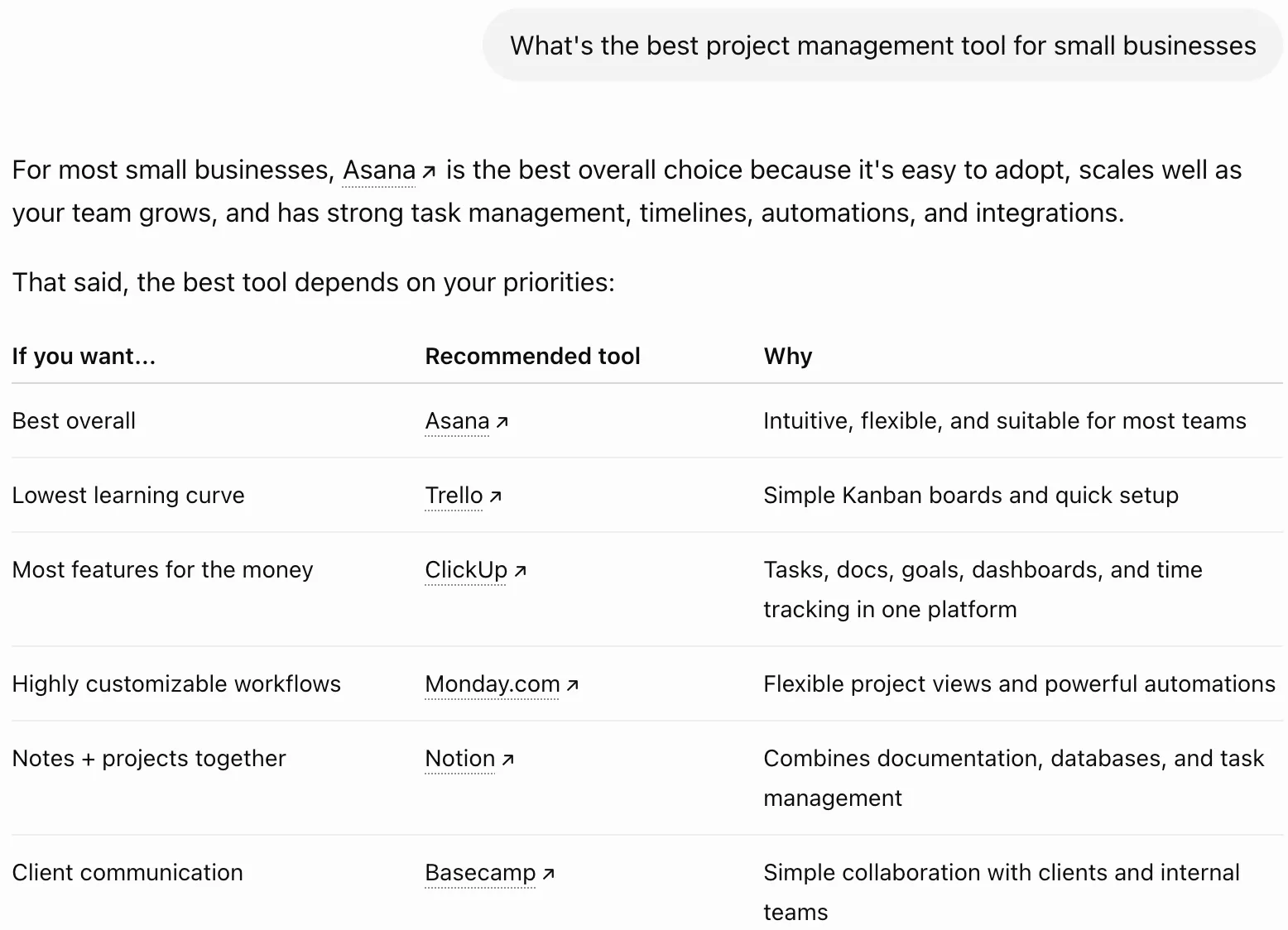
For example, searching “What's the best project management tool for small businesses” on ChatGPT returns Asana as the #1 recommendation.
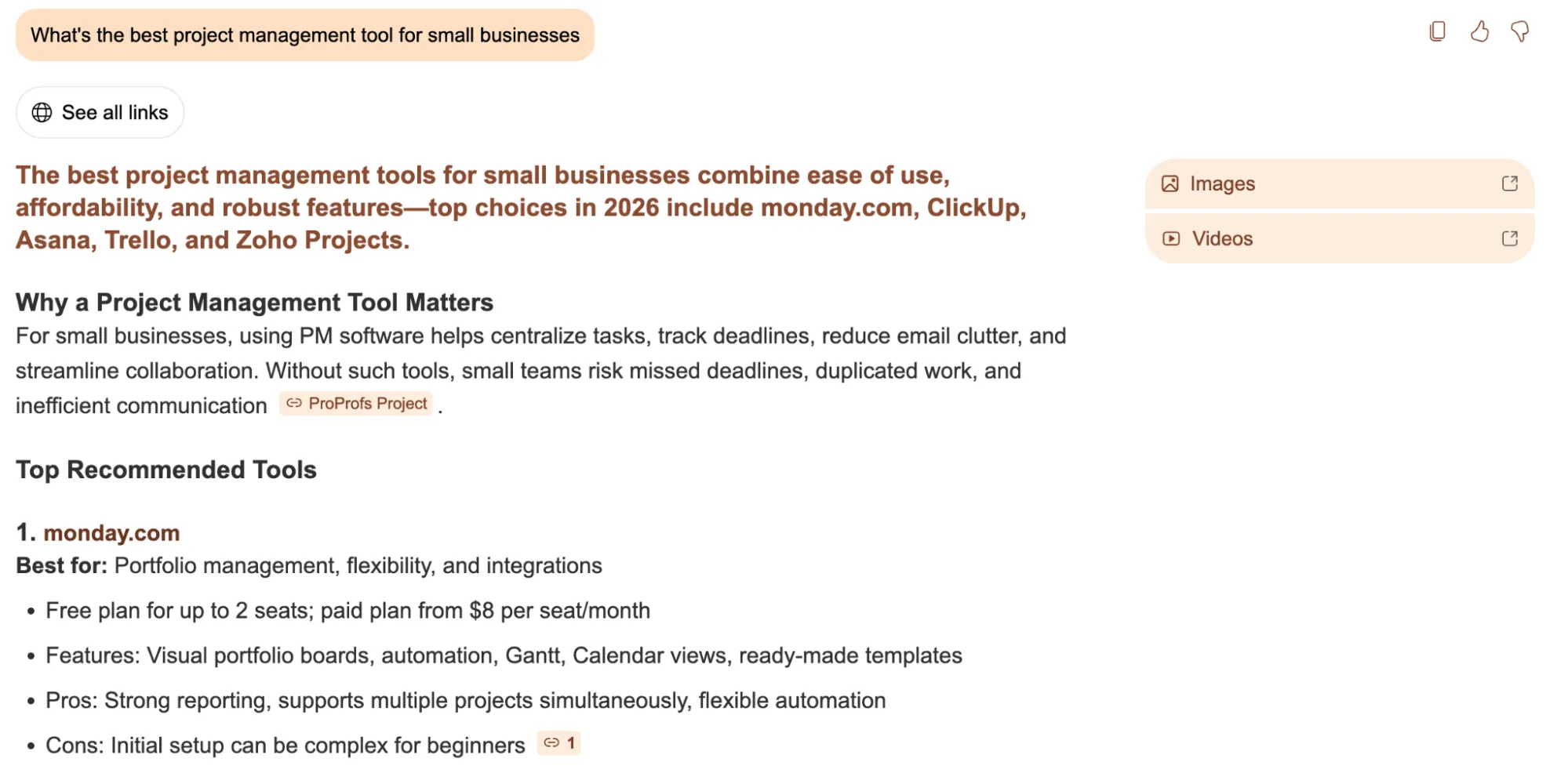
The same prompt on Copilot results in Monday.com as the top suggestion.
The unit of measurement isn’t a URL position. It’s answer inclusion plus the cited sources behind that answer. AI citation tracking exists precisely because those cited sources are where the real signal lives.
Marketers need proof of a visibility trend over time, an understanding of why competitor sources are winning, and a clear signal on what to change. Copilot tracking has to account for variability and surface patterns that hold up across repeated runs. A single snapshot doesn’t tell the entire story.
Why Copilot only has room for a few answers
The most structural thing to understand about Copilot is how few sources it cites per answer. Omnia’s proprietary data shows Copilot cites an average of 4.36 distinct domains per answer. That’s less than half of ChatGPT (9.97), Google AI Mode (10.47), and Claude (11.15). Only Gemini, at 4.16, is comparably narrow.
The concentration is even tighter than the average suggests. 6 in 10 Copilot answers cite 4 domains or fewer. 87% cite 5 or fewer. Only 13% of answers cite 6 or more domains.
Fewer citation seats means a much higher bar to be one of them. Copilot rewards being a clear category answer, not one option among many. If your brand is the third or fourth name in a list of alternatives, you’re fighting for one of 4 slots, not one of 10. That changes how you think about content, positioning, and where you invest effort.
Copilot rank tracking online: Why your citation isn’t permanent
Even if you win a Copilot citation, keeping it is harder than on any other major engine. Omnia measured week-over-week top-domain retention, running the same method across Copilot, ChatGPT, and Google AI Overviews over the same recent window so the three numbers are directly comparable.
.webp)
Only 41.5% of Copilot prompts keep the same top-cited domain from one week to the next. That’s about 10 points below ChatGPT (51.5%) and Google AI Overviews (52.1%). A number one Copilot citation is the least durable top position among the major engines measured.
This is why live, ongoing tracking matters. Some AI visibility platforms only offer weekly runs, which isn’t enough. A single snapshot tells you where you are today. But you don’t know whether that position will hold. Copilot rank tracking has to control for the variables that shift answers: country, language, device, time of day, prompt template, and competitor set. Without those controls, you can’t tell whether a change in your citation is a real trend or just noise from a different prompt phrasing.
You don’t win a citation once. Instead, you defend it, week over week, and you track it often enough to know when it slips before it becomes a pattern.
Bing Copilot brand visibility tracking: Why comparing to Bing rankings doesn’t hold up (and what does)
You might assume that Copilot visibility tracks closely with Bing rankings, since they’re both Microsoft products. It makes sense, you optimize for Bing, and Copilot visibility should follow. But if you’re looking for the best Copilot rank tracking approach, it starts with infrastructure that treats Copilot as its own engine across major AI search platforms, not a Bing proxy.
What we can’t measure
We checked whether Omnia could verify this from its data. It can’t. Omnia’s databases hold AI engine citation data only. Testing the Bing-vs-Copilot overlap claim properly would require pulling Bing organic results for the same set of prompts from an external SERP provider, then joining those results to Copilot citations on the shared queries. That’s a separate data project, not a shortcut worth pretending we have a number for.
What we can measure
So instead of pretending to answer a question the data can’t support, here’s what our data can answer: Does a domain need to win Copilot on its own, or does agreement across other models matter more?
Omnia looked at the 4,000+ prompts that ran on Copilot, ChatGPT, and Perplexity in the same window, and compared which domains each engine cited.
Looking at any single engine, only 13% to 18% of its cited domains reappear in Copilot for the same prompt. That’s a low overlap. Copilot draws from a substantially different source set than ChatGPT or Perplexity.
But cross-model consensus changes the picture. When a domain is cited by both ChatGPT and Perplexity, it shows up in Copilot 39.6% of the time. That’s roughly 3x the single-engine base rate. Consensus across models is the strongest signal of Copilot visibility Omnia can measure.
Clearly the lever for Copilot visibility isn’t optimizing for one engine. It's earning agreement across several. A domain that multiple AI engines independently decide is worth citing is far more likely to land in Copilot’s narrow set of sources than one that only ranks well in a single engine. We can say this more confidently than that if you optimize for Bing, Copilot visibility will follow.
The G2 and Capterra myth: Where B2B citations actually come from
If you’ve read anything about optimizing for AI search, you’ve probably seen that if you’re listed on G2 and Capterra, you’ll win Copilot. But the data contradicts this claim.
Omnia analyzed a broad B2B software discovery subset of Copilot citations. It included more than 19,000 citations across about 443 prompts containing terms like “software,” “tool,” “platform,” “alternative,” or “vs.” Here’s where those citations actually go.
About 93% of Copilot citations in this subset go to sources other than the brand’s own site or the big review platforms. Owned content is only 4.5%. Third-party review platforms like G2, Capterra, and TrustRadius combined are just 2.4%, spread across only 12 distinct domains. The advice to “Get listed on G2 and Capterra and you’ll win Copilot” doesn’t hold up according to our data.
A smaller CRM-specific cut illustrates the same pattern, though with a caveat. Our sample is thin (a little less than 700 citations across 23 prompts) and skews Spanish. It’s an illustrative example, but don’t treat it as a generalizable claim.
In that cut, 94.1% of citations go to other sources, 5.2% to owned content, and just 0.7% to review platforms. The top-cited domains are crm.org (5.8%) and typeform.com (3.5%), not G2 or Capterra. Across all Copilot citations, g2.com accounts for only 0.32%. The most cited domain overall is linkedin.com at 0.91%.
Winning Copilot citations is a placement game across a long tail of third-party sites, not an on-site SEO game and not a “get on the big directories” game. Copilot spreads its citations across more than 2,800 distinct domains in this subset alone.
The sources that matter are editorial sites, niche comparison blogs, community content, and other vendors’ pages, not the handful of review platforms everyone assumes dominate.
What this means for your Copilot tracking strategy
All the data above points to a coherent set of actions:
- Track cross-model consensus, not single-engine performance: If your AI tracking only covers Copilot, you’re missing other signals that predict Copilot visibility. Monitor at least two other engines alongside it and watch which domains earn agreement across all of them.
- Treat a citation as something to defend on a weekly cadence, not a one-time win: A top position you hold this week may be gone the next. Set a weekly check rhythm and watch the trend line.
- Build placement strategy around the sources your category actually gets cited from: Identify which third-party and editorial domains already win in your space, and focus effort there. Don’t assume the big review platforms or Bing rankings are the lever, our data says they're not. Brand mentions across AI platforms tell you where the real opportunity sits.
Why Omnia is the best fit for marketers who need to act on this
Every finding in this piece came from Omnia's proprietary citation database, built on ClickHouse, monitoring real AI answers across engines. Omnia monitors Copilot alongside six other major engines so you can see cross-model consensus directly, tracks citations at the URL and domain level, localizes AI visibility tracking by country, and refreshes data daily until it converges.
But finding a citation gap is only useful if you can act on it. Omnio, Omnia's built-in GEO agent, reads your citations across every engine you track, drafts the content shaped to match what Copilot already cites, and measures whether the move worked. It also connects to GA4, so you can ask it directly how much referral traffic ChatGPT is sending your site and get a chart in the chat window. Anything that publishes waits for your approval.
You can see Omnia’s transparent, tiered pricing before you commit, or book a demo to see the citation infrastructure behind these findings in action.
Start for free and sign up for an Omnia account.
FAQs
What does Copilot SEO rank tracking measure if there's no fixed ranking?
It tracks Copilot mentions, Copilot responses, and share of voice across prompts over time, segmented by country. There's no fixed rank position because Copilot generates answers, not link lists. A Copilot rank tracker measures AI search visibility as a composite of AI presence, prominence, and citations.
Does getting listed on G2 or Capterra help with Copilot rank tracker visibility?
No. Review platforms like G2, Capterra, and TrustRadius combined account for only 2.4% of Copilot's B2B citations. Competitor analysis shows the long tail of editorial and niche comparison sites matters far more, spread across more than 2,800 distinct domains.
Is Copilot visibility the same as ranking well on Bing?
This can't be verified from citation data alone. Visibility in Microsoft Copilot doesn't map cleanly to bing's index because Omnia's data covers AI citations, not organic SERPs. The more useful signal is cross-model consensus, not single-engine performance.
How often does a Copilot citation change?
Per Omnia’s data, only 41.5% of Copilot prompts keep the same top-cited domain week over week, the lowest retention among major AI engines. Roughly 6 in 10 change every week, which is why ongoing Copilot rank tracking matters. Your Copilot visibility data can shift without anything changing on your site.
What should I prioritize first if I'm starting from zero on Copilot visibility?
Start by identifying which third-party and editorial domains already get cited in your category, then check whether you're part of the cross-model consensus set. Use prompt tracking and AI visibility tracking together across multiple AI search platforms to see where you stand before assuming a single-engine fix will help. A dedicated Copilot tracker gives you the baseline you need to know where to focus first.