

Learning how to rank in ChatGPT search starts with accepting that there is no static #1 position — only mention rate, citation rate, and share of voice across a defined prompt set. Start by confirming your pages are crawlable and indexed, reverse-engineer the domains your competitors are being cited from, and track visibility weekly by prompt cluster and country. The rest of this playbook shows you how to run that system repeatably and which tool turns it from a manual exercise into an automated feedback loop.
Most "how to rank in ChatGPT" advice is traditional SEO repackaged with new terminology. Optimize your content, get backlinks, improve your E-E-A-T score — and wait. That is not a ChatGPT visibility strategy. It is an SEO strategy with aspirations.
ChatGPT doesn't maintain a ranked list of results. It synthesizes answers from a small, selective pool of sources, and based on Omnia's proprietary citation database tracking 42M+ citations, that pool averages just four domains per ChatGPT answer. That is three times more selective than Google AI Mode. Getting cited by ChatGPT is not a ranking problem. It is an eligibility and authority problem and it requires a different measurement system than the one most SEO strategists are running today.
This playbook gives you that system: a prompt library architecture, a repeatable measurement framework, a seven-step technical foundation, and an honest account of what you can control versus what the model decides on its own.
What "ranking" means in ChatGPT — and what it doesn't
There is no universal position in a ChatGPT answer. Answers vary by user, country, retrieval mode, and the specific phrasing of the prompt. Two people asking the same question in different markets can receive materially different shortlists. One run of one prompt tells you nothing reliable about your actual ChatGPT visibility.
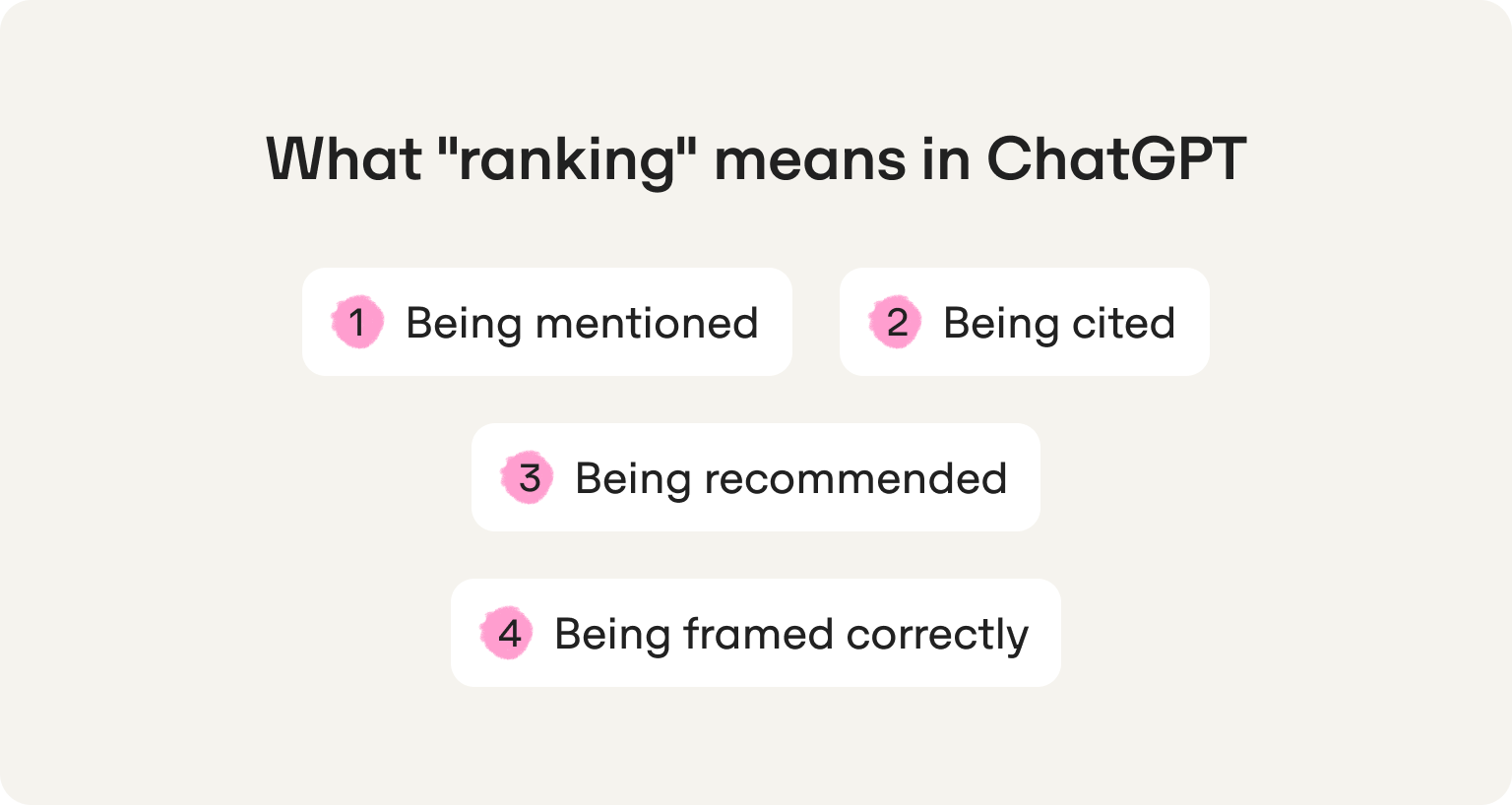
What you can measure — and what "ranking" actually means in this context — breaks into four operational categories:
- Being mentioned means your brand name appears in the answer, even without a URL citation. Mentions drive brand discovery and entity reinforcement. They do not guarantee traffic.
- Being cited means your URL is explicitly linked in the response. Citations drive verifiable referral traffic and reinforce source-level trust with the model. Ideally, you want both.
- Being recommended means your brand appears in the top one to three vendors shortlisted for a commercial prompt. This is the position that drives consideration — and the one AI competitive saturation makes progressively harder to enter as citation patterns consolidate.
- Being framed correctly means the engine describes your brand with the right category, use case, pricing model, and differentiation. A brand mentioned in the wrong context — positioned as an enterprise tool when it serves startups — loses the buyer even when it appears.
The pain point for SEO strategists: none of this is captured by traditional rank trackers, keyword tools, or traffic dashboards. You need a different measurement layer.
How it differs from traditional SEO
Traditional SEO is deterministic. A keyword has a SERP. A page holds a position. A position change is observable and attributable. ChatGPT is probabilistic. The same prompt produces different outputs across sessions, users, geographies, and retrieval modes.
Two concrete examples make this clear.
A "best project management software" keyword query produces a relatively stable Google SERP that SEO tools can track. The same question asked as a ChatGPT prompt produces a synthesized answer that may name three different vendors depending on whether the user is in the US or UK, which retrieval index was active, and what sources ChatGPT retrieved in that session.
A "how do I migrate data from Salesforce to HubSpot" query produces a Google SERP where documentation pages and how-to guides compete on backlink authority and keyword optimization. The same prompt in ChatGPT produces a synthesized answer drawn from the sources ChatGPT considers most authoritative — which are more likely to be editorial publications, comparison directories, and community platforms than the vendor's own blog.
What you can control: content structure, technical accessibility, entity consistency, and off-site source presence. What you cannot control: model behavior, personalization effects, and unseen training priors. The playbook focuses exclusively on what is controllable.
How ChatGPT search chooses what to say — training vs retrieval vs citations
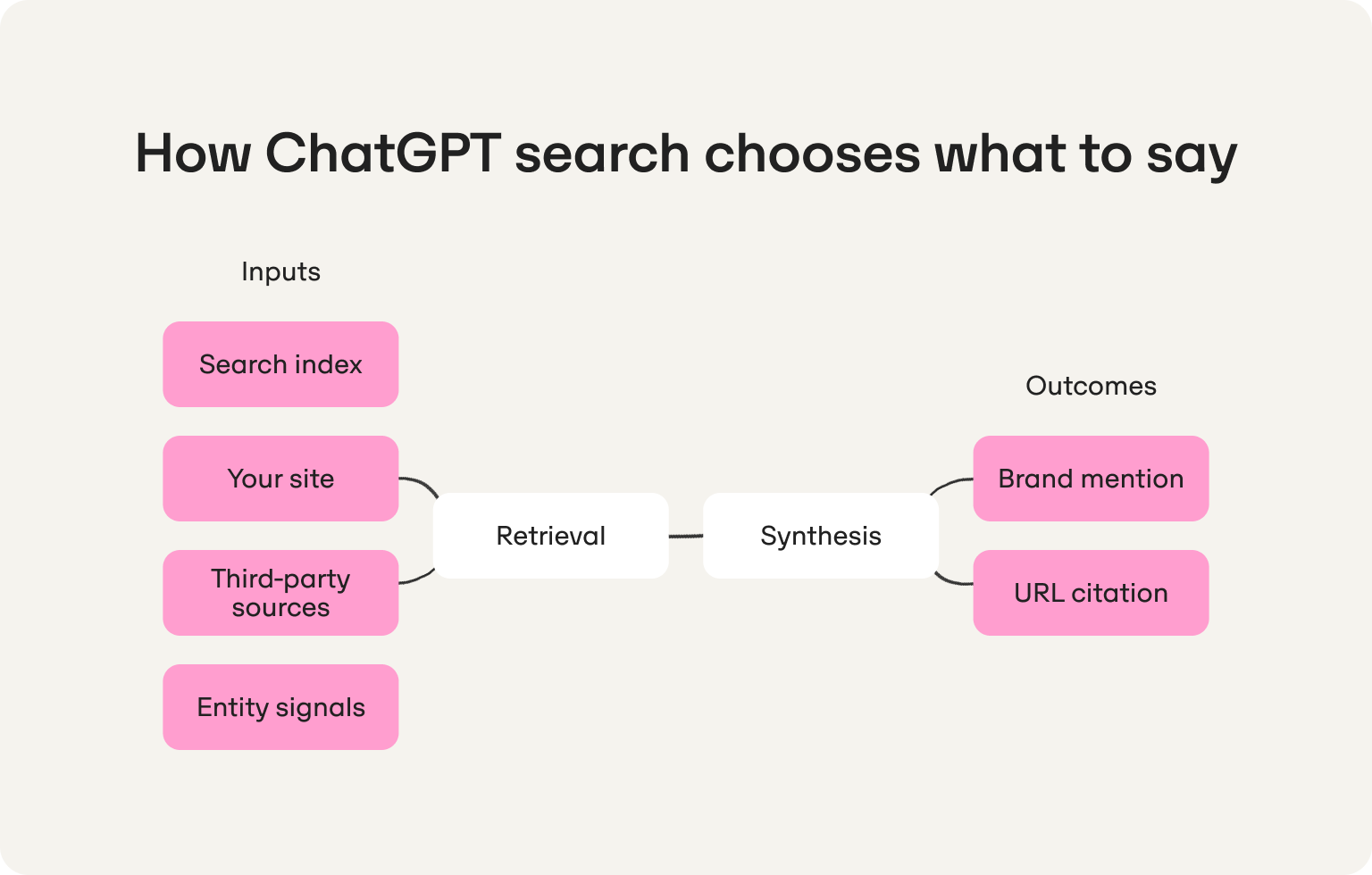
ChatGPT answers from two sources simultaneously: training data baked in during model development, and live retrieval from search indexes when the "search" capability is active. The balance between the two depends on the query type and the user's ChatGPT version.
For search-enabled ChatGPT experiences — the ones relevant to brand visibility and commercial prompts — the AI retrieval layer determines which sources are fetched, parsed, and surfaced in the answer. The model then synthesizes those sources into a response, selectively citing the ones it considers most credible and most relevant to the specific question.
Citations vs mentions — why "my site isn't linked" can still be a win (and a problem)
A mention without a URL means the model has your brand in its answer but didn't pull a specific page as a source. This is useful for brand discovery — buyers encounter your name — but it provides no verifiable traffic signal and no source-level authority reinforcement.
A citation with a URL means the model retrieved your content directly and chose to surface it as a reference. This drives referral traffic you can track, and it signals that your content meets the eligibility criteria the model applies when selecting sources.
Track both. Mention rate tells you whether your brand entity is recognized. Citation rate tells you whether your content is trusted as a source. A rising mention rate with a flat citation rate — a common pattern — signals that entity recognition is forming but source-level authority is still insufficient. That gap is what structured content, entity consistency, and off-site citation building are designed to close.
What you can trust vs what is directional
What you can trust: Logged prompt outputs with captured text, citation URLs and domains observed, referral traffic tagged to AI sources in analytics, indexation status in search consoles, and mention and citation rates measured consistently across a defined prompt set.
What is directional: True "rank" in any static sense, personalization effects on individual sessions, and unseen model priors from training data you cannot inspect. Treat these as signals, not facts.
How to rank in ChatGPT search
Before any strategic optimization, the prerequisite is confirming that ChatGPT's search function can actually find and retrieve your content. Search-enabled ChatGPT draws from Bing's index. If your pages are not indexed there, they are not eligible for citation, and this is regardless of how well they perform on Google.
The checklist before any optimization work begins:
- Verify key commercial pages return 200 status codes.
- Confirm no accidental noindex tags on pricing, integration, comparison, or alternatives pages.
- Submit an XML sitemap to Bing Webmaster Tools.
- Check robots.txt for blocks that may prevent Bing crawling.
- Confirm clean canonical tags on all commercial pages.
- Verify core content renders in server-side HTML — not behind JavaScript that Bing cannot execute.
- Test five to ten target prompts in ChatGPT with search enabled to confirm whether your domain appears at all.
Bing visibility basics that affect how to rank in ChatGPT search
Bing does not equal ChatGPT. The model has its own retrieval logic, entity understanding, and synthesis behavior. But Bing indexation is the access gate. Without it, retrievability is zero.
The operational basics, without drifting into generic SEO:
Ensure your pages are indexable and free of canonicalization conflicts. A page that canonicalizes to a different URL than the one Bing has indexed creates retrieval confusion — the model may fetch one version and cite another. Clean XML sitemaps, fast HTML rendering, and avoided accidental blocks in robots.txt are the floor conditions. Pages that meet these conditions are eligible. Pages that don't are invisible regardless of content quality.
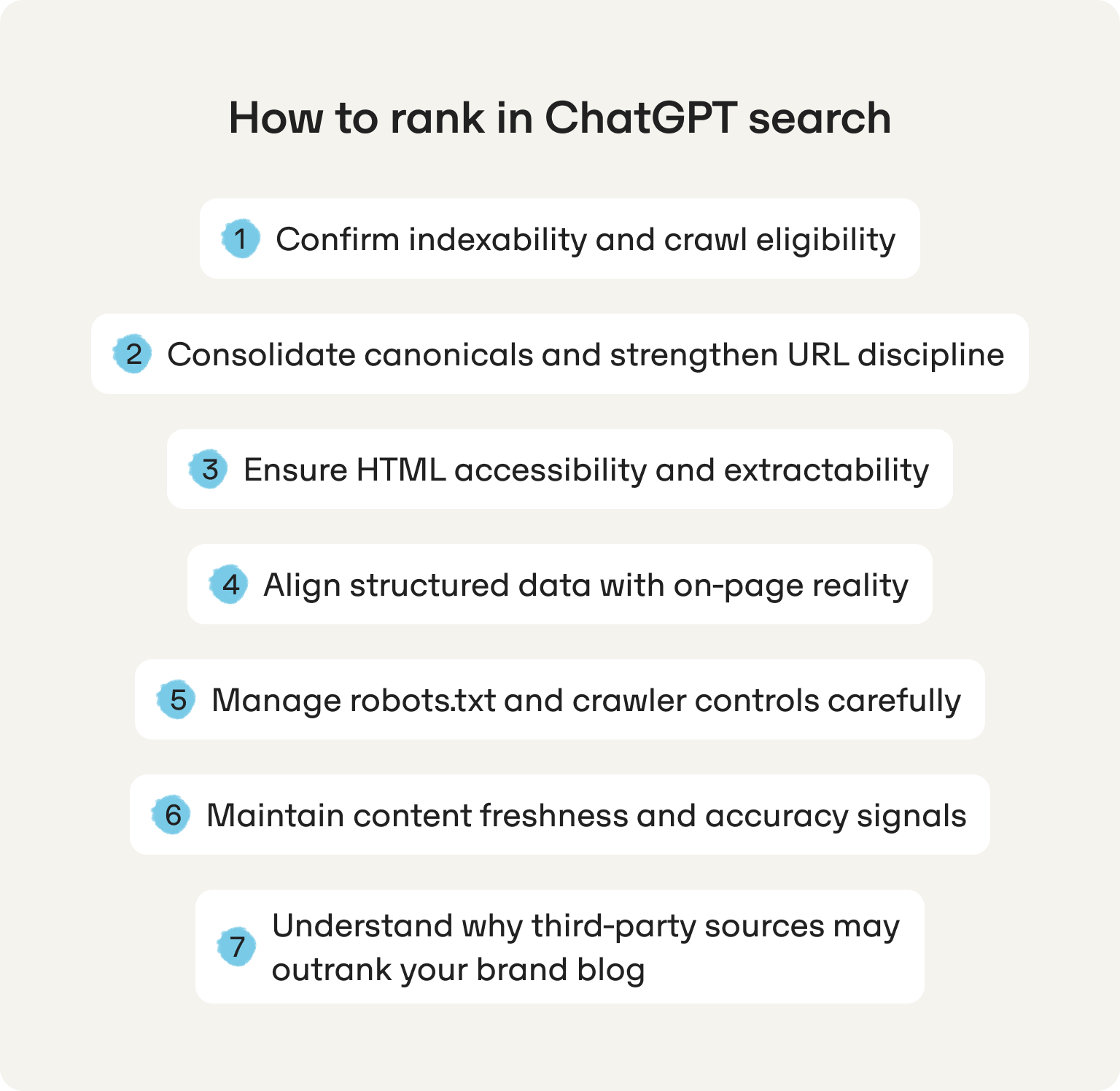
How to rank in ChatGPT search: 7 technical and retrieval foundations
Some ChatGPT answers use live retrieval from search indexes and external sources. Whether your content is included in that retrieval depends on eligibility — the combination of indexability, accessibility, structural clarity, and source authority. Model behavior cannot be controlled. Retrievability and structural clarity can. These seven steps are the operational foundation that must be in place before strategic or measurement improvements will produce consistent results.
Step 1 — Confirm indexability and crawl eligibility
Frame this as eligibility validation before optimization. A page that fails here is not in the game regardless of how well it is written.
- Audit all commercial and evaluation pages: pricing, alternatives, integrations, comparison pages, and implementation guides.
- Verify 200 status codes on all target pages.
- Check for absence of noindex meta tags and X-Robots-Tag headers.
- Confirm clean self-referencing canonical tags.
- Confirm inclusion in XML sitemap.
- Inspect robots.txt for accidental blocks — particularly on JavaScript bundles that contain critical content.
- Cross-check indexation in Bing Webmaster Tools specifically, not just Google Search Console.
Answer inclusion criteria — the conditions a page must meet to be considered as a source — begin here. Eligibility is the prerequisite. Everything else is optimization of an already-eligible page.
Step 2 — Consolidate canonicals and strengthen URL discipline
Signal dilution is the hidden cost of fragmented URL structures. When multiple pages address similar prompts with overlapping content, retrieval systems cannot identify which URL carries the authoritative signal.
- Identify overlapping or thin pages targeting similar prompt clusters.
- Consolidate duplicate or fragmented content into single authoritative URLs.
- Maintain self-referencing canonicals on every consolidated page.
- Assign one primary URL per prompt cluster and redirect competing variants.
- Eliminate unnecessary parameter-based indexed URLs.
Consolidation does not reduce content breadth — it concentrates retrieval clarity so the model knows which page to pull when a relevant prompt is run.
Step 3 — Ensure HTML accessibility and extractability
Retrieval priority is partly determined by how cleanly a model can parse your content. Pages that render core content in JavaScript that AI crawlers won't execute are functionally invisible to the retrieval layer, even if they rank on Google.
- Verify that key definitions, explanations, and claims appear in raw HTML — view page source, not the rendered DOM.
- Ensure server-rendered HTML for all content that matters for citation: product descriptions, feature definitions, comparison claims.
- Structure content using clear H1–H3 hierarchy so retrieval systems understand the page's information architecture.
- Use lists, tables, and definition blocks to improve answer extraction rate — the probability that a specific claim can be pulled cleanly from the page.
- Avoid hiding critical content behind JavaScript tabs, accordions, or late-loading components.
Step 4 — Align structured data with on-page reality
Google has confirmed that no special schema is required to appear in AI features, including AI Overviews and AI Mode. Schema is not a citation trigger. It is an entity clarity signal: it helps models understand what your brand is, what it does, and how it relates to the category it operates in.
Where schema adds value:
- Organization schema: Confirms brand name, category, website, and official social profiles to reinforce entity consistency across sources.
- Product schema: Aligns pricing model, feature set, and positioning with what the model reads on the page to reduce the risk of narrative inaccuracy in AI answers.
- FAQPage schema: Structures direct question-answer pairs that retrieval systems can extract cleanly for informational prompts.
- Article schema: Provides authorship, publication date, and update signals that support content freshness and provenance attribution.
Critical rule: schema naming must match visible on-page content exactly. A mismatch between schema declarations and on-page text creates entity confusion. The model may cite one version of your product description while your schema declares another.
Step 5 — Manage robots.txt and crawler controls carefully
Robots.txt controls crawler access. It does not retroactively remove content from model training data already ingested. Changes to robots.txt affect future crawlability — not historical model knowledge.
Allow all public-facing content. Block admin, authentication, staging, and internal search directories. Coordinate any significant robots.txt changes with engineering and legal — accidental blocks on commercial pages are a common and invisible source of citation eligibility loss.
Step 6 — Maintain content freshness and accuracy signals
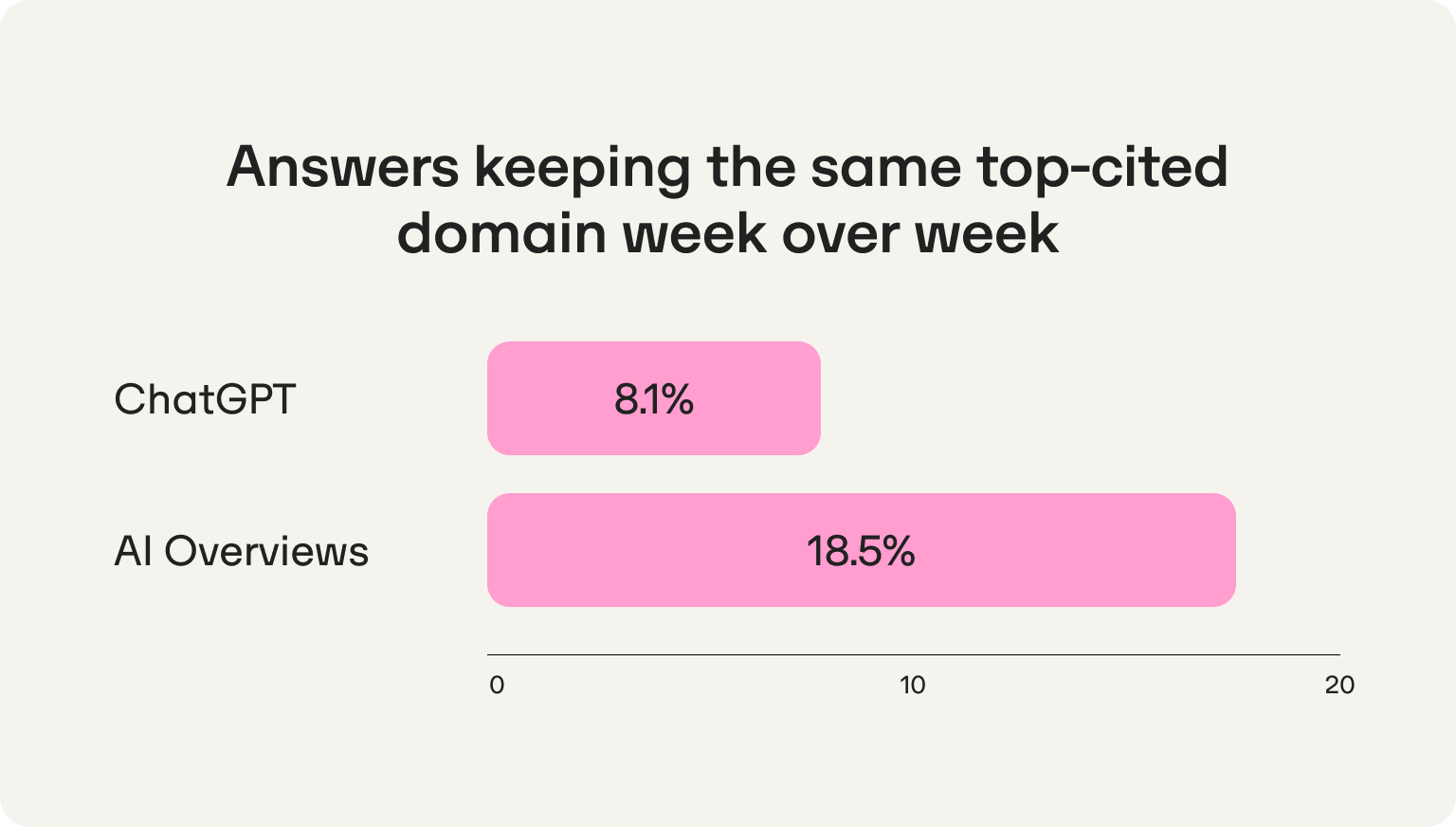
ChatGPT's citation behavior is volatile. Based on Omnia's citation database, only 8.1% of ChatGPT answers keep the same top-cited domain week over week — compared to 18.5% for AI Overviews. The model is actively re-evaluating sources. Stale, inaccurate content is a liability in this environment: a pricing page showing an outdated plan structure, a features list missing a recent integration, a comparison page that no longer reflects the competitive landscape.
- Audit pricing pages quarterly for accuracy — outdated pricing is one of the most common sources of narrative inaccuracy in AI answers.
- Audit integration lists and feature documentation at every product release.
- Update comparison and alternatives pages whenever a competitor makes a material change.
- Display clear "last updated" signals where appropriate — these function as provenance signals that models use to assess content freshness.
- Establish a quarterly review cadence for all high-intent commercial pages, not just new content.
Step 7 — Understand why third-party sources may outrank your brand blog
This is the finding most brand SEO teams resist. In commercial prompt categories — "best X software," "X alternatives," "X vs Y" — third-party sources consistently outperform vendor blogs in ChatGPT citations.
Based on Omnia's citation data and Kevin Indig's Growth Memo analysis across commercial prompts, review sites, directories, and editorial publications account for the majority of citations for "best" and "alternatives" prompt types. Vendor blogs account for a significantly smaller share. The mechanism is source trust: models perceive third-party sources as more neutral and more authoritative for comparative commercial queries than the brand being evaluated.
Citation confidence — the probability that a specific domain reliably produces citations for a given prompt type — is consistently higher for review platforms and comparison directories than for brand-owned domains in commercial contexts. Technical eligibility is necessary. It is not sufficient. The off-site trust footprint determines whether an eligible page actually gets cited.
This is the structural argument for investing in external citation building before publishing another product comparison post on your own domain.
Measurement framework: proving ChatGPT visibility is improving without fooling yourself
Most teams measure ChatGPT visibility the way they first measured SEO — by checking a few queries manually and forming an impression. That is not a measurement system. It is pattern-matching on noise.
A repeatable measurement system replaces "visibility" as a vague concept with five operational metrics, a structured prompt library, a country-level testing protocol, and an ownership layer that assigns accountability for every observed signal.
Build a structured prompt library — clustered by intent
Measurement starts with prompt architecture. A one-off prompt test tells you what ChatGPT said once. A clustered prompt library tells you how your visibility is trending across the query types that drive commercial decisions.
Required prompt clusters:
| Cluster | Example prompt | Target URL | Owner | Priority |
|---|---|---|---|---|
| Category | "Best AI visibility tools for startups" | /homepage or /product | SEO lead | High |
| Best for | "Best AI visibility tool for a lean marketing team" | /use-case page | SEO lead | High |
| Alternatives | "Alternatives to [competitor]" | /alternatives page | Content | High |
| Comparison | "[Brand A] vs [Brand B]" | /comparison page | Content | High |
| Pricing | "How much does [brand] cost" | /pricing | SEO Lead | Medium |
| Integrations | "[Brand] HubSpot integration" | /integrations | Technical | Medium |
| Implementation | "How to set up [brand]" | /docs or /guide | Technical | Low |
| Informational | "What is generative engine optimization" | /blog post | Content | Medium |
Build this library in a shared document. Assign ownership. Run every cluster on the same cadence. One-off testing produces noise; prompt coverage mapping across a consistent library produces signal.
Define the KPIs that actually matter
Five metrics. Defined operationally. No loose interpretation:
- Mention rate. Formula: (Prompts where brand appears ÷ total prompts tested) × 100. What it tells you: whether your brand entity is recognized by the model across your target prompt set.
- Citation rate. Formula: (Prompts where brand URL is cited ÷ total prompts tested) × 100. What it tells you: whether your content meets the source-level authority threshold the model applies when selecting citations.
- Share of voice. Formula: Brand mentions ÷ total brand mentions across all competitors in the prompt set. What it tells you: your competitive position — not absolute visibility, but visibility relative to the alternatives a buyer is likely to encounter in the same answers.
- Position in answer. Four operational categories: Top (first brand mentioned), Mid (included but not first), Bottom (mentioned as secondary or alternative), Not included. First-mention frequency across multiple runs is more meaningful than single-run position. Track it as a rolling average across your prompt library.
- Narrative accuracy score. Definition: does the model describe your brand correctly? Correct category, correct pricing model, correct integrations, correct differentiation. Run this as a qualitative audit quarterly — or immediately if you observe unusual drop-offs in mention rate that can't be explained by citation changes.
- Country split. Run every core commercial prompt across your priority markets. Retrieval indexes differ by geography. Trusted domains vary by region. Competitor landscapes differ. A single global snapshot systematically underrepresents or overrepresents your actual visibility in any given market.
How to measure position-in-answer consistently
Answer variability is real. The same prompt can produce different outputs across sessions, users, and retrieval states. A single run is not a data point — it is one observation from a probabilistic system.
The prompt variability impact on any individual run is high enough that single-run position tracking produces misleading conclusions. Run each prompt a minimum of three times per session. Log the full output each time — capture a screenshot or text export, not just a mental note of whether you appeared. Tag each answer segment: which brands appeared, in which position, with which citations.
First-mention frequency across multiple runs is your position metric. If your brand appears first in two of three runs, your first-mention frequency for that prompt is 67%. Track that number weekly. Changes in that number — not individual run results — are the signal.
Always capture full outputs. Always store them. A screenshot taken once and not logged tells you nothing about trend.
Country-level testing protocol
Select your top 20–30 commercial prompts. Run each prompt with location context set to your priority markets. For each market, record:
- Which brands are mentioned and in which position.
- Which URLs are cited and from which domains.
- Whether cited domains differ materially by geography.
Compare citation domain patterns across markets. In Omnia's citation data, the same "best AI visibility tool" prompt produced different shortlists across US and UK runs — UK answers cited industry blogs more frequently, US answers cited review platforms. If you are not testing by country, you are optimizing against incomplete data.
Document the geographic variation. It tells you which citation sources matter in which markets and where your off-site authority building should be concentrated.
Testing cadence and trend interpretation
Weekly: Core commercial prompt clusters — category, best for, alternatives, comparison. These are the prompts that drive consideration and should be monitored on the shortest cycle.
Monthly: Expansion prompts, new integration or feature prompts, informational prompts tied to recent content.
Quarterly: Full entity audit — does the model describe your brand correctly across all prompt types? Off-site citation review — which domains have entered or exited your citation profile?
Track rolling four-week averages to smooth the variability that makes individual-run data misleading. Do not react to a single-session drop in mention rate — it is likely noise. A four-week downward trend is a signal.
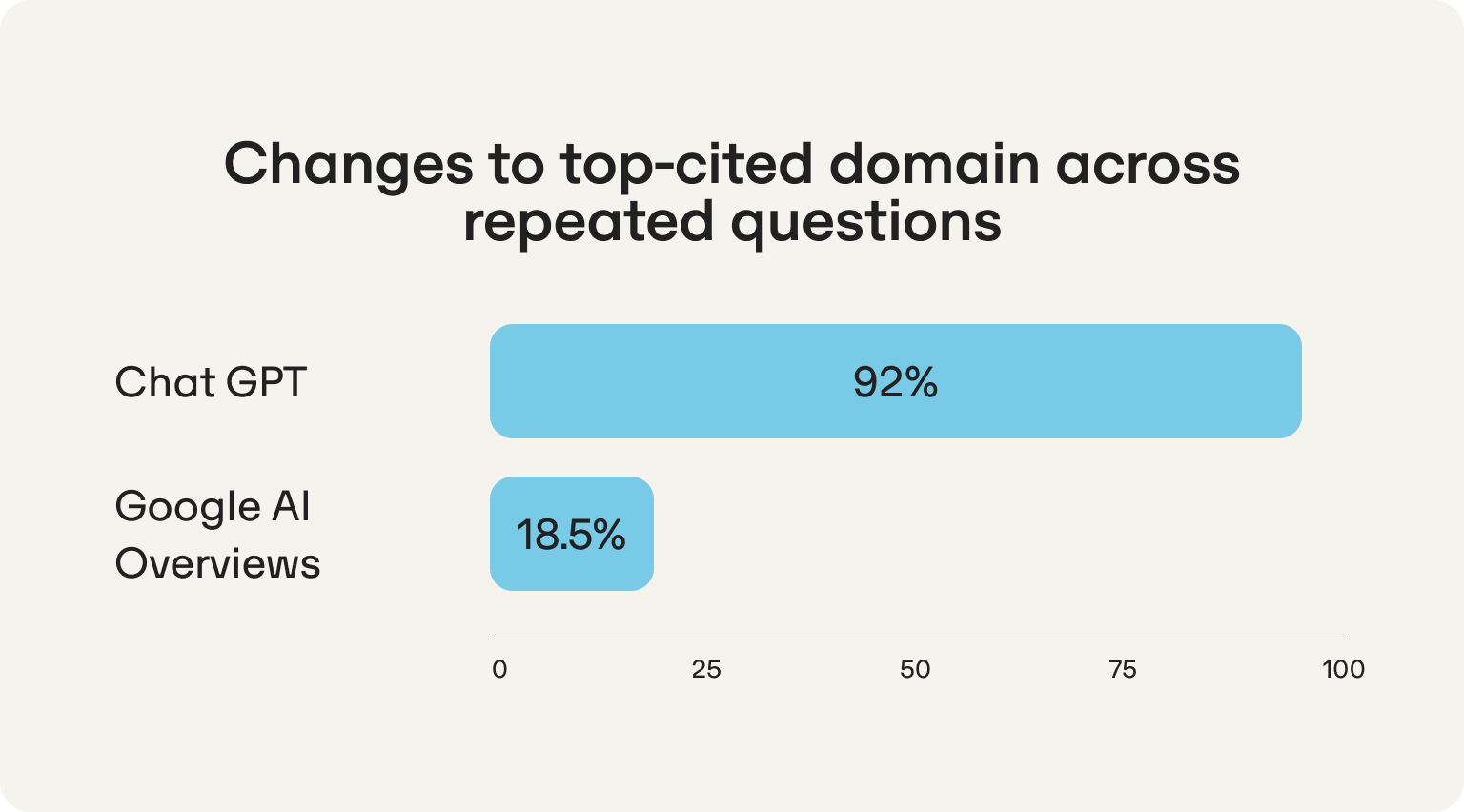
Visibility volatility in ChatGPT is significantly higher than in other engines. Based on Omnia's citation data, ChatGPT changes its top-cited domain 92% of the time week over week. Measurement cadence that treats ChatGPT like Google — monthly reporting, quarterly reviews — will miss most of the signal.
Ownership and execution workflow
Measurement without ownership creates stagnation. Assign one owner per prompt cluster. Every observed signal should trigger a documented hypothesis, a specific action, a retest date, and a logged outcome.
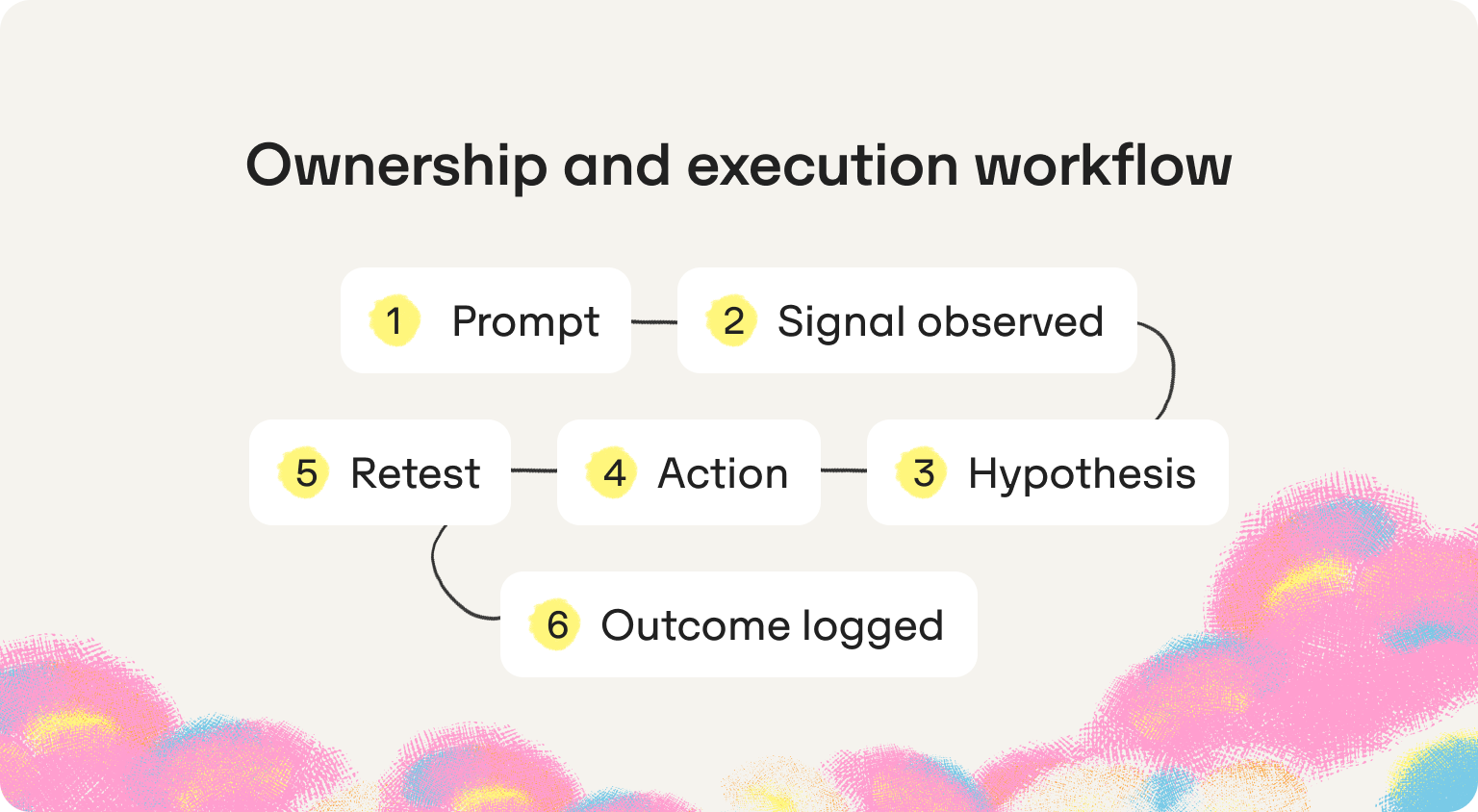
An action log with due dates and status tracking is not bureaucracy — it is the difference between a measurement system and a reporting exercise.
What our prompt tests reveal — original data
The playbook above is not theoretical. The patterns below are drawn from Omnia's citation database tracking 42M+ citations across ChatGPT, Perplexity, Google AI Overviews, and Google AI Mode.
Data block 1: Citation domain breakdown across prompt types
Across commercial prompt clusters — "best X software," "X alternatives," "how to do X" — the citation domain breakdown reveals a consistent pattern that most brand SEO teams have not internalized.
In tests across the US and UK, review sites, directories, and editorial publications account for the large majority of ChatGPT citations for "best" and "alternatives" prompts. Vendor blogs account for a significantly smaller share. The pattern is consistent across markets, though the specific domains differ — US commercial prompts lean on review platforms, UK prompts lean more heavily on industry editorial sites.
The implication is direct: for commercial prompts, off-site trust footprint matters more than publishing another comparative post on your own domain. The multi-engine optimization matrix looks different for each engine — ChatGPT's commercial citation profile is more editorially dominated than either Perplexity or AI Mode.
Data block 2: Mention rate vs citation rate gap
One of the most consistent patterns in ChatGPT visibility data is the gap between mention rate and citation rate. A brand can appear in 60% of tested prompts by name while being cited by URL in only 15% of those same prompts.
This gap is meaningful. It signals that brand entity recognition is forming — the model knows who you are — but source-level authority has not yet reached the threshold required for direct URL citation. Based on Omnia's data, ChatGPT averages just four citation slots per answer, and that number has declined approximately 30% since mid-2025. The model is becoming more selective. A rising mention rate with a flat or declining citation rate means your entity is visible but your content is not trusted enough as a source to claim one of the four available slots.
What closes the gap: schema that reinforces entity clarity, on-page structure that improves extractability, and third-party citations that build source-level authority outside your own domain.
Data block 3: Country variation example
Identical prompts produce materially different results across markets. In Omnia's testing, running five identical "best AI visibility tool" prompts across the US, UK, and a secondary European market produced three different vendor shortlists — with no overlap in the top-cited domain between the US and UK runs.
The citation pattern difference was not just brand visibility. In UK runs, industry editorial publications dominated citations. In US runs, review platforms dominated. The same brand with strong G2 presence but no UK editorial coverage would look strong in US ChatGPT answers and invisible in UK ones.
If you are operating across markets and testing only one geography, you are making optimization decisions based on half the data.
Simple visibility scoring model
For teams that need a single derived metric to track progress and report upward, this composite score provides a starting framework. It is not a model output — it is a manually calculated aggregate that gives a single number for directional trend tracking.
Visibility Score = (0.4 × Mention Rate) + (0.3 × Citation Rate) + (0.2 × First-Mention Frequency) + (0.1 × Narrative Accuracy)
The weightings reflect the relative importance of each metric for commercial ChatGPT visibility: mention rate is the broadest signal, citation rate is the most directly attributable to content and off-site authority, first-mention frequency reflects competitive positioning, and narrative accuracy is a qualitative signal that requires the lightest weighting given its manual nature.
Use this score to track four-week rolling averages. A consistent upward trend across eight to 12 weeks is meaningful signal. A single-week spike is not.
The AI visibility score concept is the formalized version of this — the composite metric that Omnia tracks automatically, without requiring manual calculation across prompt sets.
How Omnia supports a repeatable ChatGPT visibility strategy
The measurement system above is executable manually for a small prompt set in a single market. At 30 prompts across three countries with weekly cadence, it becomes a full-time function. That is the gap Omnia closes.
For the SEO strategist at a VC-backed startup or scaleup lean team, fast feedback loops, no tolerance for six-month agency timelines, Omnia provides the infrastructure to run this system without adding headcount with:
- Country-level visibility tracking: Know exactly where your brand stands in ChatGPT, Perplexity, Google AI Overviews, and AI Mode — by market, not as a single global average that flattens the variation your competitors are exploiting.
- Citation intelligence: See which URLs and domains are being cited in answers for your target prompts, so you can reverse-engineer what to build, where to place it, and which third-party sources to pursue — instead of guessing which review platform matters most in your category.
- Winnable prompt discovery: Omnia's AI Prompt Discovery surfaces the long-tail, high-intent prompts where citation slots are less contested — the specific queries where a startup with low domain authority can realistically displace a larger competitor before the citation patterns lock in.
- Action layer: Omnia turns monitoring data into a prioritized execution plan, including content briefs, PR placement targets, and page restructuring recommendations so measurement produces decisions rather than charts that sit in a folder.
- MCP integration: Omnia's MCP connector brings live visibility data directly into Claude, ChatGPT, Cursor, and any compatible AI assistant so SEO strategists running content workflows inside an AI tool has citation intelligence in the same session, without switching context.
Most AI search monitoring tools show you what happened. Omnia shows you what to do about it — and gives you the workflow to do it in one session per week.

FAQs
How to get your brand mentioned in ChatGPT answers
Build citation presence on the sources ChatGPT already trusts for your category — review platforms, industry directories, and editorial publications that appear in ChatGPT citations for prompts similar to yours. Brand mentions in ChatGPT are partly a function of entity recognition built across external sources, not just your own domain. Consistent entity statements across G2, your website, and any press coverage accelerate that recognition. Omnia's citation tracking identifies which specific domains are shaping answers in your category so you know exactly where to build presence.
How to get your company mentioned in ChatGPT
The fastest path is off-site: a fully populated profile on whichever review platform ChatGPT consistently cites for your category prompts, combined with at least one or two editorial mentions from publications that appear in your category's citation fingerprint. These moves produce measurable mention rate movement within two to four weeks. Publishing new content on your own domain without first addressing the external citation layer is slower and less reliable for direct ChatGPT mentions.
How to get your website cited by ChatGPT
Citation requires meeting eligibility criteria first: your pages must be indexed by Bing, render core content in server-side HTML, and carry clean canonical tags. Once eligible, citation probability increases with content extractability — clear H1–H3 hierarchy, definition blocks, and direct answers to specific questions in the first 300 words — and with external source authority built from third-party citations on trusted domains. See the seven technical foundations above for the full eligibility and extractability checklist.
How to rank in ChatGPT — does Reddit help?
Reddit appears in ChatGPT's citation pool but at lower frequency than Wikipedia, editorial publications, and review platforms for most commercial prompt types. Reddit is more useful as an entity signal — consistent brand mentions in relevant subreddit discussions reinforce brand recognition — than as a primary citation source. For commercial "best X" and "alternatives" prompts specifically, review platforms and editorial directories consistently outperform Reddit in ChatGPT citation frequency. Build Reddit presence for brand discovery; build review platform presence for citation.
How to rank on ChatGPT — is there a #1 position?
There is no universal static #1 position in ChatGPT. Answers vary by user, country, retrieval mode, and prompt phrasing. What you can optimize for is first-mention frequency — how often your brand appears as the first named vendor across multiple runs of the same prompt. Track this as a rolling average across your prompt library, not as a single-session observation. Consistent first-mention frequency above 50% across your core commercial prompts is a meaningful signal of strong category positioning.
How to rank in ChatGPT search vs ChatGPT answers — what changes?
ChatGPT search (retrieval-augmented responses using live Bing index data) and ChatGPT answers (responses primarily from training data) require overlapping but distinct strategies. For search-enabled ChatGPT, Bing indexation is the access gate — pages not in Bing's index are not eligible for citation regardless of content quality. For both modes, entity consistency, content extractability, and off-site authority matter. The ChatGPT rank tracking tool distinction is relevant for measurement: search-mode citations are more reliable to track because they produce URL citations; answer-mode appearances may surface brand names without a citable URL.
How to rank your website on ChatGPT if you're a startup with low authority
Target long-tail, high-intent prompts in your category rather than head-term "best X software" queries where citation slots are already locked up by established players. Low-authority startups consistently break into ChatGPT citations by building presence on the two or three external sources that dominate citation for their specific niche — often a category-specific review platform and one or two industry publications — rather than competing globally across dozens of prompts. The AI ranking checker gives you a quick baseline on where your brand currently stands before building your targeting strategy.
What should I track for ranking on ChatGPT over time?
Five metrics on a weekly cadence: mention rate, citation rate, share of voice, first-mention frequency, and narrative accuracy. Run your core commercial prompt library across your priority markets weekly. Track rolling four-week averages — not individual session results. Add a country comparison to every core prompt test. Flag any prompt where mention rate drops more than 10 percentage points week over week for investigation before acting on it. Omnia's AI visibility tracking and AI mode tracking run this system automatically — so the measurement layer runs in the background while your team focuses on the actions that move the numbers.