
Citation Analysis
How to Get Cited by ChatGPT: A Page-Level Playbook

 Alfredo BernalOrganic Growth LeadatOmnia
 Jose Luis García del RíoGrowthatOmnia

TL;DR
We analyzed 1.17 million (1,173,480) ChatGPT answers that cite sources in Spain, with 314,462 different sources. Answers that don't cite sources are not in the analysis. They come from 26,048 non-branded prompts, run every day from Spain from 1 January to 13 October 2026, across 30 sectors that each weigh the same in the ranking. Presence is the percentage of answers that cite sources in which a source appears at least once.
We analyzed 1.17 million ChatGPT answers that cite sources in Spain to find out which sources it cites most. Type "what's the best car insurance?" into ChatGPT in Spain and the answer can come with links to other websites: a newspaper, a comparison site, a forum thread… Those links are the sources.
For this study, we ran 26,048 non-branded prompts every day from 1 January to 13 October 2026 and measured how often each source appears in the answers that cite sources. This post explains every decision behind that number. The results are on the study page.
If you work on AEO, the sources are the closest thing you have to a map. When a site keeps getting cited for the prompts your customers type, what that site says about you can end up inside the answer. At Omnia we spend all day analyzing the sources ChatGPT cites, so we wanted a global view of its most "trusted" sources in Spain.
Written down, the question looks simple: which sources does ChatGPT cite most when people in Spain ask it something without mentioning any brand in the prompt? Answering it well took more decisions than I expected. Each one changes the ranking a little, so I'd rather show them than hide them.
One engine, ChatGPT. One country, Spain. 26,048 non-branded prompts across 30 sectors, run every day from 1 January to 13 October 2026.
A non-branded prompt is a question that doesn't mention any brand. "What's the best car insurance?" is one. "Is Mapfre's car insurance any good?" is a branded prompt, and prompts like that one are left out. When the prompt names a brand, that brand shapes which sources ChatGPT cites, so the result is no longer neutral. I wanted the sources that show up while someone is still choosing, before they have a brand in mind.
For us, an answer is one prompt on one day. We only store answers that cite at least one source. That gives 1,173,480 answers that cite sources, with 314,462 different sources. Answers that don't cite any source are not part of the analysis.
A source is any website ChatGPT cites, grouped by its domain: elpais.com, reddit.com, ocu.org.
The metric is presence: the percentage of answers that cite sources in which a domain appears at least once. One answer counts once. If an answer cites three different articles from elpais.com, elpais.com still counts once for that answer. Without that rule, a site that tends to appear several times in the same answer would look bigger than it is.
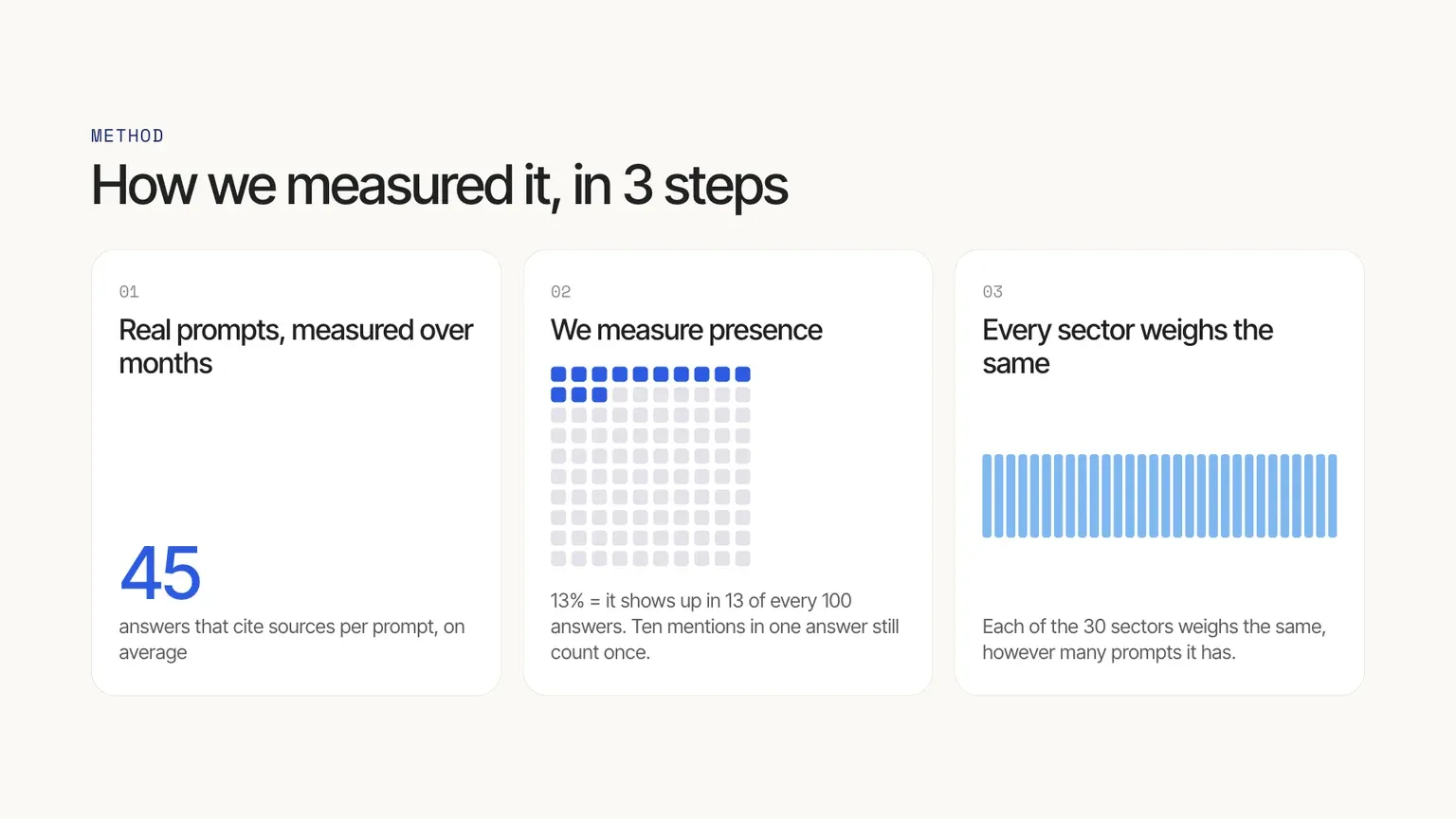
The calculation goes in three steps. First, for each prompt, the share of its answers that cite sources in which the domain appears. Then the average of those shares over the prompts in each sector. Then the average over the 30 sectors.
That is how to read the headline figure: elpais.com has a presence of 13.2%, which means it appears in 1 of every 8 answers that cite sources to non-branded prompts in Spain.
The sectors are very different in size. Software and SaaS, the largest, has 4,021 prompts. The smallest are pets, with 62 prompts and 475 answers, and gaming, with 64 prompts and 732 answers. A sector needs at least 15 prompts to be in the study, which leaves 30.
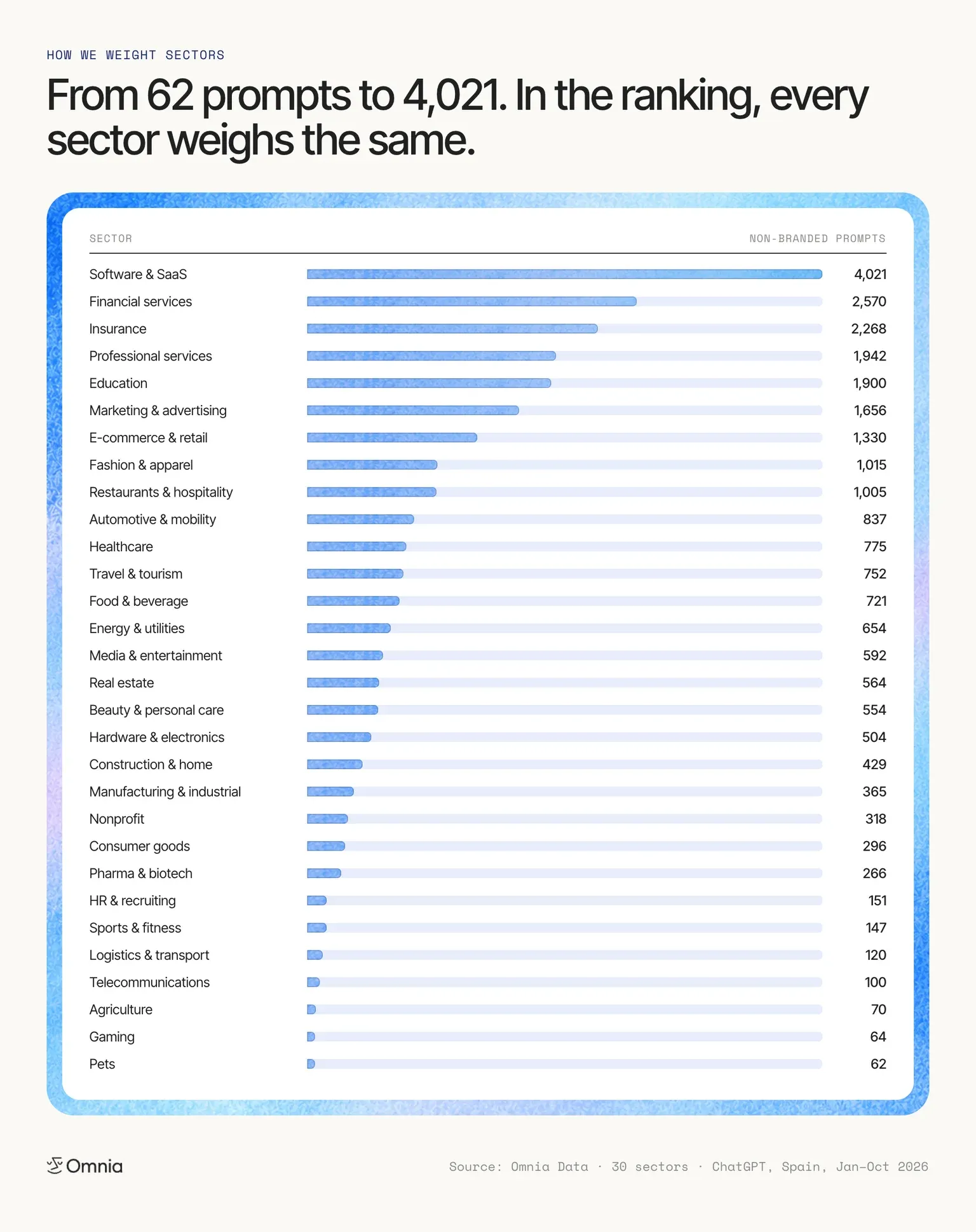
If we pooled every answer together, each sector would weigh as much as its number of prompts: 4,021 for software and SaaS against 62 for pets. So every sector weighs the same, however many prompts it has.
The clearest example is zooplus.es. It is cited in only 4 sectors, but its presence in pets is 17.1%, and because pets weighs the same as any other sector, zooplus.es enters the Retail top 10. In a pooled ranking, pets would be 62 prompts out of 26,048.
I think equal weight is the right call for a study about Spain as a whole. It is still a choice, and a reasonable person could weight by prompts instead. That's why it's written on the study page and here.
Every domain gets one type: Company websites, News, Comparison sites, Retail, Reference, Government, Social & forums, Company directories and jobs, App stores, Developer sites or Other. Domains we couldn't classify are grouped as Unclassified (10.9%). Inside each type there are subtypes, for example general news and magazines in News, encyclopedias, academic sites and dictionaries in Reference, or forums, video and social networks in Social & forums.
The presence of a type works like the presence of a domain: an answer counts if it cites at least one source of that type. That's how Company websites can have a presence of 71.0% while no single company website goes above 1.5%.
Some domains fit two types. The one I had to think about most was nih.gov. It is a US government website, but we count it as an academic source, in Reference. It has a presence of 4.1%. Putting it in Government would change both the Reference and the Government rankings, so I prefer to say it out loud.
Answers that don't cite sources. As explained above, they are not stored, so they are not in the analysis.
Types too small to rank. Company directories and jobs (5.8%), app stores (1.0%) and developer sites (0.7%) appear in the chart by type, but they don't get their own top 10. Company websites don't get one either: they have a presence of 71.0% as a type, but none goes above 1.5%.
This edition says nothing about other engines or other countries. It covers ChatGPT, in Spain, with non-branded prompts only, between 1 January and 13 October 2026.
The sectors are different sizes, and equal weight gives the smallest ones, like pets with 62 prompts, the same say as software and SaaS with 4,021.
To check that the ranking doesn't depend on prompts with very few answers, we ran it again keeping only prompts with 5 or more answers, and then only prompts with 10 or more. Both times the top 20 is the same, and the top 9 keeps the same order. That's the check we ran, and it's the only one I'm claiming.
And one more time, because it is the easiest one to get wrong: all percentages are calculated over answers that cite sources, not over all ChatGPT answers.
The study is built on the same kind of tracking Omnia runs for brands: the same prompts, every day, with every source in each answer recorded. In Omnia you can see which sources the answers to your own prompts cite, and how often your own website shows up among them.
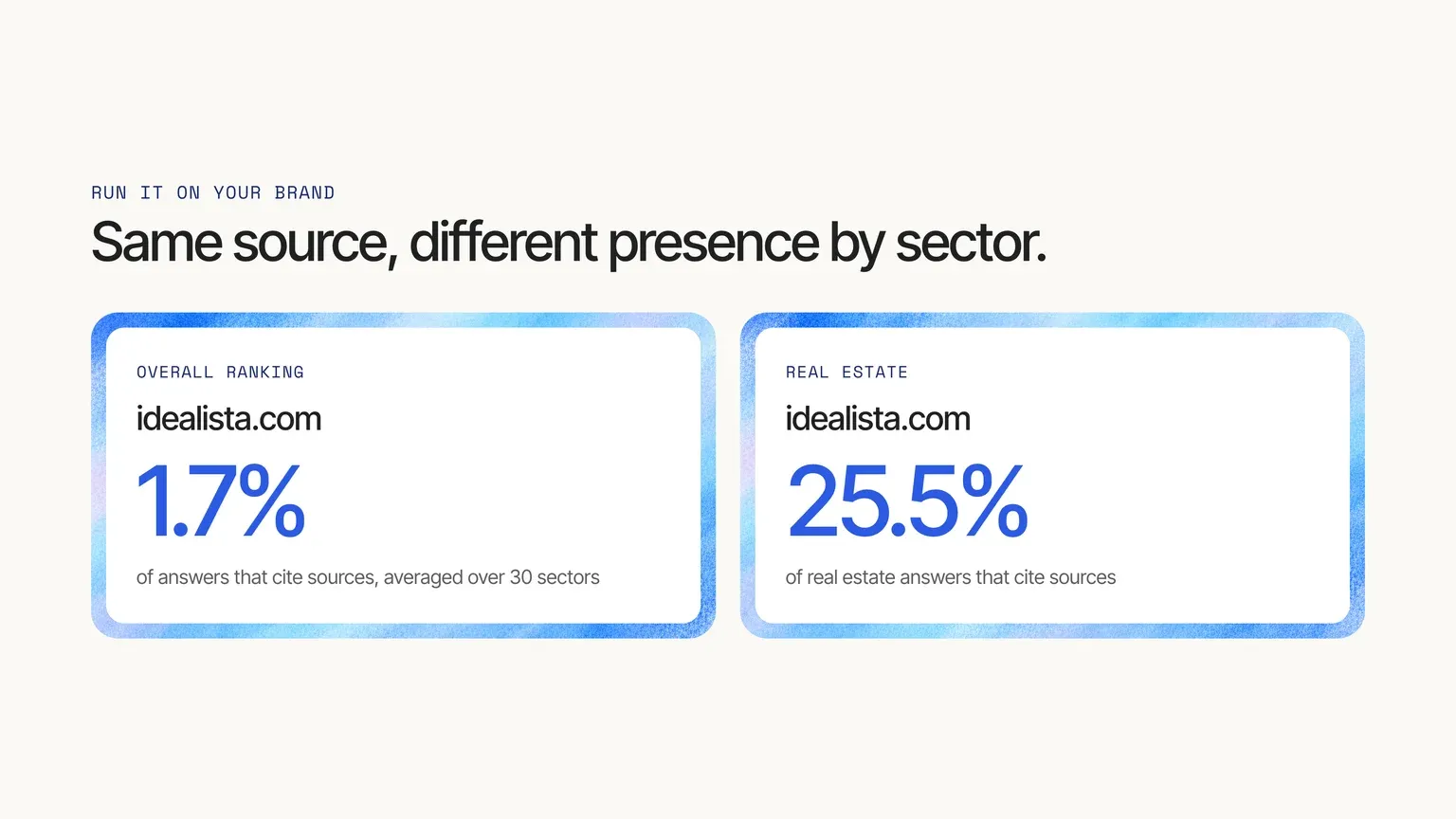
The sources in this ranking are the ones ChatGPT cites most across Spain, but that doesn't make them the right ones for your brand. They change with every sector and every brand: idealista.com has a presence of 1.7% in the overall ranking and 25.5% in real estate answers. If you want to improve your AI visibility, a general move based on this ranking is not enough. You need to track the prompts that matter to your brand and see which sources ChatGPT cites for them.
If you want to see which sources ChatGPT cites for your sector's prompts, start a free trial.
Omnia offers a 14-day free trial on the Growth plan.
No credit card required. See exactly where your brand shows up (or doesn't) across AI engines, then let the platform's recommendations guide your next move.

Not necessarily. They are the sources ChatGPT cites most across Spain, but the sources that matter change with every sector and every brand: idealista.com has a presence of 1.7% in the overall ranking and 25.5% in real estate answers. To improve your AI visibility, track the prompts that matter to your brand and see which sources ChatGPT cites for them.
26,048 non-branded prompts in ChatGPT, run every day from Spain from 1 January to 13 October 2026, across 30 sectors. That gave 1,173,480 answers that cite sources, with 314,462 different sources.
Presence is the percentage of answers that cite sources in which a domain appears at least once. One answer counts once, however many times it cites that domain. elpais.com has a presence of 13.2%: it appears in 1 of every 8 answers that cite sources.
We only store answers that cite at least one source, and an answer without links says nothing about which sources ChatGPT cites. Every percentage in the study is a share of answers that cite sources.
The sectors go from 62 prompts (pets) to 4,021 (software and SaaS). With equal weight, each of the 30 sectors counts the same in the ranking, so the largest sectors don't decide it on their own.
This edition covers ChatGPT in Spain only. Other engines and countries are not measured here.
Written By
 Jose Luis García del RíoGrowthatOmniaAlfredo BernalOrganic Growth LeadatOmnia
 Alfredo BernalOrganic Growth LeadatOmnia
 Alfredo BernalOrganic Growth LeadatOmnia
 Jose Luis García del RíoGrowthatOmnia
 Daniel EspejoFounder & CEOatOmnia
No credit card required · Free for 14 days · See your AI visibility within 3 minutes