

If you're evaluating Profound AI vs Scrunch AI AEO tooling in 2026, the gap between the two platforms is more operational than it is feature-based. Profound is built for enterprise teams that need depth like real user prompt volumes, browser-based capture, AI Agent workflows, and SOC 2 infrastructure. Scrunch targets brands that want structured AI visibility monitoring with site audit data and a clean reporting layer. Both leave a gap for lean startup and scaleup teams: Profound prices multi-engine coverage and AI search optimization out of reach at the base tier, and Scrunch locks country coverage and advanced features behind a custom enterprise plan. Omnia fills that gap with unlimited countries, seven core engines, and a native action layer that produces content briefs and placement targets without requiring a separate workflow tool.
There’s no shortage of takes on Profound AI vs Scrunch AI AEO tooling. Most of them compare pricing tables and engine counts. This article approaches the decision differently. We look at which platform moves a lean team from citation gap to shipped content in the shortest time, across every market they operate in.
The answer changes depending on your team size, budget, and what you actually need the tool to do. If you need a data research platform with enterprise infrastructure, Profound is built for that. If you need structured brand monitoring and site audit coverage, Scrunch fits. If you need multi-country tracking, URL-level citation intelligence, and an action layer that produces ready-to-use content briefs without a separate workflow setup, the gap between those two options is where Omnia sits.
This piece evaluates all three on their operational realities rather than how many features they boast.
Scrunch AI vs Profound AI vs Omnia: Side-by-side comparison table
Profound edges ahead slightly on data depth and enterprise infrastructure. Scrunch wins on site audit coverage and structured monitoring for brand teams. Omnia closes the execution gap for lean teams. You get more engines per dollar at the entry tier, unlimited countries without an upgrade, and a native workflow that turns citation data into shipped content.
One thing to keep in mind, Sitecore acquired Scrunch in June 2026, positioning its AI visibility capabilities inside a broader digital experience platform. Teams evaluating Scrunch should factor in the transition period that typically follows an enterprise acquisition, as roadmap priorities and support structures may shift during integration.
Profound vs Scrunch AI for AEO: Where each tool wins (and where Omnia slots in)
Each platform has a clear strength and a clear ceiling. The five criteria below are where those differences show up in practice, and where the decision for a lean team becomes straightforward.
Localized tracking by country
For any team operating across more than one market, country-level tracking should be the baseline requirement. But both Profound and Scrunch treat it as an upgrade, restricting multiple languages and regions to enterprise tiers only.
Profound’s Starter plan ($99/mo) covers a single country and single language. At $399/mo for Growth, you still get only one region and language. Multi-region tracking requires a custom enterprise contract.
Scrunch’s Core plan ($250/mo) is restricted to one country as well. Full multi-country access means moving to the custom enterprise tier, which has no published price. Smaller teams with tight budgets that need to understand how their AI visibility differs between markets are effectively locked out of that data unless.
Omnia executes prompts via real browsers running in actual geographic locations. Teams receive unlimited countries and languages on every plan from €79/mo. A team tracking Switzerland and Germany on the Growth plan sees exactly what local users see in each market, not aggregate data interpreted from a single server location.
What this means in practice: A two-person marketing team tracking AI answer visibility in the US and UK faces an immediate upgrade decision with both Profound and Scrunch. Or, they have to accept incomplete data. With Omnia, both markets are included from day one at the entry price.
Citation intelligence: domains and URLs
Citation intelligence is the data layer that separates a meaningful competitive analysis from surface-level mention counting. Knowing your brand appeared in 22% of tracked prompts tells you your visibility score. But seeing which domains and URLs are cited alongside or instead of your brand tells you what to do next.
Profound tracks citations at domain and URL level, with citation authority scoring to show which sources carry the most influence over AI-generated answers. Its Agent Analytics layer adds a dimension most tools can’t compete with. It shows visibility into how AI bots crawl and interpret your site, which bridges the gap between what you publish and how AI systems process it.
Scrunch tracks citations and sources at the URL level as well in its Core tier, with a Insights & Recommendations layer that flags gaps and surfaces optimization opportunities. Scrunch’s Agent Experience Platform (AXP) is available on enterprise plans and extends this into a more structured optimization workflow.
Where both platforms focus more on the analytical side than the operational one, Omnia’s citation layer is built to feed directly into placement targets. URL-level data flows into content brief generation, telling teams “Here are the specific pages you need to earn mentions on and here’s how to do it.” For teams practicing generative engine optimization, that connection between data and execution is what makes weekly progress possible and improves your brand presence.
What this means in practice: Instead of logging citation data in one tool and then deciding in a separate session what to write, your team gets prioritized placement targets as part of the same workflow that surfaced the gap.

Prompt data and coverage
Profound’s Prompt Volumes provides access to hundreds of millions of real user prompt queries. This gives teams the ability to align their tracking prompts with what real buyers are asking major AI platforms, rather than guessing at category language. This actual AI search demand data lets teams align tracking prompts with real language rather than guessing at category terms.
Access is restricted to enterprise plans, though. Profound's Starter plan tracks 50 prompts on one engine. Multi-engine tracking starts on the Growth plan (100 prompts, 3 engines). Full 10+ engine coverage requires a custom Enterprise contract.
Scrunch’s Core plan includes 125 unique prompts across 4 answer engines (ChatGPT, Perplexity, Google AIO, Copilot). That’s a reasonable entry-level AI search volume for a single-brand program, but it comes with a higher price tag than other platforms. Claude, Gemini, Meta AI, Google AI Mode, and Grok are available only on the enterprise tier.
Omnia tracks 7 AI engines on every plan. Four are enabled by default: ChatGPT, Perplexity, Google AI Overviews, and Google AI Mode. Claude, Microsoft Copilot, and Gemini are available on request at no additional plan upgrade. Prompt Discovery surfaces high-volume, low-difficulty prompts that lean teams should be tracking but may not have identified yet. Growth starts at 25 prompts, Pro at 100 prompts, and Enterprise at 200+ prompts.
What this means in practice: Profound gives you the richest prompt research database but restricts multi-engine tracking to $399/mo and above. Scrunch gives you 125 prompts across 4 engines at $250/mo. Omnia gives you up to 7 engines and helps you identify which prompts to prioritize with Prompt Discovery.
Action layer and content workflows
The difference between an AI visibility platform that gets used weekly and one that gets checked quarterly usually comes down to one thing. What does the platform hand you after the data arrives?
Profound’s AI Agents are the most capable action layer in this comparison. They can conduct deep research, draft content, run AEO and SEO tasks autonomously, and support demand generation and PR workflows. Profound has a hosted MCP server, though it’s limited to enterprise plans. Profound AI Agents are available on their entry plan, but only with 100 credits/mo.
Scrunch provides Insights & Recommendations that flag optimization opportunities, but its content generation capabilities are listed as “basic” for the entry plan. And MCP access is only for enterprise users. This makes the Core plan’s action layer more directional than operational.
Omnia’s action layer is available starting from the base plan. When citation gaps surface in a prompt set, the platform generates content briefs, on-page optimization steps, and placement targets without requiring the user to route data through a separate tool.
For teams working regularly inside AI assistants, Omnia offers an MCP connector in all plans. In practice, a marketer can ask their AI assistant which prompts saw the biggest visibility drop this week, pull the top competitor citation URLs for a specific topic, and trigger a content brief, all without leaving their AI workflow.
What this means in practice: Profound's AI Agents are the most powerful in the category, but they provide limited access. Scrunch's Core action layer points toward opportunities rather than producing ready-to-execute outputs. Omnia hands you a brief at every tier and provides MCP access in all pricing plans.
Pricing and what you actually get at each tier
What this means in practice:
- At $99/mo, Profound gives a ChatGPT-only view with a limited action layer.
- At $250/mo, Scrunch gives 4-engine Core tracking in one market.
- At €79/mo, Omnia gives 4-engine tracking (with option of extensions) across unlimited countries with a full native action layer and MCP access.
Where Omnia fits (and why it belongs on this shortlist)
Choosing between Profound and Scrunch for AEO typically forces a compromise. Profound’s data depth and agent infrastructure are strong, but the price to access them at a level useful for a startup puts it in a different category from a scaleup running a two-person marketing function. Scrunch’s structured monitoring and site audit layer are well built for brand teams that operate at scale, but its country restrictions on the Core plan and the enterprise gateway on its most useful features create the same accessibility problem.
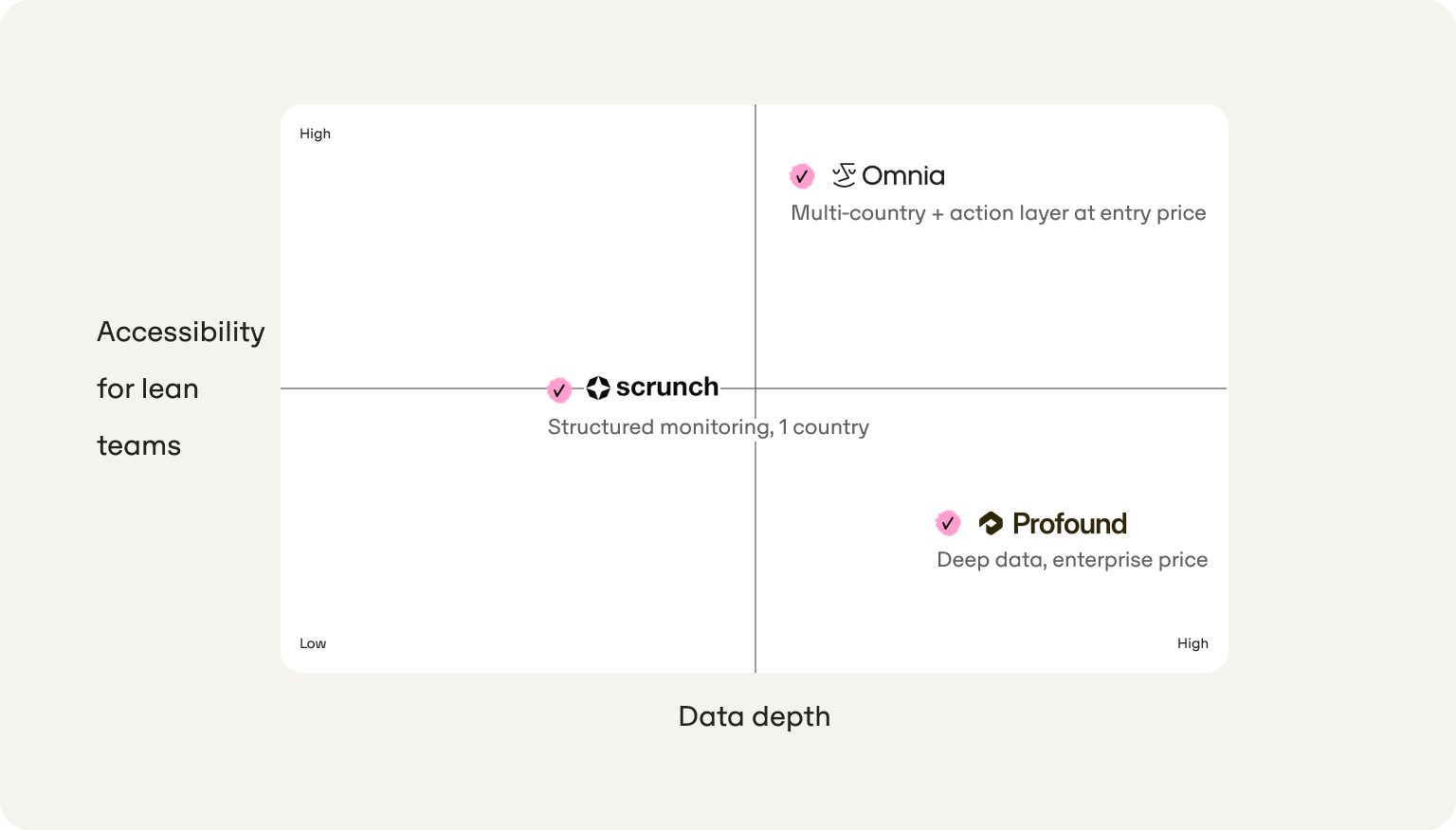
Omnia sits at a unique position in this comparison. It’s not trying to match Profound’s 10-engine data platform, and it’s not a stripped-down version of Scrunch's corporate monitoring suite. Omnia is built for teams actively publishing to a blog, making decisions fast, and needing to turn AI search signals into shipped content without waiting for an enterprise contract or a complex MCP setup.
The 60-minute weekly workflow
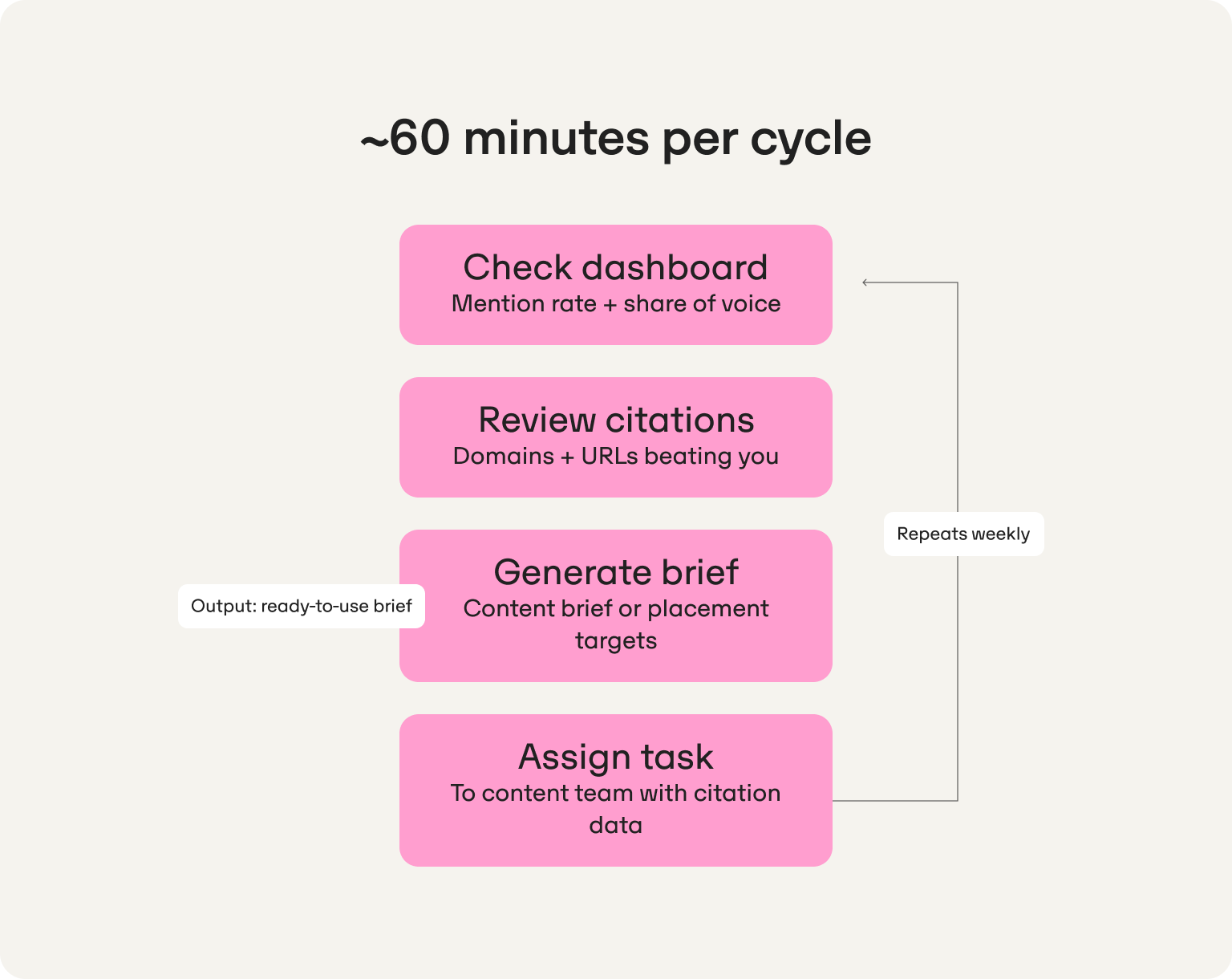
A practical weekly workflow in Omnia takes one marketer roughly an hour.
- Open the dashboard and check your AI search visibility across the US and any other markets you are tracking, looking at mention rate, share of voice against competitors, and how both have moved since the previous week.
- Move into the citation layer and review which URLs and domains are earning citations in your category. If a competitor is winning on a specific third-party domain you have not yet targeted, that surfaces immediately.
- Click into the action layer, generate a content brief or a placement target list based on that citation gap, and assign it.
By the end of the hour, you have a concrete task for the content team that’s rooted in real citation data, not a hypothesis. Over time, visibility shifts that previously required a strategy offsite to diagnose show up as actionable items in a regular workflow.
Beyond basic monitoring
Omnia extends its tracking capability through Prompt Discovery, which surfaces high-volume prompts in your category that your current prompt set may not be covering. AI sentiment analysis shows how AI models describe and frame your brand across engine responses, not just whether you appear or not.
The Omnia MCP connector brings visibility data directly into AI assistants, so teams using Claude or another AI assistant as part of their daily work can query citation and visibility data without switching contexts. These capabilities sit on top of the core tracking loop rather than replacing it, and all features (except Sentiment Analysis) are included in the entry-level plan.
How to choose: A 5-scenario decision framework
If Omnia’s approach matches your workflow, book a demo to see it with your own data, or start a 14-day free trial on the Growth plan today.
FAQs
Profound vs Scrunch review: What's the real difference?
The core divide in answer engine optimization tooling between these two platforms is depth versus structure. Profound is built around data depth, browser-based capture, and enterprise agent workflows that surface actionable insights from profound data and real user queries. Scrunch is built around structured brand visibility monitoring, site audits, and an agent experience layer primarily available at the enterprise tier. For procurement purposes, Profound suits teams that need actual search volume data and are willing to pay $399/mo for multi-engine coverage. Scrunch suits teams that want a structured monitoring program with site audit integration and can commit to an enterprise plan for full capability.
Is Profound AI worth it for a startup?
Profound is a strong fit if your team has a dedicated budget for AI visibility infrastructure, needs actual AI search demand data for content strategy, and is ready for an enterprise sales process. It’s harder to justify at the starter tier: $99/mo covers only one engine in one country with no action layer, which is a limited view of your AI search performance. A startup looking for multiple AI platforms tracked with an action layer will likely find better value elsewhere until they are ready for custom pricing at the enterprise tier.
Is Scrunch enough to improve AI citations?
Scrunch surfaces citation data and flags optimization insights, but improving citations requires publishing AI-optimized content that AI search engines choose to cite, earning placements on the domains AI systems already trust in your category, and restructuring existing pages to match the content patterns AI generated responses favor. Scrunch’s Core plan surfaces visibility gaps and tells you where brand mentions are missing. Closing those gaps is an external content and outreach program that runs alongside the tool, not inside it.
What should I look for in citation intelligence?
Start with domain-level data to understand which sites AI search engines cite most in your category, and how AI crawlers and AI indexing patterns favor certain content formats. Move to URL-level data to identify specific pages. Look for patterns in content type (editorial coverage, first-party research, review aggregators) since those patterns tell you what format of AI optimized content earns citations. The most actionable insights from citation intelligence connect URL-level AI search data to a prioritized outreach or content creation list.
Can Semrush or Ahrefs replace an AEO tool?
Semrush and Ahrefs are strong platforms for traditional SEO inputs: keyword research, backlink data, and site audit signals that influence which domains earn the authority AI systems process when forming AI responses. While both platforms measure brand mentions across AI search results and AI conversations, they’re not as strong as the dedicated AI visibility tools in this list. Look to Omnia, Profound, or Scrunch for dedicated AI search optimization to improve AI search performance for your team.
What's the fastest way to get an AI visibility win in 2 to 4 weeks?
Pick 10 prompts that map directly to your category and competitive set. Identify the top-cited domains and find visibility gaps between what they publish and what you have. Create AI-optimized content specifically designed to match the citation patterns AI engines respond to in your category. Publish it, or look to place a version on a domain already earning AI traffic in your niche. Re-check your prompt set at the end of week two and track whether the new asset registers in actual AI responses. And try Omnia’s free AI Visibility Checker.
How do I know if my brand shows up in AI answers today, by country?
Build a prompt set of 10 to 20 questions your buyers ask major AI platforms in your category. Run those prompts in each target market, logging whether your brand presence registers in AI search results, what position it holds in the AI-generated answers, and which other brands appear alongside it. Repeat weekly to track movement. Country-level tracking requires a platform that handles geographic parameters language support by executing prompts from within the target geography rather than inferring local results from a centralized server.