


BrightEdge’s AI Catalyst tracks major AI engines, but it’s locked inside an expensive, legacy enterprise SEO platform. If you already have an SEO stack, buying BrightEdge just for AI visibility means paying for redundant infrastructure. This guide compares the top 9 BrightEdge alternatives that plug the generative search gap without forcing a rip-and-replace. Use our included procurement-ready checklist to validate which platform actually turns citation data into shipped content for your team.
If you're evaluating BrightEdge alternatives for AI visibility, the decision usually comes down to your existing tech stack. BrightEdge's AI Catalyst tracks ChatGPT, Perplexity, and Google AI Overviews, but it's locked inside a massive, expensive enterprise SEO platform.
You can't buy their AI visibility tools without buying the whole suite. If you already have an SEO software you like, or if you need deeper URL-level citation intelligence and a built-in action layer to generate content briefs, you need a dedicated platform.
This guide covers both full SEO suites that can completely replace your legacy stack, and purpose-built AI visibility trackers that plug right into your existing workflows to provide deep citation intelligence and execution.
What are BrightEdge alternatives (and why are teams looking to make the switch)?

BrightEdge alternatives are SEO and AI visibility platforms that help digital marketers track their brand presence, optimize content, and measure SEO performance or search engine visibility. Teams are increasingly looking to make the switch not because BrightEdge is ignoring AI, but because of how they package it.
BrightEdge launched AI Catalyst to track brand presence across Google AI Overviews, ChatGPT, and Perplexity. However, this feature is bundled into all BrightEdge SEO software subscriptions. For enterprise teams and agencies that already use tools like Ahrefs, Semrush, or specialized technical crawlers, buying BrightEdge just to get AI visibility means paying for massive, redundant legacy SEO infrastructure.
While BrightEdge provides high-level sentiment and presence data, teams actively executing Generative Engine Optimization (GEO) often hit a wall. They need to know why competitors get cited instead of them at the URL level. And they need specific actions, like content briefs and PR placement targets, to reclaim that visibility.
How a BrightEdge competitor differs from a legacy enterprise SEO suite
Legacy enterprise SEO platforms are built for keyword tracking, backlink monitoring, and site health auditing for traditional search engines. AEO (Answer Engine Optimization) and AI visibility platforms do the same job, but on a completely different surface area. Instead of tracking deterministic search engine rankings, they track AI-generated answers. Instead of relevant keywords, they track conversational prompts. Instead of backlinks, they track citations.
For example, a legacy SEO tool might tell you that you rank #4 for “best enterprise CRM.” An AI visibility platform will tell you that when a user asks ChatGPT “What is the best enterprise CRM for a 500-person team?”, your competitor gets recommended because ChatGPT is citing a specific G2 comparison page and a Reddit thread. The AI visibility tool provides the citation intelligence (the exact URL and domain cited) and tells you what to change to win that recommendation.
Dedicated AI visibility trackers vs all-in-one SEO suites
When evaluating tools, you'll encounter full SEO suites with built-in AI tracking (like Semrush or Ahrefs) and dedicated AI visibility trackers (like Omnia or Peec AI). A true AI visibility tracker should include a robust prompt set, multi-engine coverage, localized tracking by country, competitive share-of-voice (SOV), URL-level citations, and a daily monitoring cadence.
If you're not replacing your SEO suite, look for an add-on that integrates cleanly and creates an execution backlog. You don't need another tool to tell you your domain authority. You need a tool that tells you how to win in AI search.
How these tools work: AI prompt monitoring, citation extraction, and share-of-voice
AI visibility tools operate on a fundamentally different architecture than traditional rank trackers. First, you build a list of conversational prompts relevant to your brand. The tool then runs these prompts across multiple AI engines (like ChatGPT, Perplexity, and Google AI Overviews) using real browsers. It parses the generated answers, extracts the exact citations and sources the AI used to build that answer, and aggregates your visibility rate and competitive share-of-voice.
Because AI models are non-deterministic, results change constantly based on the model, the time of day, and the user's location. According to Omnia research, ChatGPT changes its top-cited domain 92% of the time across repeated queries, while Google AI Overviews are only 18.5% stable.
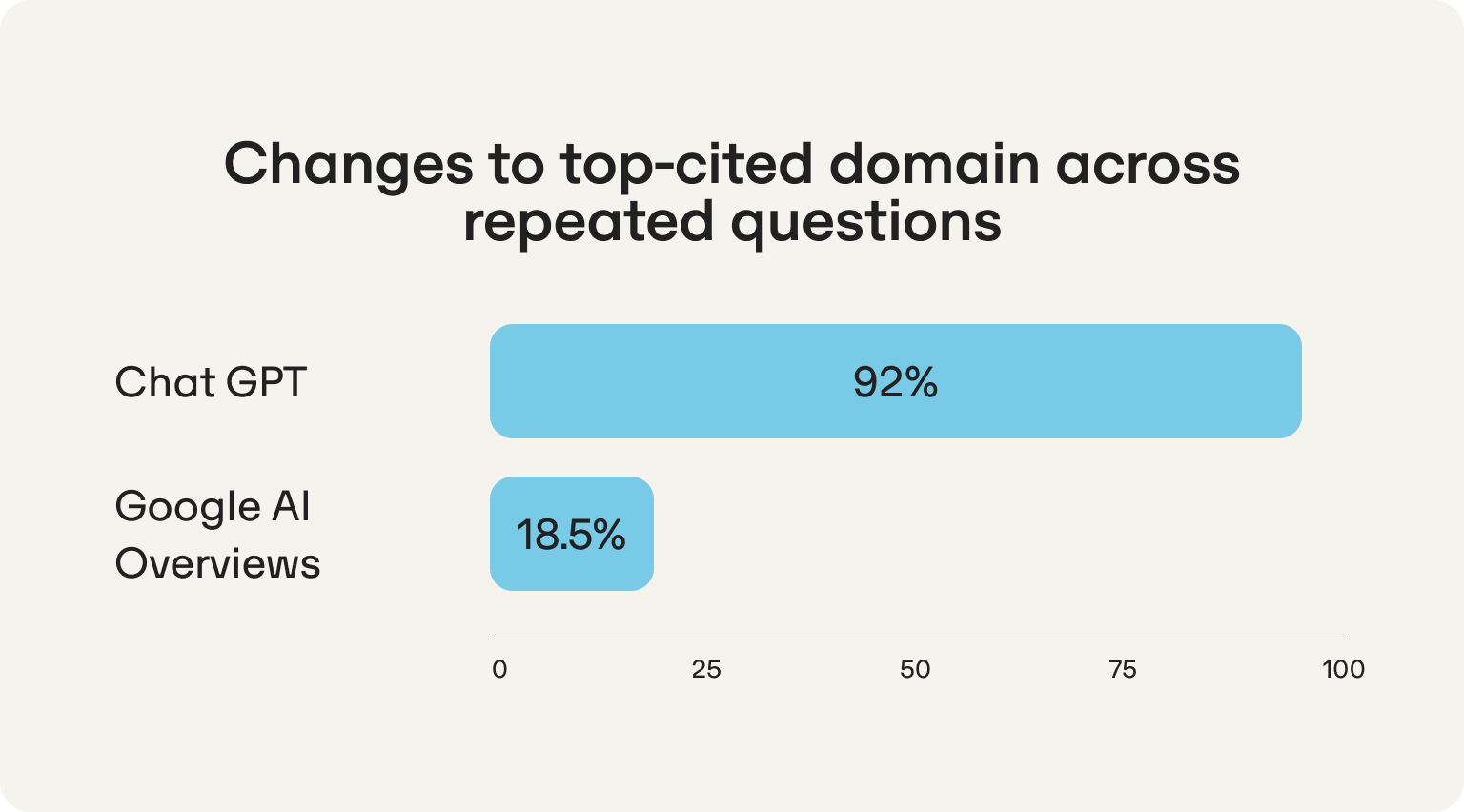
This volatility means monitoring requires a strict daily cadence and versioning to separate real trends from AI hallucinations.
Prompt coverage: how you know you're tracking real buyer intent (not vanity prompts)
Tracking the right prompts is the foundation of AI visibility. If you track generic, high-volume keywords, you'll get noisy, irrelevant data. You need to build a prompt set that maps directly to bottom-of-funnel (BOFU) buyer intent.
To validate your prompt set quality, ensure it covers:
- Intent: Are these questions buyers ask right before purchasing? (e.g., “Compare X vs Y for small business”)
- Segment: Do the prompts specify your target audience?
- Geography: Are the prompts localized for the markets you serve?
- Product Line: Is every core product or service represented?
Localized tracking by country: Why “US-only” results can mislead enterprise teams
AI engines localize their answers based on the user's IP address. If your AI visibility tool only tracks prompts from a US server, the data is useless for your teams in the UK or Spain. Localized tracking means the tool executes the prompt from the specific location, capturing the language variants and market-specific citations that local users actually see.
For example, asking ChatGPT “What is the best enterprise CRM for a 500-person team?” in France results in different answers than posing the same question to Perplexity in Austria.

ChatGPT returns Oracle and Creatio as recommendations in France (see image above), while Perplexity suggests Zoho CRM in Austria (see screenshot below).
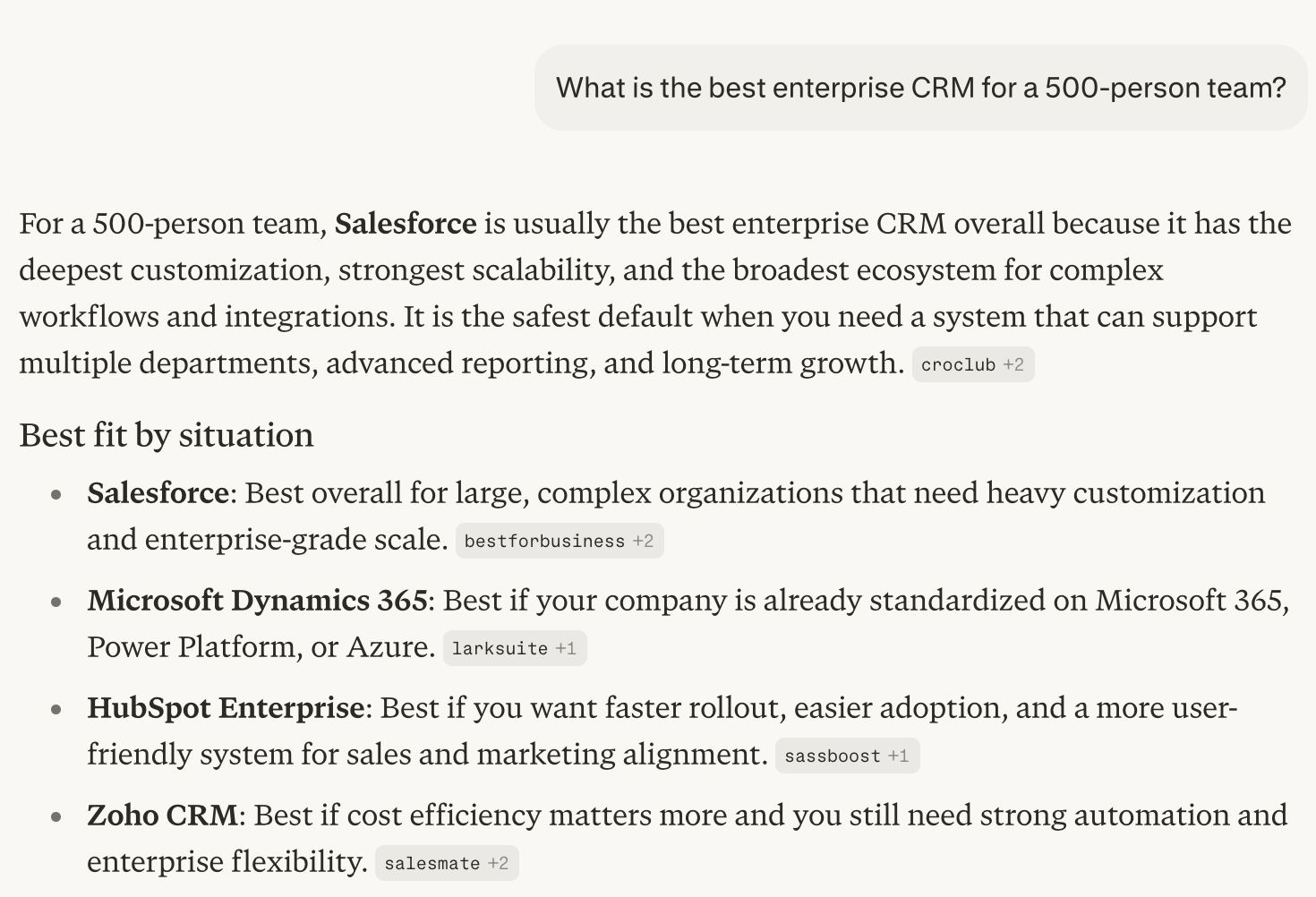
If you're running a pilot, test this rigorously: select 3–5 countries, run 20–30 prompts in each, and monitor the results for 2–4 weeks. You’ll quickly see that the competitors winning in the US are often completely different from those winning in Germany.
Citation intelligence: Why competitors get recommended (and how citations explain it)
AI engines recommend competitors based on training data and real-time retrieval. Citation intelligence is the ability to see exactly which sources the AI relied on to make that recommendation.
A strong tool should output the cited domains, the specific URLs, the frequency of citation, and which prompts trigger them. For example, you might discover: “Competitor X wins because AI consistently cites their 3rd-party comparison on G2 and their technical documentation pages.” Once you know the pattern, you can replicate it.
Omnia breaks citations down by domain and by exact URL.

The “action layer”: the difference between dashboards and execution
The biggest flaw in most AI visibility tools is that they stop at monitoring. They give you a dashboard showing that you're losing, but offer no help to fix it. The “action layer” is what separates a dashboard-heavy tool from an execution platform.
An action layer provides prioritized recommendations, an execution backlog, content briefs and outlines, placement guidance for PR, and before/after tracking. Most tools stop at monitoring, but the best tools help you ship changes weekly.
The best BrightEdge alternatives at a glance
Use this table to quickly compare the top BrightEdge alternatives based on their core architecture, whether they're a full SEO suite or a dedicated AI visibility tracker. Shortlist your top choices based on engine coverage, execution features, and pricing before diving into the detailed reviews below.
| Tool | Best for | Full SEO suite or dedicated AI visibility | Engine coverage | Action layer | Pricing starts at |
|---|---|---|---|---|---|
| Omnia | Startups/scaleups adding AI visibility | Dedicated AI visibility | 4 |  | €79/mo |
| Conductor | Enterprise SEO rip-and-replace | Full SEO suite | 4 |  | Custom |
| seoClarity | Technical SEO teams | Full SEO suite | 8 | | Custom |
| Semrush | All-in-one SEO consolidation | Full SEO suite | 6 | | $139.95/mo (+ $99/mo add-on) |
| Ahrefs | Ahrefs-first SEO teams | Full SEO suite | 7 | | $398/mo |
| Moz | ChatGPT and Google AI-only tracking | Full SEO suite | 2 | | $99/mo |
| Peec AI | Distributed agency teams | Dedicated AI visibility | 7 | | $95/mo |
| Scrunch AI | InfoSec-gated enterprises | Dedicated AI visibility | 8 | | $250/mo |
| AirOps | High-volume content ops | Dedicated AI visibility | 4 | | $200/mo |
The best Brightedge alternatives (ranked): tools you can add without replacing your SEO platform

The best BrightEdge alternatives don't force you to abandon your current SEO stack just to get AI visibility tracking. Here are the top 9 tools that plug the generative search gap while integrating cleanly with your existing workflows.
1. Omnia
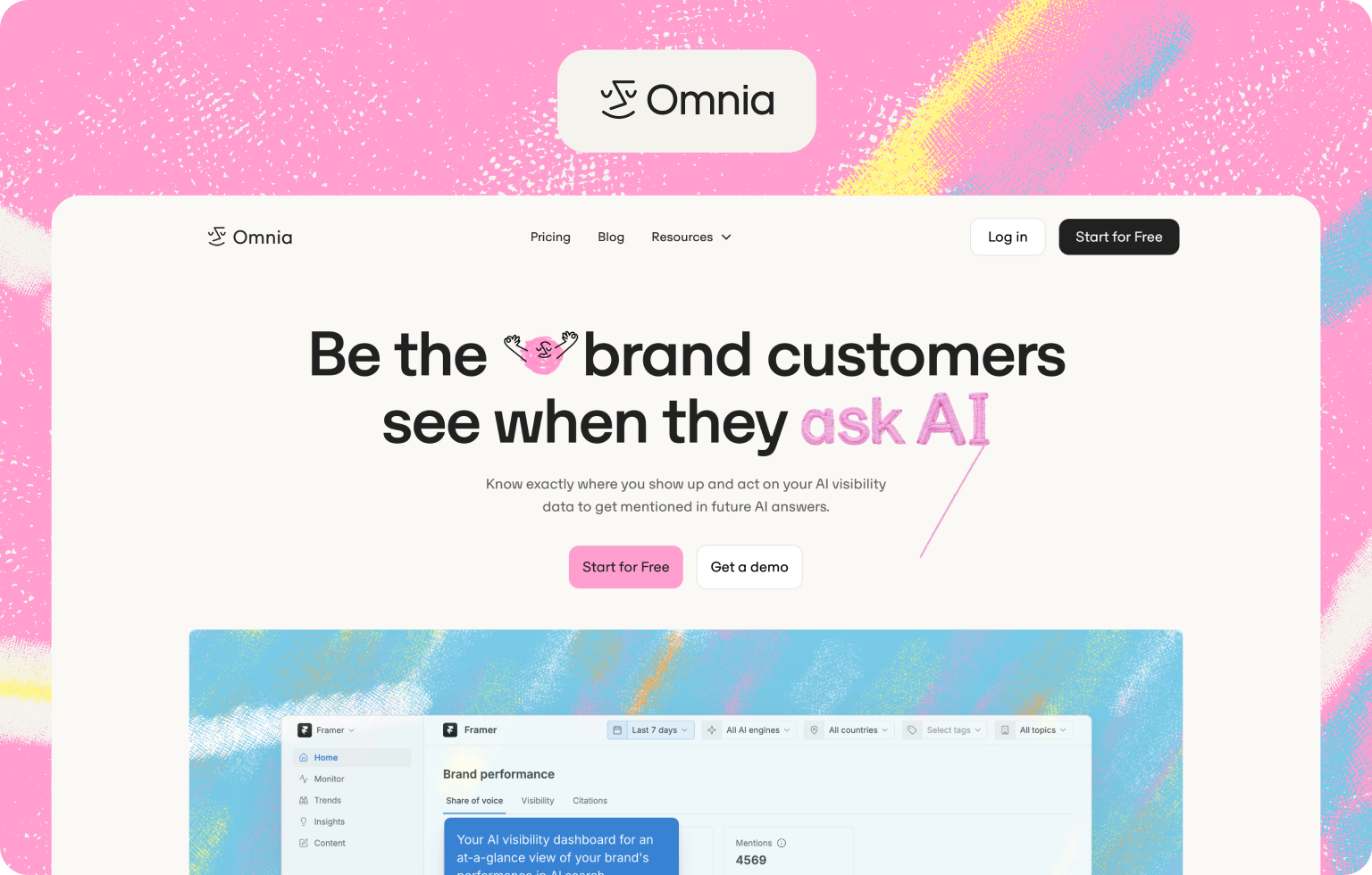
Omnia is an AI visibility platform built to plug the exact gap a legacy SEO suite leaves open. Instead of trying to replace your backlink analysis or site audits, it focuses entirely on AEO. It tracks how your brand performs across the core AI engines, maps those answers to the specific URLs driving them, and hands your content team a prioritized execution backlog. It's the layer that turns AI monitoring into actual content production.
Best for
Growth marketers, SEO leads, and founders at startups and scale-ups who want to add deep AI visibility tracking, localized country-level data, and citation intelligence without ripping out their existing SEO infrastructure.
Key features
- Tracks 4 core engines including ChatGPT, Perplexity, Google AI Overviews, and Google AI Mode
- Unlimited countries and languages on all plans via real browser execution
- Citation analysis at the exact URL level, including citation gap analysis (URLs where competitors are cited but you aren't)
- Action layer gives prompt-specific task list with content briefs, format and placement guidance, and on-page content optimization steps
- Prompt Discovery surfaces AI-native search prompts ranked by volume and difficulty across any country and language
- AI Sentiment Analysis explains how AI engines describe your brand across specific attributes (pricing, UX, support) to reveal positioning gaps
- Omnia MCP connector pipes your visibility data directly into AI assistants like Claude and ChatGPT
Where it falls short
Omnia focuses strictly on the 4 core engines driving actual traffic. If your workflow specifically requires tracking Reddit citation patterns, ChatGPT Shopping visibility, or long-tail engines like Grok and Meta AI, you'll want to supplement. Plus, while the action layer tells you what to build and where to place it, your team still has to execute the writing and outreach.
When to choose Omnia over BrightEdge
- You already have an SEO stack you like and refuse to pay for a massive, redundant enterprise SEO platform just to get AI visibility tracking
- You want a week-by-week execution backlog telling you which existing pages to fix and which domains to target for placements, rather than just a monitoring dashboard
- You need localized tracking by country via real browsers to ensure your data reflects what local users actually see
Pricing
- Growth: €79/mo
- Pro: €279/mo
- Enterprise: from €499/mo
2. Conductor

Conductor is an enterprise SEO platform and one of BrightEdge's most direct legacy competitors. While its primary focus remains traditional search, it's begun integrating AI features to track visibility across generative engines.
Best for
Enterprise teams looking to completely replace BrightEdge with another comprehensive SEO suite.
Key features
- Comprehensive enterprise SEO platform that combines deep technical site audits with traditional search metrics
- Traditional backlink and keyword analysis integrated alongside emerging AI visibility features for generative search
- Content guidance workflows that help enterprise teams align their traditional organic search strategy with new AI-driven search behaviors
Where it falls short
Like BrightEdge, AI visibility is an add-on rather than the core architecture. It lacks the deep URL-level citation intelligence and dedicated AEO action layer found in purpose-built platforms.
When to choose Conductor over BrightEdge
- You want a different enterprise SEO vendor with a slightly different approach to customer success and traditional search workflows
- You're looking for a full rip-and-replace of your legacy SEO stack rather than just adding an AI visibility point solution
- Your organization requires extensive onboarding, dedicated account management, and enterprise-grade SLAs that standalone AI trackers don't provide
Pricing
- Custom pricing only
3. seoClarity

seoClarity is an enterprise SEO tool known for its deep technical capabilities and massive keyword databases. It competes directly with BrightEdge for large-scale organic search management and also introduced features to monitor AI-driven search.
Best for
SEO teams with technical expertise at large enterprises who want to replace BrightEdge with a highly customizable traditional search platform.
Key features
- Massive proprietary keyword data that powers both traditional rank tracking and new AI-driven search insights
- Deep SEO auditing and log file analysis to understand exactly how search engine bots and AI crawlers interact with your site infrastructure
- Customizable enterprise-grade reporting dashboards that allow technical SEOs to slice visibility metrics across thousands of pages and queries
Where it falls short
It doesn't offer the granular URL-level citation intelligence or the dedicated action layer needed to execute a modern AEO strategy. seoClarity is a dashboard for analysts, but not an execution tool for content teams.
When to choose seoClarity over BrightEdge
- You prioritize deep technical SEO and log file analysis over native AI visibility execution and content generation
- You need a highly customizable enterprise platform to replace your current stack and handle millions of pages or keywords
- Your technical SEO team needs to correlate server log data with AI crawler behavior to optimize site architecture
Pricing
- Custom pricing only
4. Semrush
Semrush is a comprehensive digital marketing platform that recently added an AI Visibility Toolkit. It tracks citations at the domain and URL level across 6 engines, making it a strong option for teams that want to consolidate their stack.
Best for
Enterprise teams evaluating BrightEdge alternatives who want to consolidate traditional search optimization and AI visibility under one vendor.
Key features
- Citation tracking at both the domain and URL level, allowing you to see exactly which pages are driving your AI recommendations
- GA4 AI traffic channel integration that connects your AI visibility improvements directly to organic traffic shifts and revenue attribution
- Brand Performance reports that include sentiment tracking across AI engines, helping you understand how your brand is framed in generated answers
Where it falls short
Localized tracking is more limited than dedicated platforms, and the AI features require an expensive add-on on top of a premium base plan.
When to choose Semrush over BrightEdge
- You want an all-in-one platform that features keyword research, backlinks, and AI visibility without needing multiple enterprise contracts
- You need to justify AI visibility investment to leadership using Semrush's GA4 AI traffic channel and attribution data
- Your team is already deeply entrenched in the Semrush ecosystem and prefers an add-on over onboarding a completely new vendor
Pricing
- Standalone AI Visibility Toolkit: +$99/user/mo
- Semrush One Starter: $199/mo
- Semrush One Pro+: $299/mo
- Semrush One Advanced: $549/mo
5. Ahrefs
Ahrefs is a beloved SEO toolset that leverages a massive 254M+ real-user prompt index to track AI visibility. It covers 7 platforms, uniquely including YouTube and TikTok, and correlates existing backlink profiles with AI citation wins.
Best for
Ahrefs-first teams who want to understand which of their existing backlinks are actively driving AI citations.
Key features
- Brand Radar feature built on a massive database of 254M+ monthly prompts sourced from real user searches, ensuring you track actual buyer behavior rather than synthetic queries
- Correlates your existing backlink profile with AI citation wins, helping you understand which earned links are actively driving AI recommendations
- Historical AI visibility trend data dating back to 2024, allowing for long-term trajectory analysis and reporting
Where it falls short
Ahrefs lacks an action layer to generate content briefs, and it charges per AI platform, which makes full multi-engine coverage very expensive.
When to choose Ahrefs over BrightEdge
- You want to map your link-building ROI directly onto AI visibility gains using real-user prompt data
- You're already deep in the Ahrefs ecosystem and want brand monitoring integrated into your existing context
- You need to prove to stakeholders that your tracked prompts reflect actual search demand using Ahrefs' massive real-user prompt database
Pricing
- Select platforms: $398/mo
- All AI platforms: $699/mo
6. Moz

Moz is a foundational SEO platform that offers a gentle on-ramp to AI visibility by tracking Google AI Overviews and ChatGPT. It brings a unique dimension by surfacing EEAT signals and domain authority alongside citations.
Best for
Enterprise teams heavily invested in the Moz ecosystem who want the easiest entry point to AI visibility without a new vendor relationship.
Key features
- Link Intersect tools adapted for citation gaps, helping you identify which third-party sites are mentioning your competitors but ignoring you
- Integration of proprietary Domain Authority and EEAT signals alongside citation data to help explain why certain pages are chosen by AI models
- Familiar, user-friendly interface that makes transitioning from traditional SEO to basic AI visibility tracking straightforward for existing customers
Where it falls short
It only covers two platforms (Google AI Overviews and ChatGPT). It’s much stronger for traditional search than modern AI visibility.
When to choose Moz over BrightEdge
- You want to understand if your credibility profile (EEAT) is the reason you're losing AI citations, rather than just looking at content gaps
- You only care about ChatGPT and Google Overviews, and don't need to track other AI engines
- Your team relies heavily on Moz's Domain Authority metric as a core KPI and wants to view AI visibility through that specific lens
Pricing
- Standard: $99/mo
- Medium: $179/mo
- Large: $299/mo
7. Peec AI

Peec AI is an AI visibility tracker that offers unlimited seats and tracks 7 engines. It has URL-level citation classification and daily tracking, making it a strong seat multiplier for distributed teams.
Best for
Agencies with distributed teams where per-seat pricing on enterprise tools like BrightEdge is prohibitive.
Key features
- Daily prompt monitoring across 7 engines with a live, color-coded dashboard that tracks competitor share of voice
- URL-level citation classification and sentiment analysis that explains exactly how AI engines are framing your brand (positive, neutral, or negative)
- Auto-generated suggested prompts feature that reads your existing website content and surfaces candidate prompts, saving hours of manual setup time
Where it falls short
While it has an analytical “Actions” feature, it relies on external MCP integrations (like Claude) to actually draft content, meaning you have to build the execution workflow yourself. Lean teams may want to consider Peec AI competitors.
When to choose Peec AI over BrightEdge
- You need to give your entire agency team access to daily AI visibility data without paying enterprise per-seat licenses
- You want a tool that auto-generates suggested prompts from your website content so you don't have to build a prompt library from scratch
- You operate across multiple languages or countries and need daily tracking without per-language pricing penalties that stack up fast
Pricing
- Starter: $95/mo
- Pro: $245/mo
- Advanced: $495/mo
8. Scrunch AI

Scrunch AI is an enterprise-grade AI visibility platform that tracks 8 engines and provides a real-time bot crawling feed. It's a pure-play AI visibility tool with SOC2 certification, making it a compliance-safe add-on.
Best for
Enterprise or agency teams where InfoSec approval is a strict procurement gate.
Key features
- Agent Experience Platform (AXP) that creates a machine-readable content layer specifically designed to improve how AI crawlers process your site
- Real-time bot crawling feed that tracks exactly which AI agents visit your site, at what frequency, and which pages they are indexing
- Prompt-based monitoring across 8 engines with multi-dimensional competitor analysis by persona, topic, and geography
Where it falls short
Scrunch AI lacks an action layer, meaning your team will still have to manually interpret the data to create content briefs and outreach targets. Teams looking for a built-in action layer should look at Scrunch AI alternatives.
When to choose Scrunch AI over BrightEdge
- You need a highly secure, SOC 2-compliant tool that correlates citation wins with actual bot crawl behavior
- You want multi-dimensional competitor analysis by persona, topic, and geography simultaneously
- Your team is focused on making your technical content infrastructure more AI-readable rather than executing a content production roadmap
Pricing
- Core: $250/mo
- Enterprise: Custom
9. AirOps
AirOps is a comprehensive content pipeline executor that unifies AI citations, Google Search Console, and GA4. It turns citation intelligence into a structured PR and partnerships workflow with built-in publisher discovery and outreach automation.
Best for
Enterprise teams who want to move beyond owned content into third-party placement strategy and outreach.
Key features
- End-to-end workflow automation that takes you from citation gap identification through brief generation and AI-assisted drafting
- Direct CMS publishing integrations across 10+ platforms, allowing you to push optimized content live without leaving the tool
- Built-in publisher discovery and outreach automation that helps you target the third-party domains driving competitor citations
Where it falls short
It's limited to 1 region on its first two plans and carries a high price tag, making it less accessible for lean teams or those needing extensive geographical coverage.
When to choose AirOps over BrightEdge
- You want a tool that not only monitors AI visibility but actively automates the outreach and CMS publishing process
- You need a scale-up content operations tool to turn citation gaps into a production queue and publish at high volumes
- You want to unify AI citations, GSC, and GA4 in one dashboard to make a clear attribution case to your stakeholders
Pricing
- Solo: $200/mo
- Pro: $2,000/mo
- Enterprise: Custom
How to choose among BrightEdge competitors (a procurement-ready checklist)
Evaluating AI visibility platforms requires looking past flashy dashboards to see if the tool actually supports a modern AEO workflow. Use this checklist and pilot plan to validate whether a BrightEdge competitor can turn citation data into shipped content.
Requirements checklist: What to validate in every BrightEdge competitor

When evaluating tools to plug your AI visibility gap, don't just look at the dashboard UI. Use this checklist to ensure the platform can actually support a GEO workflow:
Pilot plan (Weeks 0–4): Prove whether you show up in AI answers today, by country
Don't sign an annual contract based on a demo. Run a 30-day pilot to prove the tool actually works for your specific market.
- Select 3 countries/markets: Pick your primary market and two secondary markets to test the tool's localization capabilities.
- Build a 50–100 prompt set: Include a mix of bottom-of-funnel category queries, direct brand queries, and competitor comparison queries.
- Establish a baseline: Run the prompts daily for the first week to establish your baseline visibility rate and competitor SOV.
- Identify gaps: Use the citation intelligence feature to find the top 5 third-party domains and top 5 competitor URLs that are winning the prompts you are losing.
- Define “win conditions”: Decide what success looks like for the pilot (e.g., “We identified 10 specific content updates that will improve our citation rate in Perplexity”).

Implementation plan (Weeks 4–12): Turn citation insights into shipped work
Once you've selected a tool, the goal shifts from monitoring to execution. This is where the action layer becomes critical.
- Weeks 4–6 (content updates): Use the tool's content briefs to update your 10 highest-value existing pages. Focus on adding FAQ schema, comparison tables, and direct answers to the prompts you're tracking.
- Weeks 7–9 (net-new content): Generate outlines for net-new content to fill the citation gaps where competitors are winning but you have no relevant page.
- Weeks 10–12 (placement and outreach): Take the list of third-party domains that the AI engines are citing, and execute a targeted PR or partnership outreach campaign to get your brand mentioned on those specific URLs.
Why Omnia is the best fit for growth marketers and agencies adding AI visibility (without replacing BrightEdge)
If you're already using a legacy SEO platform, you don't need another tool to tell you your domain authority or track your traditional keyword rankings. You need a tool that solves the specific problem of AI search visibility.
Omnia was built natively for AEO. While legacy platforms treat AI visibility as a bolt-on feature, often gating it behind expensive enterprise tiers or limiting it to a single country, Omnia makes it the core architecture. It gives you the URL-level citation intelligence you need to understand why a competitor is winning, and the built-in action layer to do something about it.
Instead of ripping out your entire SEO stack just to get AI tracking, you can plug Omnia in alongside it. You get unlimited countries, daily monitoring, and a prioritized execution backlog that turns AI signals into shipped content.
Book a demo to see Omnia with your data, or try a free, 14-day trial on the Growth plan.
FAQs
What’s the best BrightEdge alternative if I’m not trying to replace my SEO software?
If you want to keep your current stack for traditional search performance and local SEO, a purpose-built AI visibility tracker like Omnia is the best choice. It plugs the generative search gap by providing deep competitive research and content intelligence capabilities without redundant features. This allows you to execute targeted SEO campaigns without ripping out your existing infrastructure.
What is a BrightEdge cheaper alternative for agencies?
Agencies looking for a cost-effective option should consider Peec AI, which offers multi-client workspaces without enterprise per-seat pricing. While they lack the deep content planning and page optimization features of premium platforms, they provide solid competitor rankings and search results monitoring. For agencies needing an action layer to generate content ideas, Omnia's Growth plan is highly accessible.
Can I use BrightEdge and an alternative to BrightEdge together?
Yes, many enterprise teams use BrightEdge as their best SEO tool for traditional search while adding a dedicated AI visibility platform for generative engine optimization. This hybrid approach lets you maintain your legacy link-building opportunities and content structure workflows while gaining URL-level citation intelligence. It ensures you have the right data for every buying decision across both traditional and AI search.
How do I prove to leadership that AI search visibility is worth adding to the stack?
Start by running a pilot using free tools or a short trial to capture baseline competitor research across major AI engines. Show leadership exactly where competitors are winning citations that drive traffic, and how that impacts overall search performance. Connecting these citation gaps to lost revenue makes the investment in AI visibility much easier to justify than abstract metrics.
Who are the top SEO tool competitors of BrightEdge in 2026 (and which are best for AI visibility)?
The top competitors fall into two camps: legacy suites like Conductor and Semrush, and dedicated AI visibility platforms like Omnia and Peec AI. If your goal is to replace your entire stack, Semrush is a strong all-in-one option. However, for teams specifically focused on dominating AI search results with actionable content optimization capabilities, Omnia is the clear leader.

.webp)