


Google AI Overviews and AI Mode share 87% of their top cited domains. Gemini shares only 38.5% with AI Overviews, which is closer to ChatGPT than to its own siblings. Every brand following standard Google AI visibility advice is optimizing for an engine Gemini is not. The citation pool is still forming: 40.5% of all active Gemini domains in the most recent full tracking week were appearing for the first time. The brands that establish presence now will be structurally harder to displace once it consolidates. And Gemini is the one AI engine where SEOs already have the right mental model: 100% position coverage, editorial content dominating citations, and scarce slots that function like page-one real estate.
AI Overviews and AI Mode share 87% of their top cited domains. Gemini shares 38.5% with AI Overviews. If your Google AI visibility strategy treats them as the same surface, you are tracking two engines and leaving a third one completely uncovered.
That gap is not a rounding error, but it’s rather the difference between a strategy that works and one that performs on paper while Gemini sends buyers to competitors who figured this out earlier. For the cross-engine monitoring framework that covers all AI surfaces together, see how to monitor AI search visibility. This article is about Gemini specifically and how it rewards a different approach than anything else deriving from Google.
The Google AI advice that does not apply to Gemini
Most Google AI visibility strategies were built between 2024 and early 2026, when AI Overviews was the dominant Google AI surface and AI Mode had just launched. The guidance that emerged: optimize for Google's own platform content, build YouTube presence, earn LinkedIn mentions, and lean into structured data, reflected what those two engines actually cited. The problem is that Gemini was treated as part of the same family and assumed to behave the same way. The citation data shows it does not.
AI Overviews and AI Mode share 87% of their top 200 cited domains. They are near-identical in source behavior. A strategy built for one transfers reliably to the other. Gemini shares 38.5% with AI Overviews and 37% with AI Mode, which means 61.5% of the domains that matter most in Gemini do not appear in the top sources for either of its Google siblings.
Two engines that move together, and one that does not
| Engine pair | Top-200 domain overlap |
|---|---|
| AI Overviews ↔ AI Mode | 87.0% |
| Gemini ↔ AI Overviews | 38.5% |
| Gemini ↔ AI Mode | 37.0% |
| Gemini ↔ Perplexity | 33.5% |
| Gemini ↔ ChatGPT | 30.0% |
Source: Omnia citation database, May 22 to June 16, 2026.
When examining closely, the domain-level detail is where the misalignment becomes specific enough to act on. AI Overviews and AI Mode pull heavily from Google's own platform content. YouTube accounts for 6.17% of AI Overviews citations and 5.18% of AI Mode citations. LinkedIn sits around 1% for both. These are meaningful shares and are enough to justify platform-specific optimization effort.
Gemini cited LinkedIn nine times across the entire four-week tracking window. YouTube accounts for 1.03% of Gemini citations which represents a fifth of what AI Overviews pulls. Reddit is the one area where all three Google engines converge, at roughly 2% each. Where Gemini diverges is how it moves toward independent editorial sources. Medium appears at 0.62% and Forbes at 0.24%, which are both higher in Gemini than in either AI Overviews or AI Mode.
Same company, different consumption
| Domain | Gemini | AI Overviews | AI Mode |
|---|---|---|---|
| YouTube | 1.03% | 6.17% | 5.18% |
| 0.003% | 1.09% | 0.98% | |
| 2.07% | 2.24% | 2.17% | |
| Medium | 0.62% | 0.29% | 0.33% |
| Forbes | 0.24% | 0.10% | 0.11% |
Source: Omnia citation database, same window.
The citation budget makes the strategic error costly. Gemini cites an average of 4.28 distinct domains per answer, which is the lowest of any major AI engine tracked. AI Overviews averages 8.37. AI Mode averages 9.86. With roughly four citation slots per answer instead of eight to eleven, being absent from Gemini's source pool carries a higher penalty than on any other engine.
Gemini runs the tightest citation budget in the stack
Gemini also repeats its sources: 7.65 citations spread across 4.28 domains, meaning it cites the same domain roughly 1.8 times per answer. It does not cast a wide net. It retrieves selectively from a narrow pool and cites nearly everything it retrieves.
Dejan.ai's June 2026 controlled grounding test found Google received 7 pages in its retrieval layer and cited 7, a near-100% retrieval-to-citation rate, compared to ChatGPT which received 39 pages and cited 2. Getting into Gemini's retrieval layer is the primary challenge. Once retrieved, citation is near-certain.
The advice built for AI Overviews was not wrong. It was written for a different engine: one that happens to share a logo with Gemini but not its citation behavior. For teams that want to track AI Overviews alongside Gemini as a separate workstream, see how to track brand and competitor mentions in AI Overviews.
| Engine | Avg domains per answer |
|---|---|
| Claude | 11.28 |
| ChatGPT | 9.94 |
| AI Mode | 9.86 |
| Perplexity | 8.52 |
| AI Overviews | 8.37 |
| Copilot | 4.37 |
| Gemini | 4.28 |
Source: Omnia citation database, same window.
Gemini's citation pool is still being decided
The brands that appear consistently in Gemini a year from now are being determined right now. That is not a prediction, but rather what the formation-period data shows.
In Gemini's most recent full tracking week (June 8, 2026), 40.5% of all active cited domains were appearing for the first time. The week before that: 48.1%. Every week that passes, the cost of entering Gemini's citation pool rises incrementally as the pool firms up around the sources already present.
Gemini's citation pool: new domains entering each week
| Week starting | Active domains | First seen that week | New-domain rate |
|---|---|---|---|
| May 22 (partial) | 3,875 | 3,875 | Baseline |
| May 25 | 7,710 | 4,814 | 62.4% |
| June 1 | 9,262 | 4,457 | 48.1% |
| June 8 | 11,816 | 4,785 | 40.5% |
| June 15 (partial) | 5,194 | 920 | 17.7% |
Source: Omnia citation database, same window.
The declining trend is the signal that matters as much as the absolute rate. A 40.5% weekly new-domain entry rate means incumbents are not locked in and new entrants are breaking through consistently. A pool moving from 62.4% to 40.5% over four weeks is a pool moving toward consolidation, not away from it.
Teams acting now are acting at a 40.5% entry rate. Teams acting in three months may be acting into a 15% entry rate. The structure of that compounding disadvantage is the reason the timing argument is not hype.
The citation stability data tells the same story from a different angle. Only 19.8% of Gemini prompts keep the same top-cited domain across a four-week window. Nearly half (45.8%) are volatile or highly volatile, swapping their lead source three or more times in four weeks.
How settled is each engine's citation pool?
| Engine | Stable | Moderate | Volatile | Highly volatile |
|---|---|---|---|---|
| Perplexity | 37.0% | 32.1% | 20.4% | 10.5% |
| ChatGPT | 25.1% | 32.9% | 27.6% | 14.3% |
| AI Overviews | 24.8% | 33.8% | 28.1% | 13.4% |
| AI Mode | 18.8% | 33.1% | 31.4% | 16.7% |
| Gemini | 19.8% | 34.4% | 30.5% | 15.3% |
Source: Omnia citation database, same window. Method: prompts present in at least three weeks; stable = same top domain every week; highly volatile = four or more different top domains.
Perplexity at 37% stable is what a maturing engine looks like. Gemini at 19.8% stable is nowhere near that point. The brands entrenched in Perplexity's citation pool required sustained effort to get there and would be expensive to displace. The brands entering Gemini's pool right now are doing so at the lowest cost they will ever face on this surface.
The analogy worth making once and not overselling: early search engine optimization rewarded brands that built domain authority before the algorithm matured. The brands that moved in 2003 and 2004 compounded that advantage for years.
Gemini's citation pool is at a comparable early stage. The mechanism is different: editorial placement rather than backlink accumulation, but the structural logic is the same. Early presence during formation compounds. Late entry into a consolidated pool requires displacing incumbents rather than simply arriving, which is why we have a helpful guide on ranking for Gemini.
None of this means the window is already closing. Rather, the declining entry rate is evidence of a narrowing opportunity, not a closed one. But it is a specific, measurable signal that the window is open now in a way it will not be indefinitely. Tracking Gemini without acting on the formation-period data is watching the window while it is open rather than climbing through it.
Why SEOs are best positioned to win in Gemini and ignoring it
There is an irony in the Gemini data that the stability and budget findings only partially reveal. The professionals with the most relevant skill set for winning in Gemini are the ones who have dismissed it as covered by AI Overviews. It is not. And the reason their skills transfer directly is sitting in the position data.
Gemini exposes numbered positions on 100% of its citations. Not 37% like ChatGPT. Not 24.6% like AI Overviews. Every single citation Gemini produces carries a rank.
Which engines actually expose citation positions?
Position 1 holds 13.1% of all Gemini citations. Position 2 holds 12.3%. About 85% of all citations land in positions 1 to 10, decaying smoothly and consistently from the top. These are not decorative labels. A brand cited at position 2 for a high-intent evaluative prompt via a comparison article is in a categorically different situation from one cited at position 9 via a blog post for a lower-intent query. That distinction is trackable, reportable, and improvable in Gemini in a way it is not for most other engines in the stack.
SEOs already know how to think about this. Positions that decay from the top. Scarce real estate at position 1. Rank movement as a weekly performance metric. The mental model that took years to build for organic search transfers directly to Gemini and to almost no other AI engine at this level of completeness.
The content finding compounds the parallel. The page types that earn citations in Gemini are the ones SEOs have always produced.
What Gemini actually cites and what it ignores
| Page type | Gemini citation share |
|---|---|
| Blog / article / news | 32.74% |
| Review / comparison | 12.17% |
| Guide / how-to | 1.21% |
| Product page | 0.32% |
| Pricing page | 0.14% |
| Help / FAQ | 0.09% |
Blog and article pages plus review and comparison pages account for roughly 45% of all Gemini citations, the highest editorial content share of any engine Omnia tracks. Product pages, pricing pages, and FAQ pages are collectively under 0.6%. The content strategy required to earn Gemini citations is long-form editorial, comparison pieces, and earned coverage on independent sources. That is the SEO playbook applied to a new surface.
The position data by page type sharpens the argument further.
Which content formats earn the strongest Gemini positions?
Product pages average position 5.9 and are technically strong, but account for only 0.32% of total citations. High average position on a rarely-cited page type is a statistical artifact, not a strategy. Review and comparison pages earn the best average positions among the page types that actually drive citation volume. A brand that earns consistent placement in comparison roundups on domains Gemini cites is building the highest-leverage Gemini position available.
One calibration from Peec AI, published in Search Engine Journal in June 2026: across 37,804 AI responses analyzed over five LLM engines, prompt intent drives brand visibility more reliably than exact wording variation. For Gemini's editorial-heavy citation pool, intent coverage matters more than prompt variation. One well-placed comparison article targeting evaluative intent covers more Gemini citation surface than ten narrowly-worded pieces targeting the same ground from slightly different angles.
The editorial brief for Gemini is not about volume, rather grounded on placement precision on the right domains for the right intent categories. For how GEO principles connect to this approach, see generative engine optimization SEO benefits.
How to set up Gemini tracking that reflects how the engine actually works
With 38.5% domain overlap between Gemini and AI Overviews, a tracking setup built for one produces unreliable signal for the other. Every step below is grounded in what the Gemini data shows.
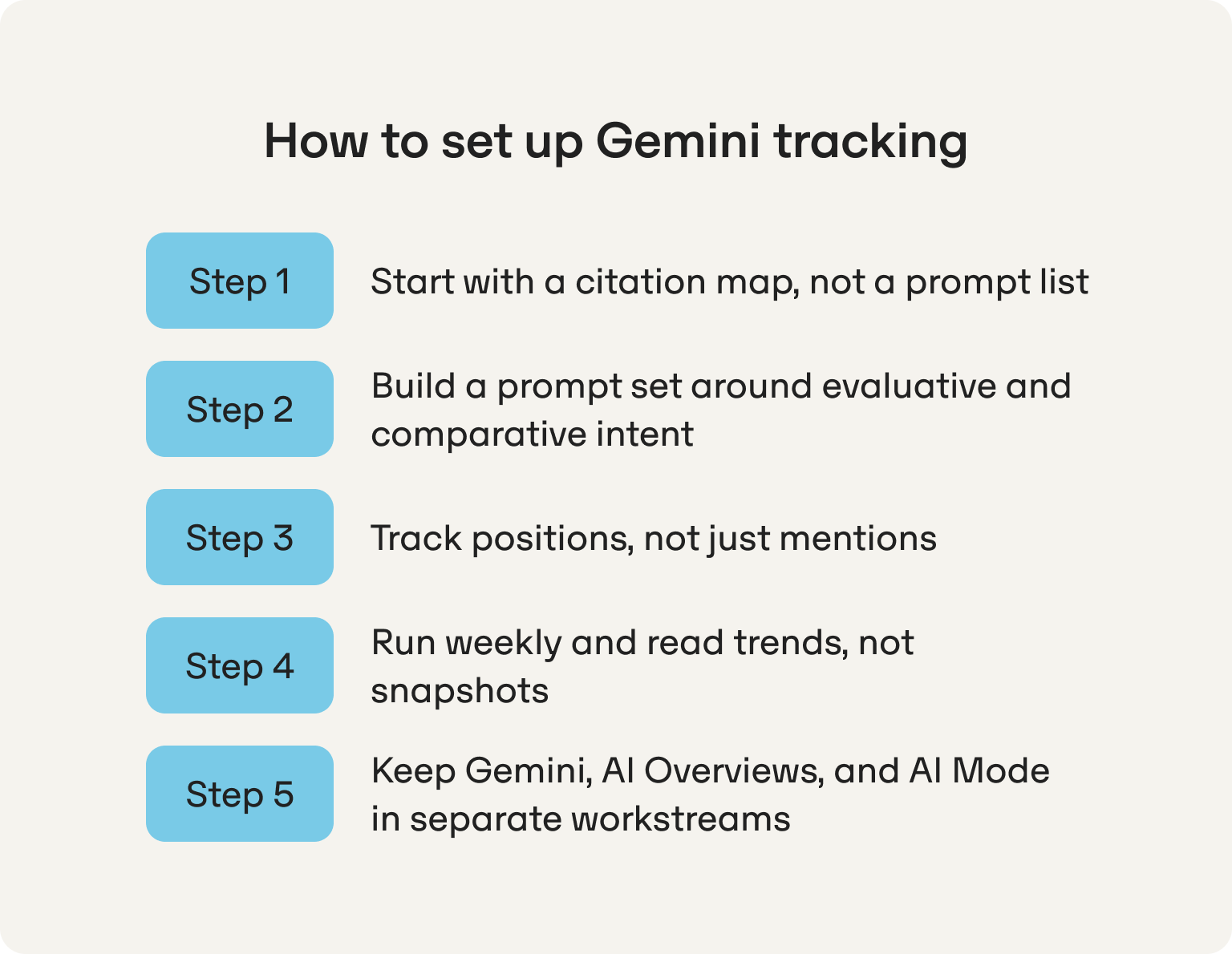
Step 1: Start with a citation map, not a prompt list.
With only 4.28 citation slots per answer, which domains fill those slots matters more in Gemini than on any other engine. The first tracking task is not building a prompt list and running it blind. It is identifying which domains Gemini currently cites for the prompts most relevant to the category. That domain map is the editorial target list. Everything else (content briefs, placement pitches, competitor analysis) follows from it. Too learn more, read about AI citation tracking for the domain mapping process.
Step 2: Build a prompt set around evaluative and comparative intent.
Gemini's citation pool is dominated by blog and article content (32.74%) and review and comparison content (12.17%). The prompts that surface those page types are evaluative and comparative: "what are the best [category] tools for [use case]," "how does [brand] compare to [competitor]," "what should I look for in a [category] solution." Navigational prompts and product-specific queries surface the page types that account for under 0.5% of Gemini citations. Build the prompt set around the buyer intent that maps to editorial content, not around the brand's own product language. See AI prompt discovery for guidance on mapping intent to buyer stage.
Step 3: Track positions, not just mentions.
Because Gemini exposes numbered positions on 100% of citations, mention-level tracking misses the most actionable signal on this surface. A brand cited at position 2 via a comparison article for a high-intent evaluative prompt is in a materially different situation from one cited at position 9 via a blog post for a lower-intent query. Position tracking is the metric that makes Gemini distinctive. Set up position capture from the start, not as a later addition. See how to track AI citations for your business for the citation and position capture setup.
Step 4: Run weekly and read trends, not snapshots.
With 45.8% of prompts volatile or highly volatile, a single week is noise. Three or more weeks of consistent directional movement is signal. A weekly cadence is appropriate: daily produces noise during the formation period, monthly misses the entry-rate moves that matter most while the pool is still fluid. Watch the new-domain rate in the category alongside brand citation share: the two signals together tell you whether the pool is consolidating and whether the brand is moving with it or falling behind.
Step 5: Keep Gemini, AI Overviews, and AI Mode in separate workstreams.
AI Overviews and AI Mode can share a setup given 87% domain overlap. Gemini cannot share either. A combined Google AI tracking view obscures what is happening in each engine and produces averaged metrics that are accurate for none of them. For teams monitoring AI Mode alongside Gemini, see AI Mode tracking for the engine-specific setup.
With 45.8% of Gemini prompts volatile or highly volatile, single-week drops are expected behavior, not alarm signals. Look for directional movement across three or more weeks. Focus position tracking on the five to ten prompts that carry the most buyer intent. Given the lean citation budget, those slots matter more here than on any other engine. And resist reading AI Overviews performance as a proxy for Gemini: a strong week in AI Overviews tells you almost nothing about what is happening in Gemini. Evaluate them separately and report them separately.
The action layer: from Gemini data to editorial placement
Manual Gemini tracking works at small prompt volumes. It cannot keep pace with a 40.5% weekly new-domain entry rate at any meaningful scale. The brands that benefit from the formation period are the ones who can see which new domains are entering the pool, which prompt intents they are being cited for, and what a placement brief for each looks like while the entry rate is still high enough for new entrants to break through without displacing incumbents.
Omnia tracks Gemini citations using real-browser simulation rather than API approximations. Gemini's responses vary enough across sessions that spot-check scraping produces citation data that does not reflect what buyers actually see. The figures in this article were collected using Omnia's standard method across the full four-week tracking window.
What Omnia surfaces for Gemini specifically:
- Which domains Gemini cites for each monitored prompt, with numbered position data, ranked by citation frequency across the tracking window
- Which new domains are entering the citation pool in the category each week, the formation-period signal that manual tracking cannot capture at scale
- How citation positions and domain presence shift week over week, so directional trends are visible without single-week noise
- Where the brand's citation footprint and average position compare to specific competitors across the same prompt set
- Which page types on cited domains are earning the strongest positions, so the editorial brief targets the right content format on the right domain
The formation period creates a specific execution problem. Knowing that Gemini cites four domains consistently for a high-intent evaluative prompt where the brand is absent is a starting point. Knowing which of those domains publishes comparison content, which competitors appear in their coverage, which prompt intents they are cited for, and what a placement brief for each should contain is what closes the gap while the entry rate is still favorable.
Omnia's action layer generates that brief from citation and position data directly so the team receives an action for each identified gap rather than an observation that requires manual translation.
Omnia MCP connects Gemini visibility data into AI assistants directly, making citation and position data accessible inside the tools the team already uses. For teams building a full multi-engine AI visibility strategy, see AI visibility tracking for how Omnia covers Gemini alongside ChatGPT, Perplexity, Claude, AI Overviews, and AI Mode in a single system.
Your potential customers are already asking Gemini which tools to use in your category. Find out what it tells them. Start a free trial or book a demo.

FAQs
Is Gemini the same as Google AI Overviews for tracking purposes?
No, and the gap is larger than most teams expect. Omnia's citation data shows only 38.5% overlap in Gemini's and AI Overviews' top 200 cited domains across the same four-week window compared to 87% overlap between AI Overviews and AI Mode. LinkedIn accounts for roughly 1% of AI Overviews citations and has appeared nine times in total in Gemini's tracking window. YouTube is 6.17% of AI Overviews citations and 1.03% of Gemini's. A prompt set, domain map, and editorial strategy built for AI Overviews will not transfer to Gemini. Both require separate tracking workstreams with separate editorial target lists.
Why does Gemini cite so few domains per answer compared to other AI engines?
Gemini retrieves selectively and cites nearly everything it retrieves. Dejan.ai's June 2026 controlled grounding test found Google received 7 pages in its retrieval layer and cited 7: a near-100% retrieval-to-citation rate, compared to ChatGPT which received 39 pages and cited 2. Gemini is not a broad sampling engine that filters aggressively. It is a narrow retrieval engine that cites almost everything it surfaces. At 4.28 distinct domains per answer, the bottleneck is getting into the retrieval layer in the first place. Once retrieved, citation is near-certain, which is why editorial placement on the right sources matters more in Gemini than on any other engine in the stack.
What type of content earns citations in Gemini and what gets ignored?
Blog and article pages account for 32.74% of Gemini citations, the highest share of any engine Omnia tracks. Review and comparison pages add another 12.17%. Together, editorial and review content accounts for roughly 45% of Gemini citations. Product pages, pricing pages, and FAQ pages are collectively under 0.6%. Gemini is the most editorial engine in the stack. It rewards the content types that SEOs have always produced for organic search and largely ignores the product-led content types that other channels prioritize. Review and comparison pages earn the best average citation positions among high-volume page types, at 6.1 versus 6.4 for blog content.
How is Gemini rank tracking different from traditional SEO rank tracking?
Traditional rank tracking measures a brand's position on a static Google SERP for a given keyword, with data sourced from Search Console or a rank tracker querying Google's index. Gemini rank tracking measures which domains Gemini cites in a dynamically generated answer for a given prompt, at what numbered position, and how that changes week over week. There are no static URLs to rank, no keyword index to query, and no Search Console data available. What makes Gemini distinctive among AI engines is that it exposes numbered positions on 100% of its citations making it the closest AI equivalent to traditional rank tracking currently available. The mental model transfers even though the mechanism is different: positions decay from the top, editorial content earns the strongest ranks, and week-over-week movement reflects content and placement actions.
How quickly can a brand break into Gemini's citation pool?
Faster now than it will be in six months. With 40.5% of all active Gemini domains in the most recent full tracking week appearing for the first time, new entrants are breaking through consistently and incumbents are not locked in the way they are on a settled engine. Editorial placement on a domain Gemini actively cites in the category can surface in citation data within two to three weeks, given Gemini's near-100% retrieval-to-citation rate once the right sources are targeted. The declining new-domain entry rate from 62.4% in late May to 40.5% in early June, is evidence that the window is narrowing, not closed. Teams that act during the formation period are building citation presence at the lowest structural cost they will face on this surface.