AI Search Visibility
AEO vs GEO vs AI SEO vs SEO: What's the Difference?

 Jose Luis García del RíoGrowthatOmniaJose Luis García del RíoGrowthatOmnia
TL;DR
Strong AI citation share in one market says nothing about any other market. Closing that gap has traditionally meant hiring an in-market SEO specialist for every language a brand operates in, a cost structure that prices out any team without an enterprise localization budget. Most AI visibility tools rebuild the same barrier in a different form, capping country or language coverage on their entry tier and charging more to expand past it. A system built for unlimited market coverage from the start removes that ceiling entirely.
A brand can win nearly every citation that matters in English and be invisible the moment someone asks the same question in Spanish or French. Most teams find this out by accident, if they find out at all, because the monitoring they already have only covers the market it was set up for. Expanding that coverage has traditionally required one of two things: an in-market SEO specialist fluent in the language and its search behavior, or a tool willing to track a new market without charging for it as an upgrade.
Neither option exists for most growing teams. A one-person or three-person marketing team cannot hire a French-market specialist to answer a single question: are we cited at all. And a monitoring tool that treats each additional country or language as a paid tier away from the current plan puts the same question behind a budget approval most teams won't get for a market they haven't even validated yet. The result is the exact situation this article opened with: dominant at home, blind everywhere else, with no affordable way to check.
The audience an English-only AEO strategy misses is no longer a minority worth deferring. OpenAI's own usage data shows that active ChatGPT consumer users who primarily speak a language other than English now outnumber English-primary users, with Spanish, Portuguese, and Arabic leading and growth fastest across Africa and Asia. Smaller languages are growing fastest of all: OpenAI's June 2026 figures show Uzbek, Kazakh, and Burmese posting the largest gains among languages with at least a million active users. An AEO strategy built around English-language monitoring is now built around less than half of the audience actually asking questions.
The commercial stakes behind that shift are not new, AI search inherited them from a pattern already well documented in ecommerce. CSA Research's long-running "Can't Read, Won't Buy" survey of over 8,700 consumers across 29 countries found that most shoppers prefer buying when information appears in their own language, and a meaningful share will not buy from a brand at all if it doesn't. Dr. Donald A. DePalma, the firm's Chief Research Officer, has been direct about what that means for any company that treats localization as optional: businesses that skip it are choosing to forfeit a real share of their addressable market, not a hypothetical one. The same logic now applies one layer earlier. If a brand isn't cited when an AI engine answers a question in Spanish or Portuguese, the buying preference CSA Research documented never gets the chance to work in the brand's favor at all.
Each language runs its own retrieval pool, and three things shift at once the moment a query changes language:
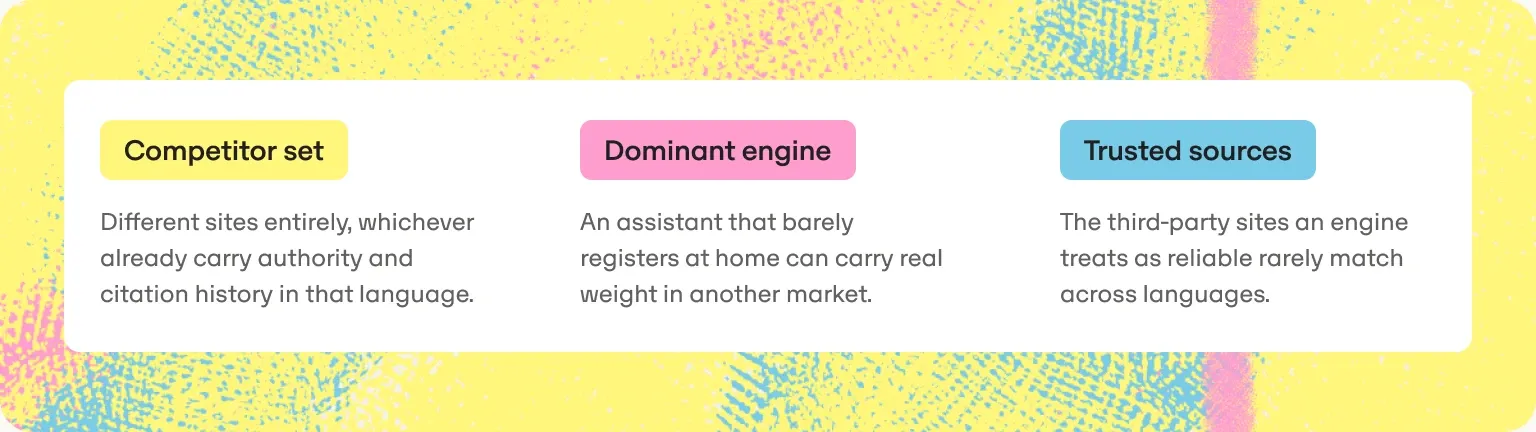
None of that carries over when a page gets translated instead of rebuilt. A page translated word for word carries none of the authority that earned the original its citations. Backlinks pointing to the English version do not transfer to the French one. The citation history an AI engine has built up around a domain in one language does not extend automatically to a subdirectory in another. The translated page starts from zero in every signal that actually determines whether an engine cites it, even on a domain with years of authority in its home market.
The disadvantage runs deeper than lost authority signals. Researchers studying retrieval-augmented generation, the technique most AI answer engines use to ground responses in real sources, have found that these systems carry a built-in preference for English documents during retrieval itself, independent of content quality. One study found that English consistently ranked as the most preferred language for answering questions across the systems tested, ahead of French, Spanish, and Portuguese, and that some systems favored English documents even over documents in the query's own language.
Separate research identified the same pattern and traced part of it to a practice called English pivoting, where a non-English query gets translated into English before the system retrieves anything, which quietly makes English the default source pool regardless of what language the person actually asked in. A well-built page in the local language starts from zero and then competes against a retrieval system with a structural thumb on the scale for English sources before relevance is even assessed.
This is a different problem from the technical distinction between GEO and SEO. Hreflang tells a search engine which page to serve to which user; it says nothing about whether that page has earned the authority to be cited once served. A multilingual SEO setup can be technically flawless, every hreflang tag correct, every subdirectory properly structured, and still fail at the one question this article is actually about: does an AI engine trust this page enough to cite it in this language.
None of this starts from a blank page. A market-by-market AEO strategy sits on top of whatever international SEO strategy a team already runs, and the fundamentals of that strategy still carry weight.
Market research still comes first, the same as it always has. Choosing a target market in Brazil over one in the Netherlands should rest on real demand signals and a target audience with genuine buying intent, not on which local market looks easiest to translate into. Thorough market research at this stage is what separates an effective international SEO strategy aimed at a target country worth the investment from one spread thin across too many international markets at once, none of them properly served.
Traditional keyword research does not disappear either. Google Keyword Planner still surfaces search volume and relevant keywords for a target language, and conducting keyword research this way remains a reasonable starting point for identifying local keywords before layering in in-language prompt research. The difference is depth: relevant keywords tell a team what people type into other search engines, while prompt research captures the fuller, more conversational user intent behind what people actually ask an AI engine, in the cultural context of that specific target country.
Technical SEO still matters as much as it ever did. Correct hreflang implementation (the link rel alternate tag connecting different language versions of a page) tells search engines which version to serve to which international audience, and getting it wrong can confuse search engines into serving the wrong page to the wrong local audience, or missing an entire language version altogether.
The choice between country code top level domains, subdirectories, and generic top level domains still signals something real to both search engines and visitors about how seriously a business takes a given local market, and it still shapes user experience for international visitors landing on the site.
Measurement carries over too. Google Search Console and Google Analytics still report organic traffic, search engine rankings, and international visitors by country, exactly as they always have.
Successful teams should continue to keep track of SEO performance across other search engines, not only the AI engines this article focuses on. Local search engines that dominate specific regions, Baidu, Yandex, Naver among them, still deliver real organic traffic in the markets where they lead, and dropping that tracking because the conversation has shifted to AI search would cost a team visibility it already had.
A technically sound international SEO setup, complete with accurate hreflang, solid keyword research, and clean tracking, can still leave an AI engine unable to answer a question about the brand in the same language, because ranking in search results pages and getting cited in an AI-generated answer draw on different signals entirely. Local SEO focuses on winning a single market's search behavior within one language. Multilingual AEO extends that same discipline across every language and every target market a brand operates in, and picks up exactly where standard international SEO efforts run out of road.
None of this groundwork goes to waste.
Correct language targeting, real keyword research per market, and tracking that covers other local search engines as well as the obvious ones are exactly what separate genuine multilingual SEO success from a site that merely exists in several languages without earning anything in most of them. That discipline holds whether a team is managing multiple countries under one global SEO strategy or expanding one market at a time.
What changes with AI search is whether that work is enough on its own: a page can rank well, look complete to every traditional measure of international SEO performance, and still be invisible the moment the question shifts from where a page ranks in search results to whether an engine cites it at all.
Three decisions determine whether a new market gets real AI visibility or just a translated site nobody cites: which markets to prioritize, what people in that market actually ask, and whether the brand resolves as one recognizable entity across every language it operates in.
Market selection has to run on commercial signal, not on which language looks easiest to translate into or which market sits closest to headquarters. A market with real existing demand and a visible competitive gap is worth the investment before a market chosen because it was next on a list. Prompt research has to happen in the language itself, not as a translation of the English prompt set.
The questions people ask an AI engine in Portuguese are not the Portuguese words for the questions asked in English; they reflect different framing, different urgency, sometimes different products entirely, and prompt research built on translated queries will target questions nobody in that market is actually asking.
The third piece is the one most multilingual strategies skip entirely: whether an AI engine recognizes the brand as the same entity across languages, or fragments it into several disconnected, weaker mentions. This depends on entity disambiguation, consistent naming, consistent structured data, and cross-language signals that tell an engine the French-language mention and the English-language mention refer to the same brand rather than two unrelated ones.
What changes at each stage, laid out directly:
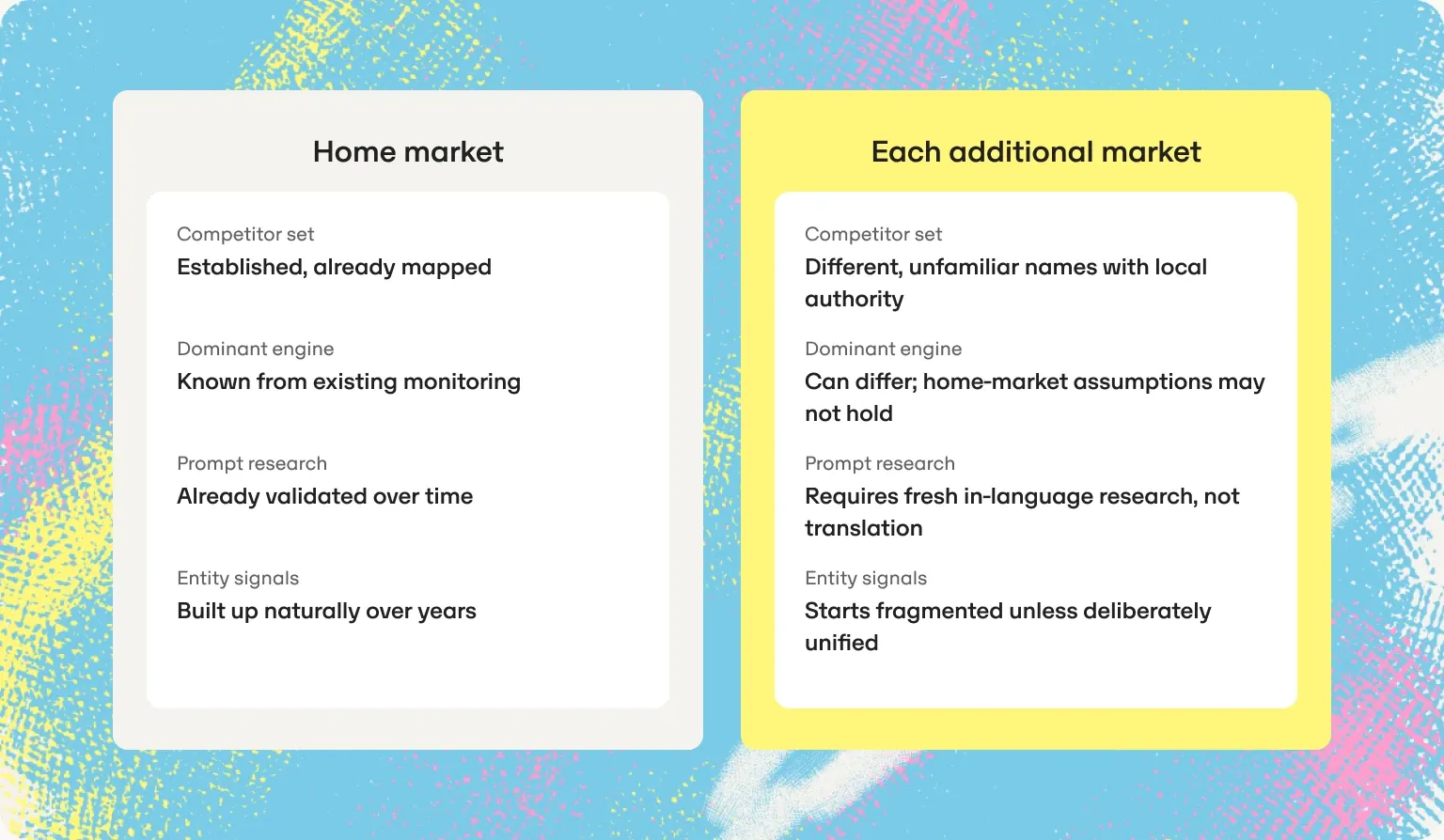
Every row on the right side of that table is a decision a translated page makes by default, usually the wrong one, simply by inheriting the home market's assumptions instead of being built for the new one.
An AI engine has to recognize a brand as one entity before it can cite that brand consistently across languages, and this is where most multilingual strategies quietly break down without anyone noticing until visibility data from a new market comes back thin. A brand built up over years of English-language mentions, backlinks, and structured data can look, to an engine parsing a French or German query, like an entity it has barely encountered at all, or worse, like several unrelated entities that happen to share a name.
A handful of causes show up repeatedly:
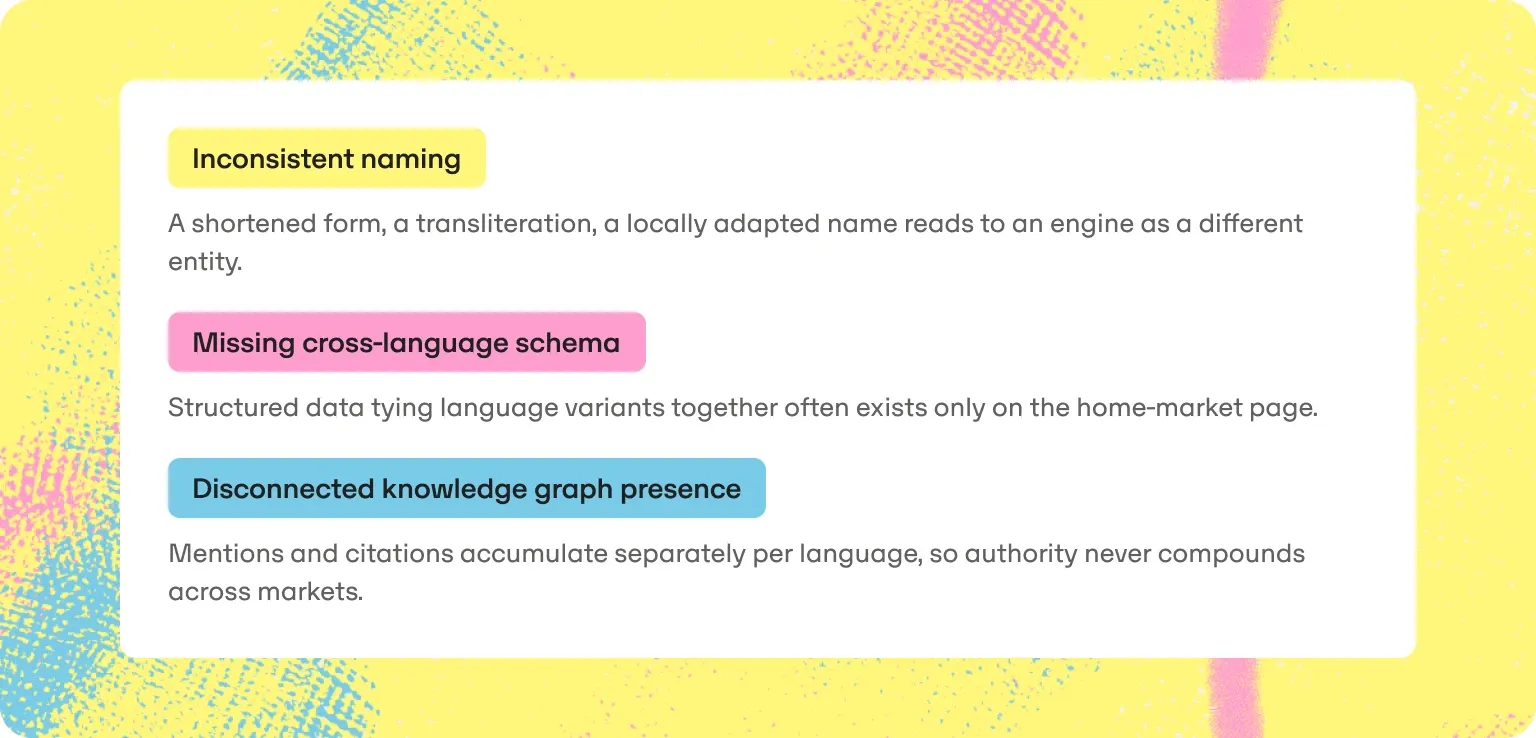
Cultural differences compound the problem further. The same core facts, stated confidently in English, can read as too direct, too vague, or simply beside the point once carried into a market with different cultural nuances and a different sense of cultural relevance, which pushes teams to rewrite content rather than translate it, and rewriting inconsistently across markets is exactly what fragments an entity in the first place. Search engines recognize a brand more reliably when culturally relevant content still traces back to the same core facts and the same name, adapted to fit the target market rather than converted word for word.
The fix runs through the same discipline used to keep any brand distinguishable inside a multi-engine optimization approach: consistent naming across every language variant, structured data that explicitly links language versions to one entity, and content that reinforces the same core facts about the brand regardless of which language states them.
Most AI visibility monitoring, where it exists at all, defaults to whichever market the tool was set up for, almost always home-market English. That default is rarely a deliberate choice. It's just where the account started, and nobody went back to add a second market because the tool wasn't built to make that easy or because doing so meant a new paid tier.
The result is a blind spot that looks like good news from the inside. Dashboards show strong citation share, healthy share of voice, a brand doing well in AI search, because every number on the screen reflects one market. Whether that same brand is cited at all in Spanish or Portuguese never enters the picture, not because the answer is reassuring, but because nobody is asking the question. This is one of several challenges that make GEO genuinely hard to get right, and it compounds specifically for teams operating across markets: the gap doesn't show up as a bad number, it shows up as the absence of any number at all.
Closing this gap has traditionally required one of two paths, and both price out most growing teams. The first is hiring an in-market SEO specialist for every language a brand operates in, the model enterprise localization vendors are built around, and a real cost structure for a company with the budget and headcount to support it. The second is a monitoring tool that treats each additional country or language as a step up to a higher tier, which puts the same question, are we cited in this market at all, behind a budget approval for a market that hasn't even been validated yet.
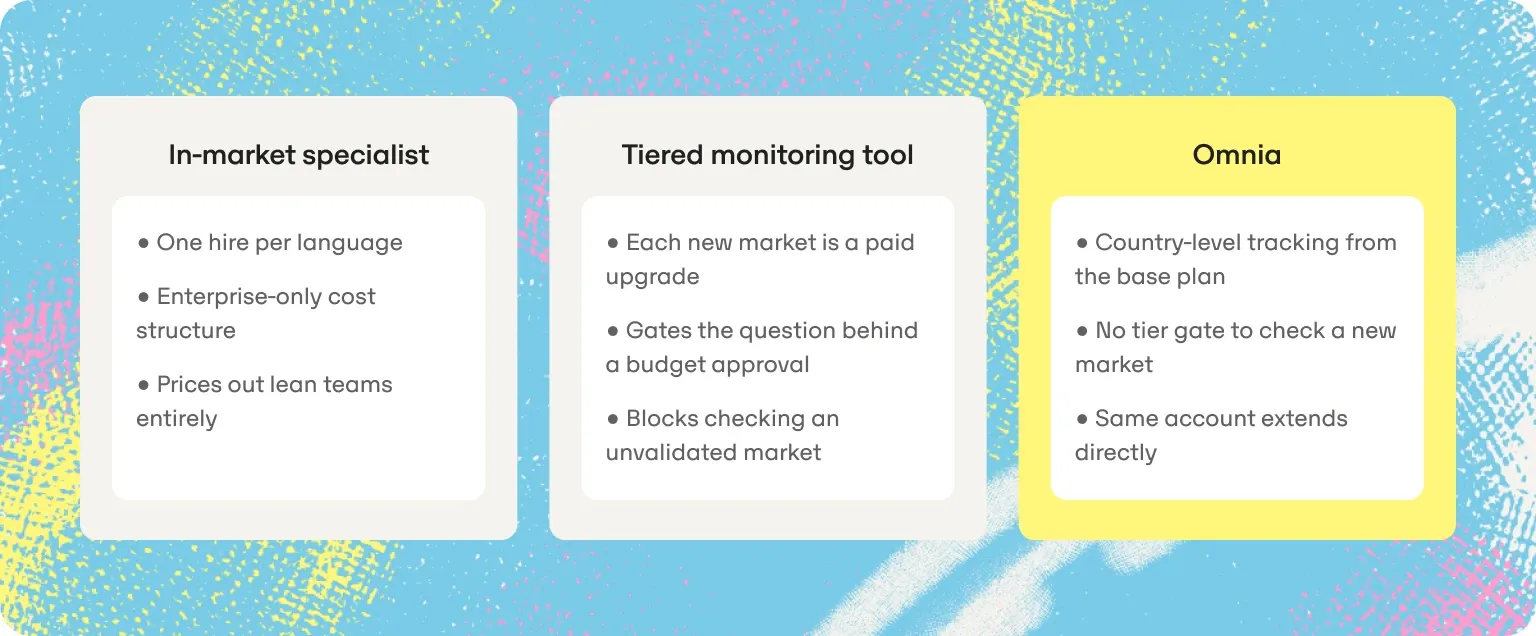
Omnia's AI visibility tracking runs country-level from the base plan rather than gating market coverage behind a higher tier, whether that means checking one additional particular geographic location or building search visibility across global markets and multiple languages at once. That means prompt discovery, citation share, and competitor benchmarking all run per market instead of arriving as one aggregated global number that hides exactly the gap this article has been describing.
A team that already has to implement international SEO groundwork and localized content per country doesn't need a specialist hire on top of it just to check whether any of that work earned a citation; the same account already monitoring the home market extends to a new one directly.
And this matters most for the team this article was written for: not an enterprise with a localization department, but a lean team deciding whether a second or third market is worth pursuing before committing real budget to it. Checking that answer should not itself require the budget the answer is supposed to justify.
Omnia offers a 14-day free trial on the Growth plan.
No credit card required. See exactly where your brand shows up (or doesn't) across AI engines, then let the platform's recommendations guide your next move.

No. Each language runs its own retrieval pool, with a different competitor set, sometimes a different dominant engine, and different sources an AI engine trusts. A brand cited constantly in English can be entirely absent from the same question asked in another language, and the only way to know is to monitor that language directly rather than assume the English result carries over.
Multilingual SEO covers technical setup: hreflang tags, URL structure, which page search engines serve to which user. None of that determines whether an AI engine trusts a page enough to cite it. Multilingual AEO covers the citation side specifically: authority signals, entity consistency, and prompt-level research per language, which a technically correct multilingual setup does not automatically provide.
Prioritize by commercial signal rather than by translation ease or proximity to headquarters. A market with existing demand and a visible competitor gap is worth checking before a market chosen because it seemed like the obvious next language. Monitoring a market before investing heavily in it is what makes that prioritization possible in the first place.
Yes. Without consistent naming, cross-language structured data, and a connected knowledge graph presence, an AI engine can treat the same brand as several unrelated entities depending on the language of the query. That fragmentation weakens citation strength in every language it affects, even when the underlying brand is well established in its home market.
Translation alone rarely earns citations in a new market. A translated page carries none of the backlinks, citation history, or local authority signals that earned the original page its citations, and it starts from zero in every signal that determines whether an AI engine trusts it. Content built for the market, informed by in-language prompt research, performs differently than a direct translation of the home-market version.
Written By
 Jose Luis García del RíoGrowthatOmniaJose Luis García del RíoGrowthatOmnia
 Jose Luis García del RíoGrowthatOmnia
 Jose Luis García del RíoGrowthatOmnia
 AndreiHead of GrowthatOmnia
 Jose Luis García del RíoGrowthatOmnia
No credit card required · Free for 14 days · See your AI visibility within 3 minutes