


Most "Perplexity ranking factors" advice is just Google SEO factors with a new label on top, domain authority, backlinks, general E-E-A-T. Based on Omnia's citation database, those aren't what actually predicts citation position in Perplexity. Content format, topical depth, and query specificity carry far more weight, and two of the factors most teams optimize first, domain authority and backlink volume, matter far less than assumed. This piece ranks the real factors against each other, so you know which ones are worth your team's time before you touch a single page.
Ask ten SEO leads what determines Perplexity ranking, and most will describe Google factors wearing a different name. Domain authority. Backlinks. E-E-A-T. It's not that those instincts are baseless, they're just borrowed from a system that doesn't select sources the way Perplexity does, and applying them here means optimizing for signals that don't move your citation position at all.
That confusion has a specific cost. A team spending a quarter building backlinks and broadening topical coverage, the standard SEO playbook, can come out the other side with a citation position exactly where it started, because Perplexity was never weighing those signals the way Google does. The factors that actually predict whether Perplexity cites you, and where, are a different, shorter list, and some of them run in the opposite direction from what general SEO practice would suggest.
This guide ranks those factors by how much they actually matter, based on Omnia's own citation data, not general best practice repackaged for a new engine. It won't walk through how to execute against them or how to track whether it's working, those are their own guides. It answers the question that has to come first: out of everything a team could optimize, what's actually worth prioritizing in Perplexity, and what can safely wait.
Why "ranking factors" means something different here than in Google
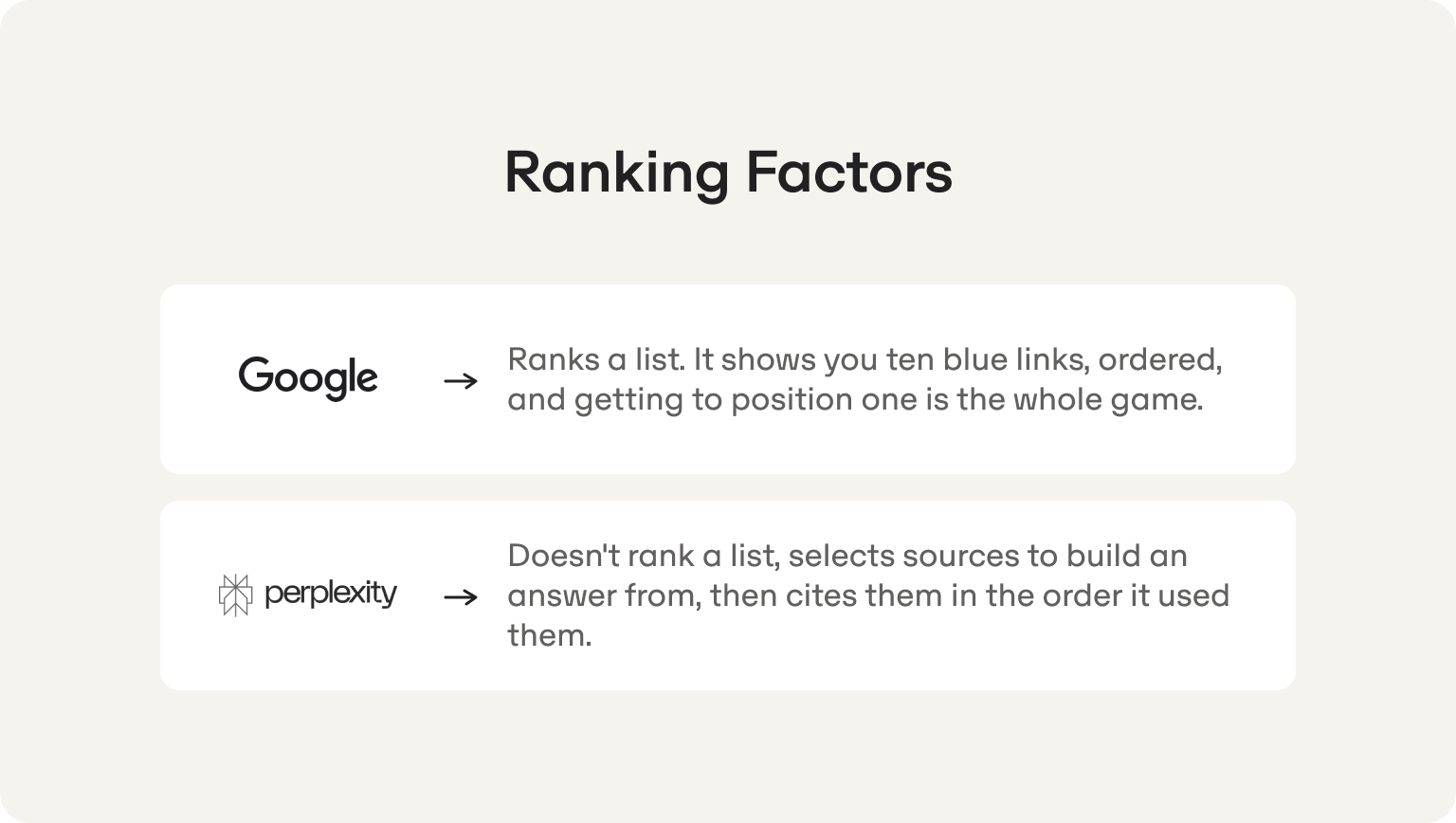
Google ranks a list. It shows you ten blue links, ordered, and getting to position one is the whole game. Perplexity doesn't rank a list, it selects sources to build an answer from, then cites them in the order it used them. That's a different mechanism entirely, and it's why the word "ranking" is doing something misleading in "Perplexity ranking factors."
What you're actually optimizing for is inclusion and position in a source selection process, not a search results page. A page can be technically excellent by every traditional SEO measure and never get pulled into a Perplexity answer, because Perplexity isn't asking "is this authoritative," it's asking "does this directly answer the specific question being asked." That's closer to being chosen as a source for a research paper than winning a ranking competition, and the two skills don't fully overlap. This is the same divide covered in more depth in Omnia's GEO vs. SEO research: the signals that predict success in one system don't reliably predict it in the other, and in Perplexity's case, some of them predict the opposite.
That reframing matters before you look at a single factor, because it changes what "matters" means. A factor matters here if it changes whether Perplexity selects your page as a source, not if it's a best practice you'd defend in a Google audit.
The factors, ranked by how much they actually matter
Here's the actual hierarchy, based on Omnia's citation database, ordered by how much each one moves citation position, not by how much attention teams typically give it.
Content format, topical depth, and query specificity aren't three separate levers so much as three views of the same underlying preference: Perplexity rewards pages built to be the direct, specific answer to a narrow question, not pages built to broadly cover a subject well. Everything else on this list either supports that preference or doesn't move the needle much at all.
What doesn't matter as much as people assume
This is the list most SEO teams build their Perplexity strategy around first, and it's largely the wrong list.
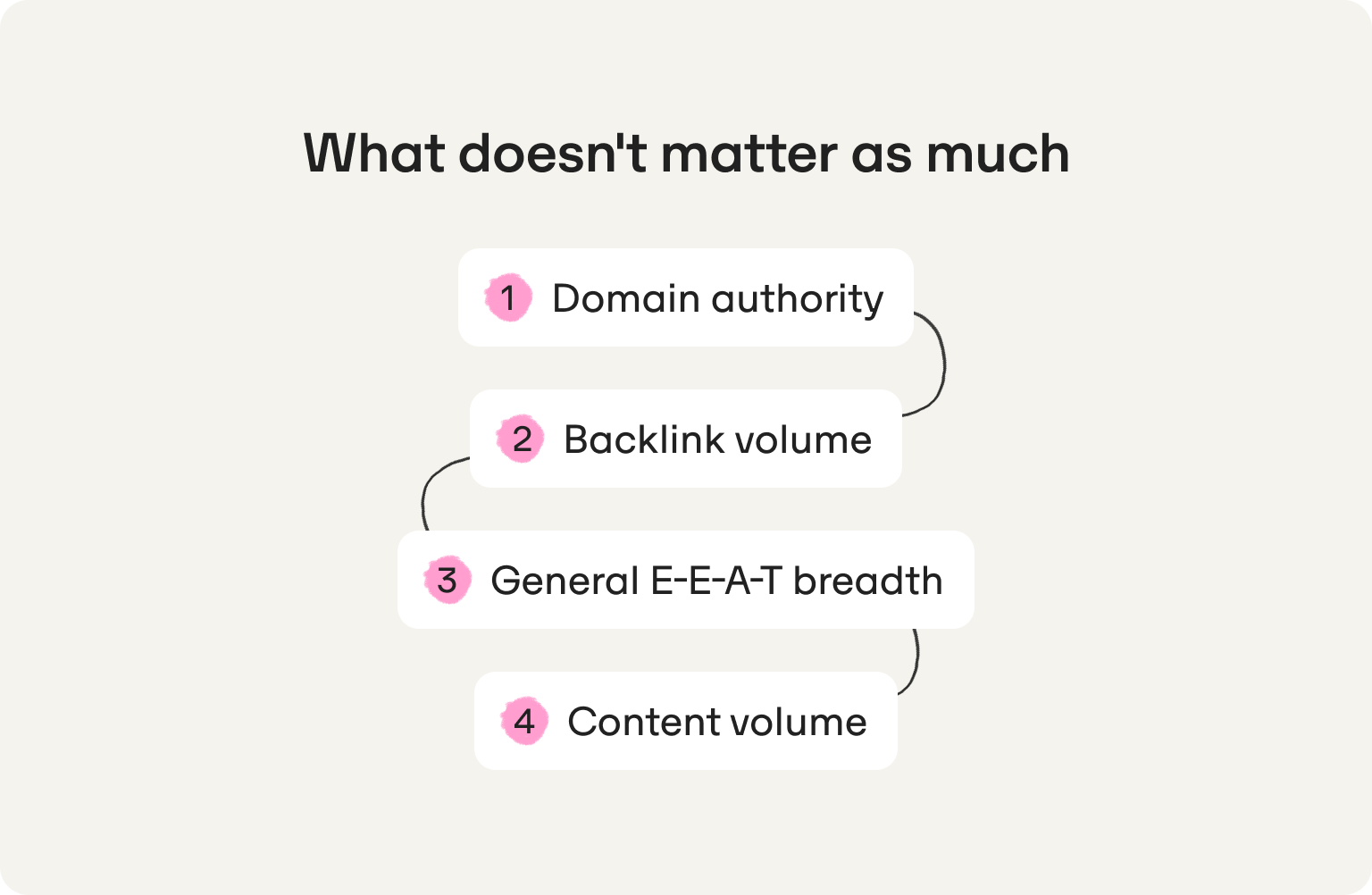
Domain authority
The instinct to chase DA transfers almost perfectly from Google, and almost none of it holds up in Perplexity's citation data. Niche sites with modest domain profiles and deep, narrow content regularly out-position generalist publishers with far stronger authority scores. Perplexity isn't asking how trusted your domain is broadly, it's asking how directly your specific page answers the specific question.
Backlink volume
No factor in Omnia's citation data points to backlink count as a meaningful predictor of citation position. That doesn't make backlinks worthless as a general SEO practice, it means treating them as a Perplexity lever specifically is misdirected effort.
General E-E-A-T breadth
Broad expertise signals across a wide subject area, the kind that helps in a Google quality assessment, don't carry the same weight here. What Perplexity weighs instead is demonstrated expertise on the exact topic a query is asking about, which is a narrower, more specific bar than E-E-A-T as it's usually applied.
Content volume
Publishing more doesn't compound the way it does in traditional SEO. A large content library spread thin across many topics doesn't build the kind of authority Perplexity is selecting for. A small library concentrated on a handful of topics, covered specifically, outperforms it.
The pattern across all four: they're signals of general credibility, and Perplexity isn't evaluating general credibility. It's evaluating fit to a specific query, which is a fundamentally different question than the one traditional SEO factors were built to answer.
A 10-minute self-check before you touch content
Before any content work starts, three questions tell you where your existing inventory actually stands, without a full audit:
- Does your best content in this category read like a review or comparison, or a broad overview? If most of what you have is general topic coverage, that's the highest-leverage format gap to close first.
- Is your content concentrated on a handful of topics, or spread across everything that touches your product?A library spread thin across many subjects is competing with itself for Perplexity's attention instead of building depth anywhere.
- When was the last time your strongest pages in this category were actually updated, not just checked, but meaningfully revised? A page that hasn't moved in over a year is competing at a structural disadvantage against one that has.
This isn't a full diagnostic, it's a gut check to tell you whether the factors above are worth acting on immediately or whether you're already closer than you think. For the complete four-question framework, including how to tell a content gap from a placement gap from a framing gap, the companion guide on tracking brand mentions and citations in Perplexity walks through it in full.
Where Omnio fits
Knowing the ranking factors is not the same as knowing which ones your brand is actually failing. The list above is general, it applies to every brand in every category. The gap that actually costs citation position is specific: which topic clusters lack a review or comparison page, which pages are spread too thin to read as concentrated expertise, which competitor has quietly out-updated you on the exact query where you used to hold position two.

What it diagnoses. Omnio reads Perplexity's citation behavior against your specific category, not the general pattern, and tells you exactly where the factors above are working against you right now:
- Which content format is missing from which query cluster
- Which subtopics have no owned citation presence at all
- Which pages are losing position because a competitor refreshed theirs last month
That's the difference between a principle and an action. "Topical depth matters" is a principle. "You're thin on these four queries specifically" is something you can actually go fix.
What it does next. Omnio doesn't stop at the diagnosis. Once it finds a gap, it:
- Drafts the review or comparison page your topic cluster is missing
- Restructures a page that's covering ground too broadly to read as a direct answer
- Flags pages losing ground before a competitor has fully taken the position
Every action waits for your approval before it publishes.
For a lean team, that's the difference between knowing content format is a high-impact factor and actually having the right page live before the slot closes.
If you want the fuller execution playbook once you know where your gaps are, how to improve visibility and rank in Perplexity covers the levers in depth. Omnio is what applies them to your specific gaps without you building the audit by hand first.
You don't need to guess anymore at what Perplexity is actually weighing. Content format, topical depth, and query specificity carry the real weight. Domain authority and backlink volume mostly don't. The only question left is which of those factors your brand is currently failing, and that's not something a general list can tell you.
See where your content stands with Omnio and get the specific gaps, not just the general factors.
FAQs
What's the single most important Perplexity ranking factor?
Content format, specifically whether a page is structured as a direct, specific answer rather than a general overview. Review and comparison pages consistently earn the strongest citation positions in Omnia's data, ahead of every other page type.
Does domain authority matter for Perplexity ranking?
Less than most teams assume. Niche sites with modest authority scores and deep, concentrated content regularly out-position generalist publishers with far stronger domain profiles. Topical depth on the exact subject predicts citation position more reliably than authority breadth does.
Is there an AI search optimization tool that shows which Perplexity ranking factors I'm missing?
Yes. Omnia surfaces which content structures, sources, and entities Perplexity is actually rewarding in your specific category, so you're not guessing which of the general factors above apply to your brand and which ones you've already covered.
How is this different from a full Perplexity ranking guide?
This piece ranks the factors themselves, what matters and how much, without walking through execution. For the step-by-step levers and how to apply them, see the companion guide on improving visibility and rank in Perplexity.
Do these ranking factors apply to other AI engines too?
Not directly. Perplexity's source selection criteria diverge meaningfully from ChatGPT's and Google AI Overviews', to the point where content optimized for one can underperform in another. Treat this list as Perplexity-specific rather than a general AI visibility checklist.