Alternatives
Ahrefs vs BrightEdge vs Omnia: Key Differences for 2026

 Jose Luis García del RíoGrowthatOmniaJose Luis García del RíoGrowthatOmnia
TL;DR
Surfer SEO alternatives split into two categories. There’s content optimization tools (Clearscope, Frase, MarketMuse, Content Harmony) for teams improving brief quality, scoring, and workflow, and there’s AI visibility platforms for teams losing organic traffic to AI answer engines. The critical distinction in the second category is pre-publish outcome projection, knowing which prompts to prioritize and what citation share to expect before writing. Omnia is the only platform that does this, combining citation gap analysis, SOV forecasting, ready-to-execute briefs, and post-publish monitoring across four AI engines.
You're evaluating Surfer SEO alternatives because something in your content workflow needs to change. Maybe you're looking for better brief quality, more affordable pricing, or stronger collaboration features.
But if part of the reason you're reconsidering is that organic traffic keeps flattening despite publishing optimized content, that's worth naming directly. AI search engines now intercept buyer questions before users reach your articles. A content editor swap won't fix an AI displacement problem. That’s why we’ve compiled 12 of the best alternatives to Surfer SEO, no matter which problem you’re facing.
People searching for Surfer SEO alternatives are usually solving one of two different problems, and the right tool depends entirely on which one applies to you.
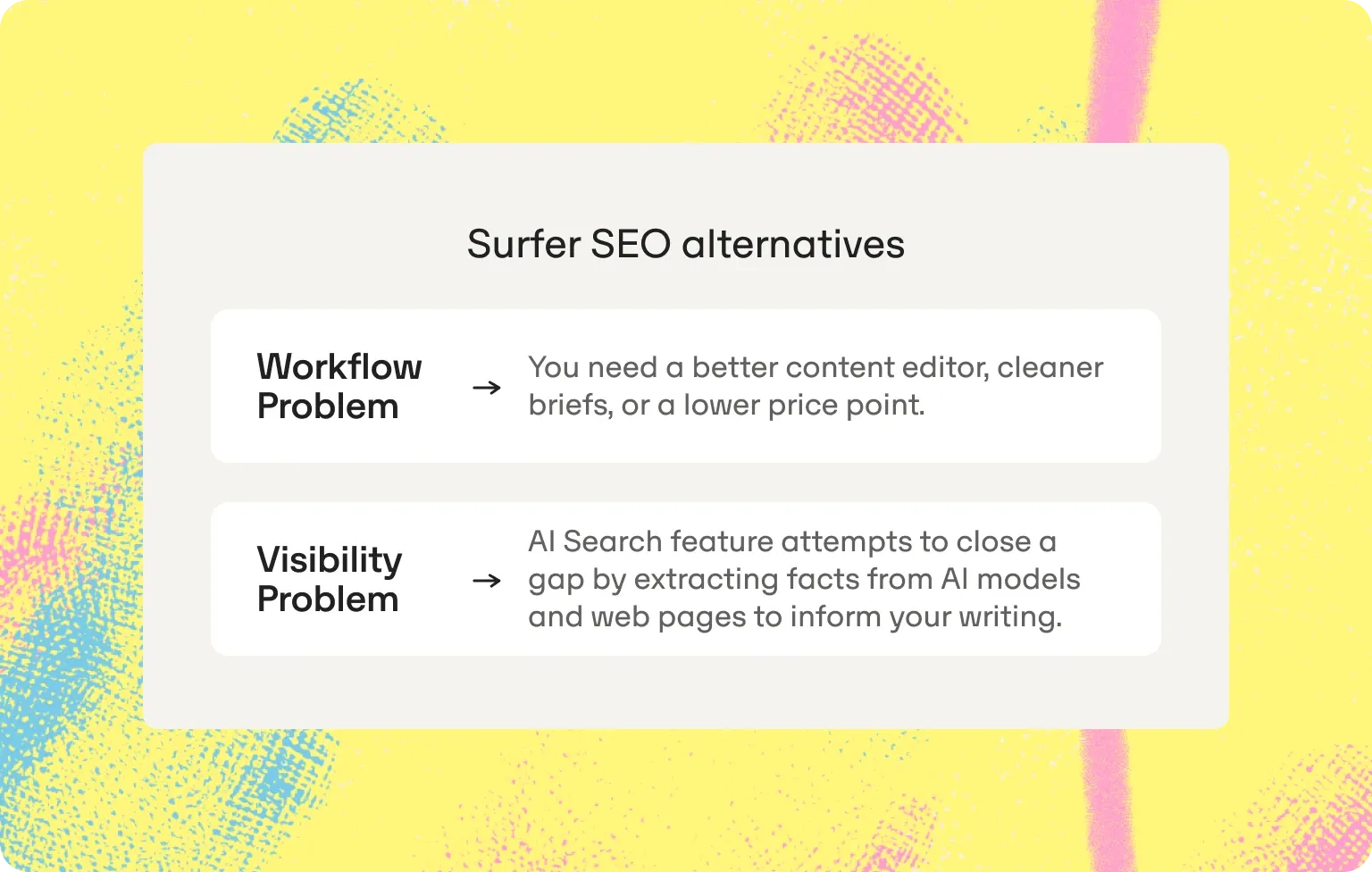
The first is a workflow problem. You want a better content editor, cleaner briefs, or a lower price point. Tools like Clearscope, Frase, and MarketMuse were built for exactly this.
The second is a visibility problem. Organic traffic is flattening and AI engines are answering buyer questions before users ever reach your site. Surfer’s AI Search feature attempts to close this gap by extracting facts from AI models and web pages to inform your writing. It's a meaningful addition, but it doesn't answer the question that actually drives ROI. That’s whether your content will get cited in AI answers once it's published, and what share of voice you can realistically expect.
That gap between “what topics to cover” and “whether it will work” is where execution stalls for lean teams. If you’re optimizing for traditional search engines, a direct Surfer SEO alternative makes sense. If you’re solving for AI answer visibility and citation intelligence, you need a platform built for pre-publish outcome projection and post-publish monitoring.
Keep Surfer if your primary goal is SERP content optimization and your team's workflow is already built around its writing interface and real-time content scoring. It remains a solid tool for traditional on-page SEO.
Switch if you need better brief quality, more collaborative workflow features, a lower price point, or if your goal is shifting toward AI answer visibility. In that case, you need a tool that goes further than extracting facts from AI models.
Content optimization tools were built for a deterministic ranking world. They analyze the top-ranking pages, extract the topics and terms they cover, score your draft against that benchmark, and optimize until you hit the target. That workflow still delivers value for traditional SERP rankings.
But AI search engines work differently. They don't rank pages, but rather synthesize responses from multiple sources and cite the URLs they pull from. The shift from ranking to citation changes what optimization means now.
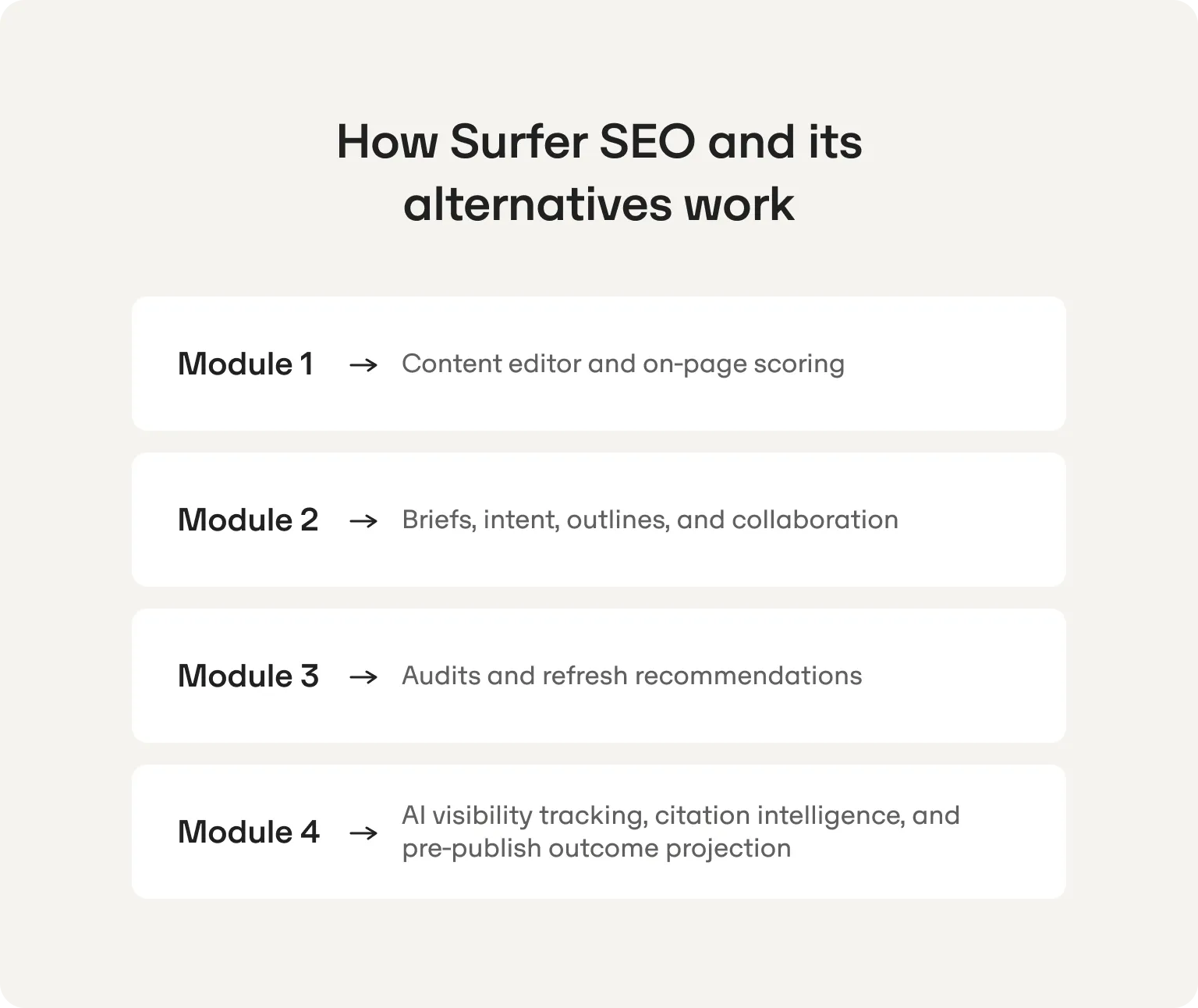
This section breaks down four modules that define the content optimization and AI visibility landscape. The first three modules describe traditional content editor functionality. The fourth module introduces the layer that separates monitoring-only platforms from execution-oriented citation intelligence.
Content editors work by scraping the top-ranking pages for your target keyword, using natural language processing to extract topics, entities, and semantic relationships, then scoring your draft from 0-100 based on how comprehensively you've covered those elements. The score updates in real-time as you write, flagging underutilized topics in green and overused terms in red.
This approach still holds for traditional SEO. If your content ranks on page two and competitors rank on page one, reverse-engineering their topic coverage can close the gap. Tools like Surfer SEO, Clearscope, and Frase excel here.
Strong brief quality starts before you open the editor. Research-backed briefs include intent classification, question mining from People Also Ask and forums, structural guidance based on what top pages are doing, and prompts for subject matter experts to validate technical accuracy.
Collaboration matters just as much. Teams need version history, approval workflows, and the ability to loop in external writers or SMEs without friction. Content Harmony and Frase both prioritize this side of the workflow, Content Harmony in particular lets teams embed SME prompts directly into briefs and build custom templates that hold across projects.
Content decays. Pages that ranked well six months ago lose visibility as competitors refresh their articles, add new data, or update for algorithm changes.
Strong audit features connect to Google Search Console, track position changes daily, flag pages losing traffic, identify cannibalization issues, and surface internal linking opportunities. Surfer's Content Audit, Clearscope, and MarketMuse all offer versions of this. The workflow is consistent across tools: Detect decay, pull the article back into the editor, update against current top-ranking competitors, republish.
Most content editors tell you what topics AI models are currently pulling from top sources. That informs your writing. It doesn't tell you whether your content will get cited once published, which prompts are realistically winnable for your domain, or why competitors are being cited for queries where you have relevant content.
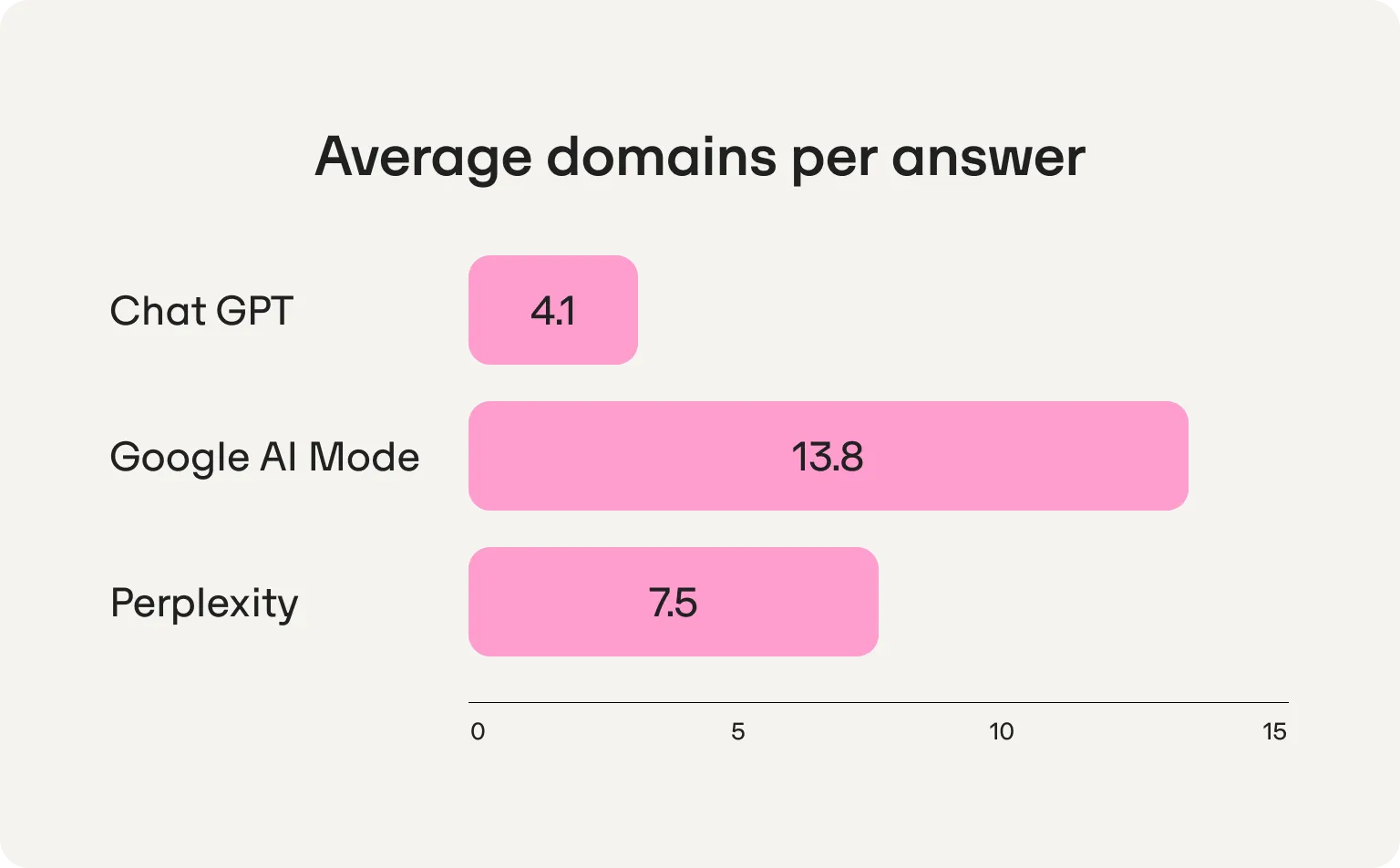
This is a harder problem than traditional ranking. Based on Omnia's proprietary citation database tracking 42M+ citations, ChatGPT averages just 4.1 domains per answer. That’s roughly 3x more selective than Google AI Mode, which averages 13.8. A typical AI Overview pulls from 9.2 sources. Perplexity sits at 7.5. There are a fixed number of slots per query, and traditional content scoring can't tell you whether they're winnable for your domain.
Understanding which slots are available is the starting point. Platforms built for AI visibility start with prompt tracking, identifying queries where competitors are cited and you're absent. Citation extraction then shows which specific URLs and domains AI engines reference. Surfer's AI Tracker operates at this level, surfacing brand-level visibility and mention rates across five models daily.
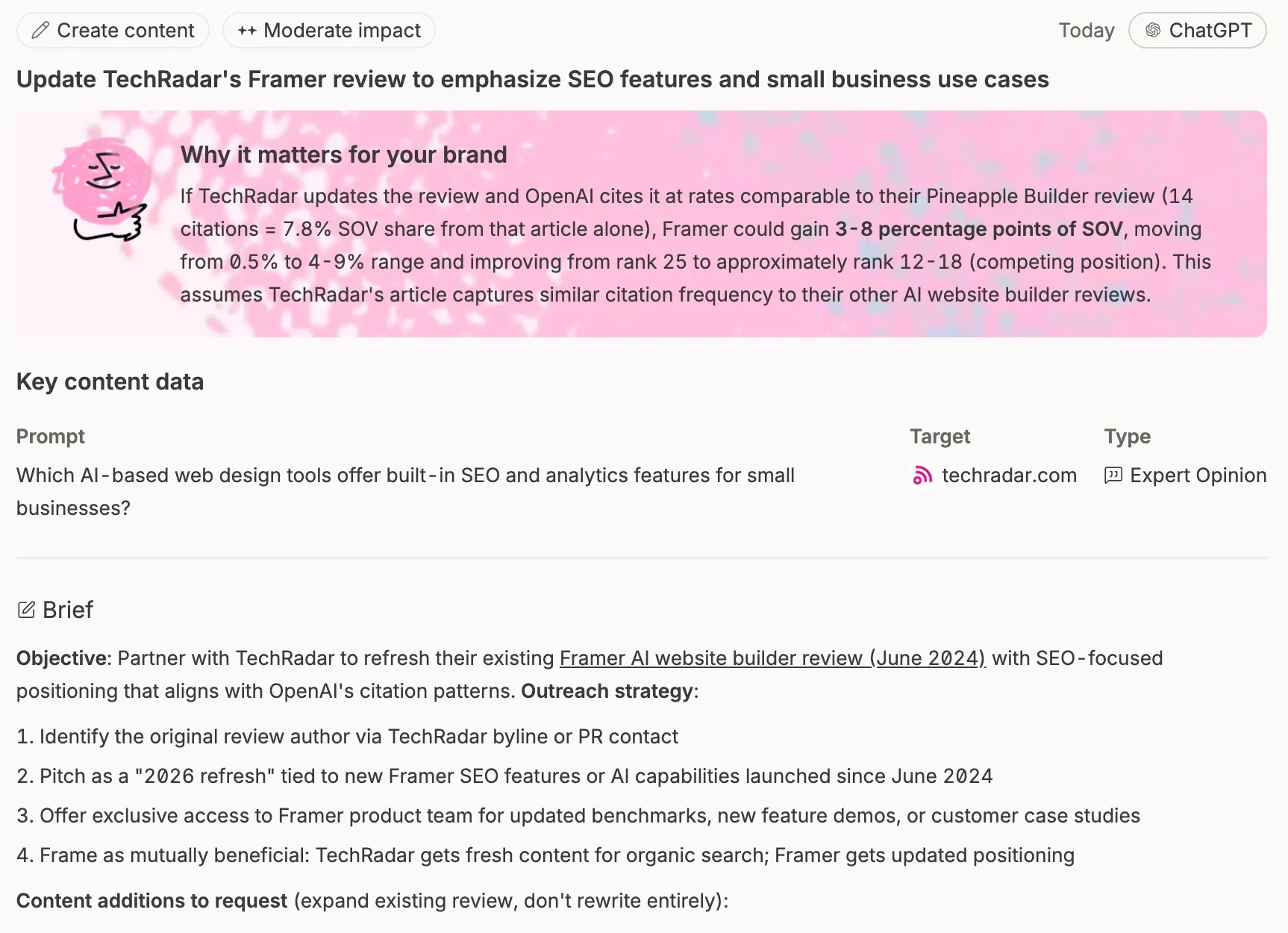
Where execution-oriented platforms go further is pre-publish outcome projection. Before any content is written, Omnia builds a business case based on real competitor citation benchmarks, projecting expected share of voice for a given prompt set. It also delivers a brief and outreach strategy.
The 12 tools in this article fall into two categories that solve different problems. Find your category first, then shortlist from there.
| Tool | Best For | Primary Use | AI search engines tracked (base plan) | Key differentiator | Entry price |
|---|---|---|---|---|---|
| Omnia | VC-backed startups & B2B scaleups | AI visibility + pre-publish forecasting | 4 | Pre-publish content briefs with citation pattern analysis | €79/mo |
| Clearscope | Traditional SEO teams | Content briefs & editorial | 0 | Google-first optimization with competitive analysis | $170/mo |
| Frase | Budget-conscious content teams | Content briefs & SEO writing | 0 | Affordable AI writing + optimization | $49/mo |
| MarketMuse | Enterprise content strategists | Content briefs & topic authority | 0 | AI-powered topic modeling & content scoring | Free for 10 queries/mo |
| Content Harmony | Collaborative content teams | Content briefs & workflow | 0 | Team collaboration & distributed workflows | $50/mo for 5 content workflows |
| Semrush | Existing Semrush customers | All-in-one SEO + AI monitoring | 2 | Unified platform for SEO + AI visibility | $99/mo add-on |
| Ahrefs | SEO teams extending Ahrefs | All-in-one SEO + AI monitoring | 6 | 150M+ prompt database, monthly refresh | $199/mo standalone |
| Otterly AI | Budget-conscious monitoring teams | AI visibility monitoring | 4 | Lowest entry price for 4-engine coverage | $29/mo |
| Peec AI | Agencies with distributed teams | AI visibility monitoring | 3 | Unlimited seats across all plans | €89/mo |
| Scrunch AI | Enterprises requiring compliance | AI visibility monitoring | 4 | SOC 2 Type II + real-time bot crawling feed | $250/mo |
| SE Ranking | Small businesses & agencies | All-in-one SEO + AI monitoring | 4 | Budget-friendly all-in-one platform | $65/mo |
| AirOps | Content ops teams at scale | Workflow automation + AI tracking | 1 | Publisher discovery + CMS automation | $200/mo |
Surfer SEO built its reputation on content scoring and on-page optimization. As AI engines reshape how buyers discover brands, the tools worth evaluating now span two distinct problems: optimizing content for search rankings, and ensuring that content gets cited in AI answers.
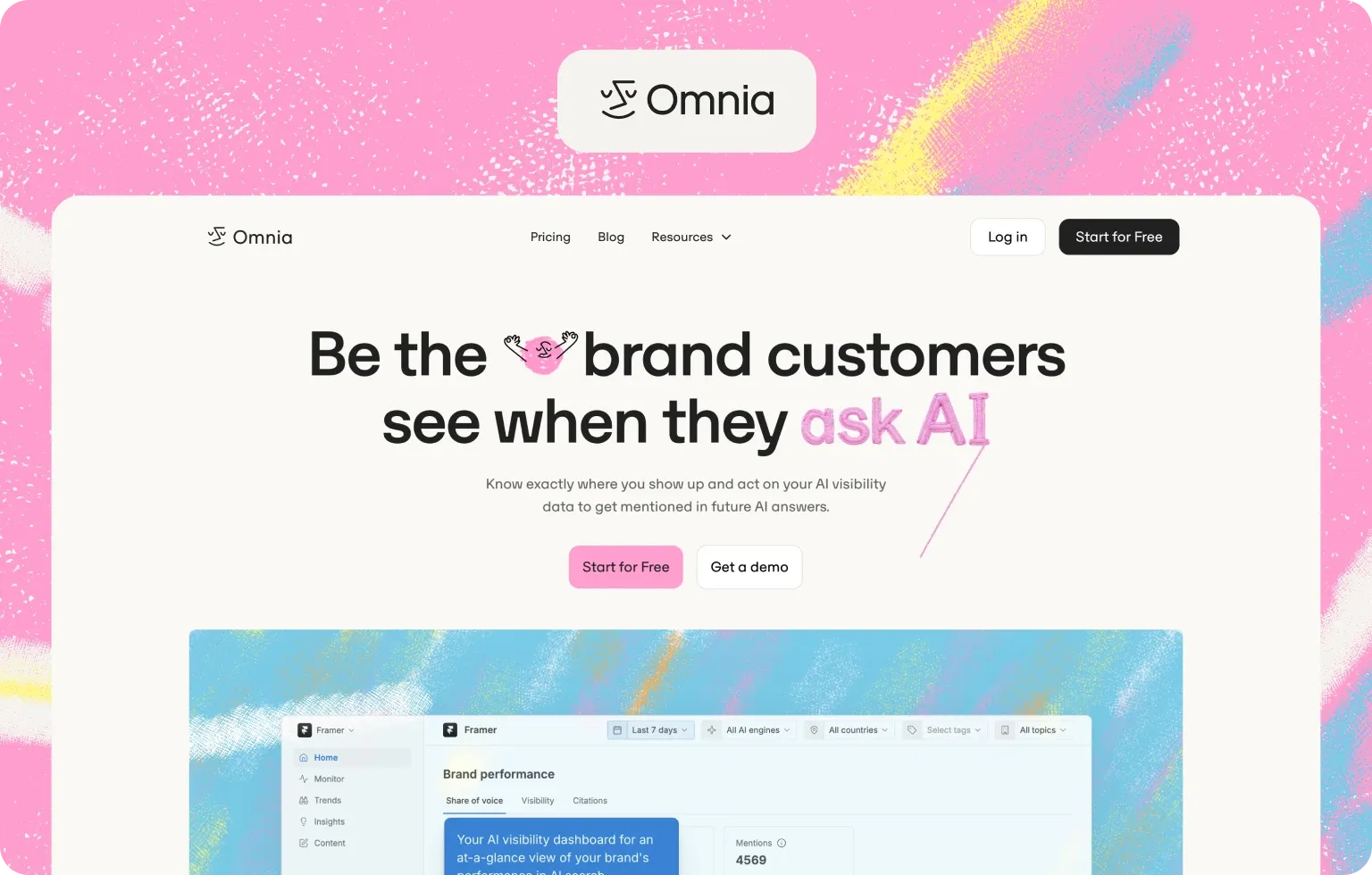
Omnia is an AI visibility intelligence platform that identifies citation gaps where competitors are being recommended instead of you, projects expected share of voice before any content is written, and generates AI-powered content briefs. After publishing, it monitors citation impact across ChatGPT, Perplexity, Google AI Overviews, and Google AI Mode by country.
Best for
Content-driven startups and scaleups with lean marketing teams that need to know which prompts to prioritize, what citation share to expect before writing a word, and whether their content is actually getting cited after publishing.
What it does well
Competitive share of voice monitoring: Tracks what percentage of relevant AI responses mention your brand versus direct competitors, measured daily with real-time alerts on visibility shifts.
When to pick Omnia over Surfer SEO
Watch-outs
If you only need a content score for traditional Google SERP rankings, a classic optimizer like Clearscope or Frase is the better fit. Omnia is built for AI answer visibility and citation intelligence, not SERP content scoring.
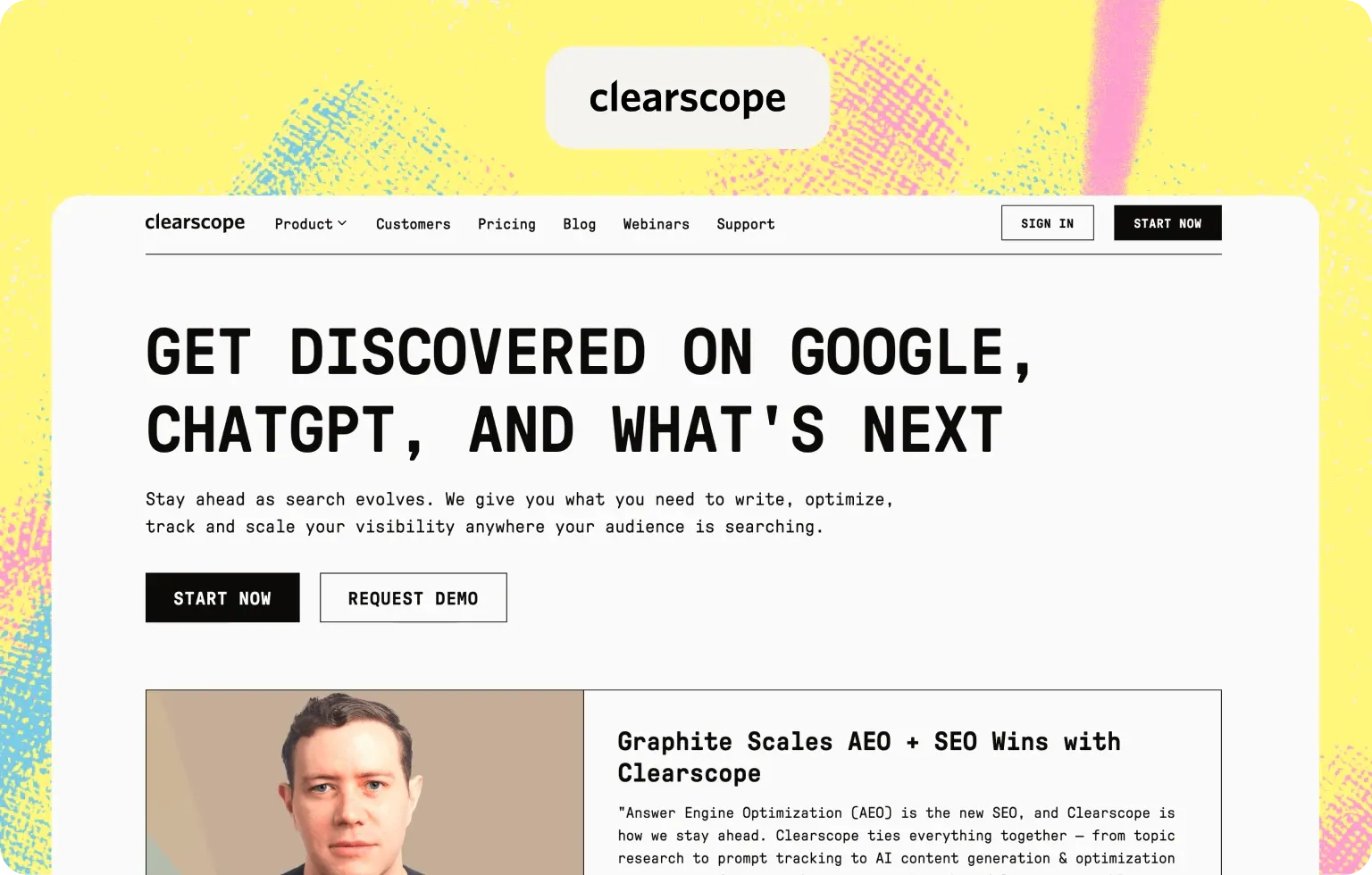
Clearscope is a content optimization platform that analyzes top-ranking pages using NLP to generate relevant term suggestions. Real-time content scoring (A–F) focuses on comprehensive topic coverage rather than keyword stuffing.
Best for
Editorial teams at mid-market companies and enterprises that prioritize content quality, have budget for premium tools, and value Google Docs integration for in-editor scoring.
What it does well
When to pick Clearscope over Surfer SEO
Watch-outs
Clearscope operates exclusively in traditional SERP analyzer with no AI answer engine visibility. Pricing jumps to $1,200/mo for Business, which may be too costly for smaller teams. If your goal is AI citation intelligence or you need more than 10 optimized articles per month on the entry tier, other platforms offer better value.
Pricing
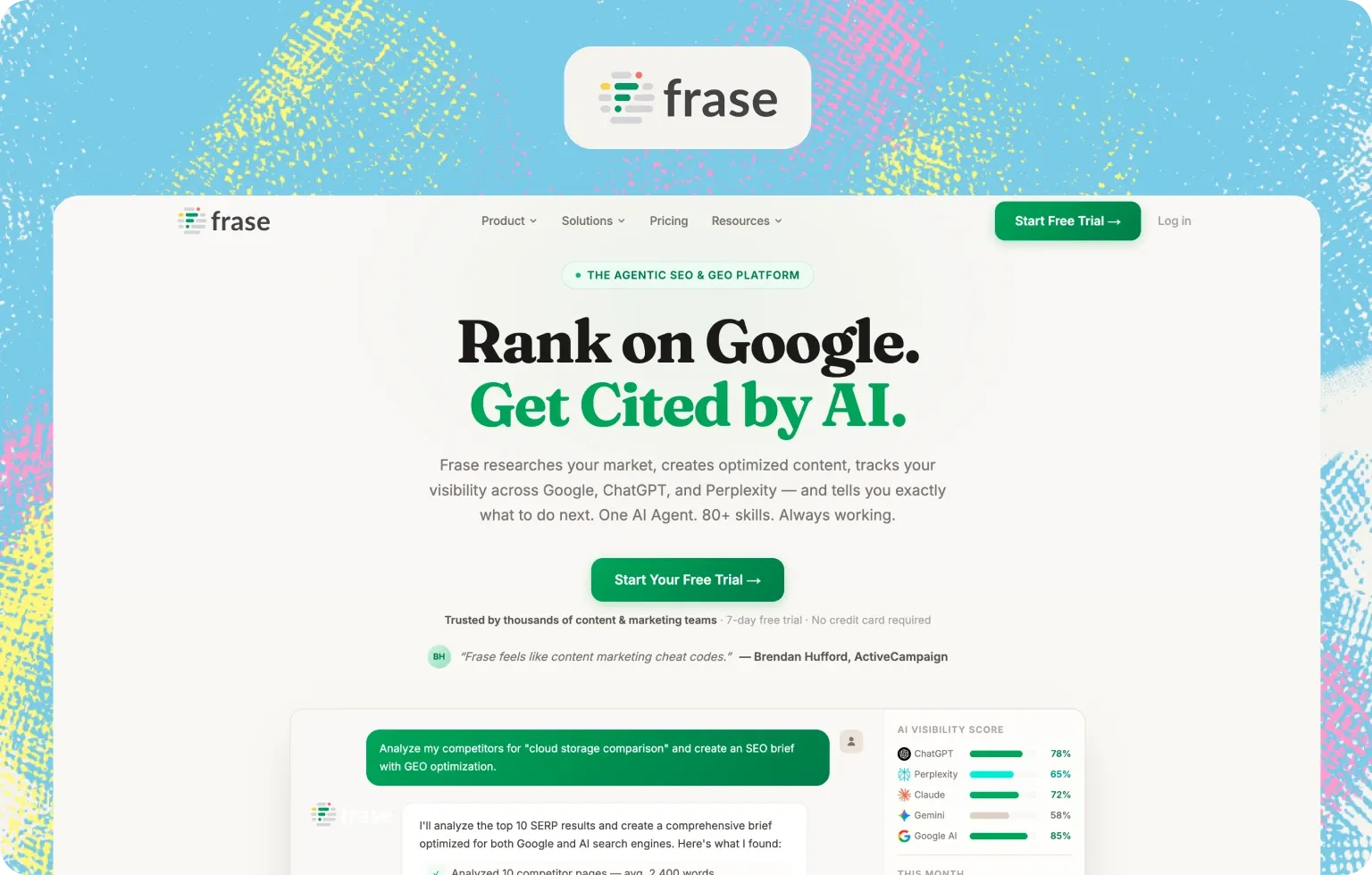
Frase combines keyword research, competitor analysis, automated content brief generation, AI writing assistance, and real-time optimization scoring in a single interface.
Best for
Budget-conscious teams, solo content marketers, and startups needing SERP research and brief generation without committing to premium platforms.
What it does well
When to pick Frase over Surfer SEO
Watch-outs
Frase operates entirely within traditional SEO strategy. Its AI writing features create operational dependency on AI to create content, rather than human-expert authorship. For teams needing AI visibility tracking or citation intelligence, Frase provides no coverage.
Pricing
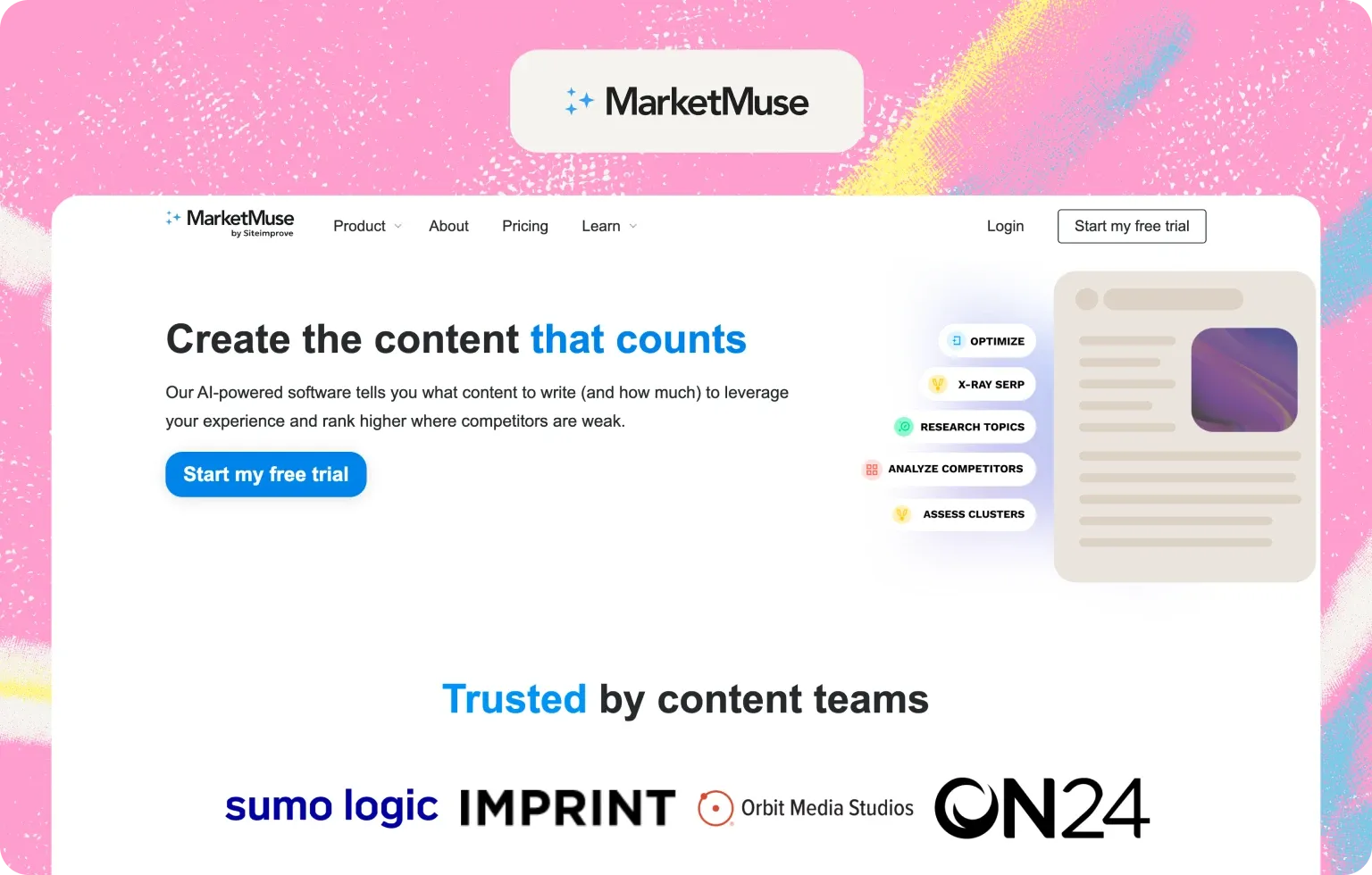
MarketMuse is a content intelligence platform that moves beyond single-article optimization to provide strategic content planning at the domain level.
Best for
B2B SaaS companies, content strategy teams needing domain-wide planning, and organizations building comprehensive topic clusters to demonstrate expertise to search engines.
What it does well
When to pick MarketMuse over Surfer SEO
Watch-outs
MarketMuse has no AI answer visibility. The topical authority model requires investment in comprehensive content clusters, which can be resource-intensive for lean teams targeting quick-win prompts.
Pricing
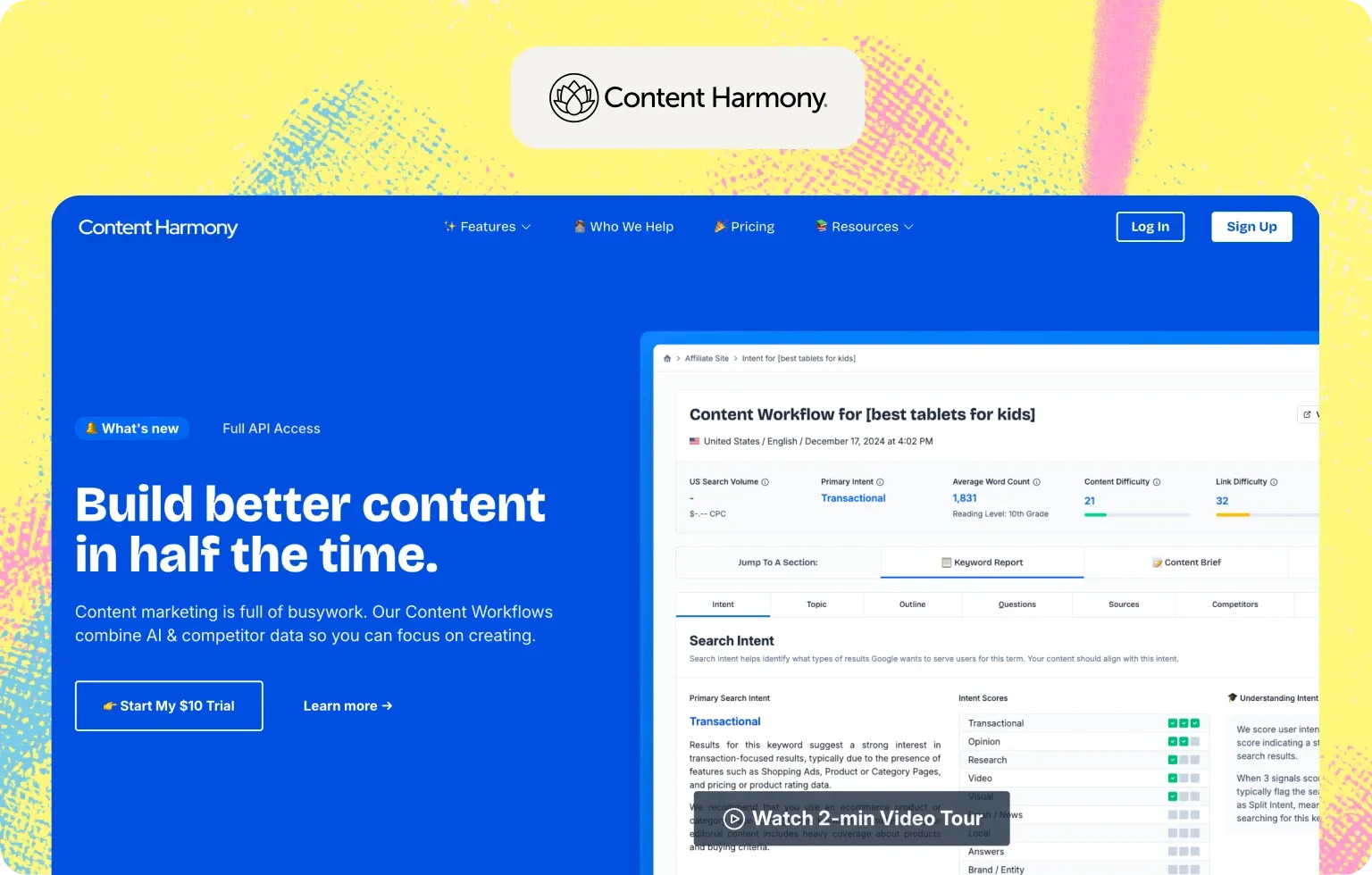
Content Harmony is a content workflow platform that replaces manual keyword analysis with automated research, custom brief generation using template-based workflows, and AI-driven optimization scoring.
Best for
Agencies managing multiple clients or content teams needing custom brief templates that match internal documentation standards.
What it does well
When to pick Content Harmony over Surfer SEO
Watch-outs
Content Harmony is a pure content optimization platform with no AI answer engine visibility or citation forecasting. Workflow-based pricing means costs can add up quickly for high-volume publishers. For teams needing AI visibility tracking, Content Harmony provides no coverage.
Pricing
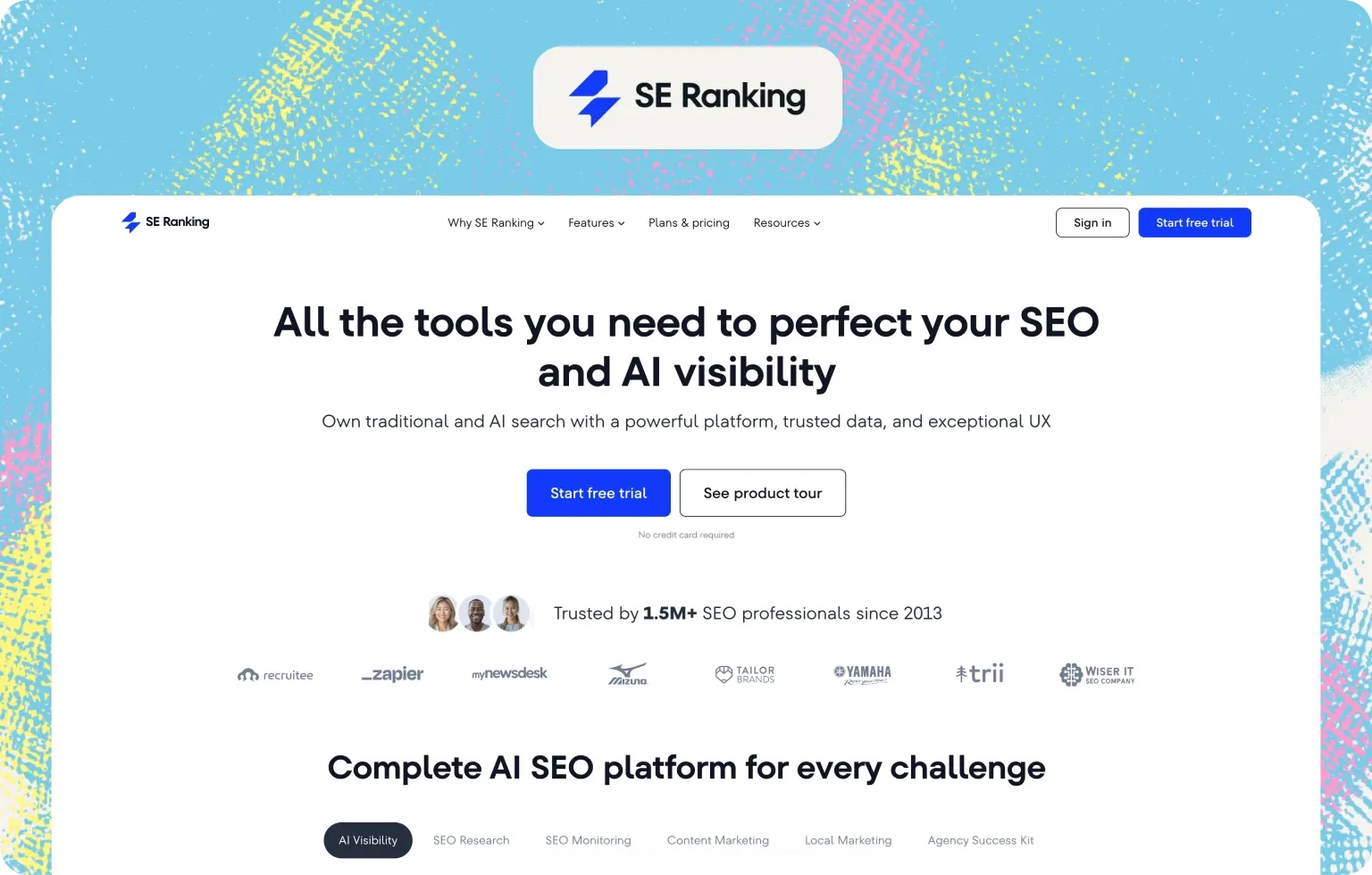
SE Ranking is an all-in-one SEO platform that combines traditional rank tracking, site audits, and backlink monitoring with a content optimization module. It also has an AI Search Toolkit add-on for AI visibility tracking across ChatGPT, Perplexity, Google AI Overviews, and Google AI Mode.
Best for
Small-to-midsize teams wanting traditional SEO tools bundled with content optimization and the option for AI visibility add-on.
What it does well
When to pick SE Ranking over Surfer SEO
Watch-outs
All AI visibility features are spread across three separate interfaces, requiring navigation between dashboards. For teams only needing content optimization without traditional SEO tools, the bundled pricing isn’t necessary.
Pricing
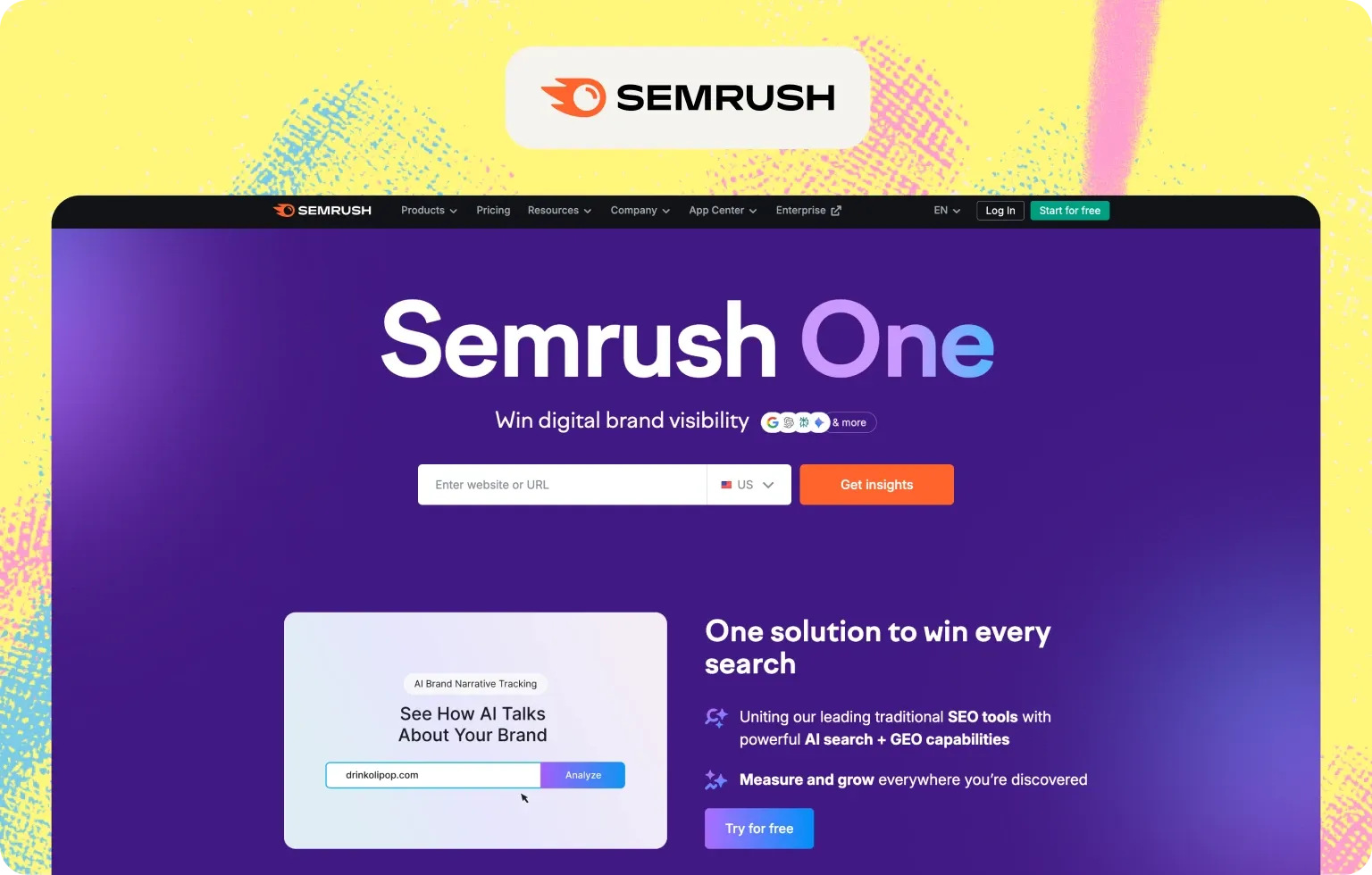
Semrush is an enterprise SEO and marketing platform that offers an AI Visibility Toolkit as an add-on module.
Best for
Marketing teams already using Semrush for SEO who want to add AI visibility tracking without switching platforms.
What it does well
When to pick Semrush over Surfer SEO
Watch-outs
The AI Visibility Toolkit is an add-on requiring a base Semrush subscription. The standalone toolkit includes only 25 prompts for Prompt Tracking and 300 daily queries in AI Analysis. Scaling requires purchasing additional prompts.
Pricing
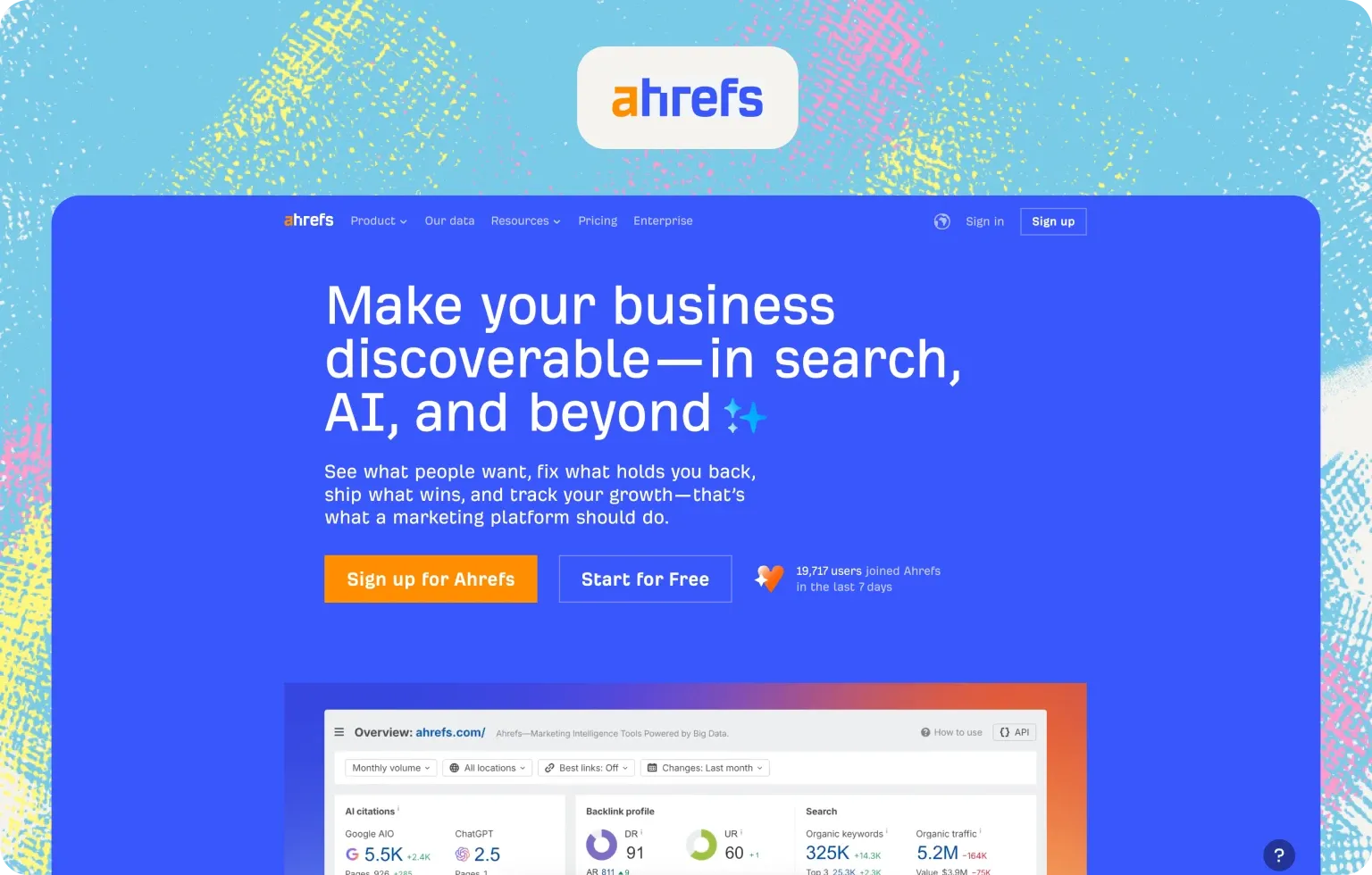
Ahrefs is an SEO research platform with a massive web index and backlink database. It offers AI Content Helper for content optimization and Brand Radar for AI visibility tracking.
Best for
SEO teams already using Ahrefs who want AI visibility tracking and content optimization within one ecosystem, without adding separate platforms.
What it does well
When to pick Ahrefs over Surfer SEO
Watch-outs
While the AI Content Helper is included in all Ahrefs plans, Brand Radar is sold separately. Combining the tools can get pricey.
Pricing
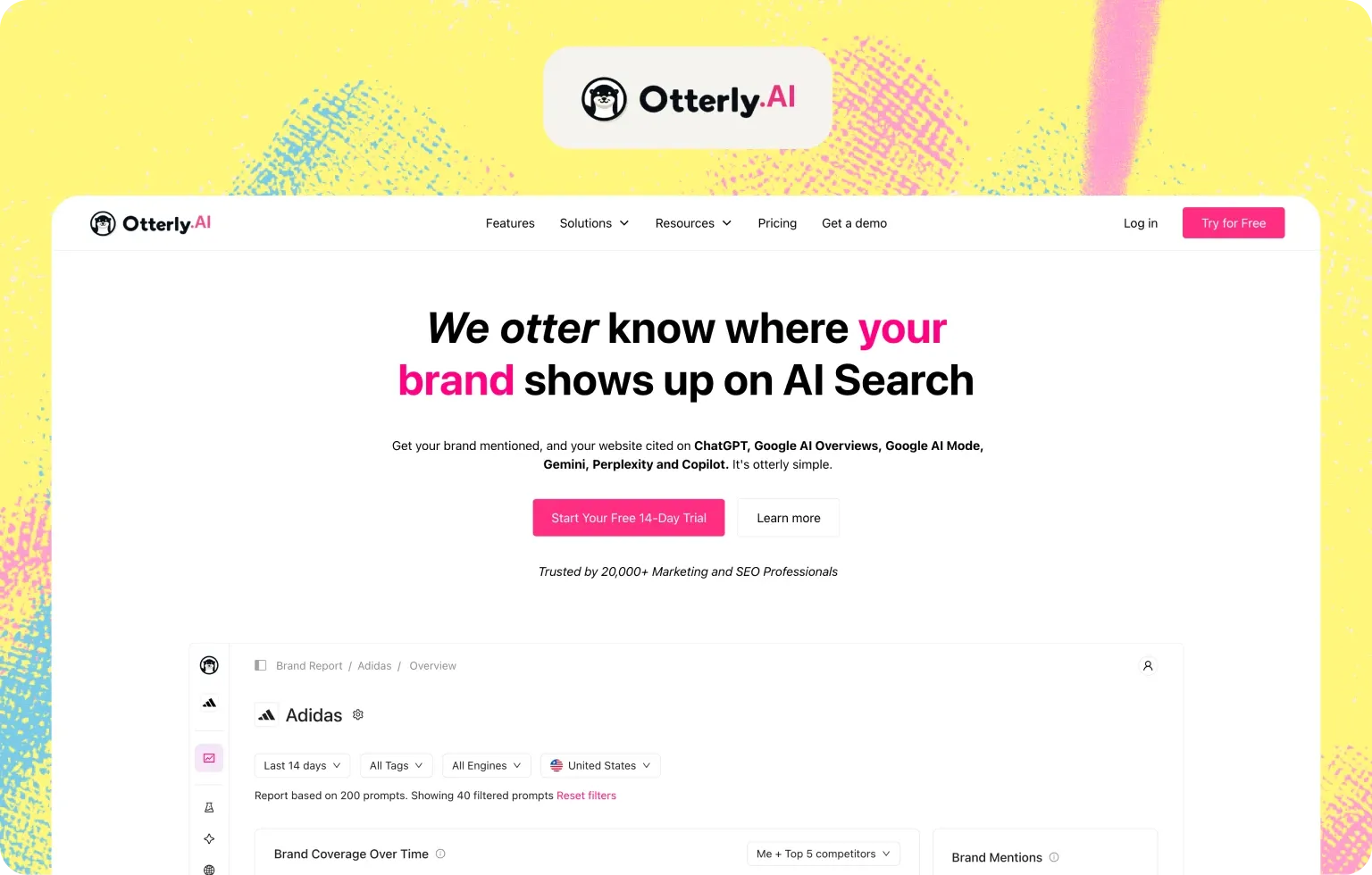
Otterly AI is a purpose-built AI visibility monitoring platform, tracking brand mentions across four AI engines with daily automated updates and simple focused interface designed for startups.
Best for
Budget-conscious startups, solo operators, and small agencies needing basic AI monitoring.
What it does well
When to pick Otterly AI over Surfer SEO
Watch-outs
Otterly AI is a monitoring-first platform with a lighter action layer compared to other tools. For teams needing execution support beyond passive monitoring, Otterly provides visibility data but not strategic recommendations. Consider Otterly AI alternatives if this is an issue.
Pricing
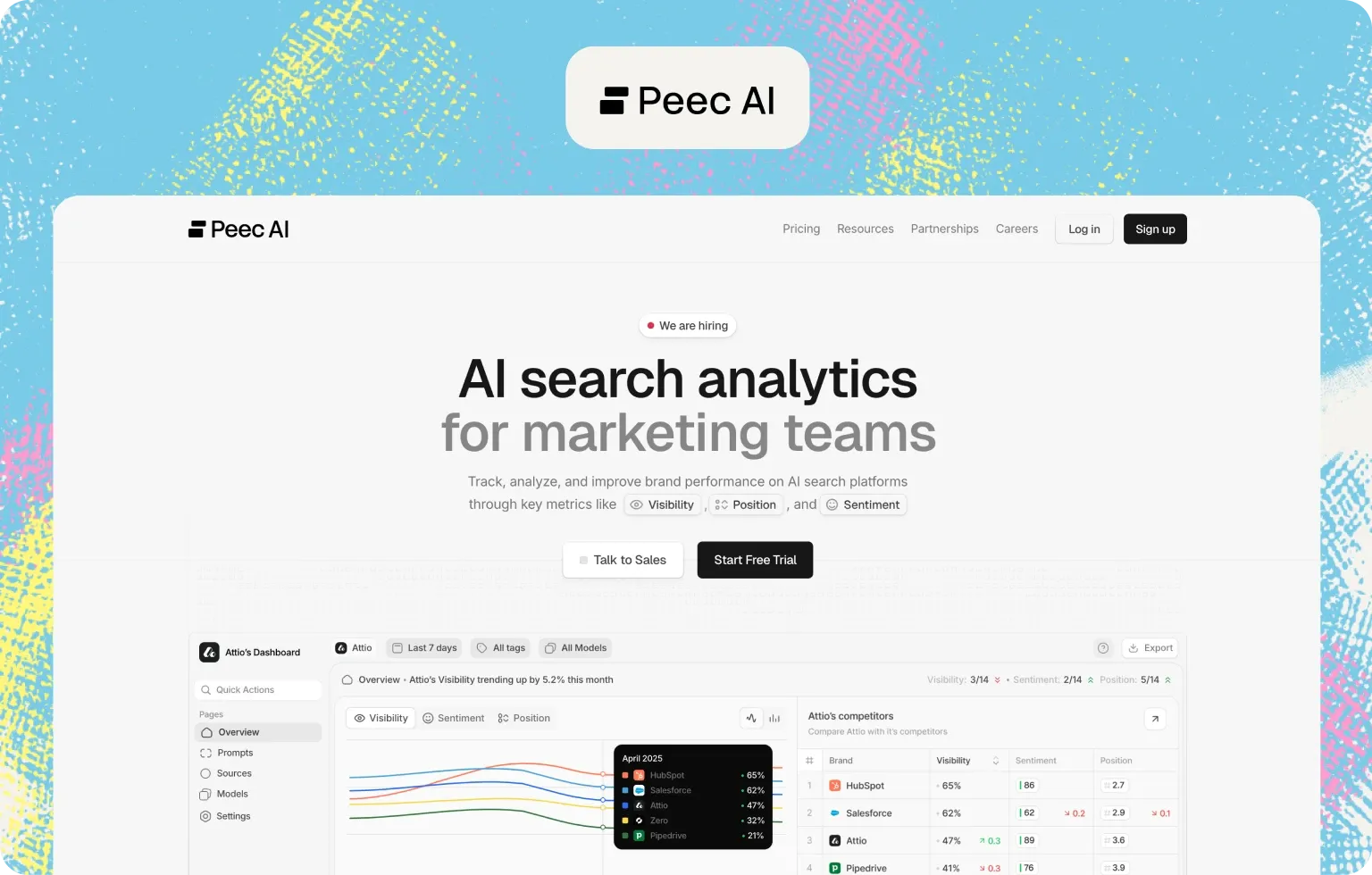
Peec AI is a purpose-built AI search visibility platform tracking 7 AI engines with unlimited seats across all plans, daily tracking, and comprehensive citation analysis.
Best for
Growing startups, agencies managing multiple clients, and B2B teams wanting accurate daily AI visibility tracking with granular citation classification.
What it does well
When to pick Peec AI over Surfer SEO
Watch-outs
Peec AI is a monitoring-only platform with no action layer (teams wanting this may want to consider Peec AI competitors). The first 3 plans only provide access to three AI models. Full 7-platform coverage requires higher tiers.
Pricing
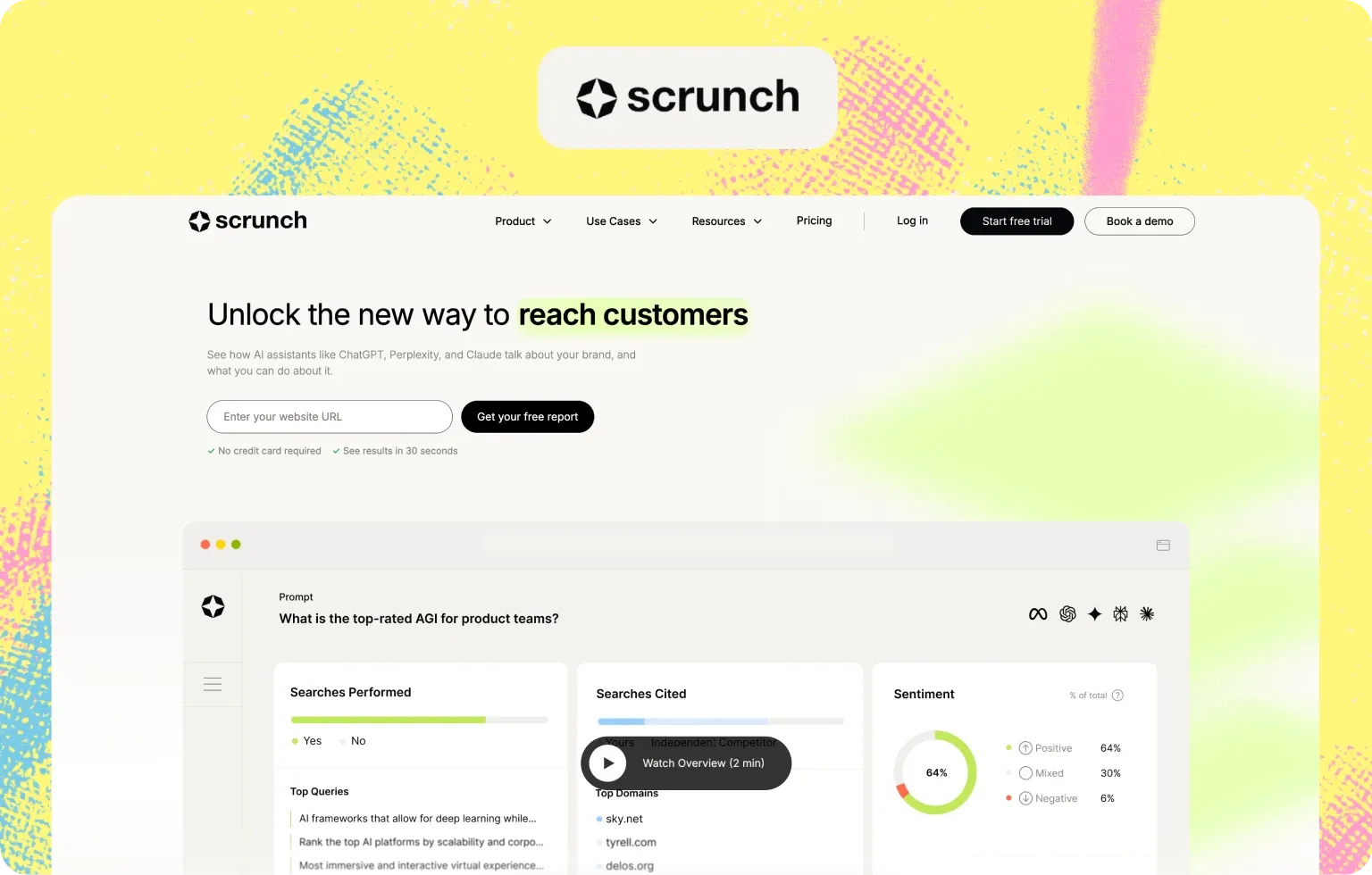
Scrunch AI focuses on AI visibility monitoring with emphasis on real-time bot crawling feeds, multi-dimensional competitor analysis by persona/topic/geography, and SOC 2 certification for enterprises requiring compliance.
Best for
Enterprise brands requiring SOC 2 compliance, agencies needing security-first architecture, and technical teams wanting to correlate bot crawl activity with visibility changes for diagnostic insights.
What it does well
When to pick Scrunch AI over Surfer SEO
Watch-outs
Scrunch’s core plan starts at $250/month but excludes Google AI Overviews and AI Mode. Additional coverage requires enterprise pricing. Prompt counting can also be confusing as one prompt across multiple engines consumes multiple credits.
Pricing
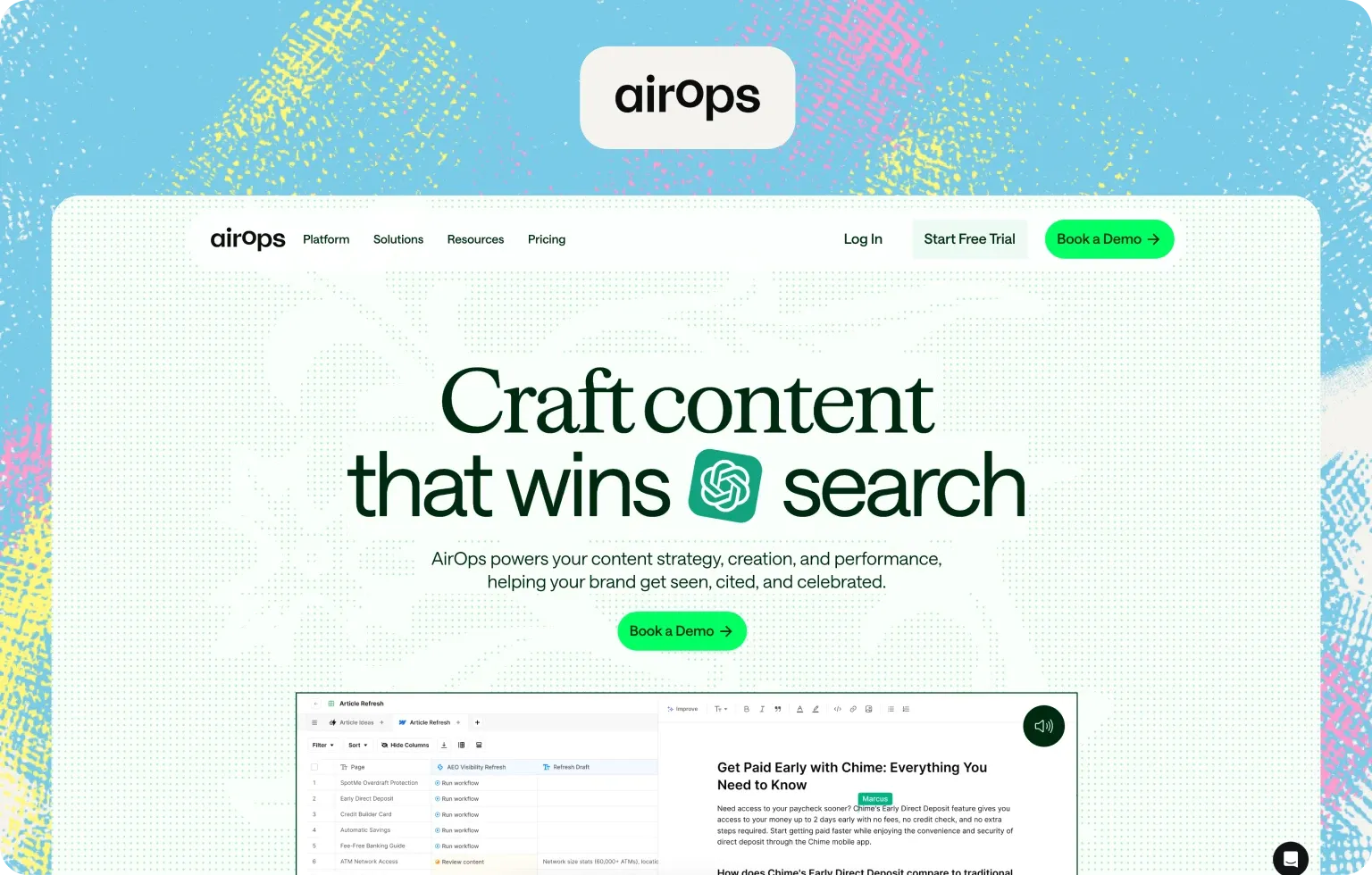
AirOps combines AEO tracking, AI-powered content creation, and workflow automation for scaled organic growth. It positions itself as a comprehensive content marketing platform rather than standalone visibility monitor.
Best for
Growth teams and content marketers needing workflow automation, scaled content operations, and publisher discovery.
What it does well
When to pick AirOps over Surfer SEO
Watch-outs
Pricing is significantly higher than monitoring-only platforms, starting at $200/month (ChatGPT only) with the next plan at $2,000/month for multi-engine tracking. Geographic coverage is limited to one region on all plans.
Pricing
If you searched for “keyword surfer alternative” and meant the free Keyword Surfer Chrome extension rather than the Surfer SEO platform, the tools you're looking for are different. The best alternatives for inline search volume and keyword data in your browser are Keywords Everywhere, Ubersuggest, and the Ahrefs SEO Toolbar.
If you need full keyword research tools and keyword suggestions rather than browser extensions, Frase and SE Ranking both include strong keyword discovery as part of their platforms and are covered above.
You can approximate Surfer's core workflow using free tools, but be realistic about the time investment. You’re spending approximately 2 hours per article for manual optimization suggestions versus 30 minutes with a paid platform. This section is honest about what's possible, where free tools fall short, and when time cost exceeds the $69/month subscription value.
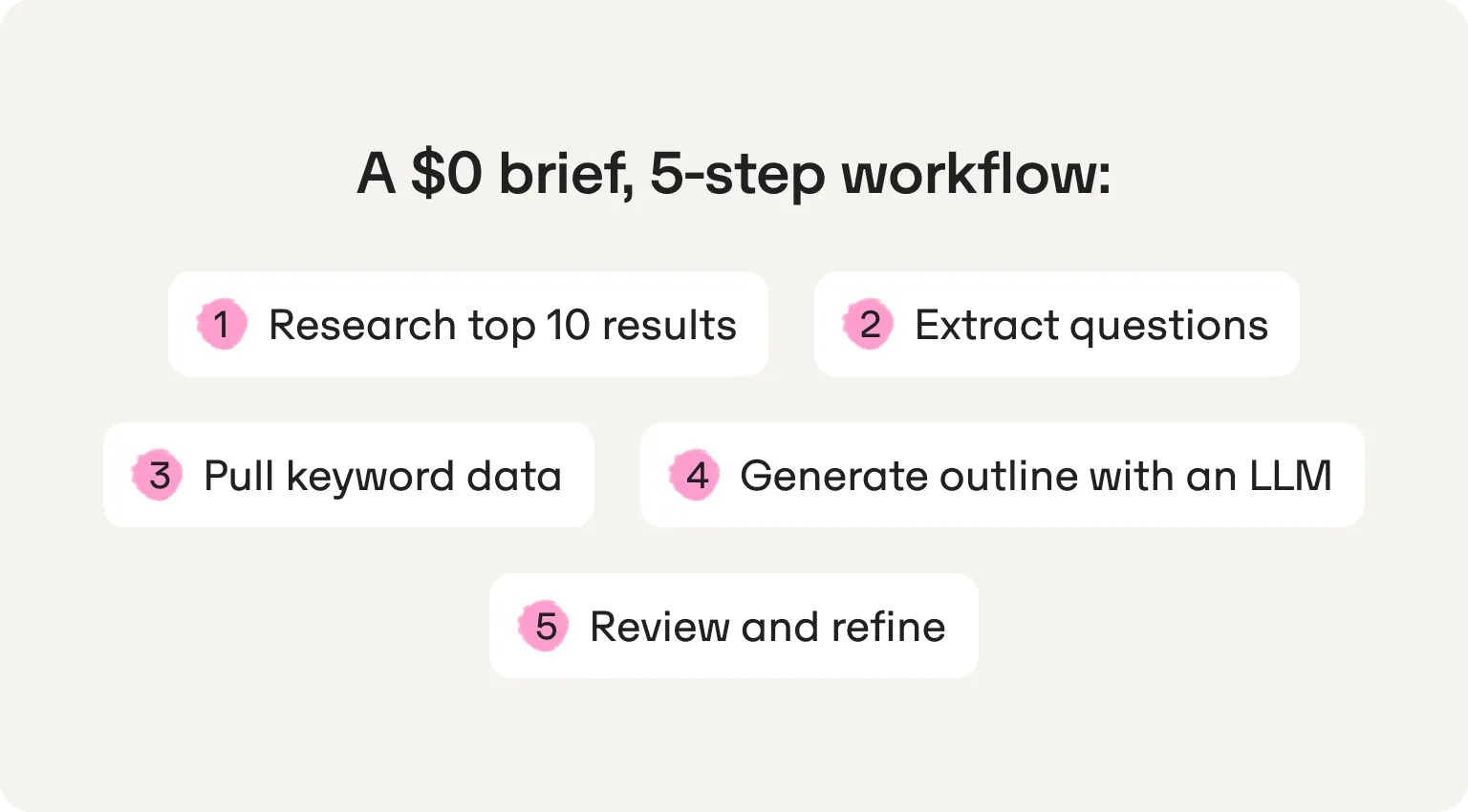
Here’s the $0 brief, 5-step workflow:
Without automated 0-100 scoring, a manual checklist keeps quality consistent. Use this Surfer SEO alternative free scoring system before every publish:
Structural checklist (30 points max):
Clear H1 with target keyword naturally integrated (5 points)
5-7 well-organized H2 sections with logical flow (10 points)
H3 subsections providing depth without overwhelming (5 points)
Introduction that hooks reader and establishes relevance (5 points)
Conclusion that summarizes key points and includes clear CTA (5 points)
Topic coverage checklist (40 points max):
Addresses all PAA questions identified during research (15 points)
Covers all major topics from top-ranking competitor content (15 points)
Includes unique angle, expert insights, or proprietary data competitors lack (10 points)
Readability checklist (20 points max):
Average sentence length under 20 words for accessibility (5 points)
Paragraphs under 4 sentences to improve scannability (5 points)
Clear transition sentences connecting sections logically (5 points)
Scannable formatting with bullet points, bold text, callouts where appropriate (5 points)
Citation checklist (10 points max):
Links to credible external sources for factual claims (5 points)
Internal links to relevant content on your site (5 points)
A score of 85-100 means you can publish confidently. 70-84 indicates minor gaps that are acceptable to leave. 50-69 requires revisions before publishing. Below 50, start the article over. Running through this checklist takes 15-20 minutes per article, compared to real-time automated scoring that updates with every paragraph.
For small teams (2-3 people) publishing regularly, you can build your own lightweight free process:
This workflow adds 30-45 minutes per article compared to automated tools. For teams publishing 4+ articles per month, that's 10+ hours monthly of manual work. At that volume, the time cost exceeds the $69-119/month paid tool subscription value.
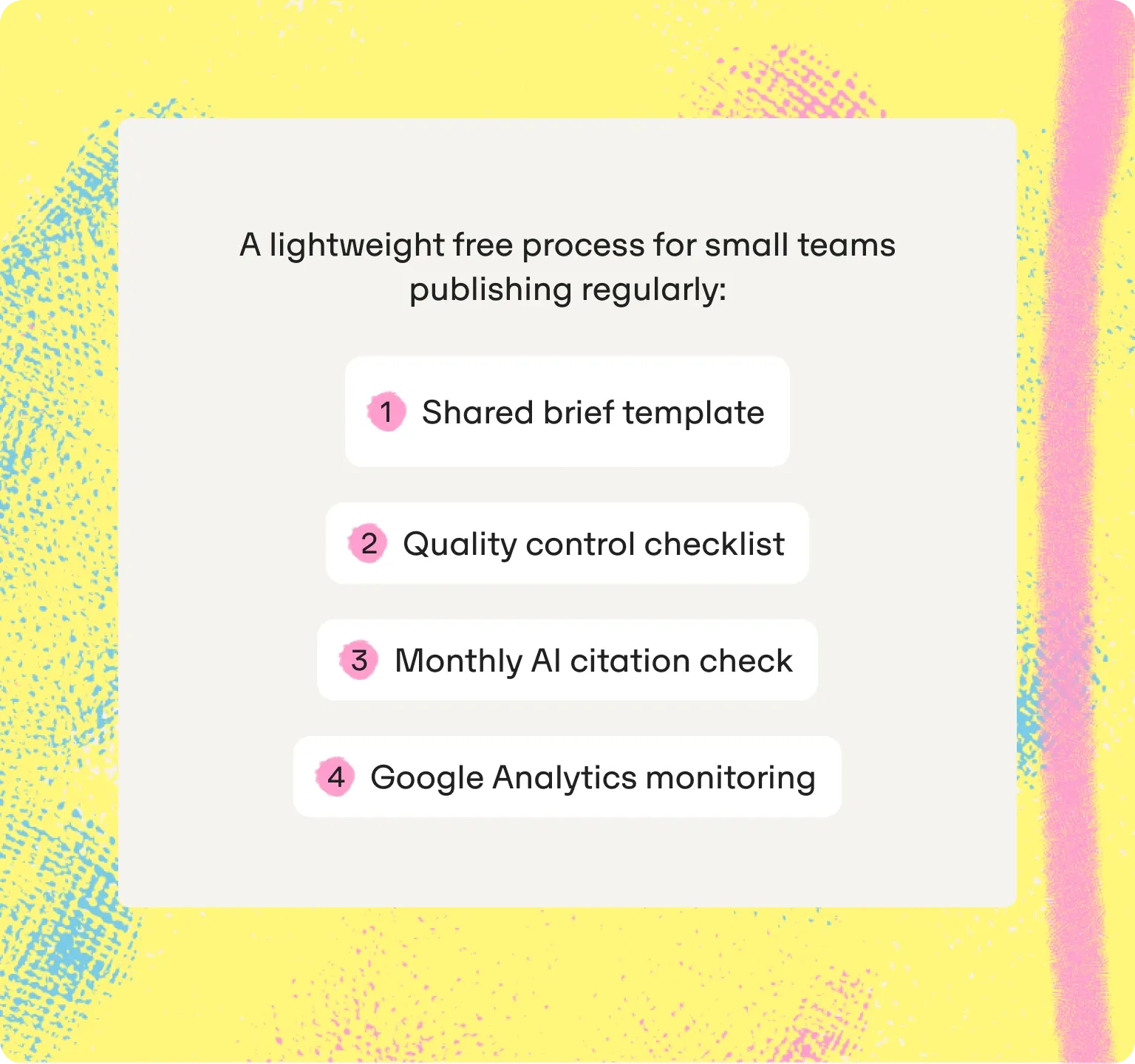
This free alternative works best for validating your content process before committing any budget or for very low-volume publishing (1-2 articles per month), not as a permanent solution for scaling content operations.
The right tool depends entirely on what problem you're solving. Most teams that end up frustrated with their AI visibility stack picked a tool that was adjacent to their actual need: a monitoring dashboard when they needed execution, or an enterprise platform when they needed simplicity. Use this table as a starting point.
| If you need... | Shortlist these tools |
|---|---|
| Content briefs and editorial workflow | Clearscope, Frase, MarketMuse, Content Harmony |
| AI answer visibility and citation intelligence with pre-publish outcome projection | Omnia |
| Enterprise governance and compliance | Scrunch AI, Semrush, SE Ranking |
| Budget-friendly tools (<$100/month) | Omnia, Frase, Otterly AI, SE Ranking |
| All-in-one suite | SE Ranking, Semrush, Ahrefs |
Content-driven startups face specific constraints. They’re usually made up of lean marketing teams with 1-3 people, facing VC pressure to show measurable growth, and competing in categories where traditional SEO is dominated by established players. When organic traffic flattens despite publishing optimized content, visibility dashboards aren't enough.
The citation landscape makes that harder than most teams realize. AI citations aren’t stable. According to Omnia’s data, only 18.5% of AI Overview answers keep the same top-cited domain week over week. ChatGPT changes its top-cited domain 92% of the time. Earning a citation once doesn’t mean keeping it.
What you publish also matters differently by engine. Blog content earns 22.8% of Perplexity citations but only 14.4% of ChatGPT's. Review and comparison pages earn the best average position in Perplexity (3.1) and 10% of ChatGPT citations, the highest-leverage format if you can only publish a handful of articles per month.
Omnia closes the execution gap with a complete loop from planning through verification. It identifies which prompts cite competitors but not your brand, with URL-level analysis showing exactly which competitor pages win citations. It projects expected share of voice before any writing begins. It also generates a ready-to-execute brief optimized for citation eligibility rather than keyword density. After publishing, it monitors citation impact over a 90-day cadence by country and engine, confirming whether your content earned the projected citations and where gaps remain.
You know what to write, what to expect, and whether it worked. Ready to see pre-publish projection in action? Book a demo with Omnia or try a 14-day free trial on the Growth plan.
Omnia offers a 14-day free trial on the Growth plan.
No credit card required. See exactly where your brand shows up (or doesn't) across AI engines, then let the platform's recommendations guide your next move.

For traditional content optimization: Clearscope, Frase, MarketMuse, and Content Harmony are top Surfer SEO competitors. For AI answer visibility, Omnia, Peec AI, and Otterly AI are some of the top Surfer SEO alternatives. Your best choice depends on whether you're optimizing for traditional SERP rankings or AI engine citation probability.
A realistic free stack combines Google Search Console for keyword and traffic data, People Also Ask extraction for question discovery, manual competitor analysis for topic identification, and ChatGPT free tier for outline generation with structured prompts. It's functionally usable but requires 2+ hours per article vs 30 minutes with paid automated tools. This method is best for validating your content process before committing subscription budget or for very low-volume publishing.
Surfer's AI Search feature extracts facts and topics from AI models and web pages to guide your writing, showing what information AI engines are currently pulling from top sources. That data is useful for ensuring comprehensive topic coverage. But it doesn't forecast citation probability before writing, prioritize prompts by realistic share of voice potential for your specific domain authority, or monitor post-publish citation performance with 90-day verification cadence by country and engine.
Yes, both platforms offer content optimization add-ons that provide similar functionality. Semrush AI Visibility Toolkit and Ahrefs AI Content Helper / Brand Radar include content scoring, topic suggestions, and AI visibility tracking. These options work best for teams already using Semrush or Ahrefs for traditional SEO research, avoiding the need to learn a completely separate content optimization platform.
Written By
 Jose Luis García del RíoGrowthatOmniaJose Luis García del RíoGrowthatOmnia
 Alfredo BernalOrganic Growth LeadatOmnia
 Alfredo BernalOrganic Growth LeadatOmnia
 Alfredo BernalOrganic Growth LeadatOmnia
 Jose Luis García del RíoGrowthatOmnia
No credit card required · Free for 14 days · See your AI visibility within 3 minutes