.webp)


If you're evaluating LLM Pulse alternatives, the gap you're likely hitting is one of three things: weekly tracking that's too slow for active campaigns, recommendations capped at 30 prompts, or no continuous country-level visibility. The tools in this guide address those gaps directly. For most SEO and growth teams, Omnia is the strongest fit. Use the comparison table to shortlist three options, then read the detailed reviews to decide.
There's no shortage of LLM Pulse alternatives in 2026. The AI visibility category has grown fast, and most tools will track brand mentions across major AI engines. The harder question is which one actually helps you do something with what you find. Mention data tells you the scoreboard.
It doesn't tell you which sources are driving competitor recommendations, whether your visibility looks different in the UK versus Germany, or what content to create this week to change the outcome. This guide ranks the best LLM Pulse alternatives for SEO and growth leads who need more than a weekly snapshot.
What “LLM Pulse alternatives” really means (and why you’re searching)
You're likely not looking for LLM Pulse competitors because it didn’t meet your expectations. LLM Pulse is a great tool and bests many others in the category. It tracks 10+ AI engines, produces GPT-generated content recommendations, generates briefs, and lets you run controlled experiments to test whether a content change actually moved your AI visibility. For many teams starting out, that's a solid foundation.
But “starting out” is exactly where the problems appear. LLM Pulse's recommendation engine analyzes up to 30 tracked prompts and 30 cited URLs at a time. Teams running larger prompt sets get a partial picture, not a full one. Its tracking cadence is weekly across every plan, even the $368/mo Scale tier.
If you ship a content fix mid-week and need to know whether it's changing citations, you're waiting for the next cycle. And while LLM Pulse has a GEO Testing feature, it's a controlled A/B experimentation tool for measuring the impact of specific content changes. It doesn’t continuously monitor what users in the US, the Netherlands, or Spain actually see when they query ChatGPT or Perplexity about your brand.
Here's how to evaluate whether a switch is actually worth making.
The three questions you need answered before you switch tools
LLM Pulse users tend to hit the same three walls. Use these as your evaluation filter — if a tool can't clear all three, you're making a lateral move, not an upgrade.
- Can it track what users in my specific markets actually see — continuously, not just in experiments? LLM Pulse's GEO Testing is a structured before/after experiment, not ongoing country-level monitoring. You need a tool that runs prompts in real geographic locations on a continuous basis.
- Does it cover my full prompt set, or just a capped sample? LLM Pulse's recommendation engine caps at 30 prompts and 30 cited URLs. If you're tracking more, your recommendations reflect a slice of reality, not the full picture.
- Can I measure the impact of a content fix in days, not a week? Every LLM Pulse plan tracks weekly. For teams actively shipping and iterating, that cadence is too slow to be useful.
All LLM Pulse alternatives at a glance
The tools below range from lightweight trackers to full-stack visibility platforms. Scan the action layer and refresh cadence columns first. Those two factors alone will narrow most shortlists from 12 to 3.
| Tool | Best for | Engines covered | Refresh cadence | Action layer | Pricing starts at |
|---|---|---|---|---|---|
| Omnia | Citation depth + execution | 4 | Daily |  |
€79/mo |
| Scrunch AI | Enterprise competitive intelligence | 8 | Daily | |
$250/mo |
| Peec AI | Granular citation classification | 7 | Daily |  |
$95/mo |
| Otterly AI | On-page GEO diagnostics | 5 | Daily | |
$29/mo |
| Indexly | SEO + AI visibility + content generation | 6 | Not specified | |
$99/mo |
| Ahrefs | AI visibility inside existing SEO suite | 6 | Daily | |
$398/mo |
| BrightEdge | Existing BrightEdge enterprise contracts | 3 | Not specified | |
Custom |
| Moz | EEAT + authority signals + AI citations | 2 | Daily | |
$99/mo |
| AirOps | Full content pipeline from signal to CMS | 4 | Weekly | |
$200/mo |
| AthenaHQ | Expert-pedigree predictive recommendations | 8 | Daily | |
$295/mo |
| Rankscale | Broad engine coverage + daily monitoring | 8 | Daily | |
€99/mo |
| LLMrefs | Freemium multi-platform tracking | 11 | Weekly | |
Free |
The 12 best LLM Pulse alternatives for AI search visibility
The tools below were chosen because they address specific gaps LLM Pulse leaves open — weekly tracking, capped recommendations, and the absence of continuous country-level monitoring. Some go deeper on citation intelligence. Some go further on execution. And some do both.
1. Omnia
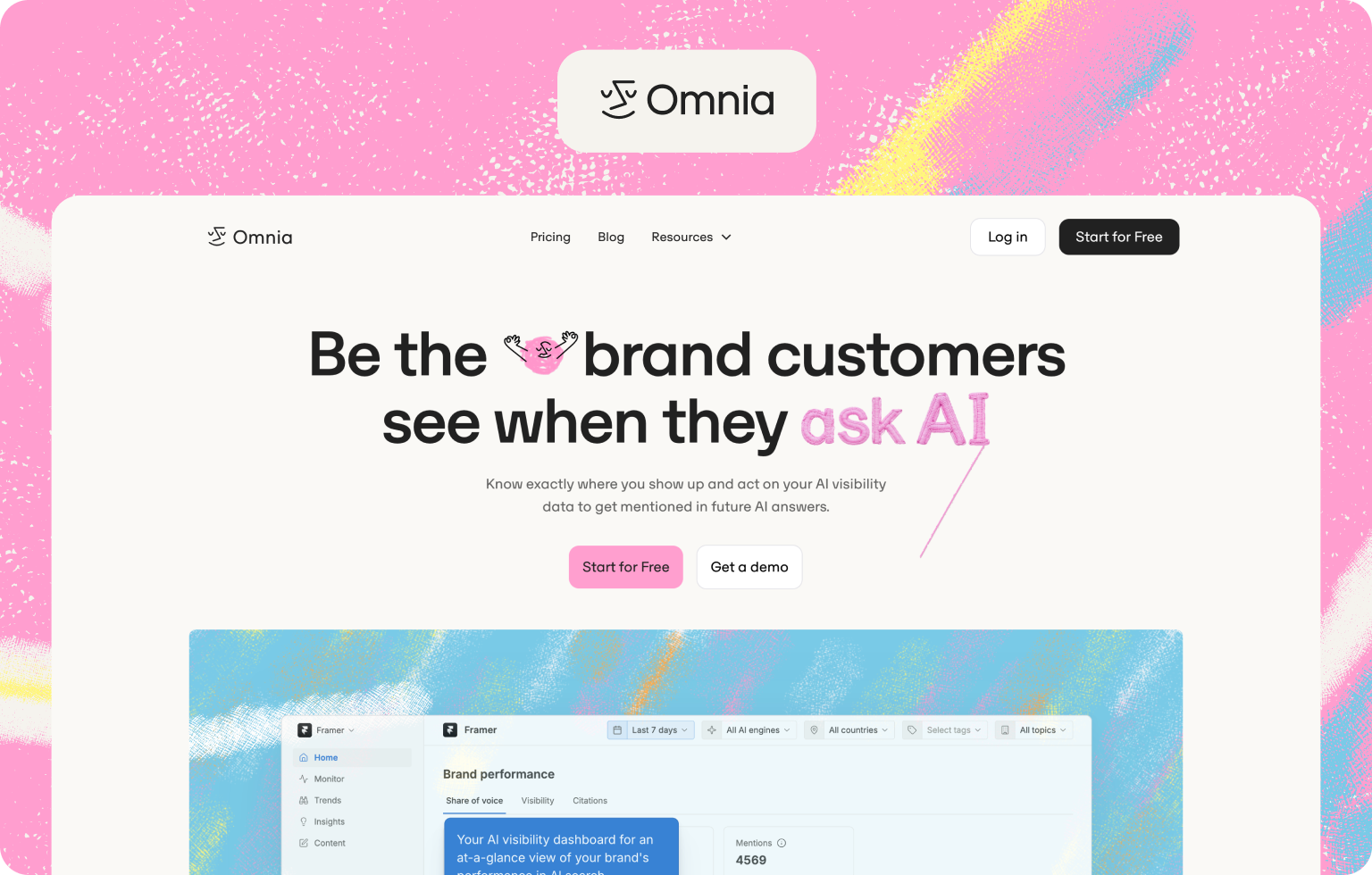
Omnia is a purpose-built AI visibility platform that goes beyond mention tracking to show you exactly which sources AI search engines are citing, why competitors win specific prompts, and what content to create or fix to change it. It's the only tool in this list that pairs citation intelligence with a concrete execution backlog — briefs, placement targets, and workflows your team can act on right away.
Best for
SEO and growth leads who've outgrown LLM Pulse's mention data and need to diagnose why competitors win AI recommendations, then act on it.
Key features
- Citation drilldowns at exact URL level, not just domains, but the specific pages AI search engines are citing when they recommend competitors
- Localized tracking by country via real browser execution in actual geographic locations, so you see what users in each market actually see
- Share-of-voice vs competitors across prompts, with trend data showing which prompt clusters you're winning or losing over time
- Omnia MCP connects visibility data into AI assistants like Claude and ChatGPT for conversational querying
- Prompt Discovery surfaces AI-native prompts ranked by volume and difficulty across any country and language
- Action layer that generates content briefs, identifies third-party domains to target for placements, and produces a week-by-week execution roadmap from citation gaps
- AI Sentiment Analysis scores brand perception feature-by-feature to reveal where AI favors competitors
Watch-outs
Omnia covers four core engines including ChatGPT, Perplexity, Google AI Overviews, and Google AI Mode, which is where the majority of AI search activity happens. If your workflow requires tracking beyond those four platforms, you'll want to supplement. The action layer also requires your team to execute. Omnia tells you what to build, but the building still requires human judgment and effort.
When to choose Omnia over LLM Pulse
- You're running more than 30 tracked prompts and need recommendations that reflect your full prompt set rather than a capped slice of it
- You operate in more than one country and need to know what users in each specific market actually see
- You need third-party placement intelligence: Omnia identifies the specific external domains and URLs to target for citation placements
- You want share-of-voice and citation trend data at scale, tracked continuously rather than in weekly batches
- Growth: €79/mo
- Pro: €279/mo
- Enterprise: Custom
2. Scrunch AI
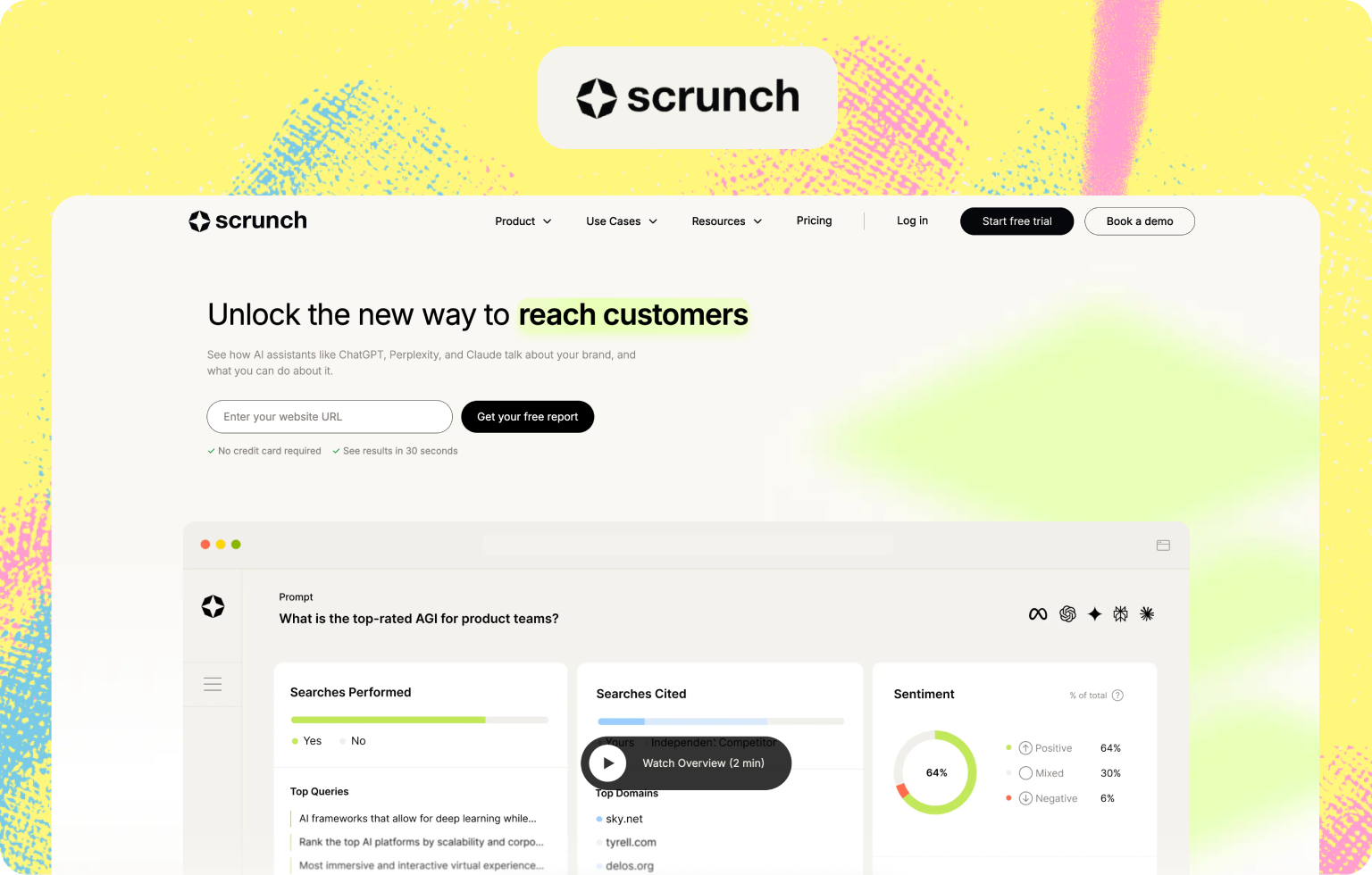
Scrunch AI is an enterprise-grade AI visibility platform with real-time bot crawling, SOC2 certification, and multi-dimensional competitor analysis across persona, topic, and geography simultaneously. The enterprise plan covers 9 AI platforms and offers an Agency Partner Program for teams managing multiple clients at scale.
Best for
Enterprise teams or large agencies that need the deepest competitive intelligence available, and for teams where security certification is a procurement requirement.
Key features
- Multi-dimensional competitor analysis lets you see who's winning not just overall, but by persona, topic cluster, and geographic market
- Real-time bot crawling feed showing exactly when GPTBot, PerplexityBot, and other AI crawlers access your content
- Running citation lists with influence scores, so you know which domains carry the most weight when AI search engines make recommendations
Watch-outs
Scrunch AI pricing, according to our alternatives coverage, starts at $250/mo, which is the highest entry price of any pure-play AI visibility tool in this list, and a real barrier for startups or lean growth teams. Content Gaps identifies and prioritizes what to build, but it doesn't write the content for you. Optimizer and AXP automate content delivery to AI agents, but still require your team to produce the underlying content. For teams coming from LLM Pulse, Scrunch is a meaningful step up in both diagnostic depth and execution tooling, but the price needs to justify the upgrade.
When to choose Scrunch AI over LLM Pulse
- You need SOC2 compliance to pass enterprise InfoSec procurement
- You're managing an agency book of business and need the Agency Partner Program infrastructure
- The depth of crawl behavior data (which bots, how often, correlating with visibility changes) is important to your diagnostics workflow
Pricing
- Core: $250/mo
- Enterprise: Custom
3. Peec AI

Peec AI is a comprehensive AI citation tracker with granular URL-level citation classification, daily tracking, and unlimited seats across all plans. It covers 7 AI platforms (9 on enterprise) across 115+ languages and integrates with Looker Studio and APIs for custom reporting.
Best for
SEO and growth teams that want granular, filterable citation data and daily tracking at a strong price-to-value ratio, with no per-seat surprises.
Key features
- URL-level citation classification with source-type filtering so you can see exactly which content categories are driving competitor citations
- Suggested prompts auto-generated from your website content, so you don't start from scratch building your prompt set
- Daily tracking with visibility, position, and sentiment metrics
Watch-outs
AI visibility tools like Peec AI don’t have an action layer — there’s no content briefs, recommendations, or optimization workflows. This is a genuine trade-off compared to LLM Pulse, which does produce GPT-generated recommendations and content briefs. Additional platforms beyond the base 7 require add-on pricing or an enterprise plan, which can complicate total cost.
When to choose Peec AI over LLM Pulse
- You need daily citation tracking so you can catch citation changes mid-week
- You want a more granular and filterable data layer than LLM Pulse's citation output
- You're managing a distributed team or agency where unlimited seats at a flat price matters
Pricing
- Starter: $95/mo
- Pro: $245/mo
- Advanced: $495/mo
- Enterprise: Custom
4. Otterly AI
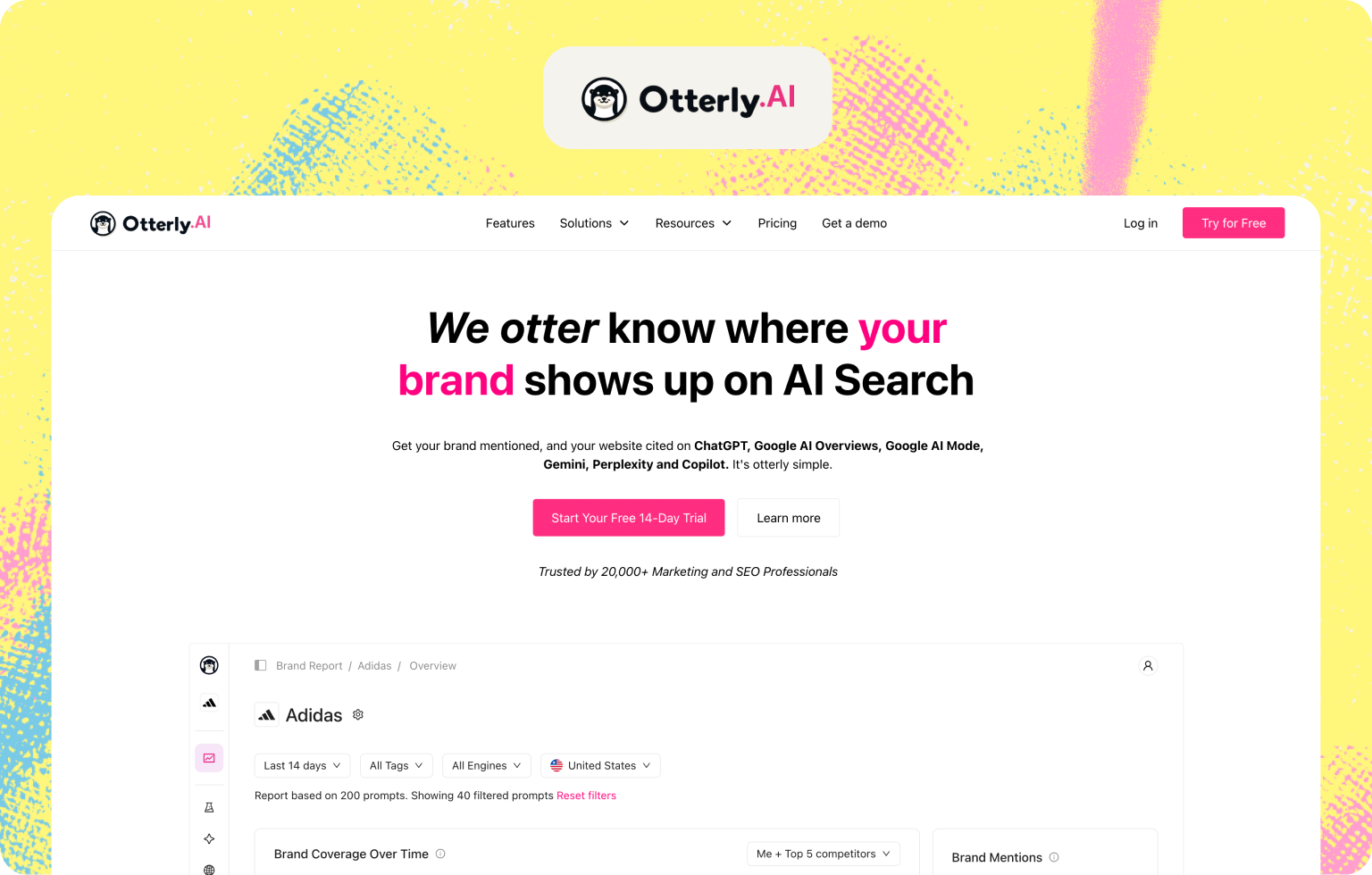
Otterly AI is an AI visibility tool with a standout GEO Audit feature that runs 25+ on-page checks and returns SWOT-style recommendations. It covers 5 AI platforms (more available as add-ons) across 50+ countries and starts at $29/mo with unlimited brand tracking at fixed pricing.
Best for
SEO leads and budget-conscious teams who suspect on-page or technical issues are causing their LLM Pulse mention gaps and want a diagnostic tool that confirms where the problem actually lives.
Key features
- GEO Audit tool surfaces the technical and structural reasons AI engines aren't citing your pages
- AI Keyword Research tool using real user prompts to build or validate your prompt tracking set
- Multi-client workspace management with native Looker Studio connector
Watch-outs
Otterly AI’s citation drilldown is domain-level only, not URL-level. You can identify which sites AI search engines are citing but not which specific pages. That's a real ceiling that causes users to consider Otterly AI alternatives.
When to choose Otterly AI over LLM Pulse
- You want a proper on-page GEO audit with SWOT-style recommendations
- Budget is a priority: Otterly starts at $29/mo vs LLM Pulse's ~$61/mo, with 50+ country coverage and unlimited brand tracking at a fixed price
- You're managing multiple client brands and want a dedicated multi-client workspace
Pricing
- Lite: $29/mo
- Standard: $189/mo
- Premium: $489/mo
- Enterprise: Custom
5. Indexly
.png)
Indexly is a combined SEO and AI visibility platform that tracks brand presence across 5 AI engines, alongside traditional SEO. Its Growth and Scale plans add a content generation layer with an Auto-Pilot Engine that can draft and publish SEO/GEO-optimized articles directly to your CMS.
Best for
Teams that want traditional SEO monitoring and AI visibility in one platform, and are ready to use automated content generation to close citation gaps.
Key features
- Citation gap analysis identifying which content is missing for tracked prompts, with status indicators (red/yellow/green) and associated prompt links
- AI brand sentiment tracking categorizing mentions as positive, neutral, or negative with source tracing
- Auto-Pilot Content Engine (Growth+) that drafts and publishes SEO/GEO-optimized articles to your CMS on a set cadence
Watch-outs
Indexly's Starter plan ($99/mo) only tracks one AI model (ChatGPT) with 50 prompts. Meaningful multi-engine coverage doesn't start until Growth ($299/mo, 3 models, 100 prompts). The content generation layer is useful but produces volume, not necessarily the citation-intelligence-led briefs that specifically address why competitors are winning prompts.
When to choose Indexly over LLM Pulse
- You want traditional SEO and AI search visibility unified in one platform
- You need white-label reporting for agency clients — available on Scale ($499/mo) and above
- You want AI traffic analytics showing which AI engines are actually sending visitors to your site, not just where your brand is mentioned
Pricing
- Starter: $99/mo
- Growth: $299/mo
- Scale: $499/mo
- Enterprise: Custom
6. Ahrefs
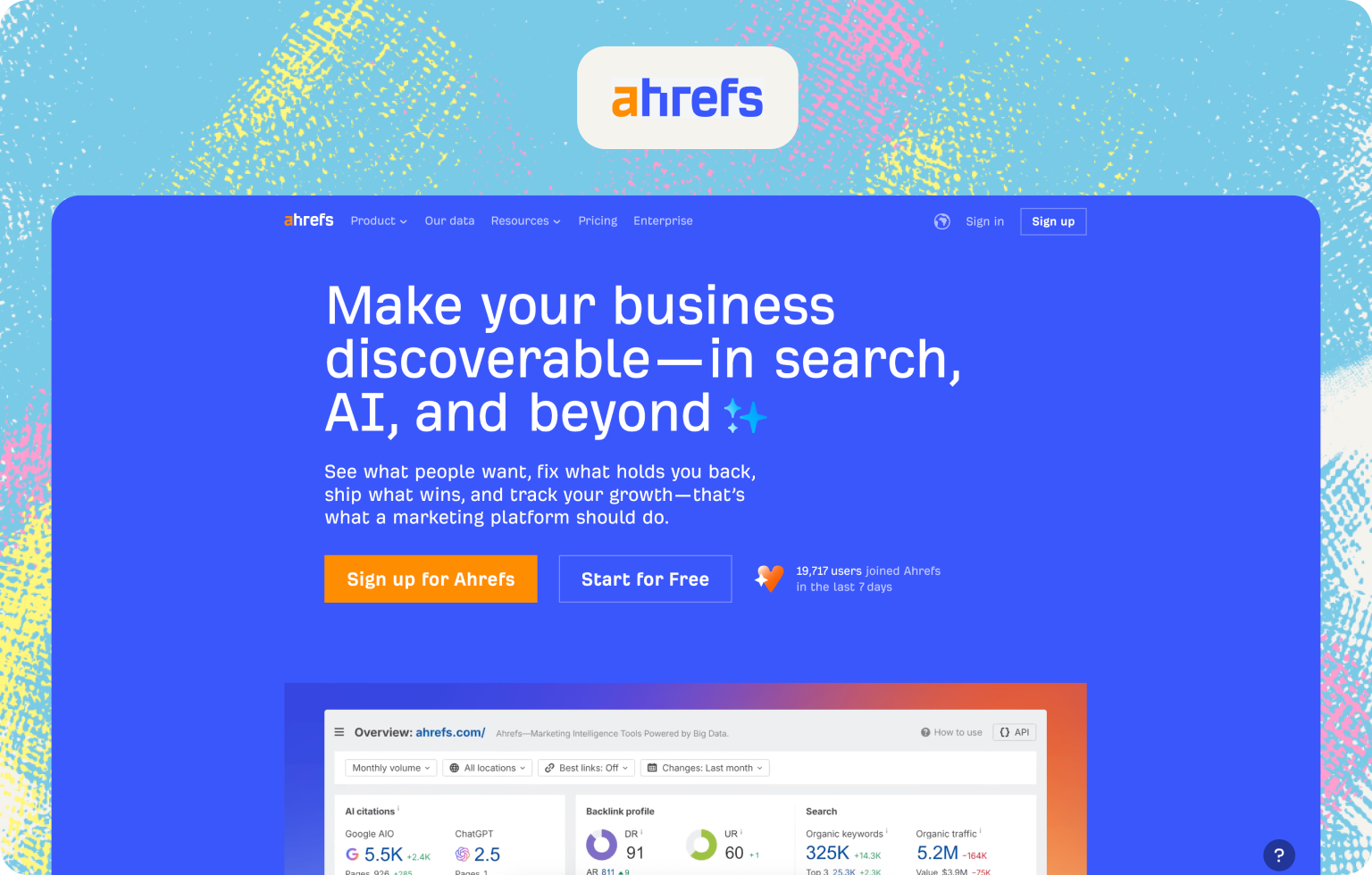
Ahrefs’ AI visibility suite integrates brand monitoring and citation tracking directly into its existing SEO platform. It covers 3 AI search engines in the base plan and YouTube and TikTok tracking are in beta. Its 264M+ prompt index is built from real user searches, not synthetic queries. For teams already deep in Ahrefs, it's the natural path to adding AI search visibility without leaving their primary workflow.
Best for
SEO teams already using Ahrefs who want AI citation tracking correlated with their existing backlink profiles.
Key features
- Site Explorer AI citations module connecting which external sites are driving AI citations to your existing backlink data
- YouTube and TikTok brand visibility tracking, which is unique and relevant for brands with significant video or social content strategies
- Citation tracking with filters across up to 7 platforms, correlating link-building investments directly to AI citation outcomes
Watch-outs
Ahrefs’ AI search visibility features are an add-on to its core SEO platform. Access to all AI platforms requires $699/mo on top of an existing Ahrefs subscription, making total cost substantial.
When to choose Ahrefs over LLM Pulse
- You're already an Ahrefs user and want AI visibility data in the same workspace without context-switching to a new platform
- YouTubeor TikTok visibility in AI-generated answers is relevant to your brand's content strategy
- You need real-user prompt data at scale (264M+ prompts) for market research, not just your own brand monitoring
Pricing
- Select platforms: $398/mo
- All AI platforms: $699/mo
7. BrightEdge
BrightEdge is an enterprise SEO platform with an AI search visibility layer added via its AI Catalyst integration. It covers 3 AI platforms with persona development, journey analysis, and industry snapshots across nine verticals. It's the platform most enterprise teams inherit rather than choose when they specifically need generative engine optimization.
Best for
Enterprise teams already contracted into BrightEdge's suite who want to activate its AI visibility features without adding a new vendor.
Key features
- Generative Parser™ analyzing how major AI platforms interpret and render content from your pages
- Persona development and intent mapping for understanding how different buyer segments encounter your brand in AI answers
- Journey analysis revealing how audiences move through AI-generated content during research and purchase decisions
Watch-outs
BrightEdge's AI visibility features are a bolt-on to a platform built for traditional search. Compared against LLM Pulse directly, it's a step back in several dimensions: fewer engines (3 vs 10+), no published pricing, no self-serve access, and no action layer for content briefs or recommendations.
When to choose BrightEdge over LLM Pulse
- You're already contracted into BrightEdge and want to activate its AI visibility layer without adding a new vendor relationship or line item
- Persona development and AI journey analysis are priorities and you have a dedicated analyst team to work with enterprise-grade outputs
- Your AI visibility need is a secondary addition to a primary traditional SEO workflow, not the core use case
Pricing
- No published pricing
8. Moz

Moz’s AI visibility features center on Google AI Overviews and ChatGPT, with citation tracking that uniquely integrates Domain Authority and E-E-A-T signals alongside URL-level source data. Its Link Intersect feature identifies citation gap opportunities where competitors are being cited but you're not.
Best for
SEO leads who suspect their authority and trust profile (not just content gaps) is the reason they're losing AI citation share, and want to diagnose it within a familiar SEO framework.
Key features
- Citation tracking integrated with Domain Authority and E-E-A-T signals
- AI Content Brief generator based on content type, topic, and region
- Keyword Explorer with AIO presence tracking, showing which of your target keywords trigger Google AI Overviews citations
Watch-outs
Moz currently covers only two AI platforms: Google AI Overviews and ChatGPT. For teams coming from LLM Pulse whose monitoring covered multiple AI engines, this is a significant regression in AI model coverage.
When to choose Moz over LLM Pulse
- Google AI Overviews and ChatGPT are your primary AI visibility concerns and you want the deepest available analysis of why specific pages win citation slots there
- You believe your EEAT or Domain Authority profile is hurting your AI citation rate and want to diagnose it with data, not guesswork
- You're already a Moz user and want to extend into AI Overviews visibility without adding a new platform
Pricing
- Standard: $99/mo
- Medium: $179/mo
- Large: $299/mo
9. AirOps
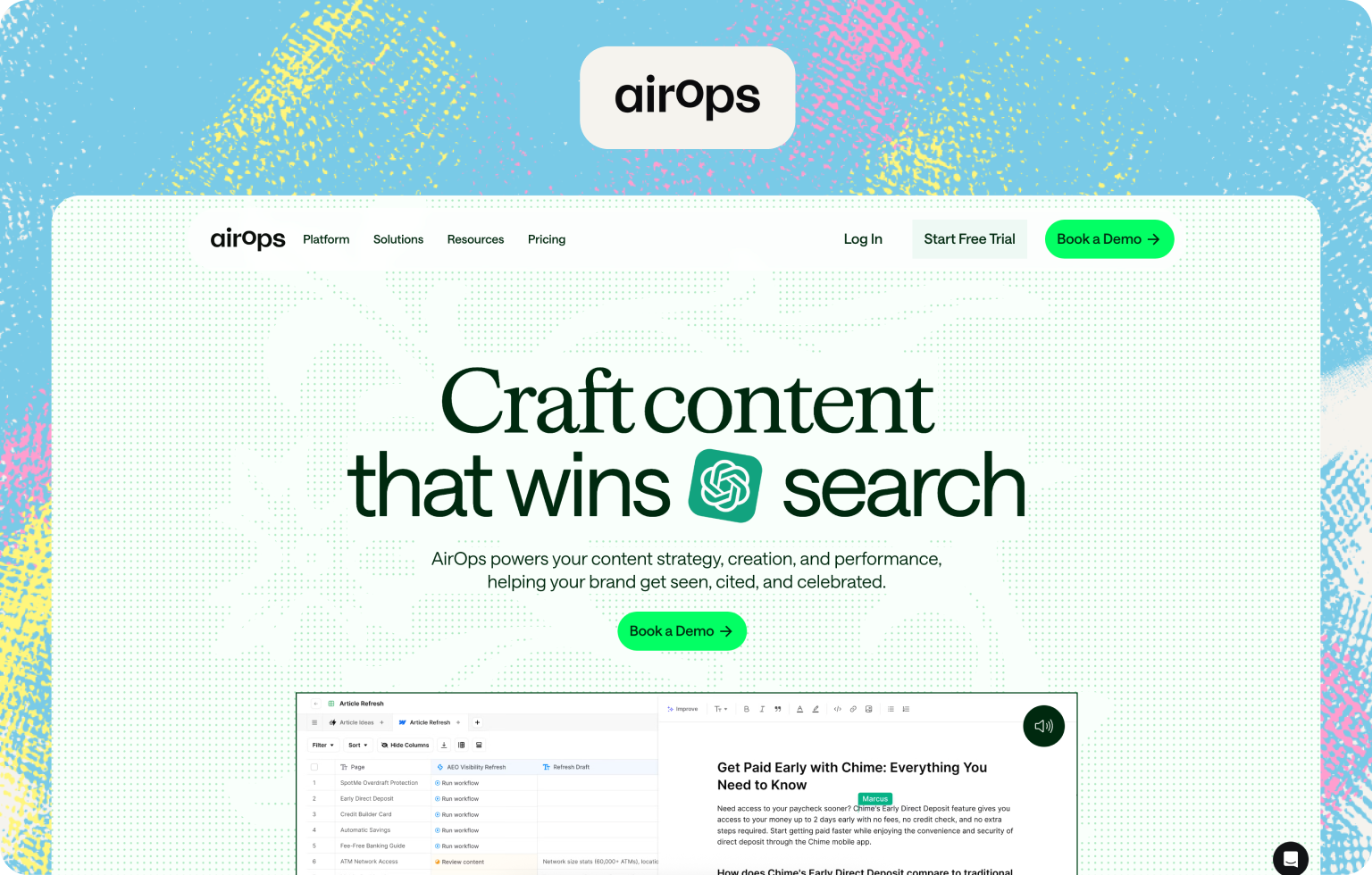
AirOps is the most operationally complete AI content pipeline in this list. It combines AI citation tracking with workflow automation, publisher discovery, outreach, and direct-to-CMS publishing across 10+ integrations. Its Page360 analytics unifies AI citation data with Google Search Console and GA4.
Best for
Growth teams or content operations leads who need to turn citation intelligence into published content.
Key features
- Influence Score ranking third-party publishers by citation impact
- Bulk content operations with human review steps and direct-to-CMS publishing across multiple integrations
- Publisher discovery and outreach automation turns citation gap analysis into a structured third-party placement strategy
Watch-outs
AirOps tracks only one region and one engine on its entry plan ($200/mo), which is a meaningful constraint for any team operating across multiple markets. For teams coming from LLM Pulse who are specifically looking to close the localization gap, AirOps doesn't solve it at the base tier.
When to choose AirOps over LLM Pulse
- Your core problem is content execution velocity — you know what to write but can't produce it fast enough, and you want AI citation data feeding directly into your CMS workflow
- You want a structured way to identify third-party domains where placing content will generate AI citations
- Your team is already using GSC and GA4 and wants AI citation data unified with those signals rather than siloed in a separate dashboard
Pricing
- Solo: $200/mo
- Pro: $2,000/mo
- Enterprise: Custom
10. AthenaHQ

AthenaHQ is an AI visibility platform built by ex-Google and DeepMind engineers. It has an Action Center that combines citation intelligence, prompt-level monitoring, and sentiment scoring into strategic recommendations. Daily citation tracking predicts visibility trends weeks ahead.
Best for
SEO and growth leads who want expert-pedigree recommendations backed by strong citation data, and are willing to pay for the predictive and strategic layer on top of monitoring.
Key features
- Daily citation tracking with a predictive model that identifies visibility trend shifts weeks before they appear in standard monitoring data
- Localized citation strategies for different geographic markets — built into the recommendation layer, not just the data layer
- Shopify integration for publishing GEO-optimized content and measuring revenue impact directly
Watch-outs
AthenaHQ's base plan starts at $295/mo. For teams making their first move beyond LLM Pulse and working within a lean budget, the cost creates a real barrier before you've proven the ROI of the category. The platform also requires dedicated resources to extract full value from its recommendation layer.
When to choose AthenaHQ over LLM Pulse
- You want predictive visibility intelligence
- Recommendations from ex-Google/DeepMind engineers carry a different weight than algorithmic suggestions
- You have budget for a premium tool and want the most strategic action layer available in the category
Pricing
- Self-Serve: $295/mo
- Enterprise: Custom
11. Rankscale
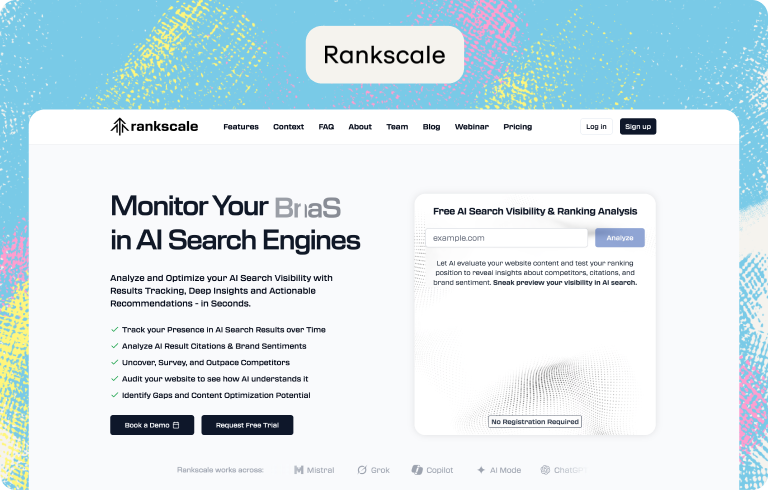
Rankscale is an AI visibility monitoring tool covering 8 AI platforms with multi-region support, daily tracking, URL-level citation analysis, and a task board that converts citation gap findings into actionable task lists. Founded in 2025, it's one of the newer entrants in the category — purpose-built for AI search from the start, not retrofitted from traditional SEO.
Best for
SEO teams who want affordable AI visibility monitoring with citation gap analysis and a lightweight task management system.
Key features
- 8 LLM coverage with unlimited workspaces and users on all plans, making it accessible for teams managing multiple projects or client accounts
- Multi-model historical snapshots for tracking how AI citation patterns shift over time
- Daily monitoring cadence with strong core analytics at entry-level pricing
Watch-outs
Rankscale has no action layer and pricing is credit-based. For teams coming from LLM Pulse who specifically want more execution support, Rankscale is a step sideways, not forward, on that point.
When to choose Rankscale over LLM Pulse
- You need daily monitoring rather than weekly
- Unlimited workspaces and users on all plans suits your team structure
- You prefer a lightweight task board for prioritizing citation gaps over a GPT-generated recommendations engine
Pricing
- Pro: €99/mo
- Growth: €385/mo
- Enterprise: €780/mo
12. LLMrefs
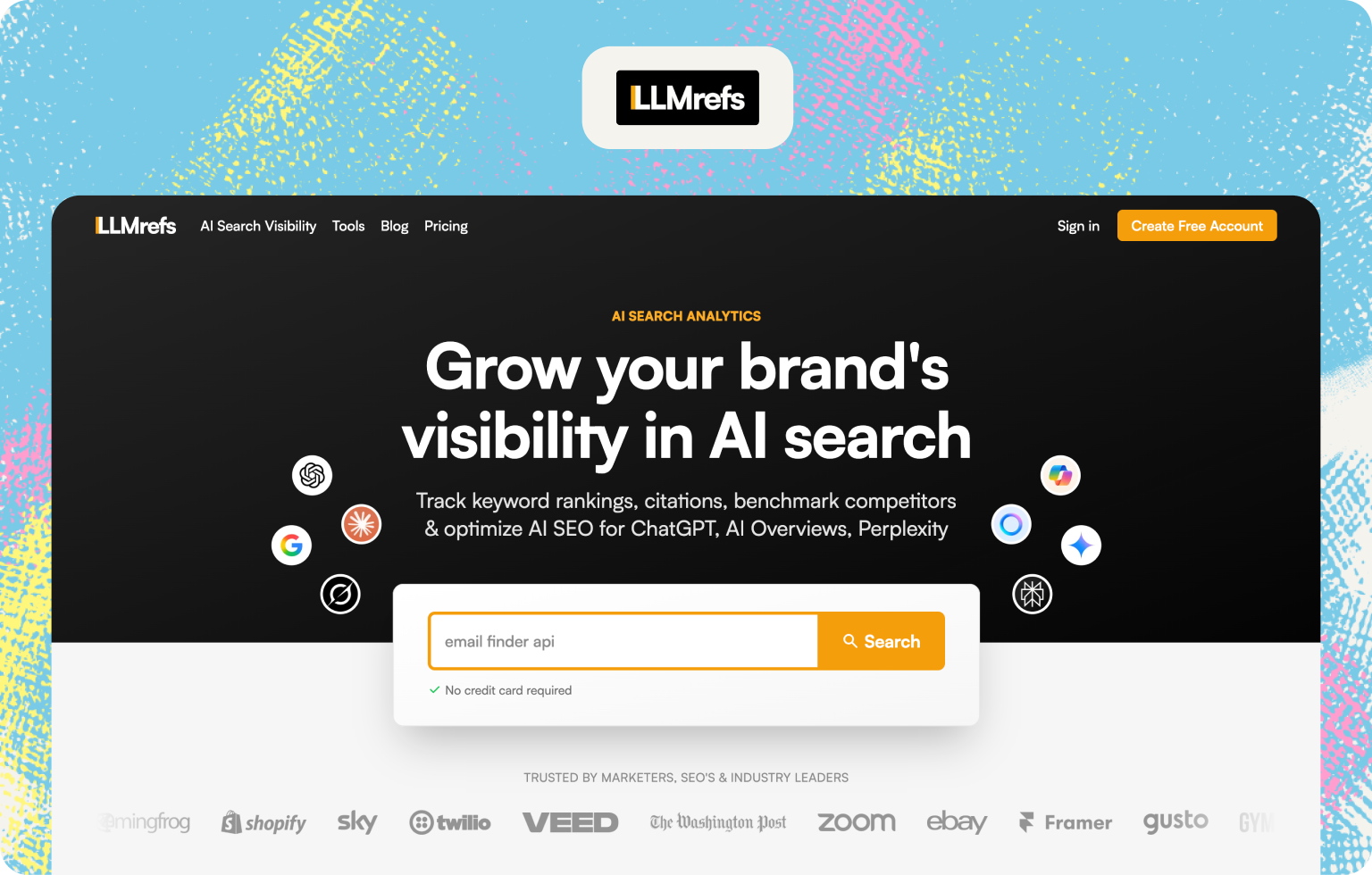
LLMrefs is a lightweight, freemium AI visibility tracker covering 11 AI platforms across 50+ countries. It has the broadest engine coverage at the lowest price point in this list. It's built for startups and solo marketers who need to understand where their brand appears across major AI engines without committing to a paid tool.
Best for
Startups or bootstrapped teams that want a risk-free way to test multi-platform AI visibility tracking before investing in a dedicated tool.
Key features
- Freemium entry tier with no credit card required, making it the lowest-friction starting point for teams new to the category
- 50+ countries with weekly tracking cadence
- Proprietary scoring system for optimization priorities, a lightweight signal of where to focus
Watch-outs
LLMrefs has a weekly refresh cadence and no citation drilldown — it shows you whether your brand appears across AI platforms, but not why it appears or doesn't, and not which sources are driving competitor recommendations.
When to choose LLMrefs over LLM Pulse
- You want to audit presence across 11 AI platforms before deciding which tools to invest in
- Budget is zero and you need a starting point
- You're in an early research stage and aren't yet ready for a platform with citation depth or execution output
Pricing
- Free tier
- All-in-one: €79/mo
How to choose the right LLM Pulse alternative (use this decision tree)
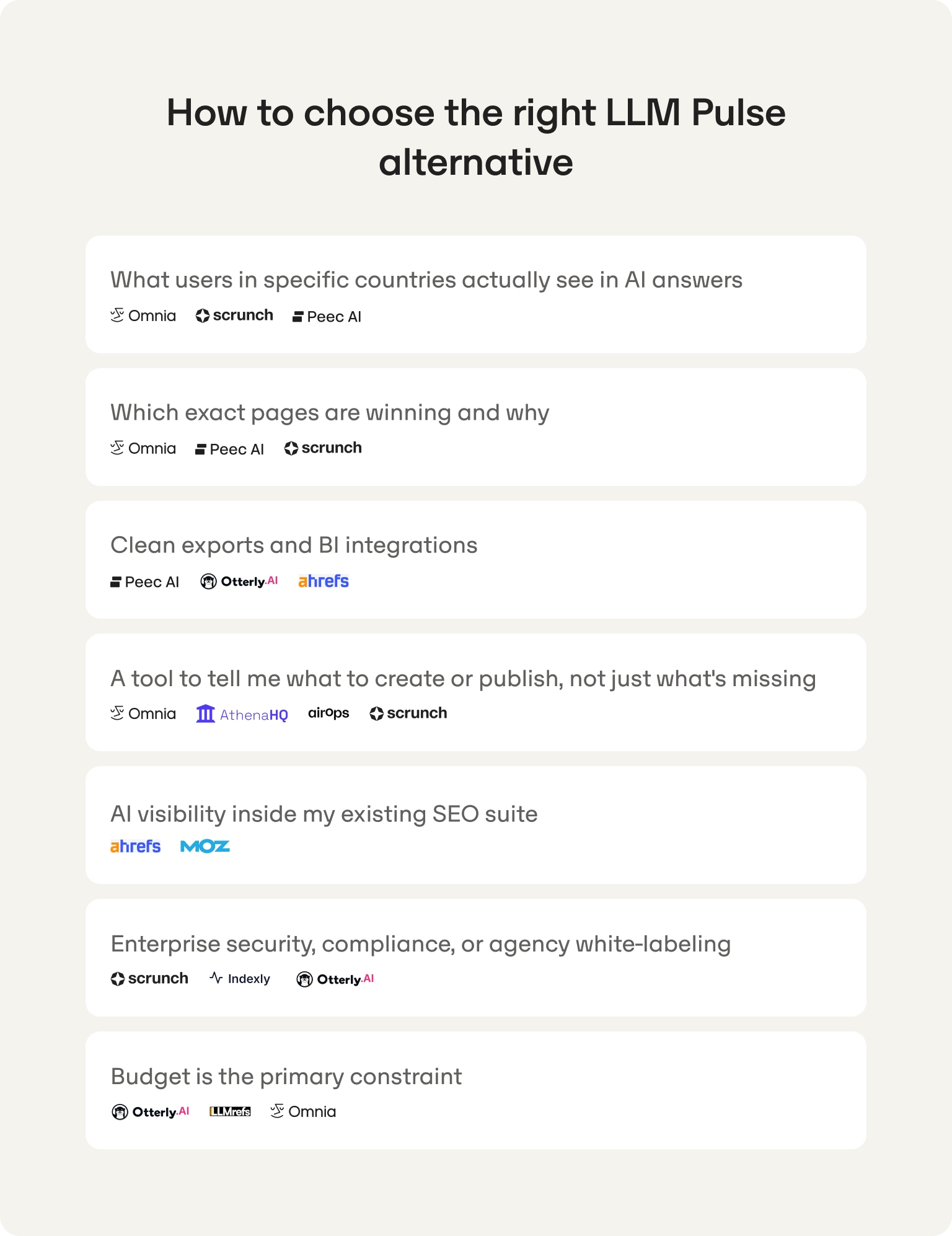
Start with your most pressing need. Each path below points to the tools that specifically address it.
- I need to know what users in specific countries actually see in AI answers
- Omnia (unlimited countries, real browser execution)
- Peec AI (115+ languages, daily tracking)
- Scrunch AI (multi-region with persona + geography dimensions)
- I need URL-level citation intelligence — which exact pages are winning and why
- Omnia (URL-level + third-party placement targeting)
- Peec AI (filterable by source type)
- Scrunch (citation lists with influence scores)
- I need clean exports and BI integrations
- Peec AI (Looker Studio + API, unlimited seats)
- Otterly AI (Looker Studio, multi-client workspace)
- Ahrefs (if already in the ecosystem)
- I need the tool to tell me what to create or publish — not just what's missing
- Omnia (citation-led briefs + placement roadmap)
- AthenaHQ (predictive Action Center)
- AirOps (full pipeline to CMS)
- Scrunch (Content Gaps + Optimizer + AXP)
- I need AI visibility inside my existing SEO suite
- Ahrefs (correlates citations with backlink data)
- Moz (Google AI Overviews + EEAT signals)
- I need enterprise security, compliance, or agency white-labeling
- Scrunch AI (SOC2, Agency Partner Program)
- Indexly (white-label on Scale+)
- Otterly AI (multi-client workspace)
- Budget is the primary constraint
- Otterly AI ($29/mo, 5 engines, 50+ countries)
- LLMrefs (free tier, 11 platforms)
- Omnia (€79/mo, 4 platforms, daily tracking)
A simple scoring rubric you can copy into a spreadsheet
Score each shortlisted tool 1–5 per criterion, multiply by the weight, and sum. Adjust weights to match your actual priorities.
| Criterion | Suggested weight |
|---|---|
| Locale support: Continuous country-level tracking, not just experiments | 20% |
| Citation depth: URL-level, filterable, with third-party placement guidance | 20% |
| Action layer quality: Briefs and workflows vs prioritized task lists | 20% |
| Engine coverage: All engines you care about included on your actual plan tier | 10% |
| Monitoring cadence: Daily or continuous vs weekly | 10% |
| Exports + integrations: CSV, API, Looker Studio, GSC/GA4 | 10% |
| Pricing transparency: Published, predictable, no hidden prompt caps or overages | 5% |
| Time-to-value: Self-serve onboarding, meaningful data within days not weeks | 5% |
Why Omnia is the best fit for SEO and growth leads who’ve outgrown LLM Pulse
Most of the tools in this list are good at one thing. Peec AI gives you daily citation granularity. AirOps gives you a content pipeline. Scrunch gives you deep competitive intelligence. Omnia is the only tool in this list that connects all three legs — continuous monitoring, URL-level citation intelligence, and an action layer that produces specific next steps — without requiring enterprise budget or a dedicated analyst to make sense of the output.
The distinction that matters most for SEO and growth leads evaluating this category is the difference between knowing your gaps and knowing what to do about them. Omnia's citation gap analysis doesn't just show you where competitors are cited and you're not. It identifies the specific third-party domains worth targeting for placements and reverse-engineers which content patterns are winning citations in your prompt clusters. That's the layer that's missing in LLM Pulse's capped recommendation engine, and it's the layer that turns AI visibility data into a weekly execution backlog rather than a monthly report.
For startups and scale-ups operating across multiple markets, the continuous geo-localized tracking is the other half of that equation. Knowing your UK visibility looks different from your US visibility is the kind of data that changes where you invest content effort. Omnia executes prompts via real browsers in actual geographic locations, so the data reflects what users in each market genuinely see, not a globally averaged response.
If you've found LLM Pulse useful but limited, Omnia isn't a replacement built on the same foundation. It's a different category of tool, built specifically for teams that need to move from signal to execution without overhead. Start for free on the Growth plan or book a demo with Omnia.

FAQs
What is LLM Pulse best at, and where does it stop?
LLM Pulse is a solid entry point for marketing teams that need to start monitoring brand mentions across a broad range of AI platforms with a simple dashboard and a lower starting price. The main difference between LLM Pulse and deeper alternatives is cadence and scale. Recommendations are capped at 30 prompts, updates run weekly, and there's no continuous country-level AI search monitoring.
How do I know if we show up in AI answers today (by country)?
To see how your brand performs across ChatGPT, Perplexity, Google AI Overviews, and AI Mode by country, you need a tool that executes prompts in real geographic locations, not just a global average. Omnia is the only platform that runs localized queries via real browsers across markets, so you see exactly what users in Germany, the UK, or the US actually see. Most other tools either skip country-level data entirely or limit it to a handful of markets.
Why does ChatGPT/Perplexity recommend my competitor instead of us?
When ChatGPT or Perplexity recommend a competitor over your brand, it's usually because AI engines are pulling from sources that cite them more authoritatively than they cite you. Answer engine optimization closes that gap by identifying which third-party domains are driving those competitor citations and building content that earns you the same placements. The right tool will show you citation gaps at the URL level, not just tell you that your share of voice is low.
How many AI search engines should I be tracking for brand visibility?
The core four — ChatGPT, Perplexity, Google AI Overviews, and Google AI Mode — account for the vast majority of AI-driven search traffic and are the right starting point for most marketing teams and agencies managing multiple clients. Meta AI is growing in reach but remains harder to track systematically, and chasing broader coverage across 10+ engines can dilute your focus unless you have the resources to act on every signal. Start with the highest-traffic platforms and expand only when you have a clear workflow for turning visibility data into content action.