Alternatives
7 Best Free vs Paid AI Overviews Rank Trackers in 2026

 Alfredo BernalOrganic Growth LeadatOmnia
 Jose Luis García del RíoGrowthatOmnia
TL;DR
Ahrefs wins on backlink analysis depth and transparent, per-engine pricing for AI visibility. BrightEdge wins on enterprise-scale governance and unified SEO platform reporting. But both treat AI visibility as something bolted onto a product built for a different search engine. Omnia was built for AI visibility first, with core engine coverage and a native action layer from the entry plan. If your main channel is shifting toward AI answers, that architectural difference is the one that matters.
Enterprise teams already running their full SEO program inside Ahrefs or BrightEdge will find it sensible to stay within the platform for AI visibility too. If you’re already paying for the core SEO tool, adding Brand Radar or AI Catalyst keeps everything under one roof.
But mid-market teams, teams using other SEO tools, or teams whose focus is strictly AI coverage will find both options inadequate for the price tag. Ahrefs charges per engine with no execution layer. BrightEdge requires a full enterprise contract just to access AI tracking.
Omnia emerges as a third option. It’s cost-affordable, has a user-friendly interface, and covers seven core AI engines on every plan. It was built for AI visibility from the ground up, not bolted onto a legacy SEO platform, and it includes a native action layer that turns citation gaps into content briefs from day one.
This article compares all three head to head, so you can see where each tool wins, where it falls short, and which one is the right fit when AI visibility is the priority.
Before reading the detailed breakdown, here’s a quick summary of how the three platforms compare to one another.
| Platform | Feature focus | Best for | Core strength | Honest limitation |
|---|---|---|---|---|
| Ahrefs | SEO tool for backlink and keyword research depth, with AI visibility as a separate monitoring product | SEO professionals who want to correlate an existing backlink and keyword research program with AI citation wins | 391M+ search-backed prompt index; transparent six-engine coverage; standalone Brand Radar available | No content briefs or execution layer for AI visibility gaps and per-engine pricing means costs scale quickly ($199 for 1 engine, $699 for all 6); no local SEO AI tracking |
| BrightEdge | Enterprise SEO platform with AI visibility bundled under the same governance layer | Large enterprises already running traditional SEO inside BrightEdge that want AI tracking without adding another vendor | Autopilot automation, unified data layer across SEO and AI search; AI Hyper Cube for domain-level competitive research and market analysis | AI Catalyst can't be purchased standalone; only 3 AI engines; no Google AI Mode, Claude, or Gemini; custom-quoted pricing |
| Omnia | AI visibility platform with a native action layer, built for teams whose primary channel is AI answers | Founder-led or 1-3 person marketing teams for whom AI visibility is the primary channel, not a checkbox on a legacy SEO program | 7 engine coverage on every tier; native action layer from entry plan; unlimited country and language coverage; citation tracking at URL level | Not a full backlink analysis tool or traditional rank tracking suite; teams that need deep backlink profile data for their website need another platform in addition |
AI visibility is the measure of how consistently your brand appears, is mentioned, and is cited in AI-generated answers across engines. Unlike traditional SEO, which tracks where you rank on a search results page, AI visibility tracks whether an AI engine recommends you as a source, at what position, and in what context, across prompts that reflect how buyers actually ask questions.
Both Ahrefs and BrightEdge were built for traditional SEO, keyword rankings and backlinks, and have since expanded into AI visibility as a secondary layer rather than a core focus.
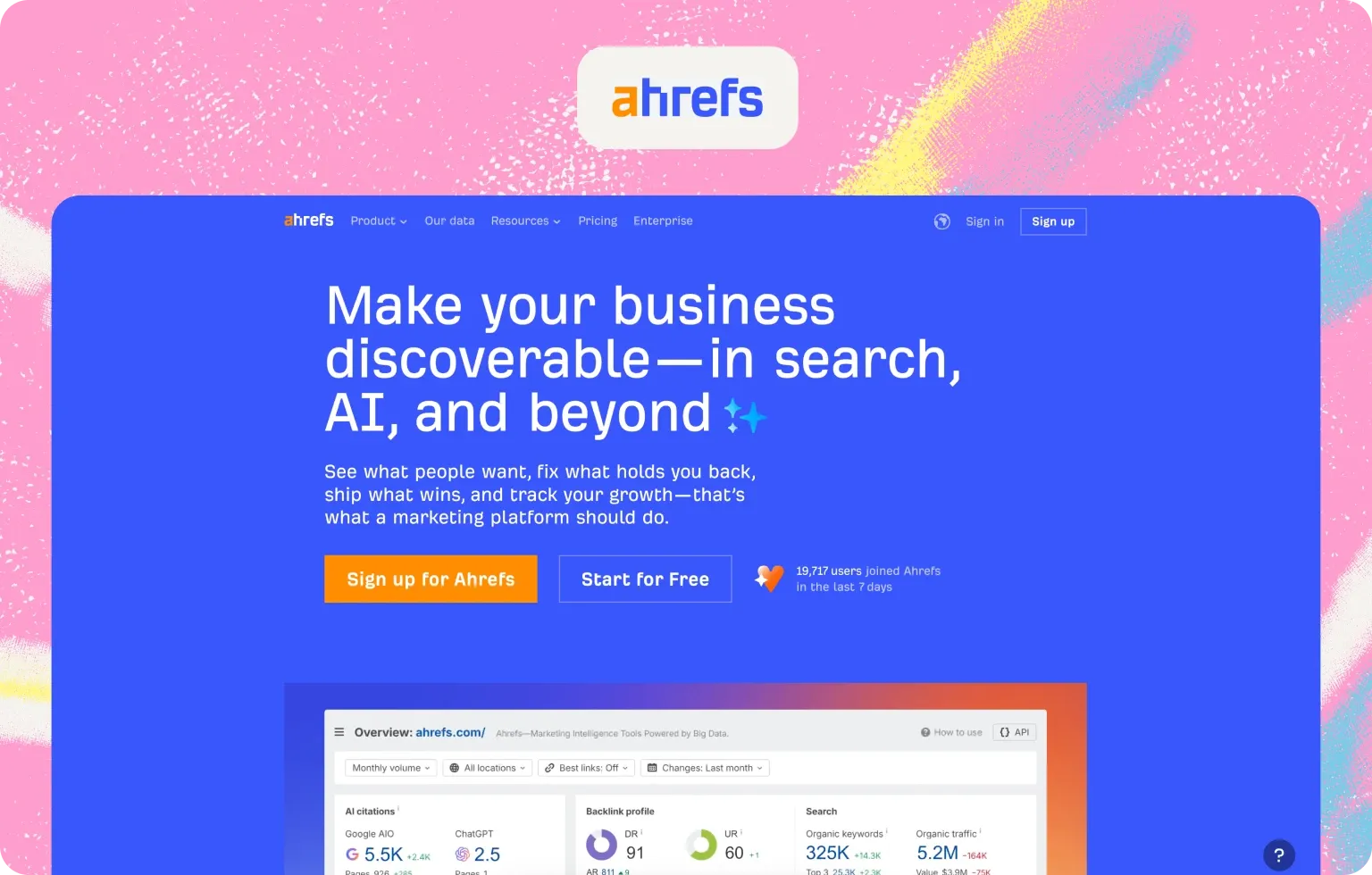
Ahrefs’ Brand Radar covers 6 AI search engines. That includes:
Brand Radar’s pricing is per-engine. You pay $199/mo for one AI engine, $398/mo for two, $597/mo for three, and $699/mo for all six. Brand Radar has more extensive AI engine coverage than Brightedge, but the cost climbs with every engine you add. And each engine is a monitoring-only view with no execution layer behind it. Ahrefs also doesn’t offer local SEO tracking within AI engines, and its keyword trends data is limited to traditional search engine behavior rather than AI-specific search intent.
Consider Ahrefs alternatives if you need more coverage at a cheaper price.
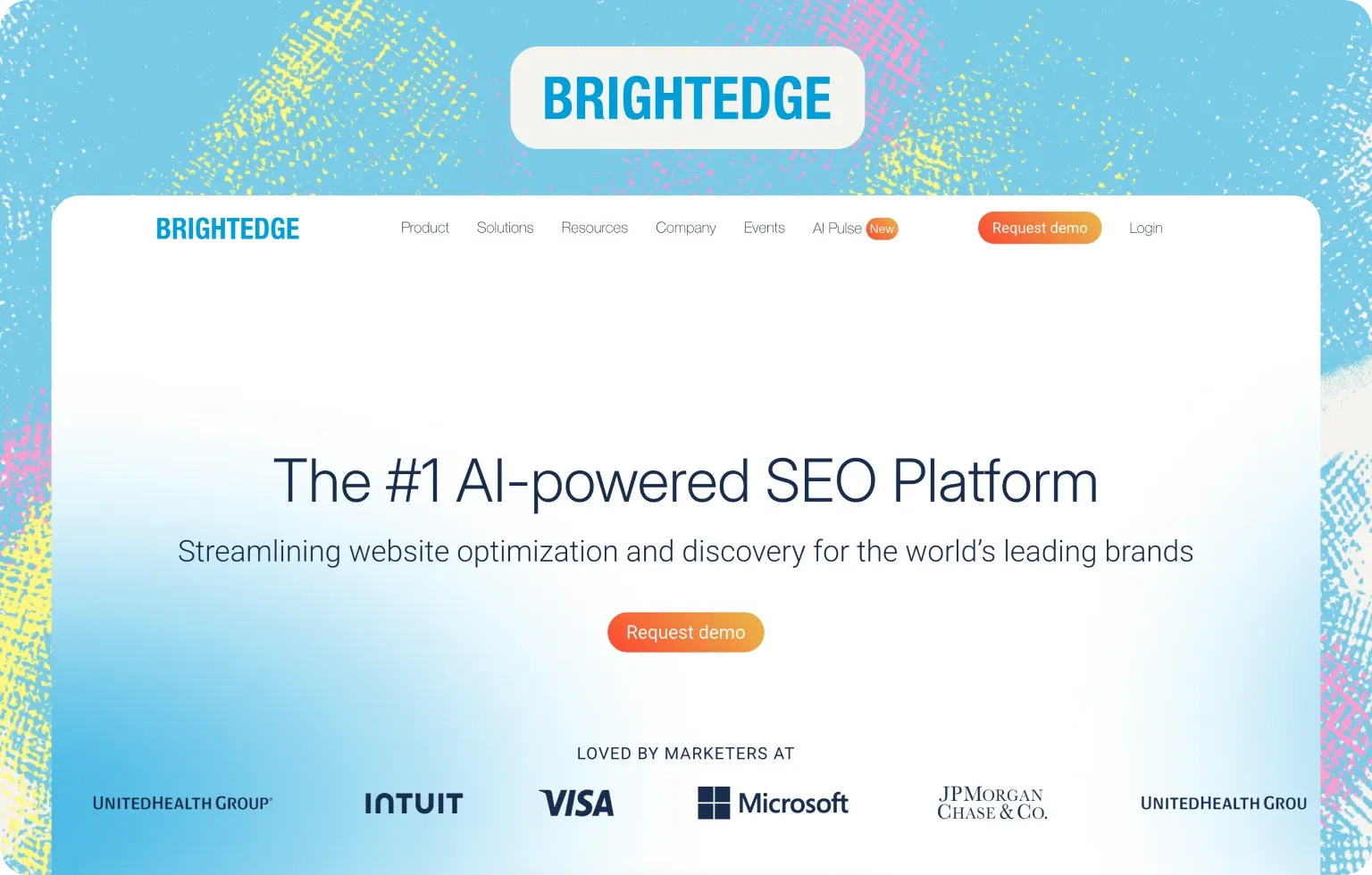
BrightEdge’s AI Catalyst covers 3 AI engines:
There’s no Google AI Mode, no Claude, and no Gemini. For enterprises already running their full SEO strategies inside BrightEdge, that’s three engines under one governance layer, which could be enough. For teams that need Google AI Mode tracking or Claude rank tracking, BrightEdge doesn’t offer coverage for those engines at all. If you need more coverage, check out BrightEdge alternatives.
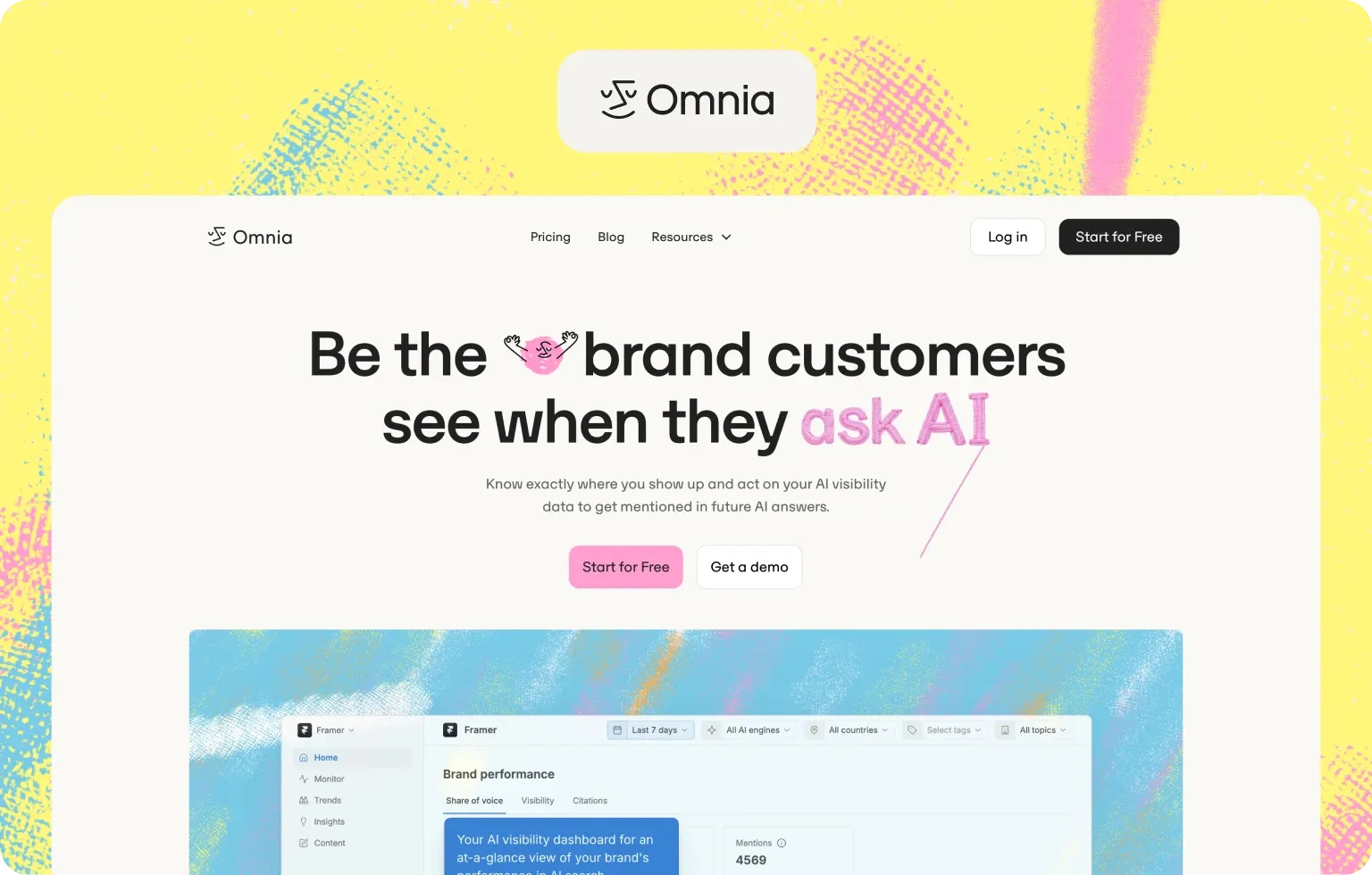
Omnia is purpose-built for AI visibility from the ground up, with citation tracking, execution, and multi-engine coverage as the core architecture, not an add-on.
Omnia covers up to 7 AI engines on every plan:
That means every Omnia customer gets up to 7 AI engines without having to pay extra. It also covers Google AI Mode, the engine BrightEdge doesn't cover and Ahrefs prices as a separate add-on tier, included from day one. For teams tracking Google AI Overview rankings alongside ChatGPT and Perplexity, Omnia’s core coverage is the most complete entry-point available.
Ahrefs’ Brand Radar draws on 391M+ search-backed prompts, one of the largest AI visibility databases on the market, powered by real user queries rather than synthetic ones. It ties citation data to Ahrefs’ existing backlink index, so you can see whether a cited domain has strong referring domains and domain rating authority. But the two datasets live in separate products, and the citation data stops at the domain level. You’ll see which domains appear in AI answers, but not which specific URLs earned the citation.
BrightEdge’s AI Hyper Cube is more capable than a typical bolt-on. It reveals AI search conversations that mention your brand, tracks competitive brands weighted by real search volume, shows which domains hold authority in your category, and maps your presence through the AI-assisted customer journey. But it operates at the domain level, not the URL level. Similar to Ahrefs, you won’t see the exact page you need to compete with.
Omnia does operate at the URL level, so you can see exactly which pages won the citation and which ones you need to match. Omnia’s citation data is also part of one connected system, not a separate product. Knowing you appeared in 22% of tracked prompts tells you your AI search visibility score. Seeing which specific URLs won instead of you tells you what to do next. Omnia also provides historical data so you can track whether your position is improving or eroding over time.
With Omnia, you don't just see which domains AI trusts in your category, you see the exact URL that won the citation, the page you need to match or exceed, and the gap you need to close.
Ahrefs supports 217+ locations and hundreds of country/language combinations across its core SEO platform, and its blog mentions using Brand Radar to track brand presence across different regions. But it’s unclear how deeply that geographic granularity extends into Brand Radar’s AI visibility layer, and custom prompts are billed per location per check, which means costs scale with every market you add.
BrightEdge’s S3 platform supports 145 country/language combinations across six continents for traditional SEO. But there's no public documentation confirming that AI Catalyst inherits that geographic depth for AI visibility tracking specifically.
Omnia includes unlimited country and language tracking on every plan. Share of voice, citations, and competitor benchmarks are all available by country and language from the entry tier, with no per-location billing.
With Omnia, every market you sell into is tracked by default, not priced as an add-on.
With Ahrefs, you can buy Brand Radar standalone without a paid Ahrefs base subscription, and you’ll get an Ahrefs Free account included. But do you also need Ahrefs’ core keyword data, backlink gap analysis, site audit, and keyword difficulty capabilities? If yes, you still need to pay for Brand Radar and a separate Ahrefs plan.
If no, Brand Radar standalone starts at $199/mo for one engine. But even at $699/mo for full coverage, you're still getting a monitoring dashboard with no execution layer. Ahrefs also integrates with Google Search Console and Google Analytics for traditional data analysis, but those integrations don't extend to AI visibility tracking.
BrightEdge doesn’t let you unbundle AI Catalyst from the full platform at all. AI Catalyst is included in all BrightEdge SEO Platform subscriptions, which means you’re committing to an enterprise SEO solution contract before you can access a single AI visibility feature. And there's no public pricing that’ll allow you to plan your budget without engaging in a sales call
Omnia is a purpose-built AI visibility platform, so every plan includes AI tracking. You can access all engines on every plan, as well as MCP and API access. All plans include unlimited country and language tracking as well.
With Omnia, every engine, MCP access, and unlimited country tracking is included from day one, no per-engine add-ons and no enterprise contract required.
| Feature | Ahrefs | BrightEdge | Omnia |
|---|---|---|---|
| Standalone AI tracking | From $199/mo (1 engine) to $699/mo (all 6) | Not available separately | From €79/mo |
| Full platform + AI tracking | $129+/mo Ahrefs core + $199–$699/mo Brand Radar | Full enterprise contract (custom-quoted) | From €79/mo |
| AI visibility add-on structure | Standalone product available; per-engine pricing | Bundled, not sold separately | 7 engines included on every plan |
Ahrefs has no action layer for AI visibility gaps. Brand Radar shows you where you appear and where you don’t, but it doesn’t generate a content brief, a placement target, or any execution-ready output. If you spot a gap, you’re on your own to figure out what to publish and whether it worked. Ahrefs’ core product excels at keyword ideas, keyword suggestions, and high value keywords discovery for traditional SEO, but none of that keyword analysis capability flows into an AI-citation-specific action layer.
BrightEdge’s Autopilot offers a real execution capability. It pushes automated on-page optimization and page optimization changes at scale, without manual implementation or development cycles. It’s trained on petabytes of data from BrightEdge's Data Cube, Data Mind, and BrightEdge Instant.
But Autopilot was built for traditional Google SEO. Its own product page describes it as moving pages to “Google's page 1 for relevant keywords.” It wasn't designed to produce AI-citation-specific briefs or close gaps in how ChatGPT and Perplexity cite your brand. BrightEdge’s on-page SEO automation is powerful for search rankings on Google, but it doesn't address content gaps in AI answers or produce briefs targeting AI citation positions.
Omnia’s action layer turns a citation gap directly into a brief or placement target on the entry plan. When Omnia identifies a prompt cluster where a competitor is gaining, it doesn't just show you the chart. It produces a content brief for the page that can close the gap.
A dashboard like Ahrefs tells you something happened. An action layer like Omnia’s tells you what to do about it. For teams comparing GEO vs SEO approaches, the action layer is what makes AEO operational rather than observational.
With Omnia, the gap between spotting a citation gap and closing it is one click, not a separate workflow, a separate tool, or a separate team.
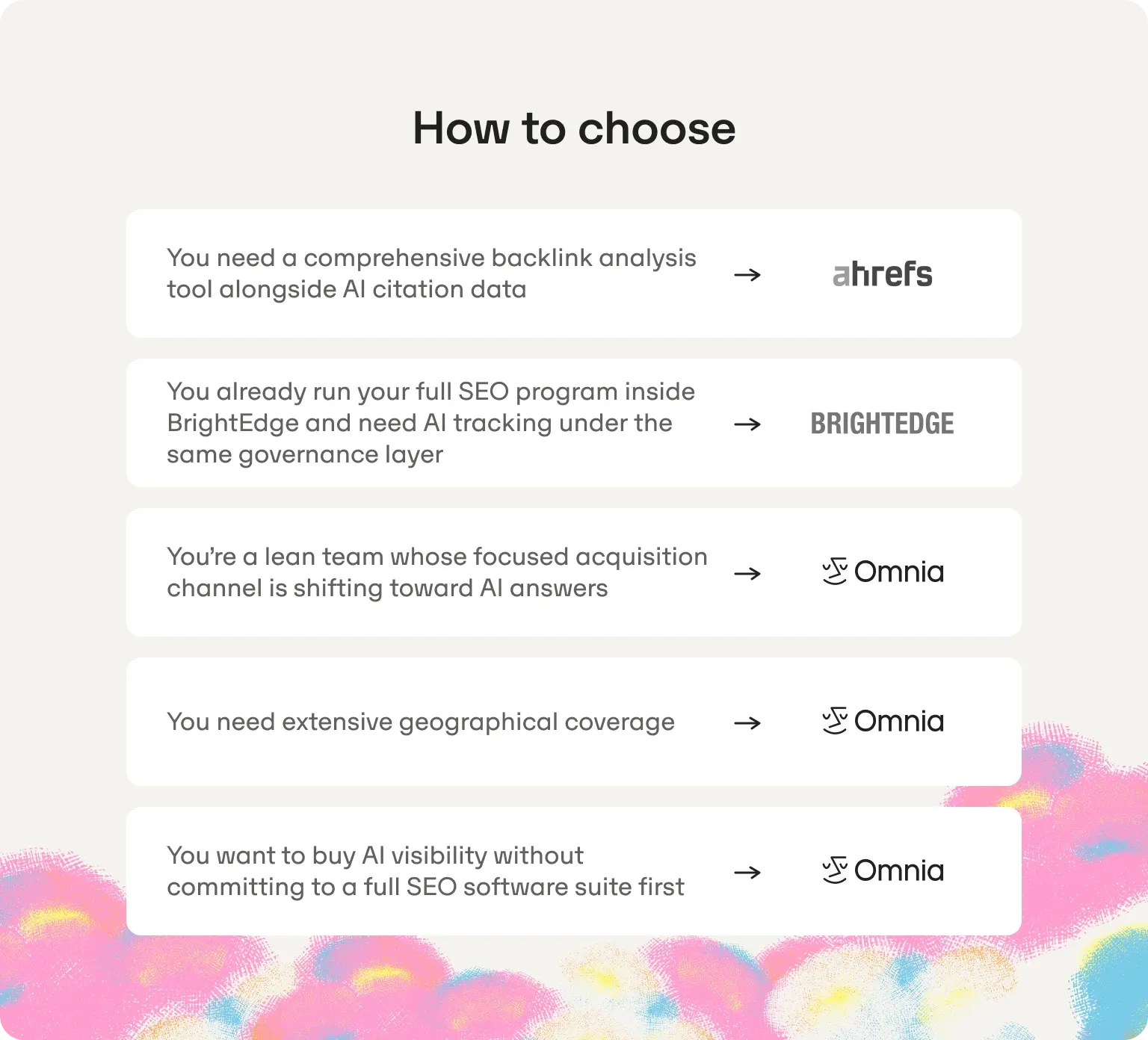
There’s not a one-size-fits-all solution. Ahrefs, BrightEdge, and Omnia each serve different markets. Use our scenario-based decision framework below to map the right tool to your primary situation.
| If your primary situation is... | The best choice is... | Because... |
|---|---|---|
| You need a comprehensive backlink analysis tool alongside AI citation data | Ahrefs | Its 391M+ search-backed prompt index correlates directly with an existing link building and backlink profile program |
| You already run your full SEO program inside BrightEdge and need AI tracking under the same governance layer | BrightEdge | AI Catalyst shares BrightEdge's unified data layer, reporting, and Autopilot automation |
| You're a lean team whose focused acquisition channel is shifting toward AI answers | Omnia | Core engine coverage and a native action layer from €79/mo, no add-on required |
| You need extensive geographical coverage | Omnia | Omnia allows unlimited country and language coverage across all plans |
| You want to buy AI visibility without committing to a full SEO software suite first | Omnia | Standalone by design, not gated behind a base subscription or bundled enterprise contract |
Omnia was built for teams whose primary acquisition channel is shifting toward AI answers, not for teams adding AI visibility as a checkbox on a legacy SEO program. That architectural difference shows up in five places:
For teams coming from Ahrefs, the shift is from monitoring to execution. Brand Radar tells you where you appear in AI answers. Omnia tells you where you appear, why you’re losing to a specific competitor URL, and what to publish to close the gap.
For teams coming from BrightEdge, the shift is from bundled governance to standalone speed. BrightEdge’s AI Catalyst is powerful inside the enterprise suite, but you can't access it without committing to a full platform contract. Omnia gives you AI visibility and action from day one, without the enterprise sales process.
A weekly workflow with Omnia takes about 60 minutes:
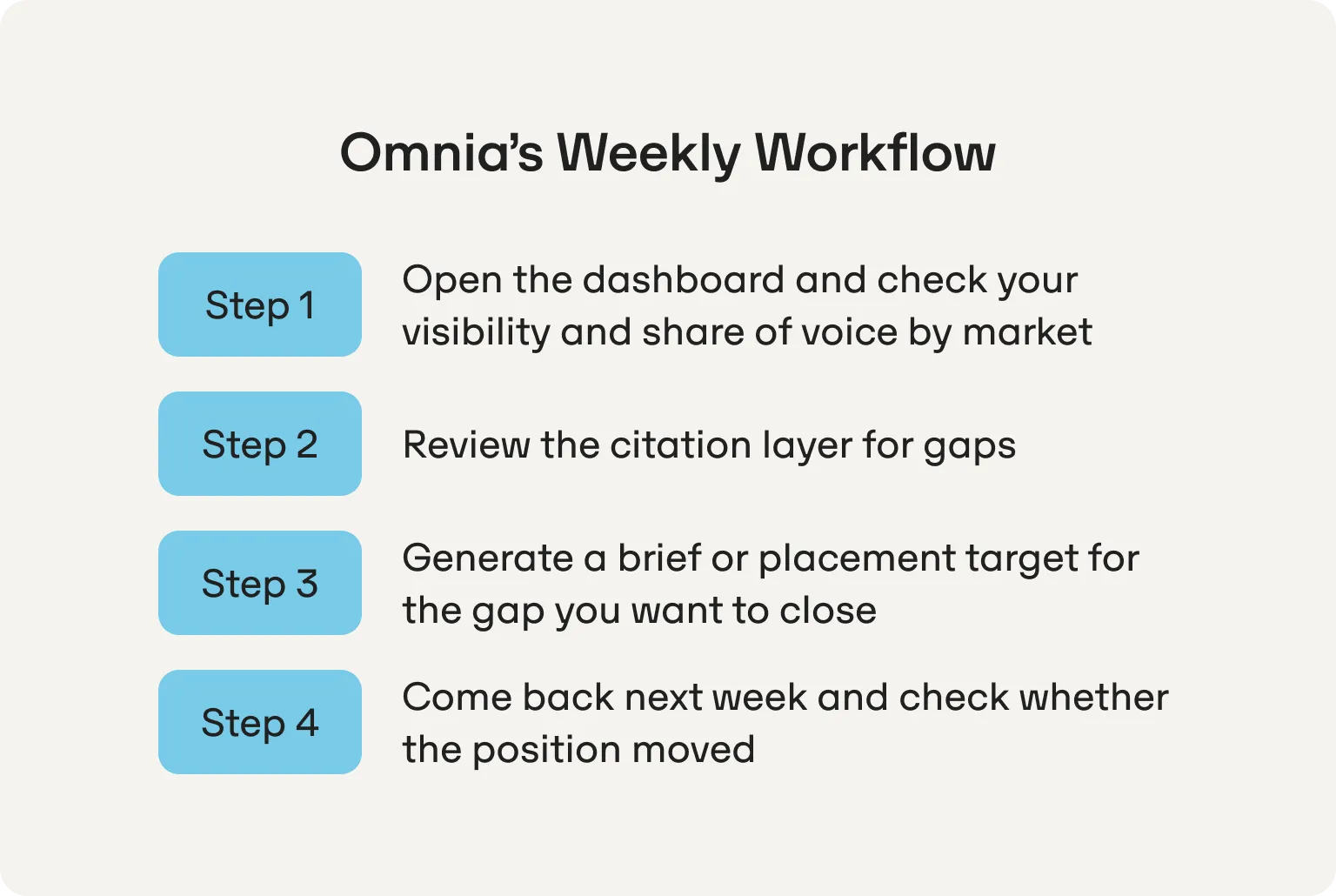
That loop, monitoring, diagnosing, acting, measuring, is what turns AI visibility from a reporting exercise into a growth channel.
Prompt Discovery and MCP access are included on every plan. For teams already comparing AI visibility tools, our comparisons of Omnia vs Profound, Omnia vs Scrunch AI, and Omnia vs Peec AI cover those matchups in similar detail.
Start for free on the Growth plan. Or book a demo to see the action layer in action.
Omnia offers a 14-day free trial on the Growth plan.
No credit card required. See exactly where your brand shows up (or doesn't) across AI engines, then let the platform's recommendations guide your next move.

Ahrefs is a keyword research and backlink analysis tool with transparent pricing, built for SEO professionals who need an extensive keyword database, keyword difficulty scoring, and performance tracking. BrightEdge is an enterprise SEO platform with unified governance, Autopilot automation, and custom-quoted pricing, built for large organizations that need competitor benchmarking and content optimization at scale. The decision comes down to whether you need backlink profile depth or enterprise governance.
Brand Radar covers six AI engines with per-engine pricing, giving you more coverage options but no execution layer. AI Catalyst covers only three engines (ChatGPT, Perplexity, Google AI Overviews) but includes content briefs through AI Hyper Cube. Neither provides URL-level citation data or a native action layer. If you want to test Ahrefs vs BrightEdge on AI visibility specifically, both fall short of a dedicated tool like Omnia that includes core engines and execution from the entry plan. Neither tool tracks keyword performance within AI answers the way a purpose-built platform does.
Brand Radar starts at $199/mo for one AI engine and scales to $699/mo for all six. You can buy it standalone without a paid Ahrefs base subscription. But if you also need Ahrefs’ core keyword tracking, rank tracking feature, site audit, broken links detection, Google Business Profile integration, and meta tags analysis, you’d need a separate Ahrefs plan on top. The BrightEdge and Ahrefs cost comparison depends entirely on whether you need the full SEO software toolkit alongside AI monitoring. Choosing the right SEO tool means understanding what you're actually paying for.
Not if AI visibility is your primary channel. Ahrefs gives you monitoring with no execution layer and no valuable keywords targeting for AI citations. BrightEdge gives you domain-level intelligence and content marketing briefs, but only three engines and no URL-level citation data. Neither was built with AI visibility as the core architecture. Omnia covers seven core engines on every plan, provides URL-level citation tracking, and turns gaps into briefs from the entry plan.
You can start with Ahrefs' free Brand Radar preview to get a snapshot of your AI visibility, or request a BrightEdge demo for a guided walkthrough of AI Catalyst. If you want to test Ahrefs vs BrightEdge against a purpose-built alternative, Omnia's free tier lets you compare all three side by side, with no enterprise sales process and no per-engine pricing. For teams evaluating other SEO tools, the fastest way to decide is to run the same prompt set across each platform and compare what you actually get back.
Written By
 Jose Luis García del RíoGrowthatOmniaAlfredo BernalOrganic Growth LeadatOmnia
 Alfredo BernalOrganic Growth LeadatOmnia
 Alfredo BernalOrganic Growth LeadatOmnia
 Jose Luis García del RíoGrowthatOmnia
 Jose Luis García del RíoGrowthatOmnia
No credit card required · Free for 14 days · See your AI visibility within 3 minutes