AI Search Visibility
AI Visibility API: What to Look For and 6 Options Compared (2026)

 Alfredo BernalOrganic Growth LeadatOmniaAlfredo BernalOrganic Growth LeadatOmnia
TL;DR
A buyer asks ChatGPT which tools in your category are worth a look. It names three competitors. You weren't in the answer, and nobody on your team saw it happen.
That's the problem AI brand monitoring solves. AI answers are generated for one person, in one session, and then they're gone. Your analytics doesn't record them, and your social listening tool has nothing to pick up, because nothing was published.
Below are six steps to see what AI engines say about your brand, find the pages behind those answers, and change them.
AI brand monitoring is the practice of tracking how AI engines mention, describe and recommend your brand when people ask them questions. It covers ChatGPT, Perplexity, Gemini, Claude, Copilot, and Google's AI Overviews and AI Mode.
The term gets used for two different things. Social listening tools such as Brandwatch and BrandMentions describe their AI-powered mention tracking as "AI brand monitoring" too. That's monitoring what people publish, with AI doing the analysis. This guide is about the other meaning: monitoring what AI engines themselves say about you.
AI brand monitoring tracks four things:
Track mentions and citations separately. An AI engine can name your brand without citing any of your pages, or cite your page while recommending a competitor. Each gap needs a different fix.
Brand mentions in AI answers matter because the answer is often the buyer's first shortlist, and you can't see it from your own analytics. If an AI engine leaves you out, describes you wrongly or recommends a competitor for your use case, you only find out by asking it yourself.
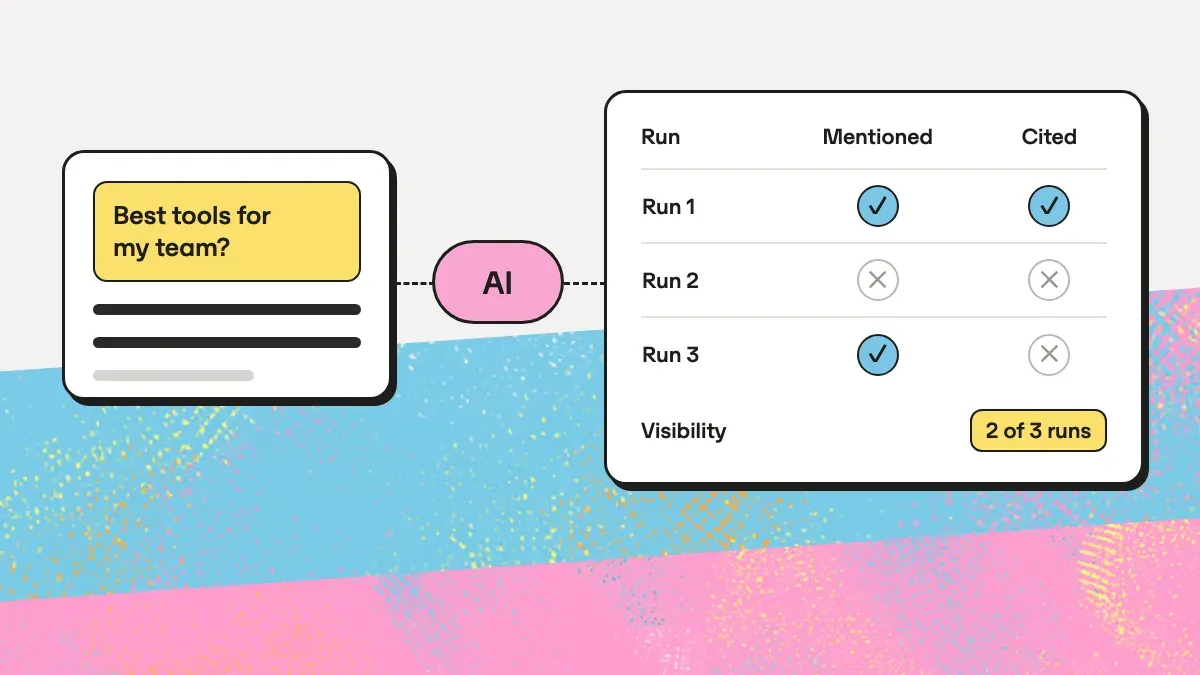
Asking once isn't enough. In a study reported by Search Engine Land, SparkToro and Gumshoe.ai had 600 volunteers run 12 identical prompts through ChatGPT, Claude and Google's AI nearly 3,000 times. In that study, the odds of getting the same list of brands twice were under 1 in 100. The odds of the same list in the same order were closer to 1 in 1,000.
The same study found what does hold steady: how often a brand appears across many runs. In the SparkToro data, some brands showed up in 60% to 90% of answers for a given intent, even as their position moved. That's why AI brand monitoring measures rates across repeated runs, not a single position.
Start by writing 10 to 20 prompts a buyer would type before choosing a product like yours. These prompts are your sample, so they decide what your monitoring can tell you.
Cover the questions that come up at each stage of a purchase:
Keep two groups apart. Non-branded prompts don't name you ("best [category] for [use case]") and show whether AI engines bring you up on their own. Branded prompts name you ("is [your brand] good for [use case]?") and show how AI engines describe you once you're in the conversation. Most of your 10 to 20 prompts should be non-branded, because that's where buyers who don't know you yet start.
Write them the way people talk to AI engines: full sentences, with context such as team size, industry or budget. Then keep the wording fixed. If the prompts change every week, the results can't be compared. Our guide to finding the prompts that decide whether your brand appears covers how to choose them.
Run each prompt at least three times per engine, in a fresh session each time, so earlier conversation doesn't steer the answer. Treat each engine as a separate channel, because each one draws on different sources.
Each engine needs slightly different handling:
If you sell in more than one country, run your prompts in each market. AI engines give different shortlists in different countries.
Record the same fields for every answer, so a week's results can be compared with the next. A shared spreadsheet is enough to start.
| Field | What to record |
|---|---|
| Engine and country | Where the prompt ran |
| Prompt and date | The exact wording, and when |
| Mentioned | Yes or no |
| Position | First, in the list, or a passing mention |
| Competitors named | Every other brand in the answer |
| Description | How the answer describes you, in a few words |
| Cited pages | Every URL the answer links to or credits |
From these rows you can calculate your visibility (answers that mention you ÷ answers logged) and your share of voice (your mentions ÷ all brand mentions) for each engine. Keep the engines separate. A blended average hides the engine where you're missing.
Look at which pages AI engines cite for your prompts, because those pages shape what the answer says about you. When you aren't mentioned, the cause is usually that you're absent from the pages the engine reads.
Omnia's own monitoring shows how spread out those pages can be. For the prompt "What are the best tools to track ChatGPT mentions?", monitored from October 26 to November 24, 2026, AI engines cited 369 different pages. The most-cited page, a "best tools for monitoring ChatGPT mentions" roundup on beamtrace.com, earned 3.5% of all citations. Nine of the 10 most-cited pages were roundups with titles close to the prompt itself.
A how-to prompt drew a different kind of page. Omnia monitored "how to track brand mentions in perplexity" over the same dates. AI engines cited 249 different pages for it, and the most-cited were step-by-step guides: a Rankability guide led with 5.6% of citations. AI engines tend to cite pages shaped like the question: roundups for "best tools" prompts, guides for "how to" prompts.
These findings come from two prompts in one category, so don't treat them as rules. But the method applies everywhere: rank the cited pages for each prompt cluster by how often they appear, and note which ones mention your competitors but not you. That list is your target list for Step 5. Our AI citation tracking guide explains how to map citations to prompts.
Each pattern in your log points to a different fix. Work on the one that affects your most important prompts first.
AI sentiment analysis shows how AI engines describe you feature by feature against competitors, which helps with the second and third patterns.
Rerun the same prompts every week and judge changes over four weeks, not day to day. Because answers vary between runs, a one-week drop is usually noise.
Treat a change as real when three things are true:
When an AI provider ships a new model, expect a break in the trend and set a new baseline. Then check your log against business signals, such as branded search, direct visits and demo requests, because an AI mention rarely sends a click right away. For keeping a longer record, see our guide to platforms with historical AI search data.
Manual tracking works for a first baseline, but 20 prompts, three runs, several engines and a few countries is a few hundred answers a week. An AI brand monitoring tool runs the prompts for you and keeps the history.
When you compare tools, check five things:
Our comparison of AI search monitoring tools reviews the options side by side.
Start this week with a spreadsheet: write 10 prompts, run each three times in ChatGPT and one other engine, and log the fields from Step 3. A rough baseline now will tell you more in a month than a perfect one started later.
When the spreadsheet stops being practical, Omnia does most of that work, and you make the calls. Omnia monitors your prompts daily in real browsers, by country, in ChatGPT, Perplexity, Google AI Overviews and Google AI Mode, with Claude, Gemini and Bing AI Mode available on request. It shows your visibility, share of voice and sentiment against competitors, and which pages each engine cites, down to the URL.
Your Omnia Agent then works from that data. It finds the cited pages where competitors appear and you don't, and drafts the pitches, comparison pages and page updates to change that. You approve what ships.
Start your 14-day free trial. No credit card needed.
Omnia offers a 14-day free trial on the Growth plan.
No credit card required. See exactly where your brand shows up (or doesn't) across AI engines, then let the platform's recommendations guide your next move.

Short answers to the questions people ask most about AI brand monitoring.
AI brand monitoring tracks what AI engines generate about your brand; social listening tracks what people publish about it. An AI answer can combine several sources, compare you with competitors, or state something no single post said. You need AI brand monitoring to see those answers, because they aren't published anywhere a listening tool can find.
Check your brand mentions in AI weekly, with the same prompts each time. Weekly checks catch lasting changes while smoothing out run-to-run variation. Daily checks mostly show noise, and monthly checks make it hard to link a change to its cause.
You can track brand mentions in AI for free by running prompts manually and logging the answers in a spreadsheet. It works for a baseline of 10 to 20 prompts. It stops being practical once you track several engines, countries and weekly runs, which is when a paid tool saves time.
ChatGPT tends to mention the brands that appear on the pages it reads for that question, and you may be missing from those pages. Check which pages it cites for the prompt, then see whether your competitors are covered there and you aren't. Getting onto those pages, and publishing comparison pages of your own, is usually the fix.
No, AI engines don't give everyone the same answer. Answers vary between runs, sessions and countries, even for identical prompts. That's why AI brand monitoring measures how often you appear across many runs, not where you appear in one.
Improving brand mentions in AI usually takes weeks, not days. A new placement on a page AI engines already cite can show up within a few weeks, while building presence from scratch takes longer. Judge progress on a four-week trend, not a single check.
Written By
 Alfredo BernalOrganic Growth LeadatOmniaAlfredo BernalOrganic Growth LeadatOmnia
 Alfredo BernalOrganic Growth LeadatOmnia
 Alfredo BernalOrganic Growth LeadatOmnia
 Alfredo BernalOrganic Growth LeadatOmnia
 Alfredo BernalOrganic Growth LeadatOmnia
No credit card required · Free for 14 days · See your AI visibility within 3 minutes