AI Search Visibility
Schema Markup for AI Search: What It Does, What Google Says, and What to Add

 Alfredo BernalOrganic Growth LeadatOmniaAlfredo BernalOrganic Growth LeadatOmnia
TL;DR
Someone forwarded you a post about "LLM SEO" and asked if you're doing it. You already do SEO. Is this something new, a rebrand, or one more channel to staff?
This guide answers three things: what LLM SEO is, how it relates to the other names you've heard, and what to do about it this month.
LLM SEO is the practice of making your brand and pages easy for large language models like ChatGPT, Perplexity and Gemini to find, understand and cite in their answers. Some people call it large language model SEO, or LLMO (LLM optimization).
Success looks different from classic SEO. There is no position 1. Instead, you win when an AI answer does one of three things:
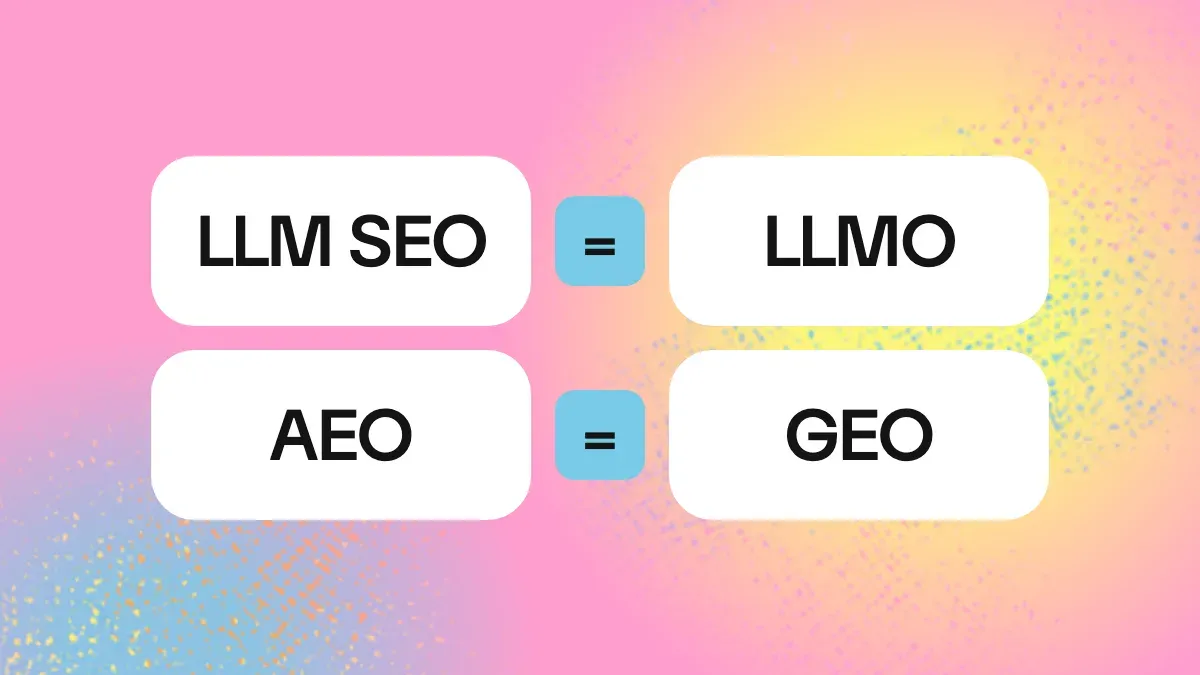
LLM SEO, LLMO, AEO and GEO describe the same practice; the name depends on who is talking.
| Name | Stands for | Where you hear it |
|---|---|---|
| LLM SEO | Large language model SEO | SEO teams and agencies |
| LLMO | LLM optimization | Some tool vendors and SEO blogs |
| AEO | Answer engine optimization | Omnia, HubSpot and many marketers |
| GEO | Generative engine optimization | The 2023 GEO research paper (Aggarwal et al., accepted to KDD 2024) and many agencies |
At Omnia we call it AEO. For the full definitions, read our AEO guide and our GEO guide, and for the side-by-side, see AEO vs GEO vs SEO.
LLM SEO differs from traditional SEO in what you win: a mention or citation inside one generated answer, rather than a position in a list of links.
| What changes | Traditional SEO | LLM SEO |
|---|---|---|
| Goal | Rank a page in search results | Be named and cited in AI answers |
| What the user sees | Ten or more links | One answer naming a few brands and sources |
| Main metric | Position, clicks | Mentions, citations, share of voice |
| What tends to win | Relevance, links, technical health | Clear direct answers, original facts, presence on sources AI trusts |
| How stable it is | Rankings shift slowly | Answers vary by run, day and country |
The overlap is large. AI engines that search the web still retrieve pages, and Google's guidance on its AI features says standard SEO practices still apply. Good SEO is the base; LLM SEO adds what it takes to be quoted.
AI engines that search the web retrieve a set of pages for each prompt, then build an answer from the clearest and most trusted ones. They rarely rely on a single page.
Omnia's monitoring shows this. It tracked the US prompt "What is GEO and how is it different from SEO?" daily from 14 October to 12 November 2026. Across 39 AI answers, engines cited 337 different URLs.
The 10 most cited were all pages that explain GEO versus SEO directly. SEO tools, CMS vendors and media published them. seo.com led with 83 citations, followed by dotCMS (73) and Informa TechTarget (70).
That is one prompt in one market over one month, so read it as an example of how AI engines source an answer, not as a rule. The pattern is still useful: pages that answer the exact question, plainly and near the top, get cited.
An LLM SEO strategy is a short loop: find the prompts, check the answers, improve the pages and sources AI uses, and measure again.
List the questions your buyers type into AI engines: category questions ("best tools for X"), problem questions ("how do I fix Y") and comparisons. Start with 20 to 50. Tools like Omnia's Prompt Discovery help find the ones with real demand.
Run your main prompts in ChatGPT, Perplexity and Google's AI Mode, or use a free AI visibility checker. Note who gets named, how you're described, and which URLs are cited.
Give every priority prompt a page whose first sentence answers it. Use question-style headings, short paragraphs, tables for comparisons, numbered steps for processes and an FAQ. Make each section make sense on its own, because AI engines often quote one passage.
Here is the difference in practice. A page that opens with "Visibility matters more than ever" gives an AI engine nothing to quote. Now compare: "An AI visibility tool tracks how often AI engines mention and cite your brand." That opening answers the question in one sentence that can be lifted as it is. Write every opening the second way, then use the rest of the section for detail, examples and proof.
Original facts give AI engines a reason to cite you rather than a competitor: your own benchmarks, survey results or product data, with the date. Update key pages when facts change, and show the updated date.
Look at the third-party pages cited for your prompts: reviews, roundups, comparisons, forums. Ask to be included where it's a fair fit, and keep your profiles current. Do it honestly. Google's own guidance warns that "seeking inauthentic 'mentions' across the web isn't as helpful as it might seem" (Google Search Central, updated 10 July 2026).
Make sure your key content is in crawlable HTML, not hidden behind scripts, and that AI crawlers aren't blocked by mistake. Add standard structured data where it fits, and consider setting up Bing Webmaster Tools, a step several LLM SEO guides recommend. An llms.txt file is optional. Google says you don't need "new machine readable files, AI text files, markup, or Markdown to appear in Google Search", and no engine has shown that the file improves citations.
Re-run the same prompts on the same engines and markets on a schedule, and judge the trend over weeks. Measure visibility (how often you're named), share of voice (your share of all brand mentions) and citations (which of your URLs are cited). Our guide to LLM SEO checking tools compares the options.
Read the cited URLs as closely as the scores. When a competitor's comparison page or a review site keeps appearing as a source, that page is your next piece of work. Either publish a better answer to the same question, or earn a place on that source. Review the trend monthly with whoever owns content, so each month ends with a short list of pages to update and sources to approach.
LLM SEO improves your odds; it does not control the answer.
Omnia is AEO software for small marketing teams doing this work in-house. It monitors your prompts daily in real browsers on ChatGPT, Perplexity, Google AI Overviews and Google AI Mode, with Claude, Gemini and Bing AI Mode available on request. It shows every complete answer and the exact URLs each engine cites.
The Omnia Agent works from that data. It suggests projects, such as a page to rewrite or a cited source to earn a place in, and drafts the work. Omnia does most of the work; you make the calls and approve what ships.
Start with the free AI visibility checker, or compare Omnia's plans and try the Growth plan free for 14 days.
Omnia offers a 14-day free trial on the Growth plan.
No credit card required. See exactly where your brand shows up (or doesn't) across AI engines, then let the platform's recommendations guide your next move.

LLM stands for large language model, the kind of AI behind ChatGPT, Gemini and Claude. In SEO, LLM SEO means optimizing your brand and content so these models mention and cite you when they answer questions about your category.
Yes. LLM SEO, GEO (generative engine optimization), AEO (answer engine optimization) and LLMO are names for the same practice: earning mentions and citations in AI-generated answers. Different communities prefer different names, but the work is the same.
No. AI engines that search the web still retrieve and rank pages before they answer, and Google says standard SEO practices still apply to its AI features. LLM SEO builds on good SEO; it adds direct answers, original facts and presence on the sources AI trusts.
No, not for Google: Google's guide to its AI features says you don't need AI text files or special markup to appear in Google Search. Some sites add an llms.txt file anyway, but no AI engine has shown that it improves citations, so treat it as optional.
There is no fixed timeline. Changes appear only after AI engines retrieve your new or updated pages, so track the same prompts weekly and judge progress over several weeks. Earning a place on a source AI already cites often moves faster than a new page.
Hire an agency if you have budget and no time, especially for digital PR. If someone on your team can act on clear data a few hours a week, software can cover most of the work. Our guide to what generative engine optimization services include and cost helps you compare.
Written By
 Alfredo BernalOrganic Growth LeadatOmniaAlfredo BernalOrganic Growth LeadatOmnia
 Alfredo BernalOrganic Growth LeadatOmnia
 Alfredo BernalOrganic Growth LeadatOmnia
 Alfredo BernalOrganic Growth LeadatOmnia

 Jorge HermoSoftware EngineeratOmnia
No credit card required · Free for 14 days · See your AI visibility within 3 minutes