

This guide compares 11 platforms that keep a running record of what AI search engines say about a brand. The category is new and the gaps between tools are wide when it comes to how long data lasts, how often it refreshes, and whether raw responses are stored. Most vendors that archive responses reserve access for top-tier plans. A comparison table breaks down the differences across five criteria. Four questions help a team pressure-test any vendor on a demo, so the choice holds up when the board asks what changed.
AI search is a few years old as a category, and the tools built to track it are newer still. When a space is this new, standards take time to develop. Some platforms excel at real-time monitoring. Others focus on citation analysis or competitor benchmarking. But historical data, the durable, queryable record of what AI engines said over time, is where the category is still finding its footing. And it's where the gaps between tools are widest.
That matters because a standalone score on a random Tuesday tells a team nothing about whether it's climbing or falling. A six-month record of what ChatGPT, Google AI Mode, or Gemini said about a brand is what a growth team needs to show a board what changed and why. Without history, AI visibility is a gut check. With it, the category becomes measurable.
This guide compares the best platforms for AI search optimization and data accuracy. Each excels at different areas, which is why most teams discover what features tools are missing only after signing up.
What a historical AI search data platform actually is (and the three things it gets confused with)
A historical AI search data platform stores what AI engines like ChatGPT, Perplexity, or Google AI Overviews say about a brand over time. It's not a one-time score or a stale snapshot. These tools contain the raw, dated, queryable record of what the model generated, which sources it cited, and how that changed week to week. These are the tools that provide historical trend analysis for AI search mentions.
AI search optimization tools with historical data are still rare, and the ones that only show today's score aren't historical tracking. The best platforms for AI search optimization archive what the model said, when, and why it shifted.
It can be difficult to pinpoint the differences between AI visibility platforms since the category is still growing and shaping itself. But we see historical search as one of the key criteria.
To explain it further, here's what a historical AI search data platform isn't:
- Keyword rank history: Semrush and Ahrefs built their names on tracking where a page ranks in Google. This measures a search result position, but not what an AI engine says in a generated answer.
- AI referral traffic analytics: GA4 and Similarweb measure who arrived at a site from an AI surface. This is the downstream of the answer, not the answer itself.
- An SEO agency with “historical data” in its pitch: Agencies sell services and consulting, but they can't sell queryable archives. A consultant's summary of what AI said is not the same as a dated, queryable record of the raw response.
Growth teams lack access to historical AI search data to identify trends, momentum, and long-term visibility patterns. Then, six months in, they discover the tool they picked only kept data for 90 days. But the board wants a year-over-year trend line.
Choosing the right prompts to track AI visibility matters, but only if the platform retains the history long enough to show whether those prompts moved. Think of brand visibility in AI search as a trajectory rather than a point-in-time metric.
Snapshot vs. archive: The distinction that decides everything downstream
A snapshot answers where your brand stands at this very moment. An archive tells you what changed, when, and whether anything you did caused it. The distinction matters most for AI citation tracking. Knowing which sources AI engines cite is useful today, but only a historical archive lets a team see which source replaced theirs when visibility shifted.
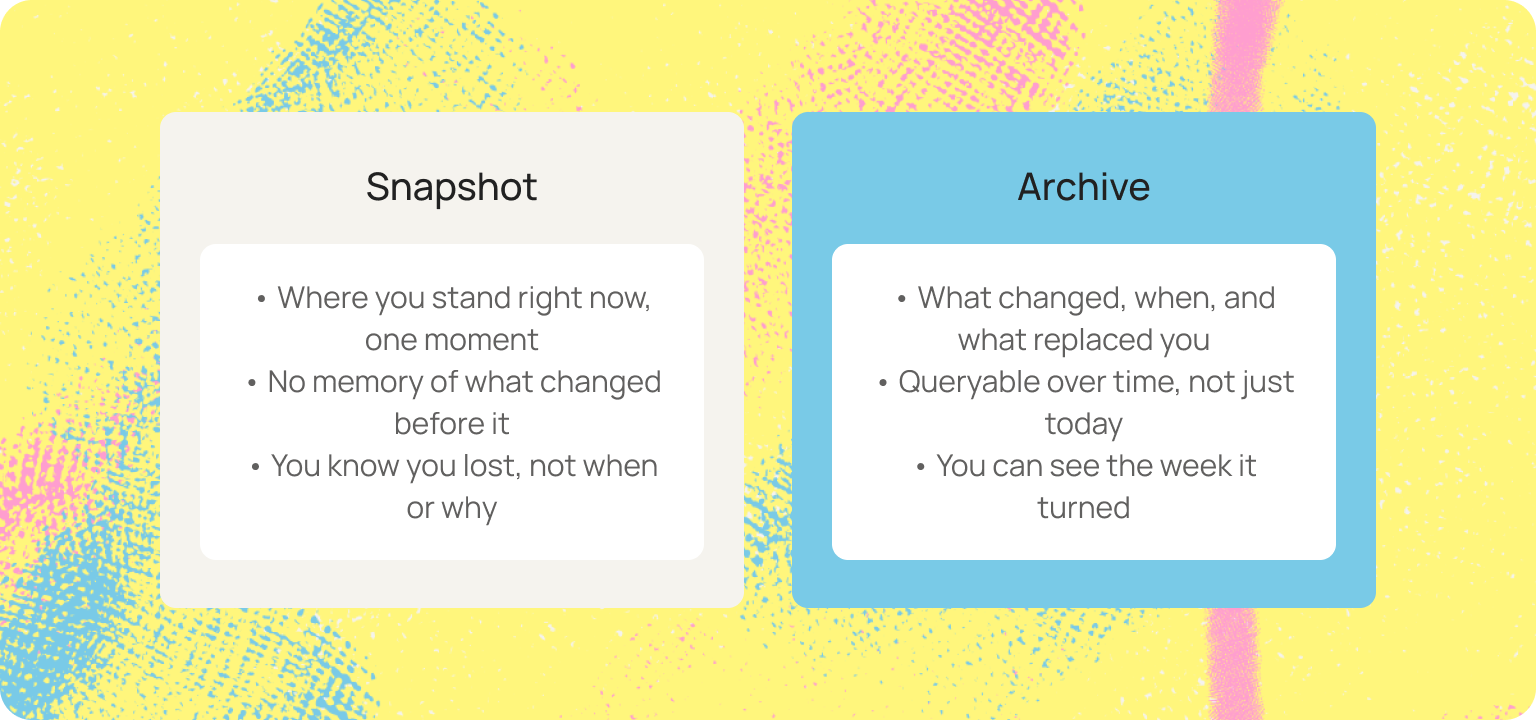
A team could publish a comparison page in March and a competitor could overtake them in ChatGPT answers in June. With a basic AI visibility tool, the team knows they lost. But if they use a tool with an archive, the team can see the week it turned, which citations moved, and which source replaced theirs.
Most AI visibility platforms sell a live dashboard and quietly retain very little behind it. The differentiator worth paying for is a durable, queryable record of what AI engines actually said, plus something that acts on the trend rather than just charting it.
The question nobody asks: Does the history start before you did?
Before signing up for any platform, you need to know when the tool starts collecting history. Most tools begin collecting the day a user onboards, which means every trend line starts at zero. Backfill, the ability to query historical AI responses from before signup, is what separates many tools in this category.
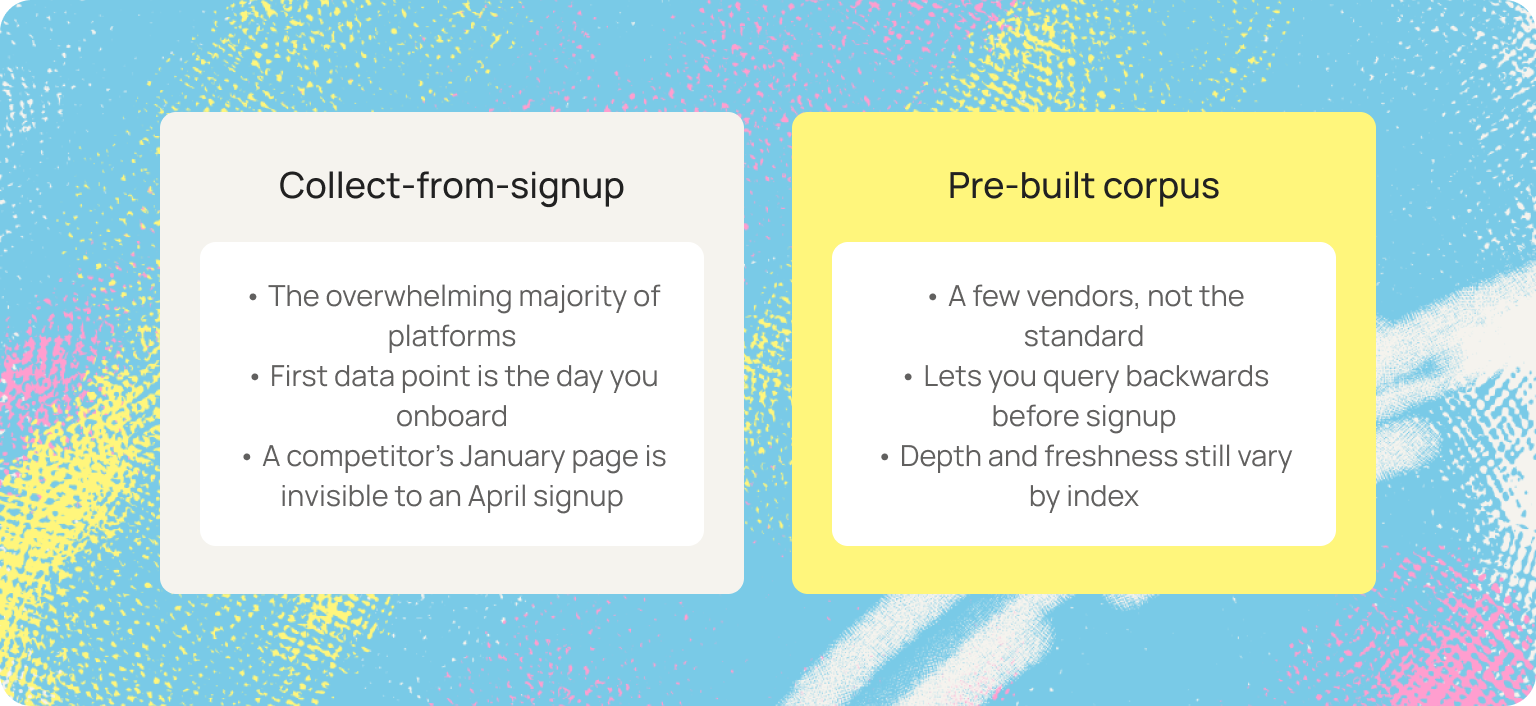
Collect-from-signup
The overwhelming majority of platforms work this way. A user's first data point is the day they onboard. They'll wait 90 days for a quarter of trend. But if a competitor launched a negative comparison page in January and the team signed up in April, that history is unavailable.
Pre-built corpus
A few vendors have been running large prompt sets continuously and can let a user query backwards. This isn't standard for the category though, and even where it exists, the depth and freshness vary by index.
For teams weighing GEO vs. SEO, this matters. Traditional SEO tools have years of keyword history, but AI search optimization historical data is still in its first generation.
The broader shift toward generative engine optimization makes the gap more urgent. Teams need generative engine optimization strategies grounded in real trend data, not single snapshots.
How these platforms were evaluated
Every figure in this comparison comes from each vendor's own documentation, pricing page, or API reference. Where a vendor doesn't publish a number or information, we say “not stated.”
Five axes were scored: lookback depth, backfill before signup, snapshot cadence, raw response archiving, and export portability. Everything is true as of September, 2026.
Comparison table: Best platform for AI search optimization historical data
Use this to shortlist three platforms, then read the reviews below. If a vendor doesn't publicly state any of these, be sure to ask them to clarify before you sign.
The 11 best tools for AI search data analysis history
Each platform below is reviewed on what it documents. The historical data bullets come straight from vendor docs, pricing pages, and API references. Where a vendor doesn't publish a figure, it says “not stated.”
1. Omnia
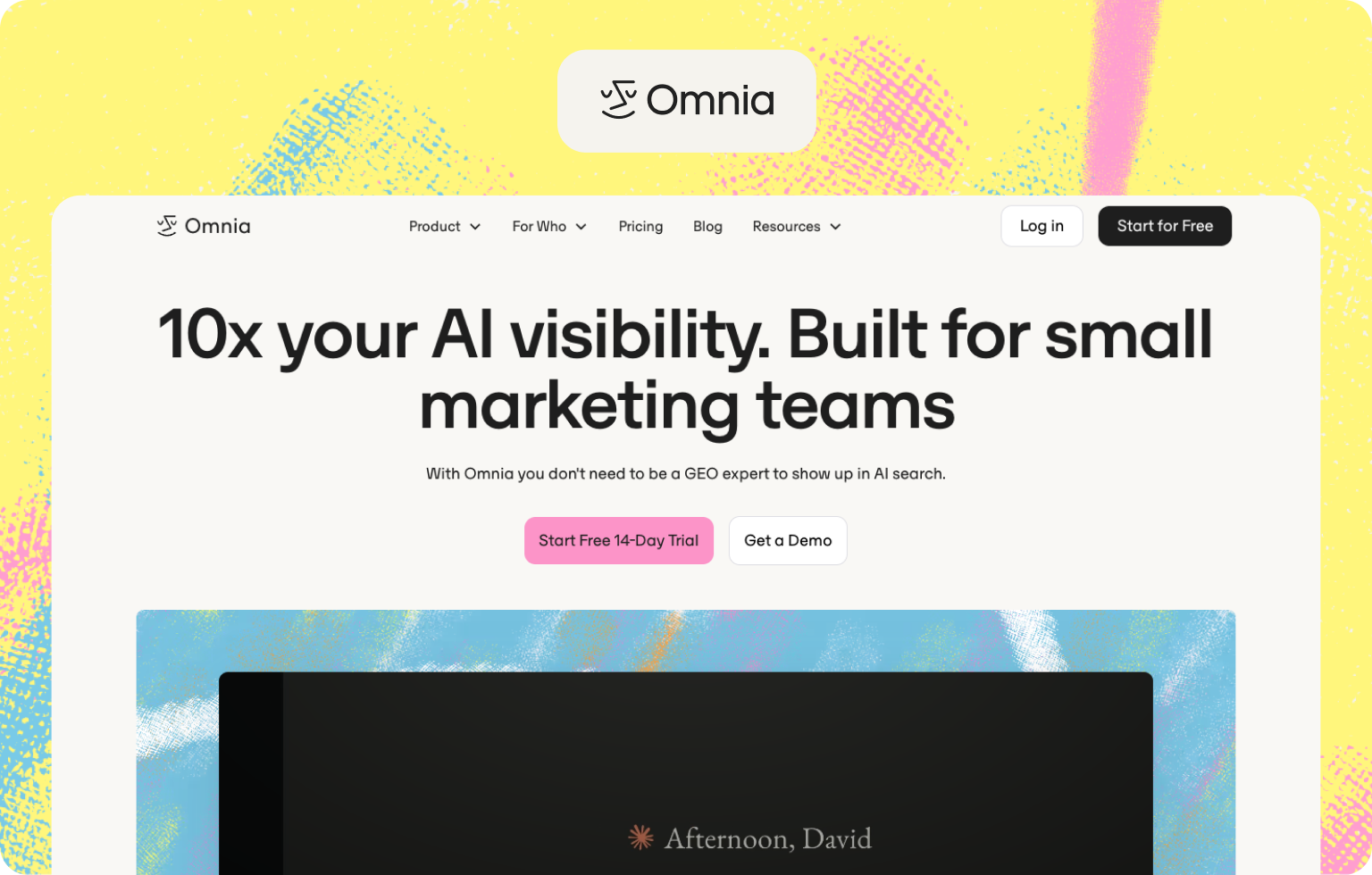
Omnia is an AI visibility platform built for small marketing teams that don't have the bandwidth to run a generative engine optimization (GEO) strategy solo. It shows where and how a brand appears in 7 different AI search engines. Then, it goes beyond tracking to show how to act on the data, with an AI agent (Omnio) that does the execution work.
Best for
Lean scaleup marketing teams that need indefinite data retention, raw response access, and an agent that acts on the findings.
Historical data
- History start / backfill: No pre-built corpus. Data starts from signup forward.
- Retention: Indefinite. Gathered prompt monitoring data is stored indefinitely on every plan, with no tier-gating.
- Snapshot cadence: Daily.
- Raw responses archived: Yes. All data visible in the UI is also available in raw format via API and MCP.
- Export / API: REST API (JSON), MCP, and Google Sheets export via the Omnio GEO agent. API exports daily performance data as flat JSON files loadable into Looker Studio, BigQuery, Tableau, or any BI tool.
What it does well
Omnia has real-browser, location-specific tracking that simulates actual user behavior across any country and language, rather than sanitized API responses. Native MCP integration puts the full visibility dataset inside Claude, ChatGPT, Cursor, VS Code, Windsurf, and Microsoft Copilot, so the history is reachable from any workflow. The Omnio GEO agent turns visibility gaps into shipped work by discovering untracked prompts, diagnosing regressions, creating content, and placing it through 20-plus integrations.
Omnia provides raw screenshots of sourced data.
Watch-outs
Teams with no prior history must build their trend line from zero. Omnio is also more comprehensive than a pure monitoring tool. Teams wanting only data may find the setup more involved than a simple rank tracker.
Pricing
- Growth: €79/mo (Google AI Mode access starts here)
- Pro: €279/mo
- Enterprise: €499/mo
2. Profound
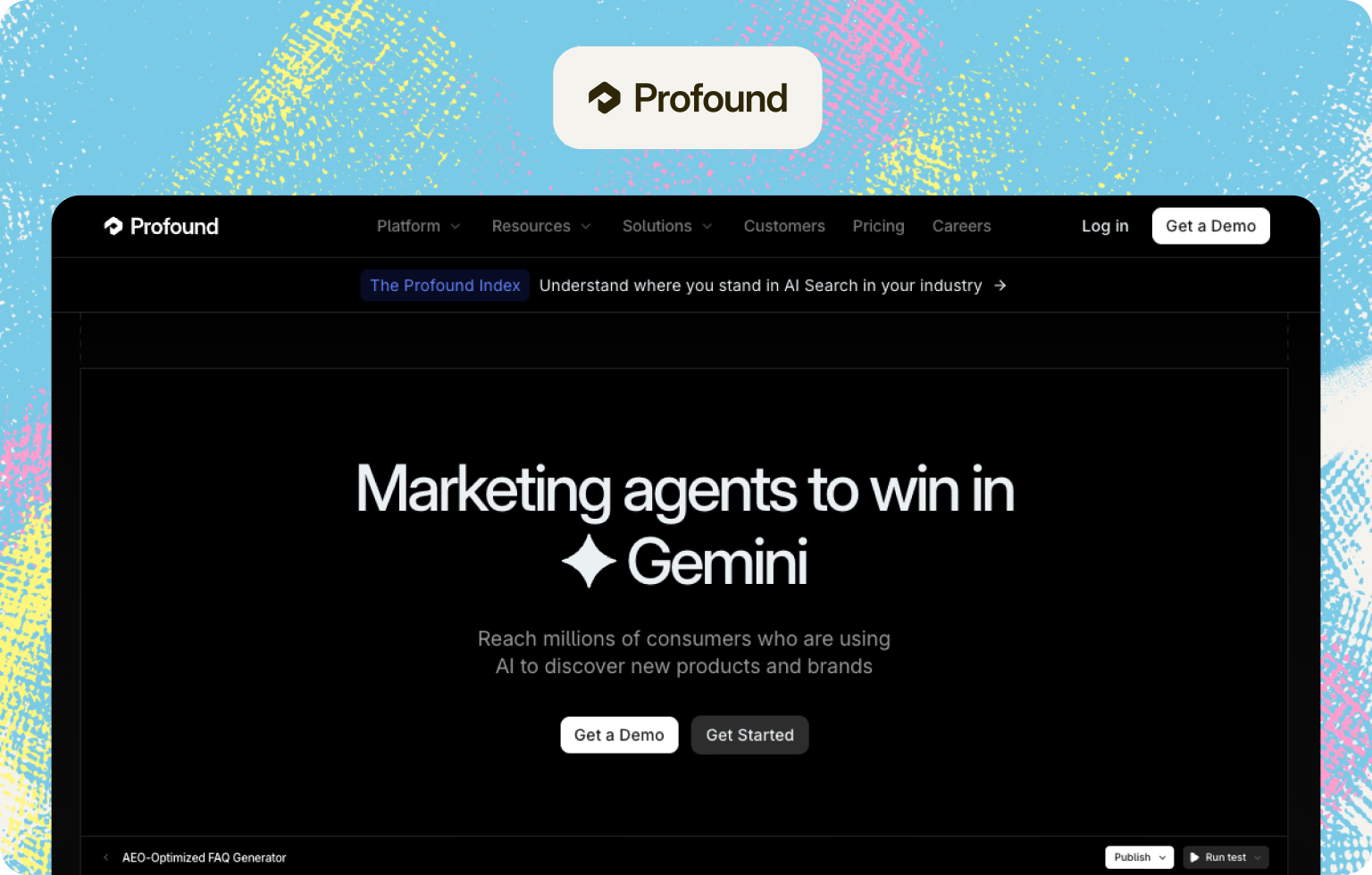
Profound is a full-stack AI search optimization tool. It combines visibility analytics, content optimization, and autonomous agents for content generation and PR in one platform.
Best for
API-first teams and enterprises that want deep citation intelligence and raw response access alongside content optimization.
Historical data
- History start / backfill: No pre-built corpus. Data starts accumulating 24 to 48 hours after prompts are added per the Help Center, so lookback runs from signup forward.
- Retention: All time. The pricing page lists “History: All time” across all tiers.
- Snapshot cadence: Daily.
- Raw responses archived: Yes. API features the ability to access raw per-execution prompt-answer rows.
- Export / API: Tier-dependent. Starter gets no exports, Growth gets CSV/JSON, and Enterprise gets CSV/JSON plus API access capped at 600 requests per hour.
What it does well
Profound captures responses directly from the consumer browsing experience, not model APIs, so data reflects what real users see. It tracks across up to nine engines and features a full-stack AEO workflow featuring analytics, content optimization and autonomous Profound Agents.
Watch-outs
Engine coverage is gated by pricing tier so you may need to pay extra to unlock the one search engine you need. Starter tracks ChatGPT only, Growth adds Perplexity and Google AI Overviews (three engines), and only Enterprise unlocks the full set (up to nine engines).
Pricing
- Starter: $99/mo
- Growth: $399/mo
- Enterprise: Custom
3. Ahrefs Brand Radar
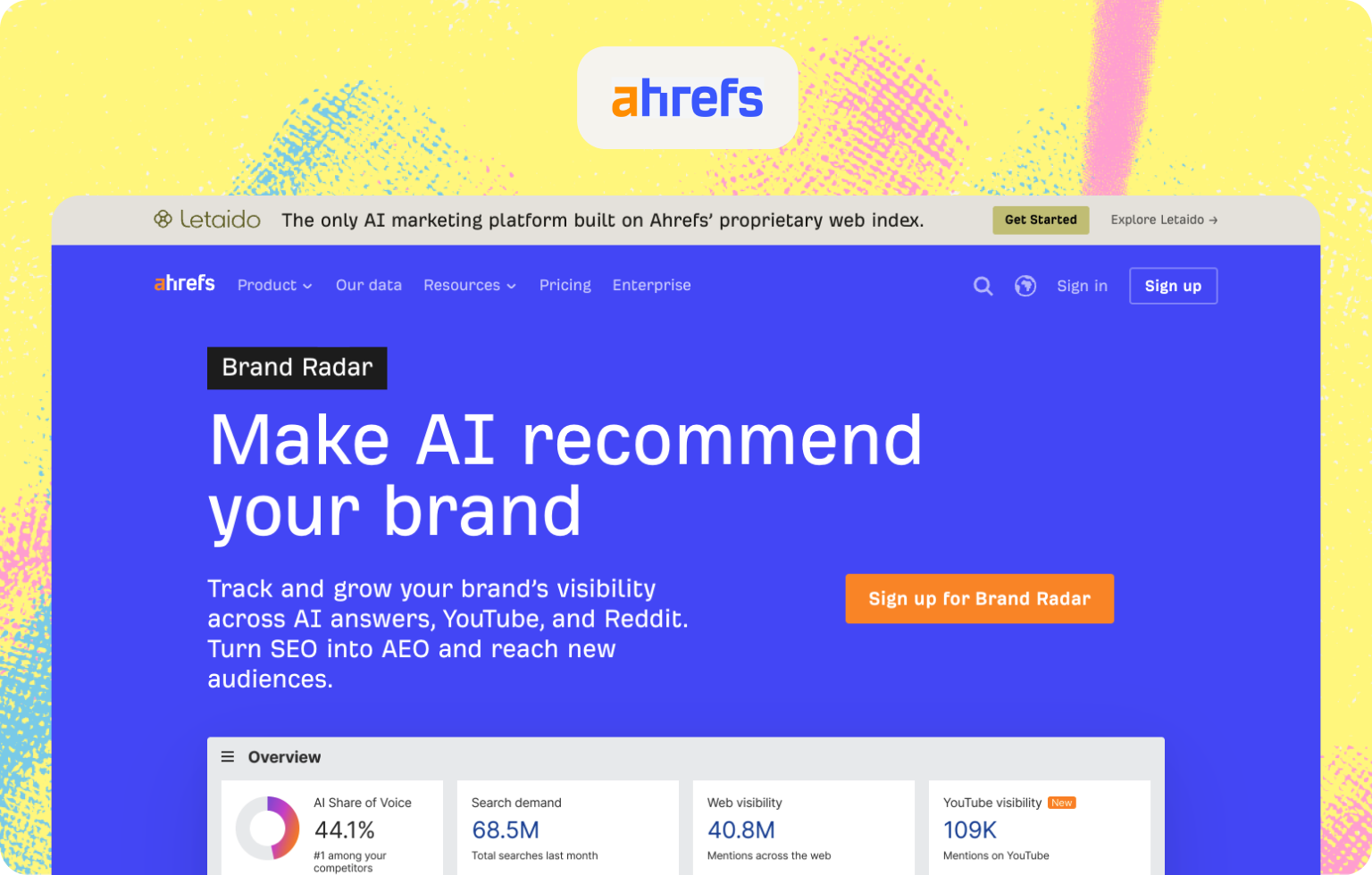
Ahrefs Brand Radar is Ahrefs' AI visibility tool, built on a massive pre-collected prompt database with no setup required. It gives a 360-degree view of a brand across Google, AI search, and the entire web.
Best for
Teams that want the deepest backfill and a pre-built corpus queryable before signup, without setup.
Historical data
- History start / backfill: Pre-built corpus. AI Overviews data goes back to August 2024 and AI Chatbot Sources to May 2025 without any signup needed. Custom prompts, though, have no backfill.
- Retention: Not stated. No documented deletion or expiry policy for stored responses.
- Snapshot cadence: Daily to monthly. Custom prompts are user-set to daily, weekly, or monthly. AI Chatbots refresh once a month, AI Overviews every few days.
- Raw responses archived: Yes.
- Export / API: CSV, Google Sheets, API (JSON/CSV/XML/PHP), and MCP. No Looker Studio is mentioned.
What it does well
Ahrefs Brand Radar has a massive pre-collected prompt database with no setup and covers 7 AI platforms. It includes 468M-plus search-backed prompts derived from People Also Ask and Ahrefs' 110-billion-keyword database, giving instant AI search visibility unlike competitors that require seed-topic configuration.
Watch-outs
Coverage has a documented English-language bias and long-tail or niche prompts may be omitted. Total cost depends on how many AI engines you want. Claude is available for custom prompts only and each check consumes 8 checks rather than the standard 1.
Pricing
- Custom prompts: From $50/mo
- AI visibility index: $199–$699 (1–6 models)
4. Scrunch
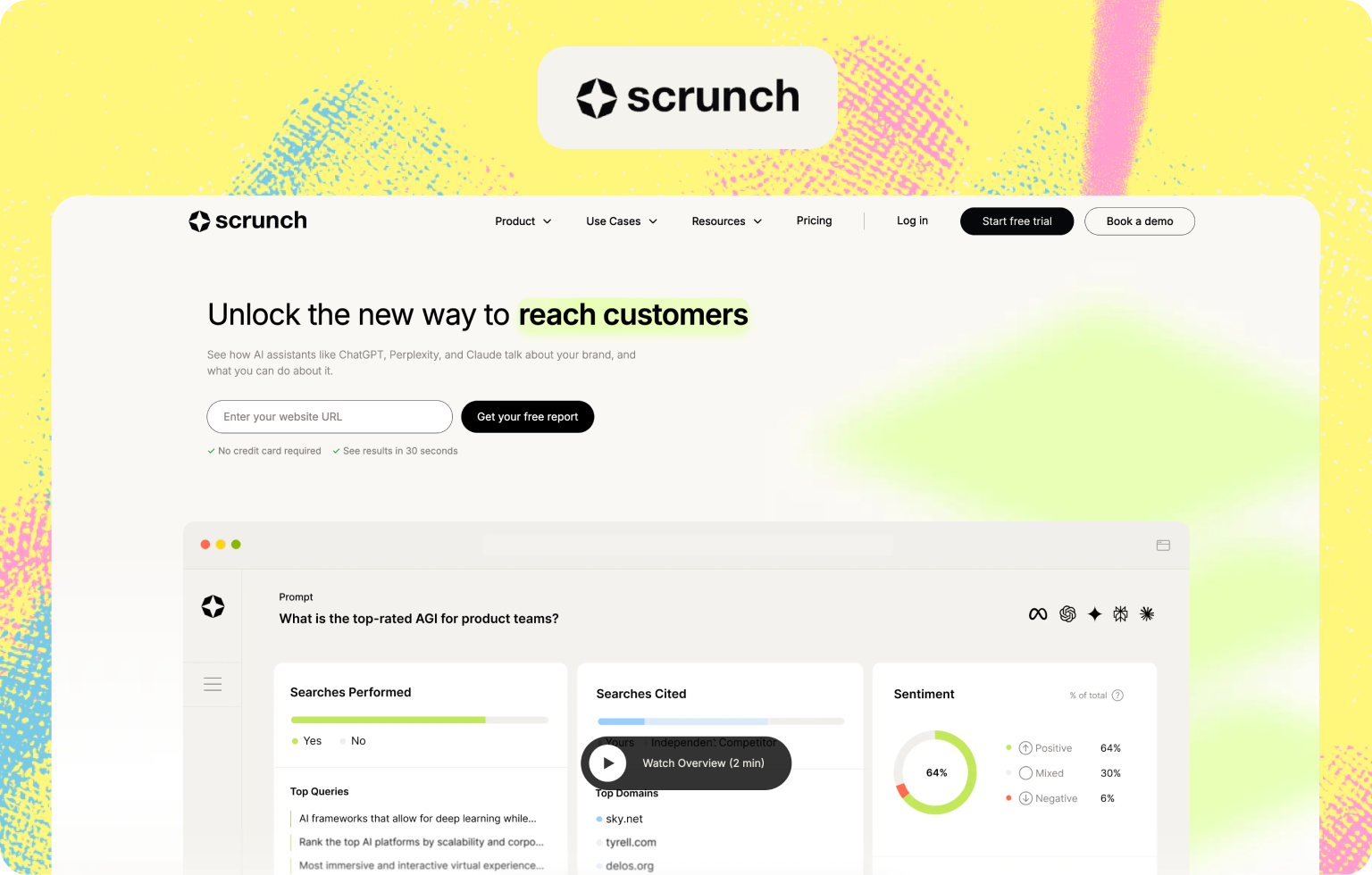
Scrunch is the “Agent Experience Platform” that helps brands get AI-ready so they show up in answers, get cited, and grow revenue. It goes beyond monitoring into active site optimization for AI agents.
Best for
Enterprise brands that need both AI search visibility monitoring and active site optimization for AI agents.
Historical data
- History start / backfill: No pre-built corpus. Data starts from signup.
- Retention: 90 days. The Query API date dimensions are each capped at “Only last 90 days of data” (default 30 days) per API docs.
- Snapshot cadence: Daily for the first 14 days, then a default 72-hour refresh, though prompt data can be refreshed at any time.
- Raw responses archived: Yes.
- Export / API: Enterprise-only. Query API, Looker Studio, Advanced API, CLI, and MCP require an enterprise plan.
What it does well
Scrunch helps brands tackle monitoring as well as optimization. The Agent Experience Platform actively serves a token-light, AI-optimized version of the site at the edge in real time, plus Site Diagnostics gives page-by-page prioritized recommendations. Engine coverage spans 9 major AI platforms.
Watch-outs
Engine coverage and feature depth appear to vary by plan tier. The Core plan may cover only 4 platforms while full 9-platform coverage and the Agent Experience Platform are gated to Enterprise, so buyers should confirm what is included at their tier.
Pricing
- Core: $250/mo
- Enterprise: Custom
5. Trakkr
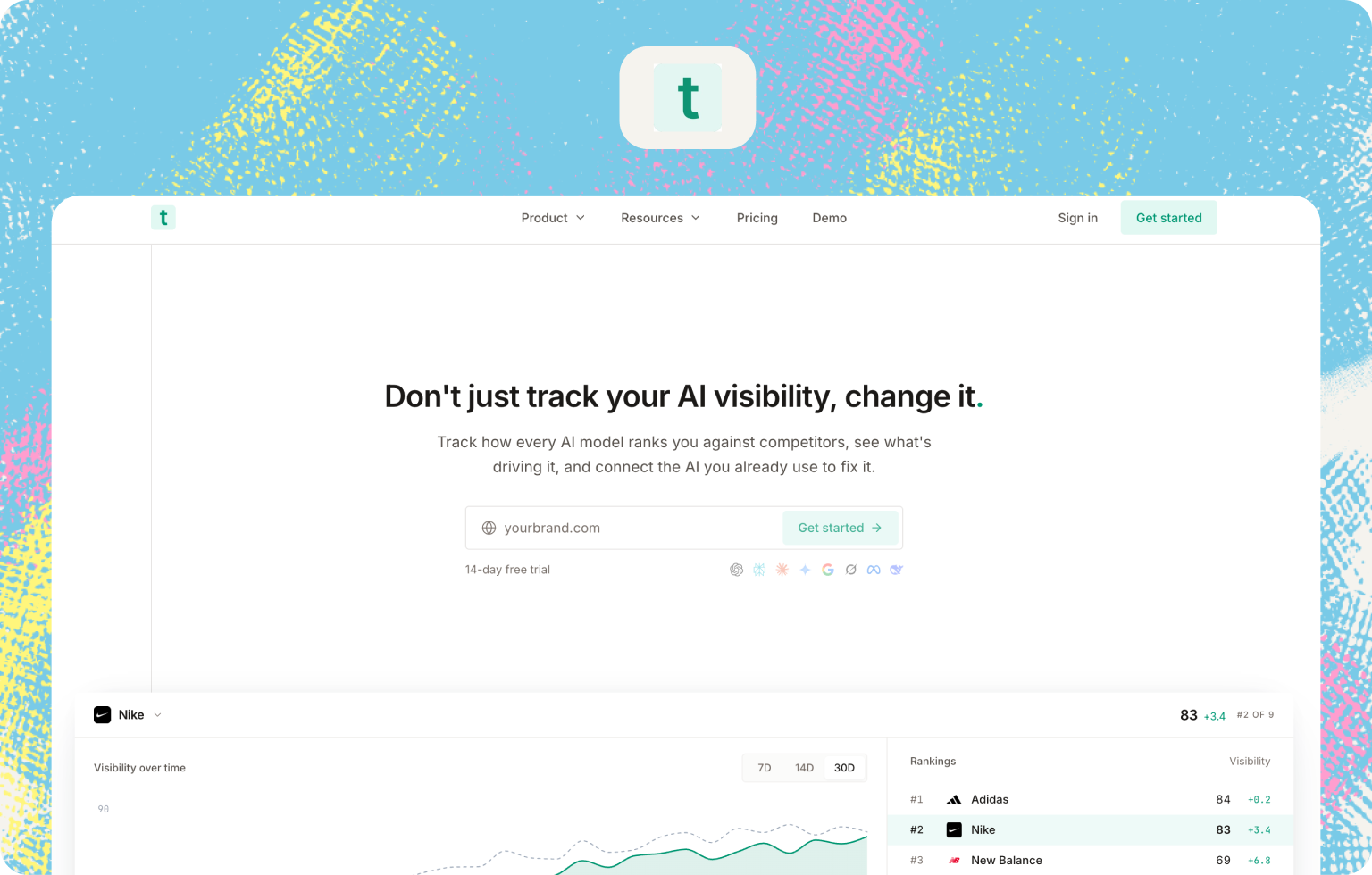
Trakkr is an AI visibility platform for brands and agencies that measures the answers AI gives to buyer questions. It keeps model answers, citations, visible referral visits, and crawler requests as separate evidence.
Best for
Brands and agencies that need AEO measurement and execution together in one workflow, with multi-model daily tracking and action-oriented playbooks.
Historical data
- History start / backfill: No pre-built corpus. No pre-signup backfill is documented, meaning data starts from signup.
- Retention: Tier-dependent. One year on Growth and unlimited on Scale.
- Snapshot cadence: Daily.
- Raw responses archived: Yes.
- Export / API: CSV, JSON, Google Sheets, Looker Studio (Scale), REST API (Scale), and MCP (any paid plan). Caps of 10,000 records per request and 365 days max for time-based exports.
What it does well
Trakkr transparently separates evidence so that one signal isn't ever passed off as another. The platform delivers weekly prioritized playbooks and end-to-end fix workflows, plus MCP integration so fixes can be handed to AI assistants.
Watch-outs
Several advanced capabilities are gated behind the Scale tier like REST API access, unlimited historical data, unlimited team seats, and 10 brands. On the Growth plan, you can only track 1 brand daily.
Pricing
- Growth: $100/mo
- Scale: $500/mo
- Enterprise: $1,000/mo
6. Conductor
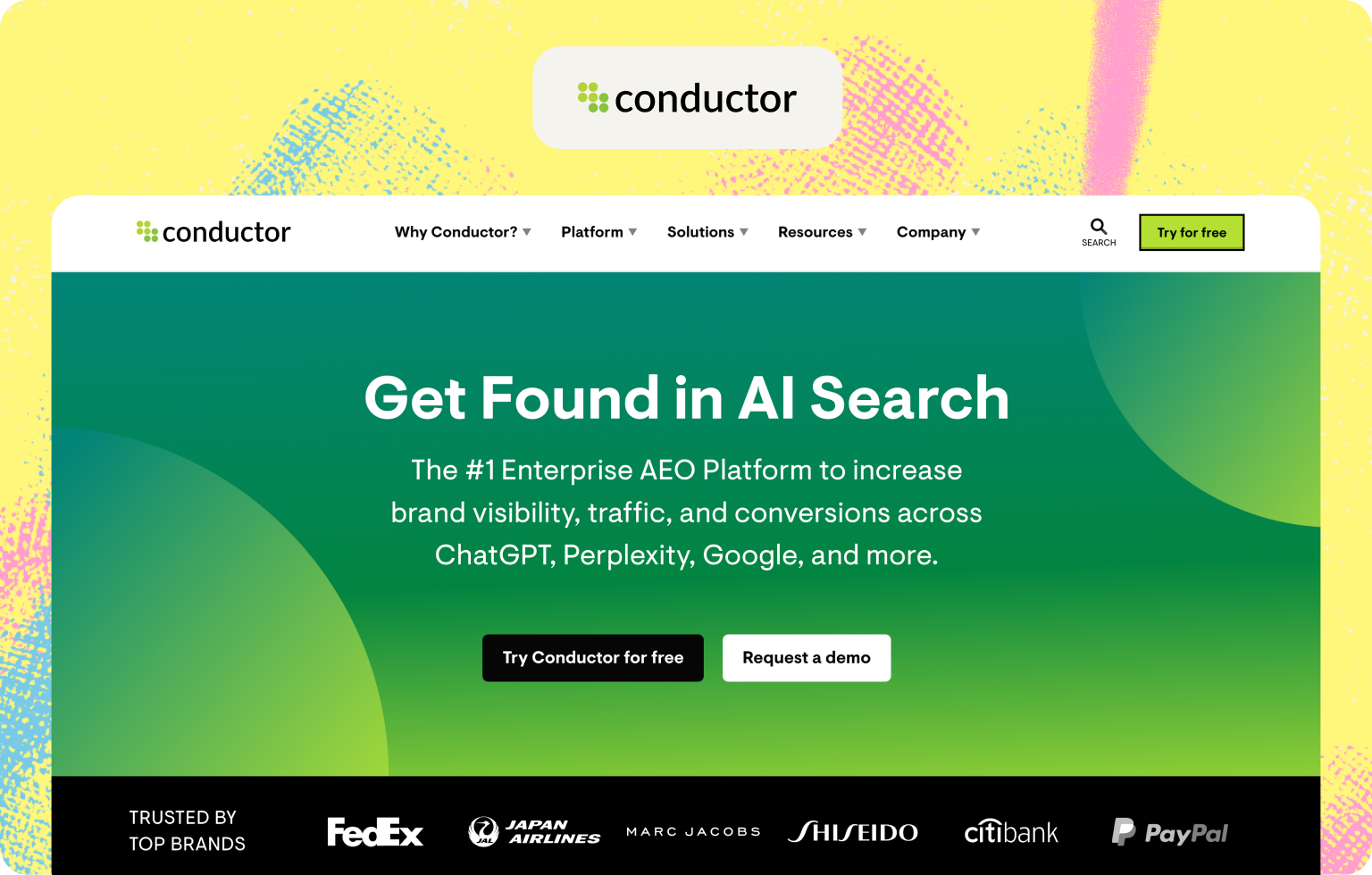
Conductor is an enterprise AEO platform covering the full AEO lifecycle from AI visibility tracking to content creation to real-time site health. It positions itself as the only platform that connects AI visibility to website analytics (GA4, Adobe) for business-impact measurement.
Best for
Enterprise teams that need broad multi-engine AI visibility tied to traditional SEO, content creation, and revenue impact in one platform.
Historical data
- History start / backfill: No pre-built corpus. Conductor tracks prompts from the point they're configured.
- Retention: Not stated. No documented retention period or data expiry policy.
- Snapshot cadence: User-set. Refresh cadence can be set to daily, weekly, or monthly, but daily tracking increases your credit usage.
- Raw responses archived: Yes.
- Export / API: XLSX export in-app and a Data API (JSON) with async endpoints designed for BI integration.
What it does well
Conductor has 9 engine configurations across 160-plus countries, plus unique mode-level ChatGPT granularity (Auto vs. Search vs. Crawl) and fan-out query decomposition. It's a unified AEO and SEO platform that connects AI visibility to GA4 and Adobe analytics.
Watch-outs
Conductor's AI Search Performance is configurable rather than out-of-the-box. Users have to manually add brands, topics, personas, and prompts before any data is collected. The platform is explicitly positioned for enterprise complexity and scale, signaling a cost and procurement cycle that smaller teams may find heavy.
Pricing
- Essentials: Custom
- Growth: Custom
- Enterprise: Custom
7. Semrush AI Visibility Toolkit
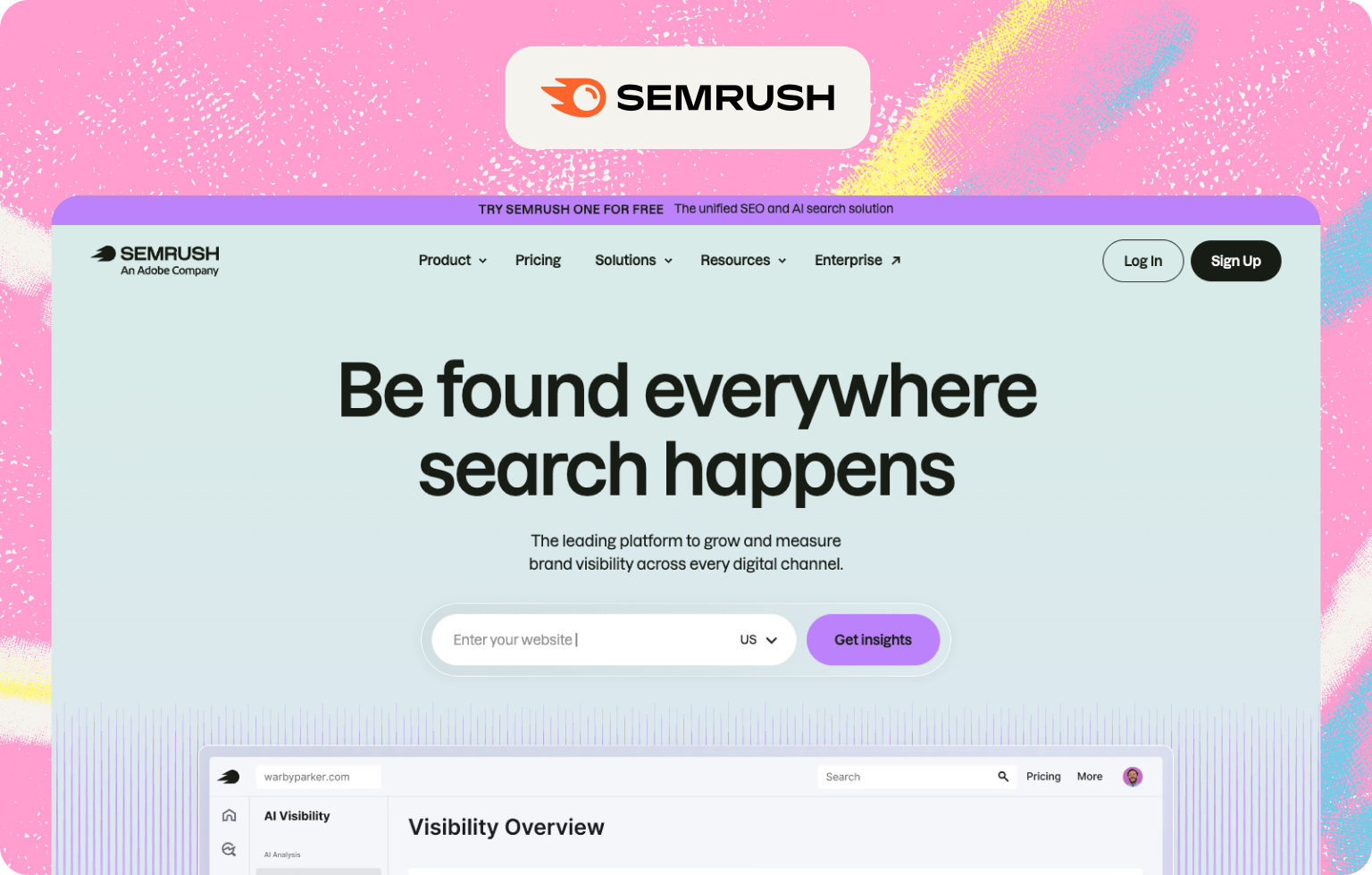
Semrush's AI Visibility Toolkit is the AI visibility layer within Semrush's broader SEO platform. It has a 317M-plus prompt database sourced from real AI search clickstream data, integrated alongside Semrush's mature SEO, content, and traffic toolkits.
Best for
Existing Semrush subscribers and SEO teams that want AI visibility integrated with traditional SEO in one mature platform.
Historical data
- History start / backfill: Partial. The underlying database is a collection of over 317 million prompts and responses sourced from clickstream and Google keyword data, implying a pre-built corpus. But Semrush doesn't publish an explicit earliest date or lookback window.
- Retention: Not stated. The toolkit offers “All time” trend toggles alongside one-month and six-month views, but no explicit retention policy is documented.
- Snapshot cadence: Mixed by report. Visibility Overview and Prompt Research refresh daily on a rolling basis, Brand Performance reports update weekly, and Prompt Tracking provides daily updates.
- Raw responses archived: Yes.
- Export / API: Excel, CSV, Google Sheets, PDF, and scheduled automated email exports. But no JSON or API export option is mentioned for the toolkit.
What it does well
Semrush goes beyond mentions to narrative and sentiment intelligence — Brand Performance analyzes share of voice, sentiment, and “narrative drivers” to show the story AI tells about a brand. AI visibility sits alongside SEO, content, and traffic and market toolkits, so brands get traditional and AI search tracking in one place.
Watch-outs
Coverage only extends to 4 AI search engines. There's no mention of Claude or Microsoft Copilot. The toolkit also has no API or JSON export option at all.
Pricing
- Semrush One Starter: $199/mo
- Semrush One Pro+: $299/mo
- Semrush One Advanced: $549/mo
8. Peec AI
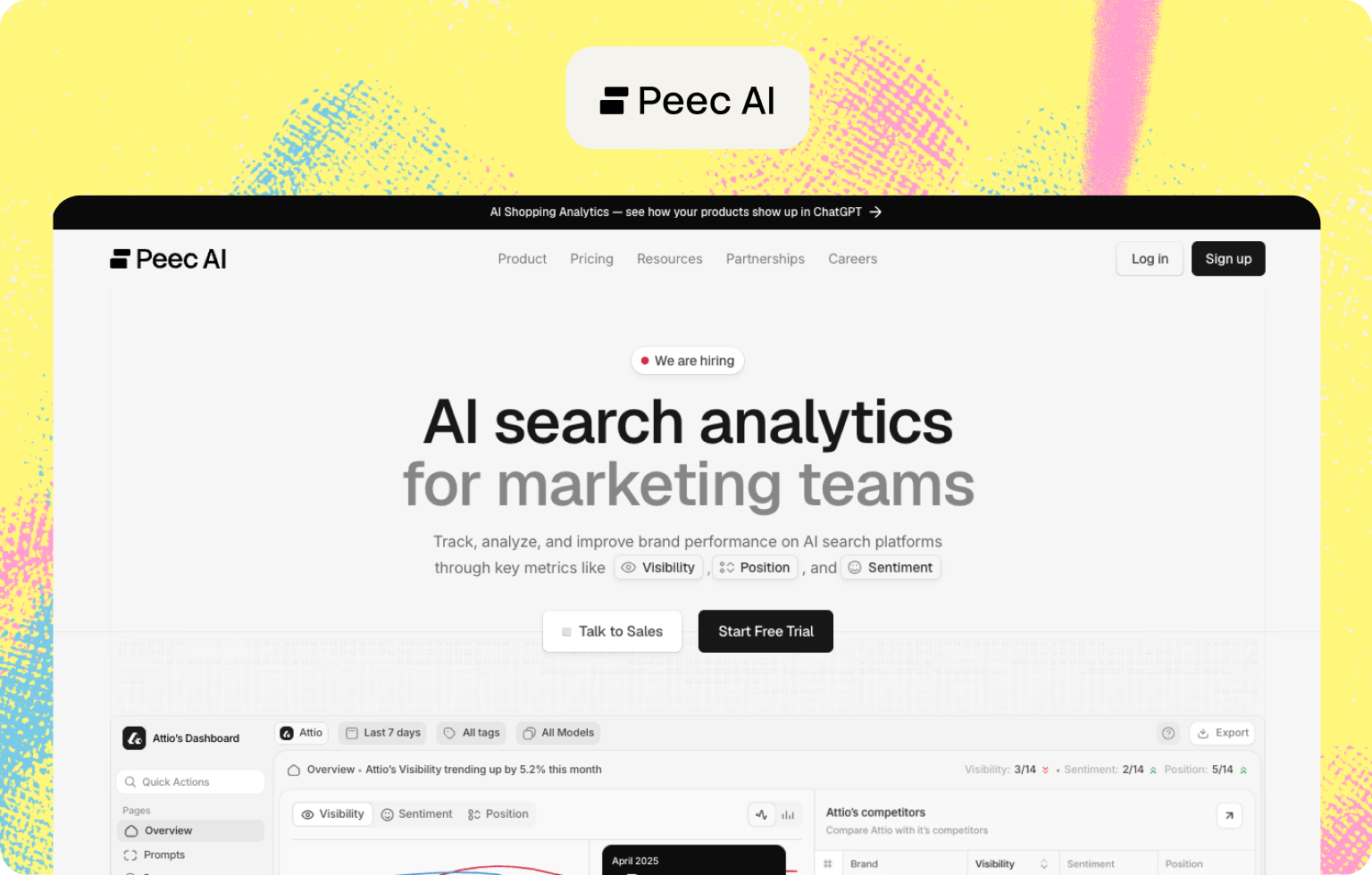
Peec AI is an AI search analytics platform that emphasizes action-oriented intelligence. It actively turns visibility data into prioritized action plans rather than just presenting dashboards.
Best for
Marketing teams and agencies that want daily AI visibility tracking with action-oriented recommendations and agency-ready reporting.
Historical data
- History start / backfill: No pre-built corpus. No backfill policy is documented, so data starts from signup.
- Retention: Not stated. The docs describe viewing “the last 100 chats for each prompt” and exporting “all chats generated on your account so far.”
- Snapshot cadence: Daily.
- Raw responses archived: Yes.
- Export / API: CSV, Looker Studio connector (Advanced and up) and API (gated to Enterprise). Large chat CSV exports are resumable.
What it does well
Peec AI's Actions feature clusters sources by content type, scores opportunities with Relative Opportunity Scores, and gives step-by-step create, optimize, and influence guidance. Peec AI tracks 11 models, providing some of the most extensive coverage.
Watch-outs
API access is limited to Enterprise plans, so lower-tier customers cannot automate or integrate data. And unless you pay for an Enterprise plan, you can only pick 3 out of the 11 models.
Pricing
- Starter: $95/mo
- Pro: $245/mo
- Advanced: $495/mo
- Enterprise: Custom
9. Evertune
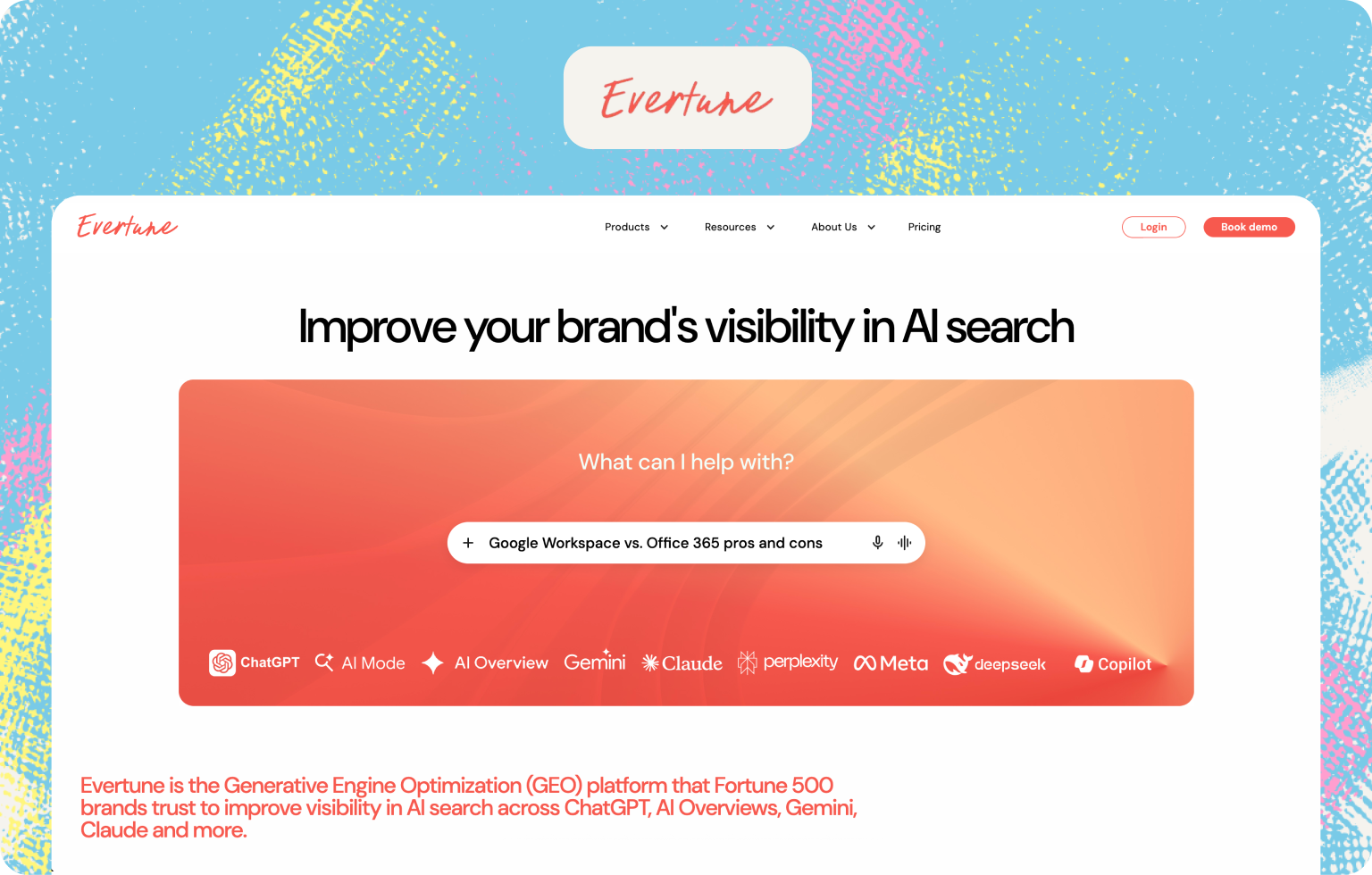
Evertune is a marketing platform for brand discovery in AI search. It positions itself as the first generative search engine optimization platform built to explore, measure, act, and advertise across the entire AI customer journey.
Best for
Enterprise brands that want statistically rigorous AI visibility measurement grounded in real consumer behavior.
Historical data
- History start / backfill: Not stated. No pre-built corpus or backfill is documented.
- Retention: Not stated. The site doesn't say how long AI visibility data is retained.
- Snapshot cadence: Daily, weekly, or monthly per the pricing page.
- Raw responses archived: Not stated.
- Export / API: Not stated. Pricing page doesn't mention CSV, JSON, API, Looker Studio, Google Sheets, or any data export capabilities.
What it does well
Evertune has statistical rigor that most of the competitors lack. It samples each prompt 100 times per model rather than once a day, giving statistically significant visibility measurement. It's grounded in real consumer behavior via EverPanel, a panel of 150M-plus real conversations, so prompts reflect what people are really asking.
Watch-outs
There are only two pricing plans, and the base one starts at $800/mo, out of reach for most smaller companies. There's no API or export details.
Pricing
- Pro: $800/mo
- Enterprise: Custom
10. Rankscale
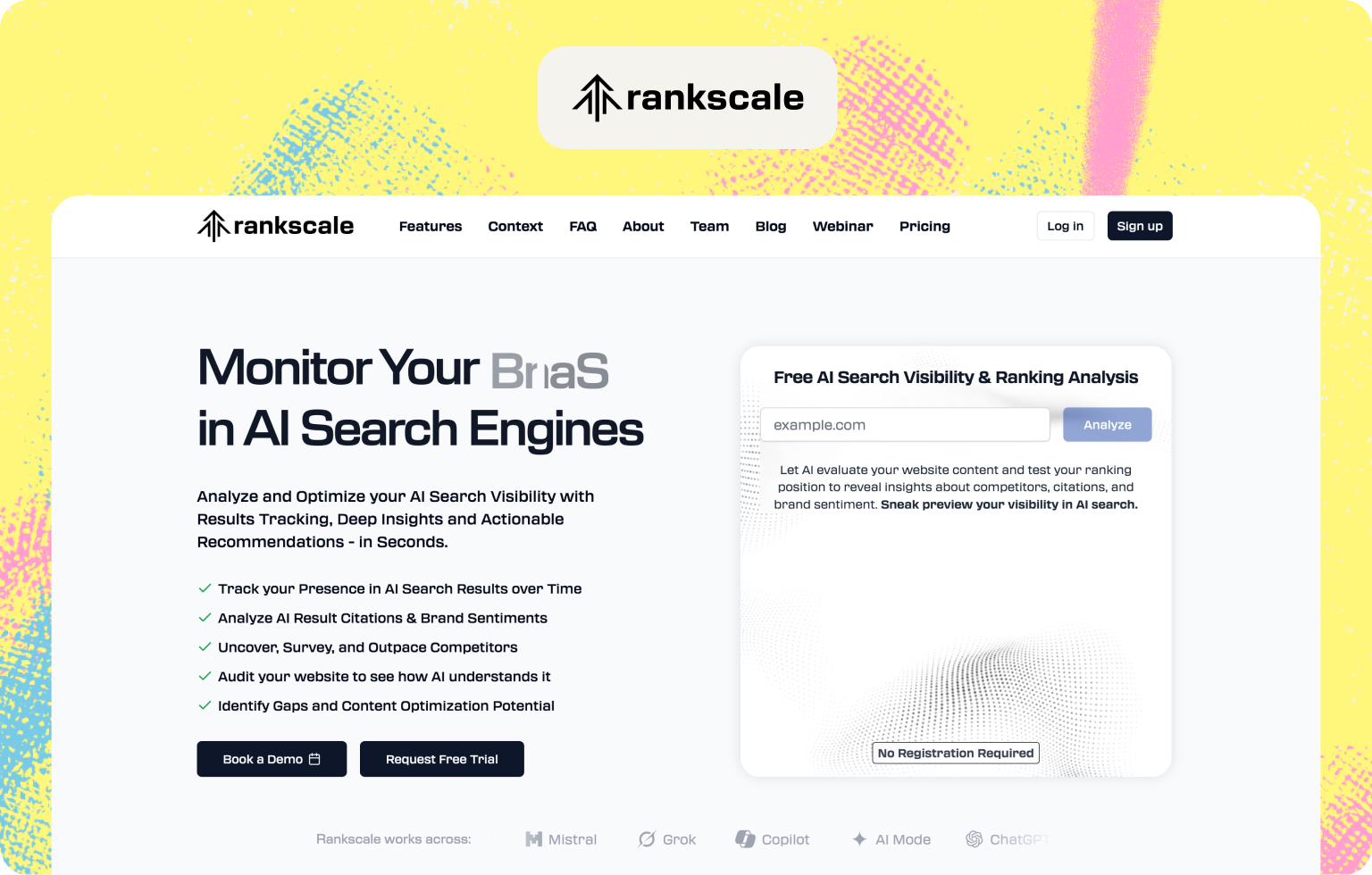
Rankscale is an AI visibility tracker that has some of the broadest engine coverage in the category (17 AI engines). Its flexible credit-based monitoring model lets users choose cadence from hourly to monthly.
Best for
Teams that want maximum engine coverage and flexible cadence control with API and MCP integration.
Historical data
- History start / backfill: No pre-built corpus. No backfill policy is documented; data starts from signup.
- Retention: Defaults to 90 days. The API Prompt History endpoint's start date parameter defaults to 90 days ago per the API docs.
- Snapshot cadence: Hourly to monthly. Choose if you want to monitor your search terms hourly, daily, weekly, or monthly.
- Raw responses archived: Yes.
- Export / API: CSV, Google Sheets, Looker Studio, and REST API.
What it does well
Rankscale covers 17 AI engines in one platform, with new models added over time. It has granular citation intelligence and share-of-voice analytics that tracks top domains by volume, category distribution over time, monthly mentions, and share of voice by citation mentions, unique URLs, and unique domains.
Watch-outs
The credit-based system makes it difficult to calculate your budget and usage. Though Rankscale supports 17 AI search engines, each engine you track consumes more credits.
Pricing
- Pro: €99/mo
- Growth: €385/mo
- Enterprise: €780/mo
11. Nightwatch
Nightwatch is an SEO rank tracker and AI visibility tool. Its central thesis is that GEO is heavily tied to traditional SEO, making it the tool for teams that need both traditional rank tracking and AI visibility in one platform.
Best for
SEO teams that want traditional rank tracking and AI visibility unified in one platform, with the linkage between rankings and AI citations.
Historical data
- History start / backfill: No pre-built AI-response backfill. Data starts from signup.
- Retention: Not stated for AI-specific retention. 3 years for SERP archives and 13 years of ranking data.
- Snapshot cadence: Daily. Also supports on-demand checks.
- Raw responses archived: Yes.
- Export / API: PDF, CSV, and HTML reports, Google Sheets, Looker Studio, and API.
What it does well
Nightwatch unifies traditional rank tracking with AI visibility in one platform. Citation Intelligence links Google SERP rankings to AI mentions across six platforms.
Watch-outs
AI tracking capacity is tier-limited (50 AI prompts and 1,500 AI answers per month on Starter, up to 500 and 15,000 on the highest listed tier), which could constrain teams running large prompt sets.
Pricing
- Starter: €99/mo
- Professional: €199/mo
- Agency: €499/mo
- Enterprise: Custom
The four questions that separate a real archive from a pretty chart
Next time you have a demo or sales call, come equipped with these questions.
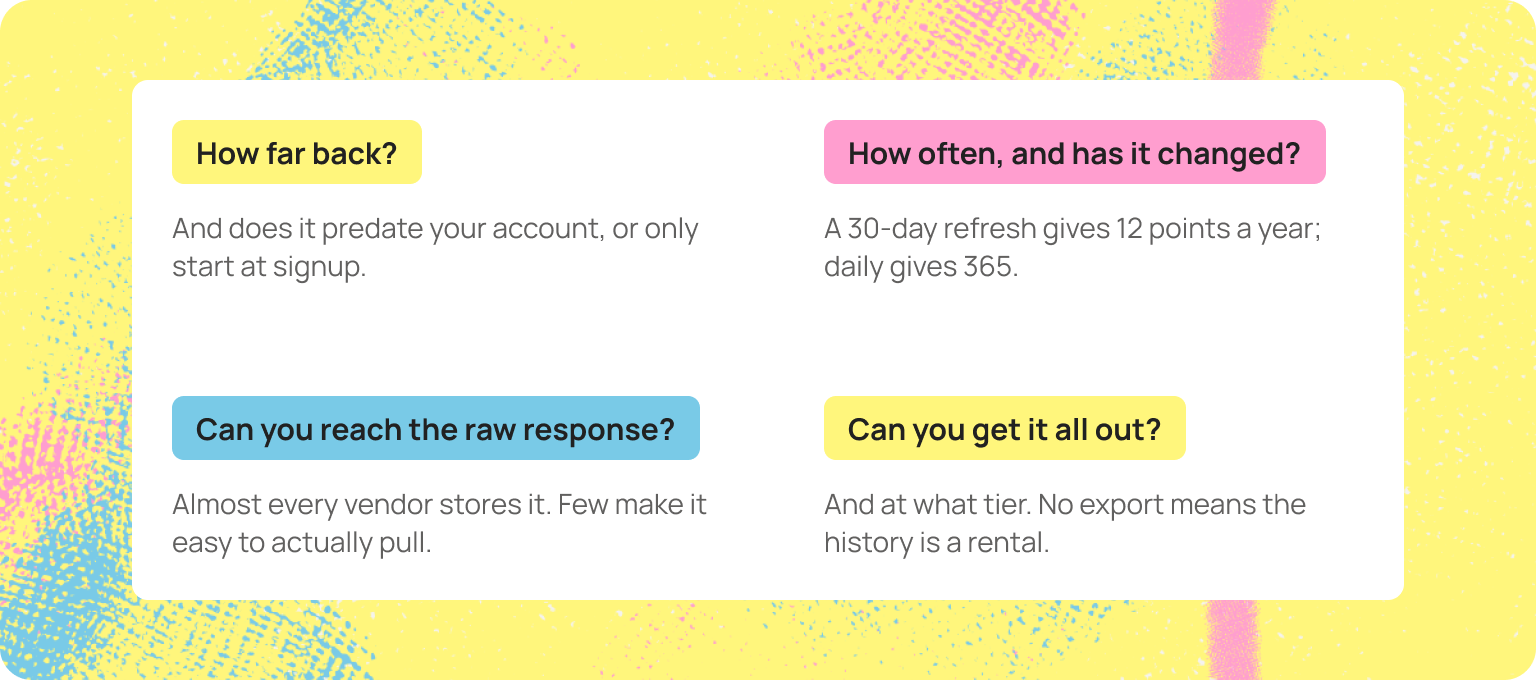
1. How far back can I query, and does it predate my account?
Most platforms start history at signup, so every trend line begins at zero. A few vendors maintain a pre-built corpus that lets a user query backwards, but this is the exception, not the standard.
If a tool has a pre-built corpus, ask for the earliest date and whether it applies to your tracked prompts or only to a shared index. If tracking starts from your signup date, weigh how long data is retained and how often it samples. Those matter more than backfill for most teams.
The best historical data providers for AI search optimization are the ones that answer this question clearly.
2. How often do you sample, and has that cadence ever changed?
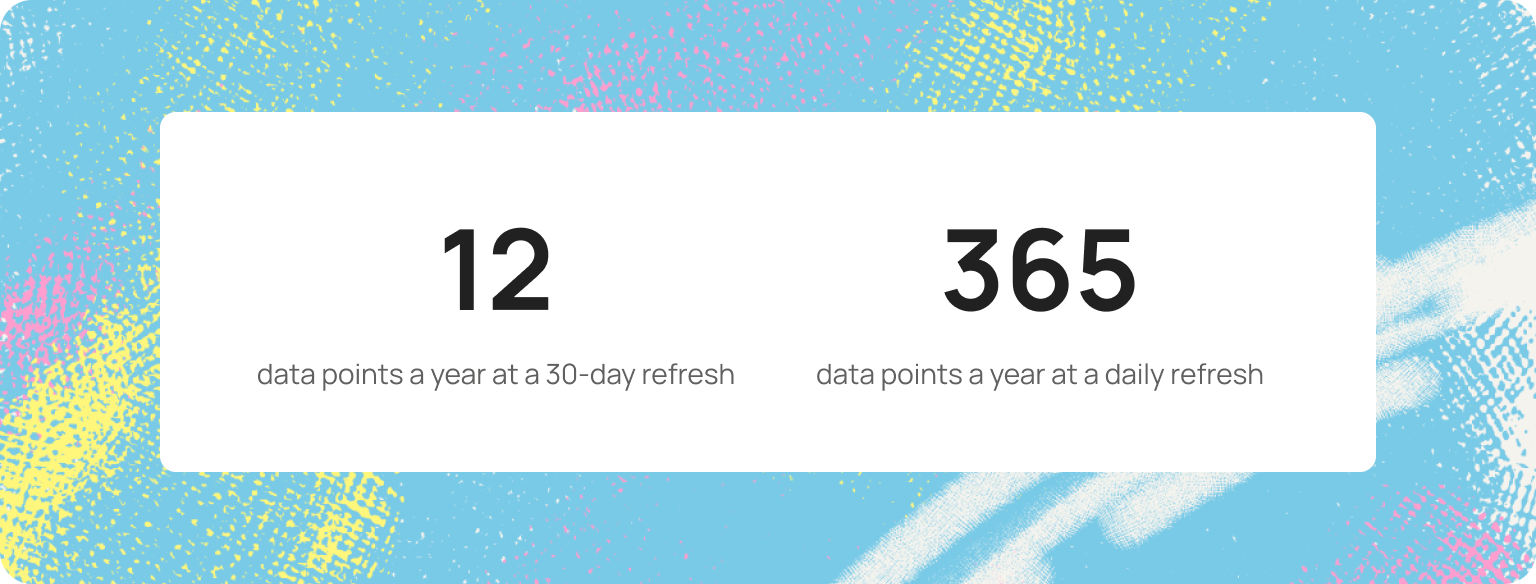
The practical math is simple. At a 30-day refresh, a team gets 12 data points a year and cannot resolve anything shorter than a month. A daily refresh gives teams 365 data points and they can see the week something moved. The difference in this category ranges from hourly (Rankscale) to monthly (Ahrefs AI chatbots).
3. Do you store the raw response, and can you actually get to it?
Nearly every vendor on this list archives raw AI responses. Instead, focus on how accessible those responses are. Some platforms gate their raw-response APIs behind Enterprise tiers.
For a deeper look at which platforms tell you what, see our guide on the best citation analysis options for optimizing AI search. Ask whether you can pull the full response text via API on the tier you're subscribed to, or if it's via in-app download only. AI-generated answers are only as useful as a team's ability to revisit them. Answer engine optimization depends on having the raw material to query.
4. Can I get all of it out, and at what tier?
If the data can't leave the platform, then the “history” you have access to is more like a rental. Some platforms give you no exports at all on lower tiers, offering CSV/JSON only on mid-tier plans and API access only on Enterprise.
Why Omnia is the right fit for scaleups analyzing AI search trends
Most of this category gives you plenty of data and plenty of storage. But the scaleup problem isn't not having data, it's having the data, only two people, and no bandwidth to do anything with it.
Omnia is built for that team. Daily samples across 7 engines on every plan. You can also access per-market history because regions and languages are unlimited on every tier, which is critical for multilingual SEO for AI search. MCP read and write access makes the history reachable from Claude, ChatGPT, or Cursor. Where most vendors in this list leave retention unstated, Omnia retains gathered prompt monitoring data indefinitely, on every plan. For teams that want AI search optimization with top historical data and the ability to act on it, this is the difference.
The real difference is Omnio. Every platform in this list can tell a team that visibility fell in June. Omnio discovers untracked prompts, diagnoses regressions by comparing cited pages over time, creates AI-optimized content built to earn citations back, places it through 20-plus integrations, and measures against the same tracked prompt set. Omnio does 95% of the GEO work. The team orchestrates the other 5%. Looking to make decisions? Project suggestions give you the breakdown of potential actions so you can choose which ones to prioritize on your own time.
Book a demo to start building your AI search history today. Or try a free 14-day trial of Omnia.
FAQs
How do AI search engines decide which brands appear in their answers?
How large language models generate answers depends on the prompt, the training data, and the retrieval layer. It's not on keyword research or structured data the way classic SEO works. A brand appears inside AI-generated answers when the model judges it relevant to user intent, which is why AI search optimization focuses on content quality and topical authority rather than rankings alone. The best AI search optimization platforms track this over time so teams can see whether their AI presence is growing or shrinking.
Why do two AI search platforms report different visibility for the same brand?
There's four honest reasons: sampling method, prompt set, engine coverage, and locale. One tool may test 100 prompts per model while another tests one, and one may cover eight AI systems while another covers three. Visibility metrics like brand mentions and AI visibility score will diverge accordingly. When comparing AI search tools, ask each vendor how they sample and whether they offer responsive customer support when the numbers look wrong.
Is Google Search Console a source of historical AI search data?
Partially, yes, but it's capped at 16 months. Google Search Console shows search queries and clicks, including some AI-powered search referrals, but it doesn't show what appeared inside AI-generated answers or how AI features like citations and direct answers shifted over time. For historical AI data on what models actually said, generative AI tools built for this purpose are still needed.
What's the difference between historical AI search data and keyword rank history?
Keyword rank history tracks where a site appears in classic search results, the kind of data AI SEO tools and platforms have tracked for years. Historical AI search data tracks what AI systems actually said about a brand, including the citations and how they changed across AI search experiences. AI visibility often doesn't align with organic rankings, so a site can rank well in traditional search and barely appear in AI-generated answers at all. This distinction suits teams that rely on AI tools to understand why visibility moved, not just where they rank.
How much historical data do you need before a trend is real?
Three months is the minimum for a directional read while six months is where historical context starts to separate signal from noise. Historical tracking with fewer than 90 days of data will show movement but not pattern, which is why advanced SEO teams wait for a full quarter before reporting to a board. Generative engine optimization is a long game. Predictive analytics on visibility trends only works with enough history behind it. AI visibility data must connect to crawlability and content quality, so a trend without that feedback loop is just a chart, not effective search optimization.