

According to Omnia’s citation data, Perplexity's citation pool shrank 36% in five months. The average top-3 position lasts 2.37 weeks. However, free tools only give you a snapshot of a channel that moves faster than monthly check-ins can track. This article maps what free trackers actually cover, their limitation, and the three conditions that signal a paid tool will pay for itself. If you are a lean team deciding whether to invest in Perplexity tracking, the decision framework and tool comparison will give you the insights to narrow down your choices.
Most teams evaluating free Perplexity trackers are asking the wrong question. It’s not whether one exists, but whether a viable free tool can keep pace with a channel that is getting more selective, more volatile, and more consequential for how buyers discover brands.
Perplexity is currently contracting. According to Omnia's citation database, tracking +6M citation events across more than 28K unique prompts in 2026, the engine pulled back from a peak of 11.8 domains per answer in November 2025 to a meager 7.5 domains in April 2026.
Fewer slots means more competition for each one. Also worth noting that only 17.5% of domains that earn a top-3 position hold it for four or more consecutive weeks. The average streak is 2.37 weeks! A snapshot tool checked once a month has data gaps across nearly every citation cycle, which means you may not be getting the long-term visibility that you and your team needs.
What follows is a breakdown of the best free and paid Perplexity rank tracking tools, and a clear framework for knowing which one is right for where you are now.
What "rank" actually means in Perplexity and why it matters
If you have opened Perplexity, searched for something in your category, and watched a competitor get cited above you, your instinct is probably to find out where you rank and fix it. That instinct is right. The mental model most people bring to it is wrong.
Perplexity rank tracking is not position 1 through 10 on a stable list. It is citation presence, meaning whether your brand appears as a named, linked source in an AI-generated answer to a specific prompt. That matters because Perplexity is the only major AI engine that exposes a real, numbered position hierarchy. ChatGPT and Google do not. Positions 1 through 6 on Perplexity each capture roughly 11 to 12% of all citations, according to Omnia's citation database (6.23M Perplexity citation events, 2026), with a sharp dropoff after position 7. There are real slots. Real competition for them. And a real cost to not being in them when a buyer is asking Perplexity which tool, service, or brand to consider.
For a lean marketing team or a founder running GTM without dedicated headcount, that cost is not abstract. Perplexity is increasingly where high-intent buyers research before they ever visit a website. If your brand is not appearing in those answers, you are not losing a ranking. You are losing the conversation entirely, at the moment it matters most.
The complication is that those slots are not stable. Visibility volatility on Perplexity is high by design. Only 17.5% of domains that earn a top-3 position hold it for four or more consecutive weeks. The average streak is 2.37 weeks across both top-3 and mid-range positions. Top positions are no stickier than mid ones. Perplexity rotates heavily at every level, which means earning a citation once tells you very little about whether you will hold it, lose it, or compound it. That is the problem a one-time snapshot cannot solve.
What free Perplexity rank tracking tools can (and cannot) do
Free Perplexity trackers are built around a single interaction: enter a prompt, see whether your brand appears. For a first check, orienting yourself before a pitch, verifying a brand mention before a client meeting, or getting a baseline before committing to a GEO investment, that is genuinely useful. The ceiling appears the moment you need to do anything beyond that.
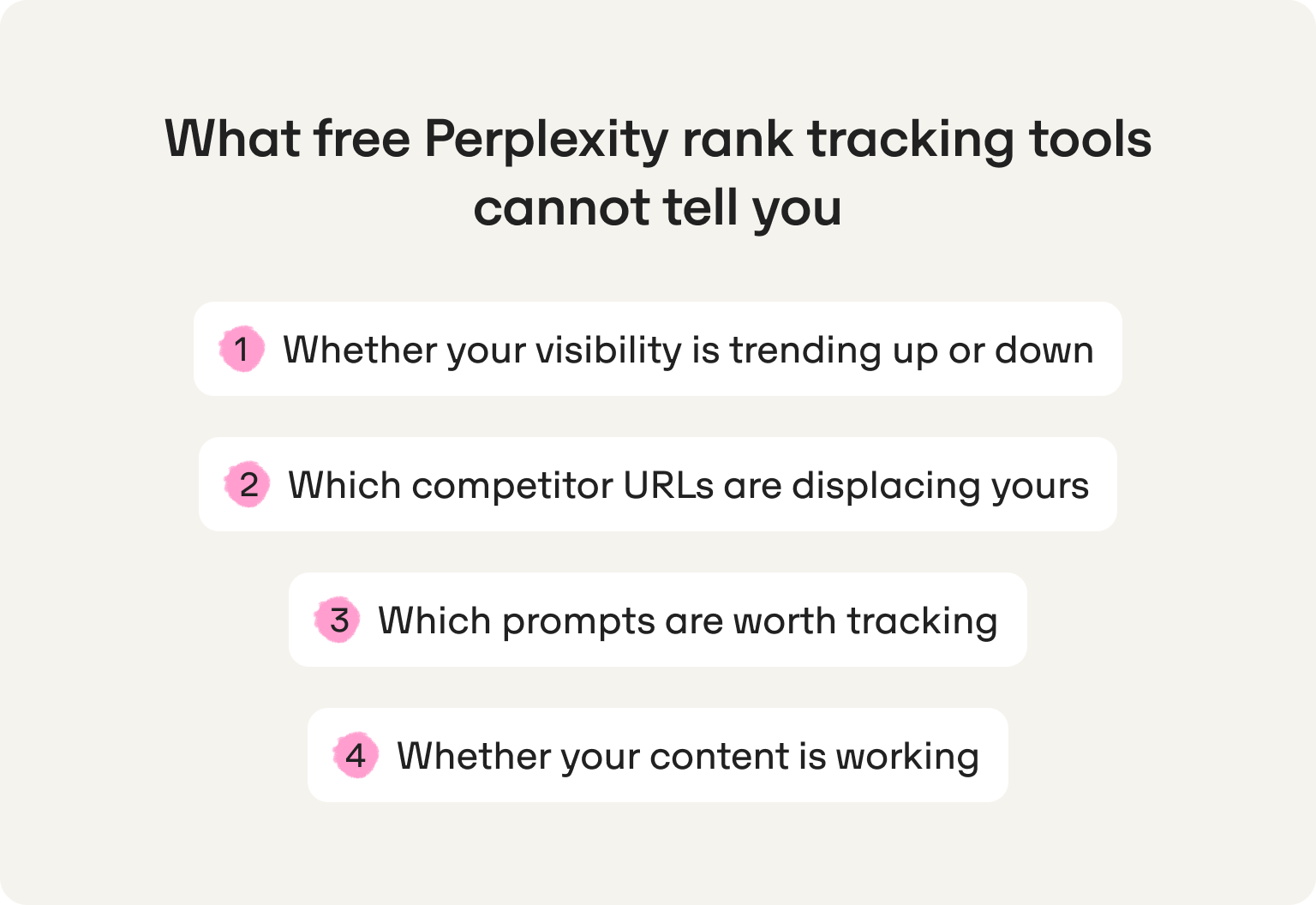
Here is what free tools structurally cannot tell you, and why each gap matters:
- Whether your visibility is trending up or down. Without historical data, you have no way to know if last week's content action moved anything. You are checking a number with no reference point to compare it against.
- Which competitor URLs are displacing yours. Free tools surface the outcome, a competitor appearing above you, but not the cause. Knowing that a competitor ranks higher is not the same as knowing which of their pages Perplexity is citing, at which positions, and across which prompts. Without that, you have no clear fix.
- Which prompts are worth tracking. Checking visibility on the wrong questions is not a neutral activity. It produces false confidence or false alarm. Prompt research, meaning identifying the high-intent questions your buyers actually ask AI engines, is what makes tracking data useful rather than decorative.
- Whether your content is working. This is where the freshness data becomes relevant. According to Omnia's citation database, 25.62% of all Perplexity citation events come from pages with a year in the title. Of those, 81.8% carry the current year. Year-tagged URLs are cited 1.63 times more often per unique URL than pages without a year in the title. Content freshness is a real signal on Perplexity. A one-time snapshot taken today tells you nothing about whether your content is keeping pace with that signal in six weeks.
A free tool that shows you are invisible confirms there is a problem. It does not tell you which prompts to prioritize, what your competitors are doing to earn their citations, or whether the gap is widening or closing. That is the distance between a diagnostic and a tracking system.
Free vs paid Perplexity tracking: the decision table
The table below maps what actually separates free from paid across the criteria that matter for a team running a GEO motion. Not features for their own sake, but the capabilities that determine whether your tracking data can produce a decision.
| Tool | Free or paid | Perplexity coverage | Historical tracking | Competitor benchmarking | Multi-engine | Action/content layer |
|---|---|---|---|---|---|---|
| Omnia Free Checker | Free | Yes | No | Yes | Yes | No |
| Geoptie | Free | No | No | Snapshot only | No | No |
| Sellm | Free | Yes | No | No | No | No |
| HubSpot AEO Grader | Free | Yes | No | No | No | No |
| Omnia (Growth Plan) | Paid | Yes | Yes | Yes | Yes | Yes |
| Cognizo | Paid | Yes | Yes | Yes | Yes | Yes |
| Otterly AI | Paid | Yes | Yes | Yes | Yes | No |
| Peec AI | Paid | Yes | Yes | Yes | Yes | No |
The best free Perplexity rank tracking tools
Free trackers do one thing well: they tell you whether your brand shows up in a Perplexity answer to a specific prompt, right now. For a team at the start of a GEO motion, that is a legitimate starting point. Here are the five best options available at no cost.
1. Omnia's free AI Visibility Checker
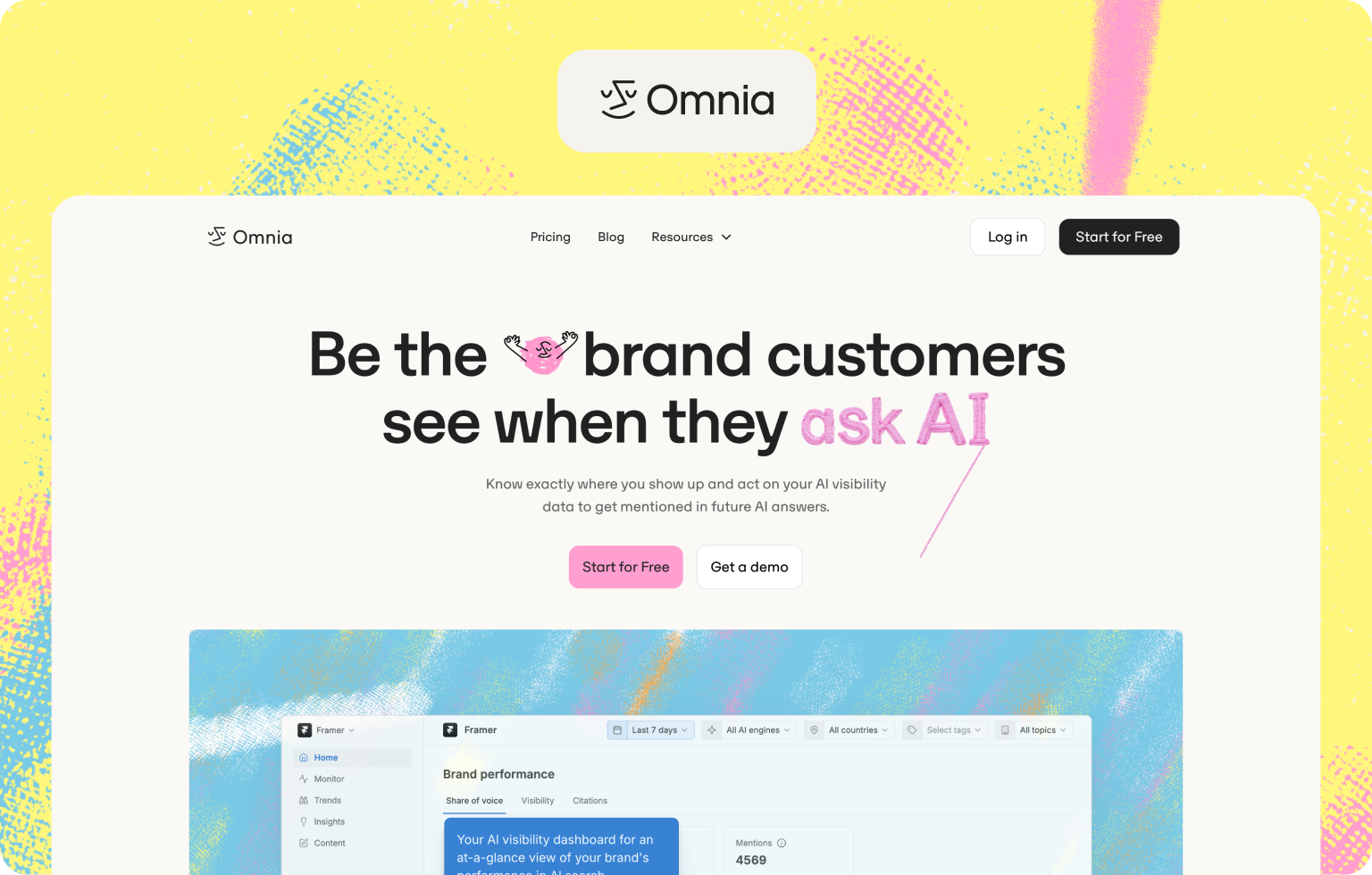
Runs 40 prompts across four AI engines including Perplexity and delivers a baseline AI visibility diagnostic in under five minutes. No signup required. Best for lean teams that want a fast, multi-engine baseline before deciding whether to invest in continuous tracking. The watch-out is scope: it is a single snapshot with no scheduling, no historical trends, and no competitive benchmarking. It tells you where you stand today, not whether you are moving. For a full breakdown of features across all Perplexity tracking options, see the complete Perplexity rank tracker comparison.
2. Geoptie
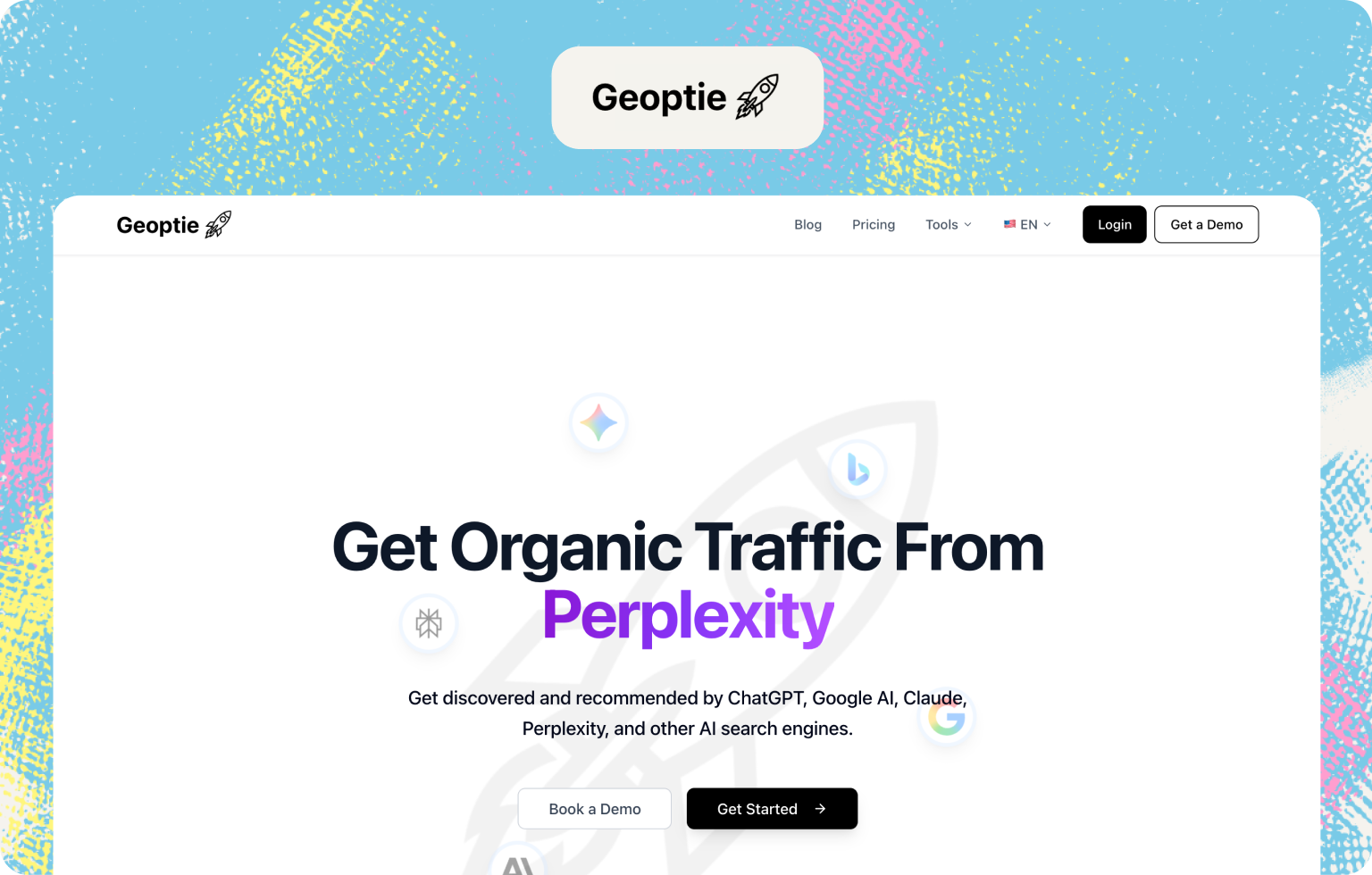
Geoptie checks brand mention and lists competitors appearing in the same Perplexity answer, free and without signup. Best for a quick competitive snapshot before a pitch or a client conversation. The watch-out is repeatability: no scheduling, no historical data, and no multi-engine coverage. Anything beyond a one-off check requires a paid plan.
3. Sellm
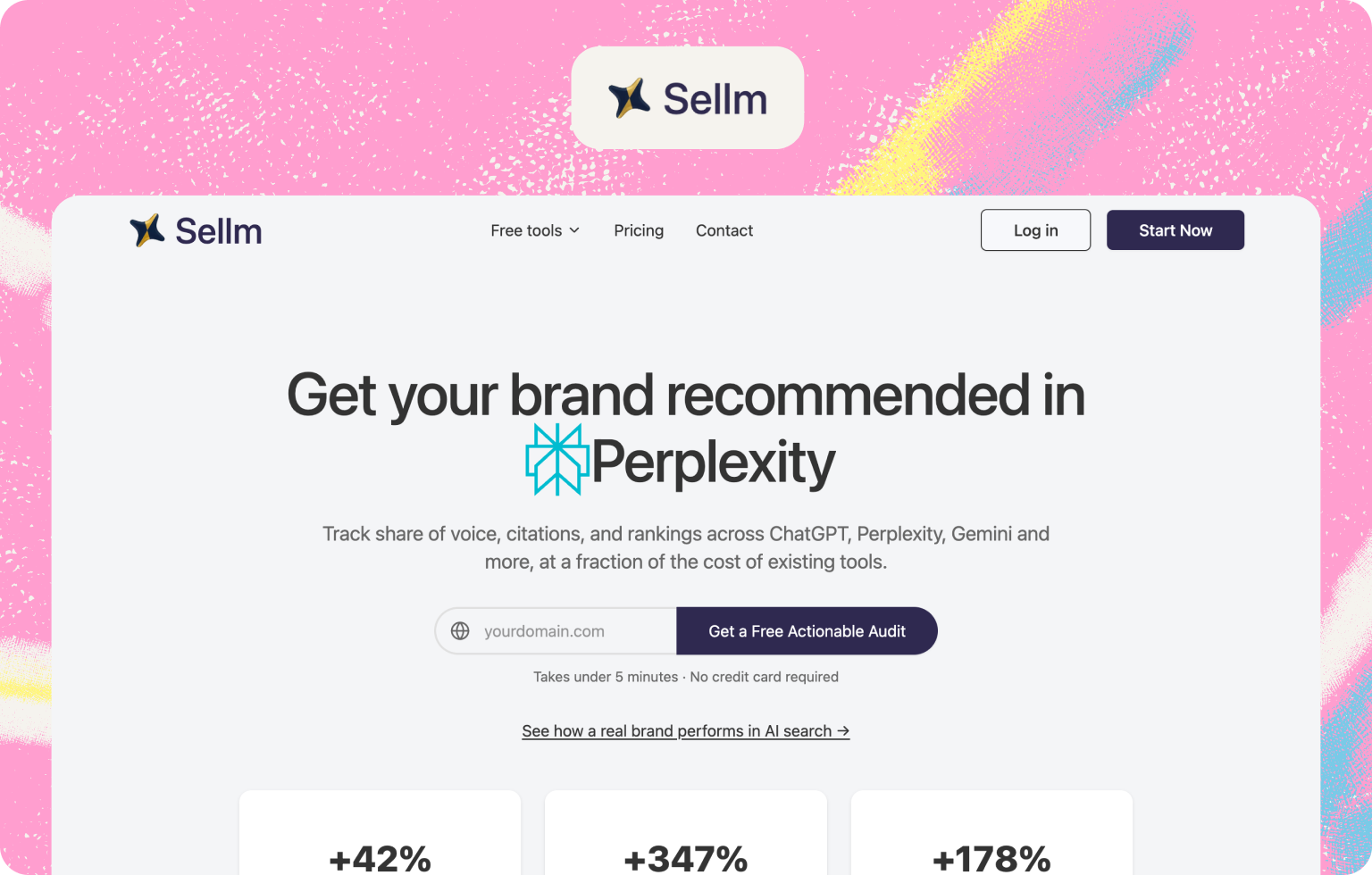
Sellm offer a free one-query checker with a Presence Score framing across a small prompt set. Best for verifying whether a single branded prompt surfaces the brand on Perplexity. The watch-out is scale: single-query architecture limits strategic value significantly, and anything beyond a one-off check requires a paid tier.
4. HubSpot AEO Grader
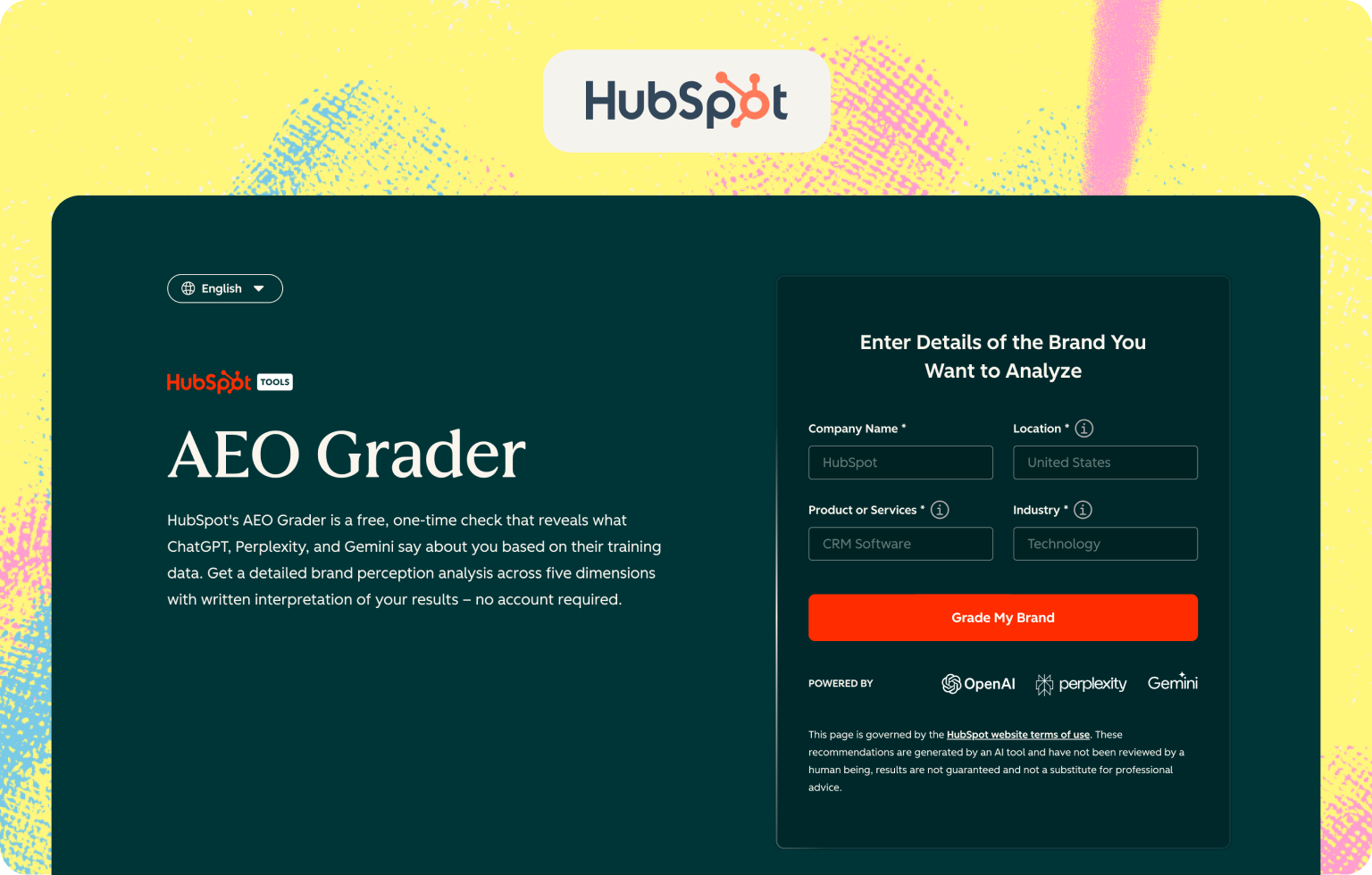
Hubspot offers an unlimited free Perplexity visibility audits with no credit card required. Best for teams already operating inside the HubSpot ecosystem who want a zero-cost starting point. The watch-out is depth: snapshot only, no competitive data, no trend tracking, and advanced features tied to a paid HubSpot subscription.
The best paid Perplexity rank tracking tools
Paid Perplexity trackers separate from free ones on three axes: historical trend data, competitive benchmarking, and whether the platform helps you act on what you find or just reports it. Here are the four leading options.
1. Omnia
On the Growth Plan, Omnia monitors prompts daily across ChatGPT, Perplexity, Gemini, and AI Overviews, AI Mode, Claude, and Copilot, and surfaces citation share gaps against competitors, tracks share of voice over time, and turns those gaps into content through agents trained on your brand data. The free trial includes full Perplexity coverage with historical trend data, competitive benchmarking, and content recommendations built from the same citation database behind every data point in this article. Best for lean startup and scaleup teams that need to show progress, outpace a specific competitor, and run a repeatable GEO motion without a dedicated content team. The watch-out is intent: Omnia is built for teams that intend to act on data, not just observe it. If the current bottleneck is budget rather than execution capacity, start with the free checker and move to the full platform when the gap between what you can see and what you need to do becomes the real constraint.
2. Cognizo
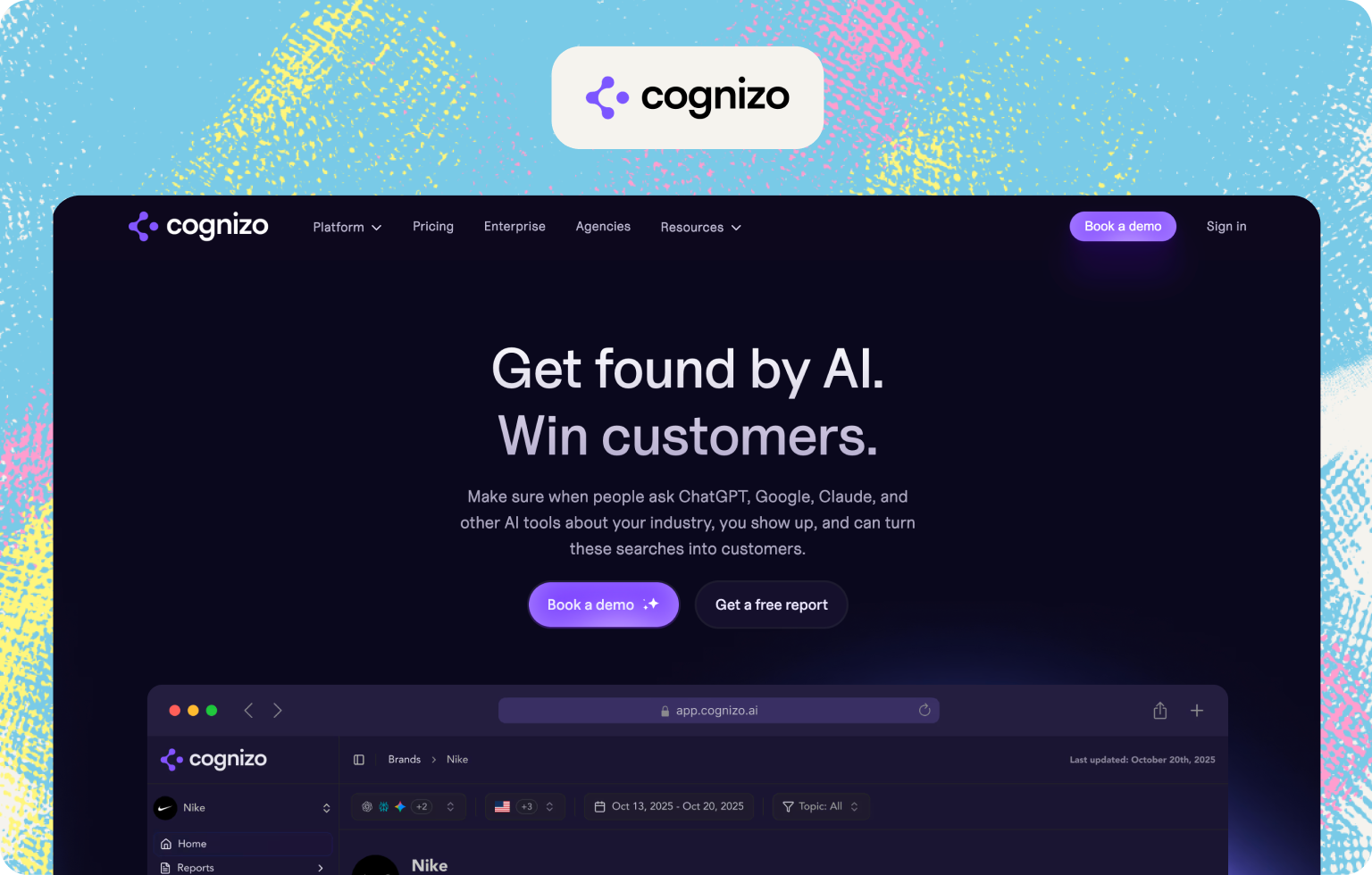
Cognizo covers nine AI engines with citation-level data from Perplexity and includes a content studio and recommendation engine. Best for teams that want monitoring and content output in one platform without managing separate tools for each. The watch-out is fit: broader engine coverage and a richer feature set come at a higher price point, which may be more than a lean startup team needs if Perplexity is the primary engine they care about right now.
3. Otterly AI
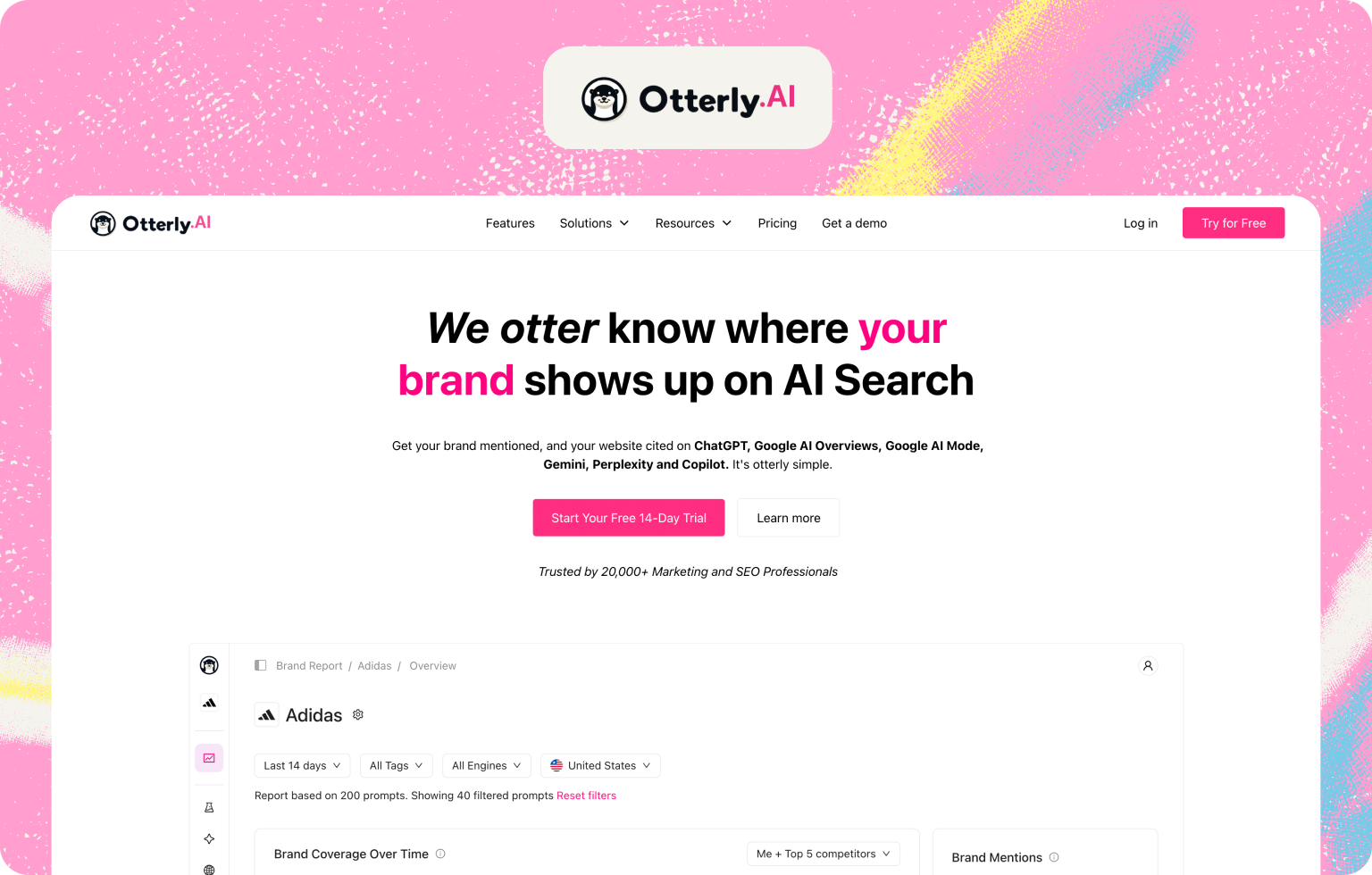
Otterly AI is a lightweight citation-focused tracker with solid Perplexity coverage and clean historical trend data. Best for small teams that want clear citation data without a complex platform to manage. The watch-out is the action layer: Otterly monitors well but has no built-in content workflow. What to do with what you find is still a separate process you own.
4. Peec AI
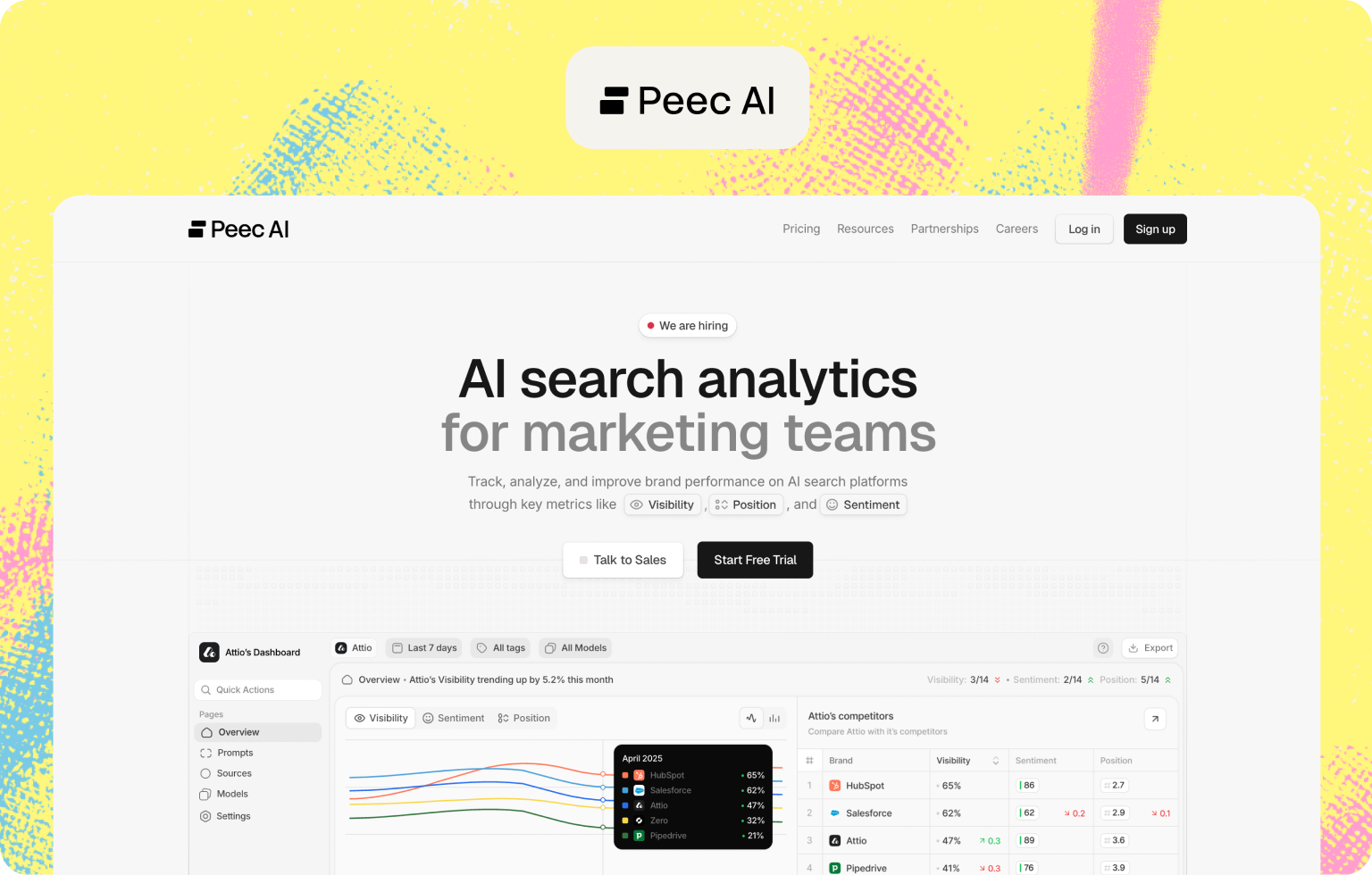
Peec AI offers multi-engine coverage with Perplexity citation data and competitive benchmarking. Best for teams that need cross-engine presence data and are comfortable working without deep citation-level granularity on Perplexity specifically. The watch-out is depth: citation analysis is partial rather than full, which matters when Perplexity's position hierarchy (positions 1 through 6, each capturing roughly 11 to 12% of citations) is exactly the signal you are trying to read.
For a broader view of options across budget tiers, see our roundup of AI search analytics tools under $100.
When free visibility is no longer enough
Free tools have a defined ceiling. The question is not whether you will hit it but when. Three conditions signal that the cost of staying on a free tool is higher than the cost of a paid one.
Condition 1: You are monitoring more than a handful of prompts
Manual spot-checking a few prompts weekly is manageable. At ten prompts across two or three competitors, it becomes a significant time cost for a team that is already stretched. And because Perplexity's average citation streak is 2.37 weeks, checking monthly means you have data gaps across nearly every citation cycle. You are not tracking a channel. You are taking occasional readings of one.
Condition 2: A competitor is consistently appearing in answers and you have no path to understand why
Seeing a competitor recommended above you in Perplexity is the most common trigger that moves teams from free to paid tracking. Free tools confirm the problem. They do not surface which of the competitor's pages are being cited, at what positions, across which prompts, or through which source trust signals Perplexity is extending to them. Without that, you cannot close the gap. You can only observe it.
Condition 3: You need to show progress to someone
A founder reporting to investors, an SEO lead justifying a content spend, a marketing lead presenting to a CMO — none of them can work with a screenshot from last Tuesday. Competitive AI visibility benchmarks and historical trend data are the difference between "we are working on it" and a defensible narrative with a direction.
The urgency behind all three conditions is real. Perplexity's citation pool shrank 36% between November 2025 and April 2026, according to Omnia's April 2026 citation data brief (42M+ citation events, four engines).
Fewer slots means incumbents are harder to displace and ground lost is harder to recover. Teams not tracking weekly are missing the signal that tells them whether their content is earning position or ceding it.
Start with the data layer that actually moves with Omnia
Most tools in this space stop at the monitor. They show you the gap, hand you a chart, and leave you to figure out what comes next. For a founder running GTM without a dedicated team, or an SEO lead already stretched across six priorities, that handoff is where visibility programs stall.
The first question to ask of any Perplexity tracker is not what it shows you. It is how it collects the data. Most free tools, and several paid ones, rely on scraping. They simulate a query, parse the HTML response, and return what they can extract. Perplexity's answers shift based on session context, rendering state, and query phrasing. A scraped result captures one version of one response. It is not a stable signal.
Omnia captures Perplexity data through real-browser simulations, the same method used to build the citation database behind every data point in this article. That accuracy is the foundation everything else is built on.
Here is what that foundation enables:
- Citation intelligence built from real responses. Not scraped snapshots. Daily real-browser captures across ChatGPT, Perplexity, Gemini, and AI Overviews, normalized across 42M+ citation events so the data you act on reflects what these engines are actually doing.
- Competitive gap analysis at the citation level. Not just who is appearing above you, but which specific pages, at which positions, and across which prompts. The information you need to close the gap, not just confirm it exists.
- Insights for content generation. Agents trained on your brand data that turn citation gaps into ideas for content, without adding headcount.
- Workflow integration through Omnia MCP. Citation intelligence connected directly into your existing tools, so the distance between insight and action is not a handoff. It is a step.
Perplexity rewards topical depth, content freshness, and consistent publishing cadence. A team of one or two people cannot sustain that manually and run everything else. That is exactly the team Omnia is built for.

FAQs
Are free Perplexity rank trackers actually free, or do they require a signup?
Most are genuinely free with no credit card required. Omnia's free AI Visibility Checker, Orchly, and Geoptie all return real Perplexity citation data without an account. HubSpot AEO Grader requires a free HubSpot login. The signup question matters less than the data quality question: a free tool built on scraped responses is returning one version of one answer. That is a starting point, not a tracking foundation.
Why does Perplexity tracking matter more now than it did a year ago?
Because the channel is consolidating around established sources faster than most teams realize. Perplexity cited 11.8 domains per answer at its November 2025 peak. By April 2026 that figure had dropped to 7.5. The brands appearing consistently in answers are compounding their authority. The brands not appearing are falling further behind with every cycle they miss. Tracking is not optional at this stage. It is the difference between knowing you have a problem early enough to fix it and discovering it after a competitor has already made the position theirs.
Is Perplexity the right engine to prioritize for rank tracking?
For most B2B and B2C tech brands, yes. Perplexity exposes numbered citation positions. ChatGPT and Google do not. That transparency makes it the only major AI engine where you can connect a specific content action to a measurable position change and build a repeatable playbook from it. It is also the engine where review and comparison content earns the strongest average citation position at 3.1, according to Omnia's citation database. That is exactly the content type that shapes purchase decisions for the buyers your ICP is trying to reach.
How is Perplexity rank tracking different from tracking brand mentions?
Brand mention tracking tells you whether your name appears somewhere in an AI answer. Perplexity rank tracking tells you where you appear, across which prompts, against which competitors, and whether that is changing week over week. Position determines exposure. A brand cited at position 6 and a brand cited at position 1 are both mentioned. They are not receiving the same consideration from a buyer who reads the first two sources and moves on.
How do I know if a Perplexity tracking tool is returning accurate data?
Ask how the data is collected. Tools that rely on scraping parse HTML responses from simulated queries. The problem is that Perplexity's answers vary based on session context, rendering state, and how a query is phrased. A scraped result captures one version of one response on one occasion. It is not a stable signal. Tools that use real-browser simulation capture what an actual user sees, consistently and at scale. That is the method Omnia uses across its entire citation database, and it is why the position and citation frequency data the platform surfaces can be used to make content decisions with confidence rather than treated as directional at best.