
AI Search Visibility
How We Fixed Our Own AEO in a Single Day by Leaving Webflow for Astro

 Miguel FernándezFounder & CTOatOmnia
 AndreiHead of GrowthatOmnia
TL;DR
Claude can write content built to earn AI citations. It cannot tell you whether that content is earning them. Omnia MCP puts your real citation and share of voice data inside the same Claude conversation where you already draft, so the two stop living in separate places. That still leaves every step manual. The Omnia Agent runs the research-to-report loop on its own and pauses for approval only where it counts.
Most marketers using Claude for AEO content are missing the same thing: a way to check whether any of it worked. Claude has become a real team member in the content workflow rather than an experiment. It drafts blog posts, builds campaign briefs, and increasingly pulls from a stack of MCP connectors, Semrush, Clay, Figma, HubSpot, to produce something closer to a finished deliverable than a single document. None of that changes the core problem. Ask Claude to write a page built to get cited by ChatGPT or Google AI Overviews, and it will follow good general practice. It has no way to confirm the page actually got cited, because it has no access to your citation data. That gap is what this article closes.
Claude earned its place in most workflows through a dozen small wins rather than one big pitch. Content creation is the obvious one: feed it a content brief, your brand guidelines, and a couple of examples of your best-performing website content, and it drafts close enough to brand voice to save real editing time on both long form strategy pieces and shorter blog content. Campaign planning works the same way. Claude turns a rough idea into a structured campaign brief, complete with messaging themes, a channel mix, and a first pass at campaign ideas, then human review sharpens the strategic recommendations before anything reaches a team member for execution.
Competitive analysis follows a similar pattern. Paste in a competitor's landing pages or a pile of keyword research, and Claude finds the positioning gaps and messaging differences faster than manual analysis would. It will not replace a proper Semrush or Ahrefs pull. It is very good at turning that raw research into a set of recommendations someone can act on. The same logic extends to repurposing: one strategy doc becomes a run of social media posts, a set of landing pages, and a handful of personalized email campaigns, without a writer starting from a blank page for every format on the content calendar.
The more advanced version of this workflow runs several connectors together. A common pattern now pulls keyword research from Semrush or Ahrefs, prospect and enrichment data from Clay, design context from Figma, and CRM data from HubSpot into a single Claude conversation, then hands the synthesis to Claude Design to produce a sales deck, a campaign performance report, or a landing page mockup ready for human review.
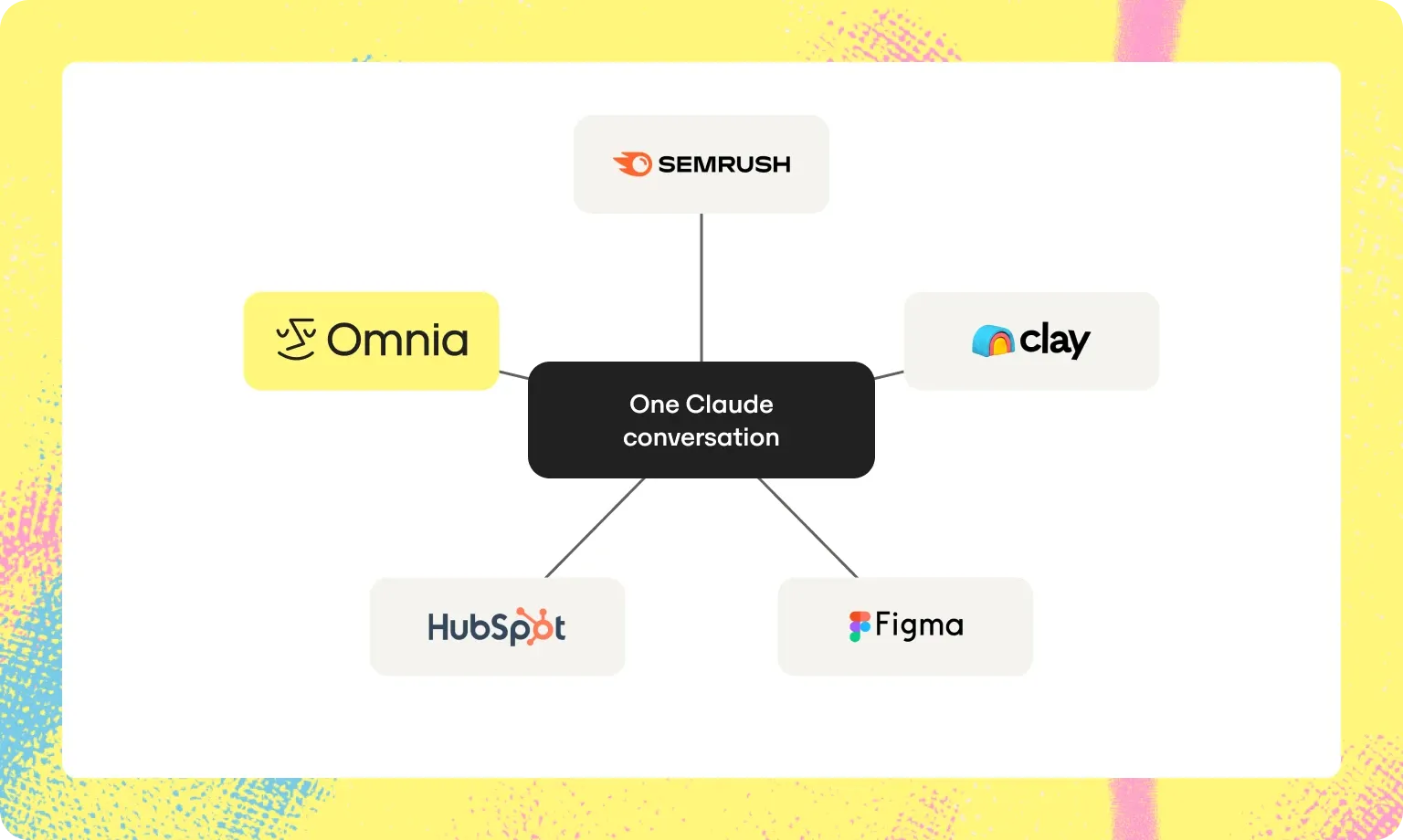
This is the stronger pattern for anything that needs to read as one deliverable rather than a pile of separate exports. Every connector in that stack covers a piece of the martech stack it was built for. None of them cover AI search visibility. Semrush and Ahrefs report on traditional SEO metrics. Clay and HubSpot report on pipeline and enrichment. Whether the resulting content, or any existing page, is actually being cited by an AI engine sits outside all of it.
Worth noting that Claude is also becoming a surface to be measured, alongside being a tool to work in. Teams tracking where their brand appears in AI answers increasingly want Claude rank tracking covered as its own engine, not folded into a generic AI search number.
Getting to this point takes no technical skills. All of it runs inside a normal Claude conversation, Claude Pro on the web or Claude Cowork for teams who want an agentic assistant working across files without anyone touching a terminal. Marketers comfortable with more setup have a second path: installing Claude Code and working with content calendars, campaign data, and markdown files directly, using sub agents and plan mode to run multi step workflows without losing context halfway through.
Neither path is required. Both need one check before they go further: any Claude conversation or MCP connection that touches CRM data or ad account access needs its data privacy controls reviewed first, the same as any other AI powered tool touching customer data.
Here is what even the strongest connector stack still misses. Claude can write content structured to be cited by AI engines: clear definitions, comparison tables, FAQ sections, a confident answer stated up top. None of that guidance comes from your brand's actual citation behavior. It comes from general knowledge about how AI search tends to work. Semrush, Ahrefs, Clay, and HubSpot all report on real data inside their own categories. None of them report on your share of voice in AI answers, which competitor is winning the citations you are missing, or whether the page you published last week actually moved anything.
This is a coverage gap rather than a flaw in how Claude writes. AI visibility data was never part of the SEO, CRM, or design tooling most connectors were built around. Closing the loop between publishing content and confirming it worked requires a data source built specifically for that job.
Most teams assume the fix is a better prompt: more detail about the brand, a sharper instruction on structure, a longer list of dos and don'ts. A better prompt changes how well Claude writes. It does not change what Claude can see. No amount of prompting gives a model access to data it was never connected to, the same way no amount of prompting gives it access to a CRM it has no credentials for. The fix is a connection.
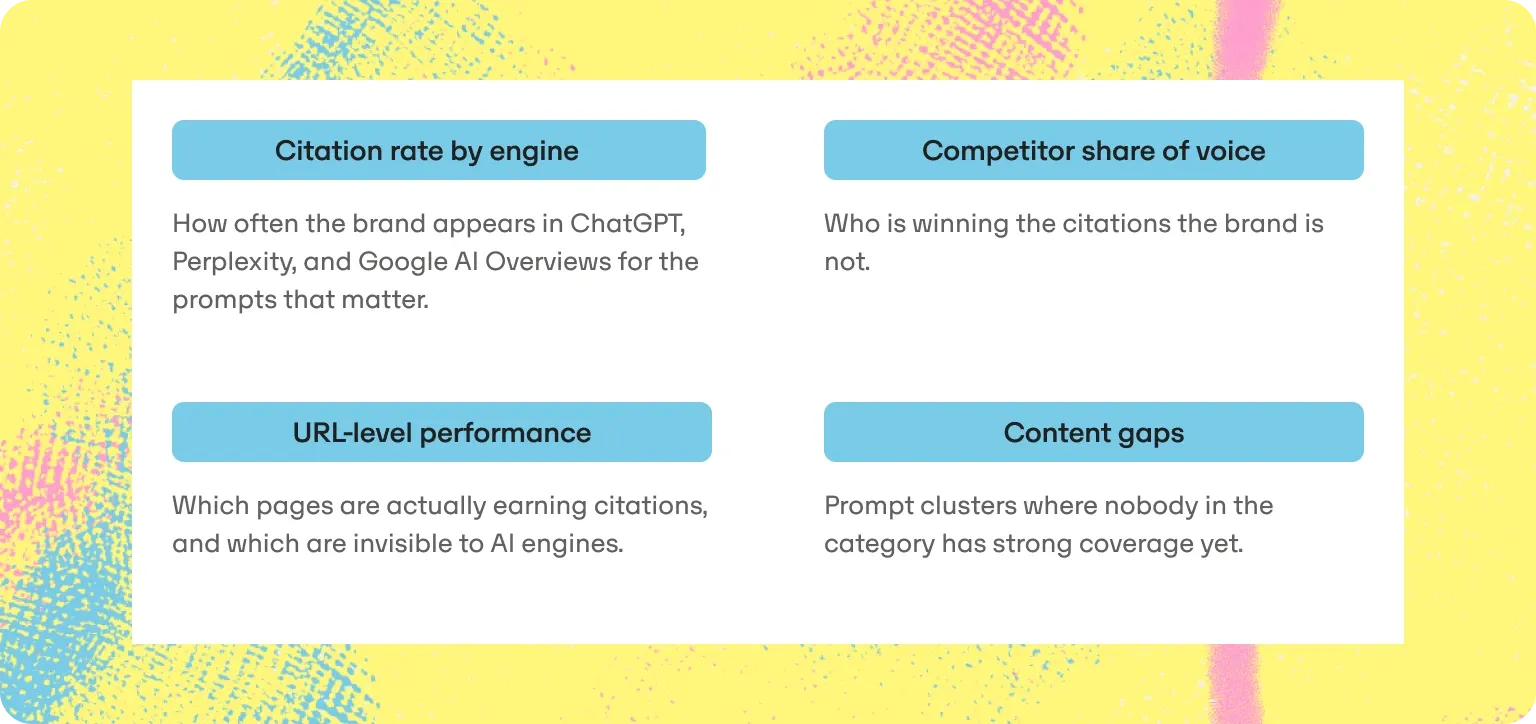
An AEO-aware content workflow runs on four categories of data. Citation rate by engine shows how often a brand actually appears in ChatGPT, Perplexity, Google AI Overviews, and Google AI Mode for the prompts that matter. Competitor share of voice shows who is winning the citations a brand is not. URL-level performance separates the pages actually earning citations from the ones invisible to AI engines. Content gaps identify the prompt clusters where nobody in a category has strong coverage yet.
For most teams, this data lives in a dashboard checked on its own schedule, disconnected from the moment someone sits down to draft. That disconnect, rather than any weakness in Claude's writing, is the real cost.
Omnia MCP connects an Omnia account to Claude, so citation and visibility data can be queried in the same conversation already pulling keyword research, CRM data, or design context, with no separate dashboard and no report exported first. Setup runs three to four steps and takes under five minutes, with no code involved. Alongside Claude Desktop, Claude Code, and Cowork, the same connection works in ChatGPT Desktop, Cursor, VS Code, Windsurf, and Copilot.
The connection reads and writes. On the read side, everything in an Omnia workspace is available: visibility scores, share of voice, citation sources, competitor benchmarks, prompt data, topic trends, insights, and sentiment, across ChatGPT, Google AI Overviews, Google AI Mode, and Perplexity. On the write side, a conversation can create new tracking prompts, manage topics and tags, trigger insight generation, and mark insights complete.
That matters for the workflow. Finding a content gap and starting to track the prompt behind it happen in the same message thread, without a tab switch. A weekly summary formatted for Slack is one question rather than a dashboard export and a manual rewrite.
Once Omnia MCP is connected, the weekly cycle looks like this:
Ask Claude for this week's citation gaps, pulled straight from Omnia. Pick a target by weighing gap size against competitor share of voice and realistic keyword volume. Create a tracking prompt for the target in the same thread, so the result is measurable before the draft exists. Draft against the gap, since Claude already has the context for why the topic matters. Audit the draft against AEO structure: clear definitions, FAQ coverage, comparison tables, the signals AI engines tend to reward. Publish, then ask for a summary next cycle to see what moved.
This is a real upgrade over checking a dashboard separately from the writing process, and the write access means the loop actually closes rather than dead-ending at a read-only report. It is also, by design, six prompts a person has to remember to send, every cycle, for every piece of content.
The gap between Claude with Omnia MCP and the Omnia Agent is not about capability. Both reach the same data and both can act on it. The difference is who starts the cycle.
With MCP, every query begins with a person deciding to ask. In a normal week that happens. In a launch week, a reporting week, or a week somebody is out, it does not, and the data is only ever as current as the last time someone remembered to open the thread. The cycle is data-heavy, repetitive, and dependent on attention that competes with everything else on a content lead's calendar.
The Omnia Agent inverts that. Your Omnia Agent runs the same loop, research, even outreach, grounded in real citation data rather than general knowledge.
Different teams have genuinely different bottlenecks, and the honest answer is that MCP wins for some of them.
| Omnia MCP inside Claude | Omnia Agent | |
|---|---|---|
| Best for | Teams whose bottleneck is insight, and who want to keep every editorial call human | Teams whose bottleneck is execution, where good insights already stall before publication |
| Who runs the cycle | You, prompt by prompt | Your Omnia Agent, with approval gates |
| Strongest use case | Ad hoc analysis, joining Omnia data with Semrush, HubSpot, or Clay in one thread | The recurring weekly loop nobody owns |
| Typical fit | Analysts, agencies building custom client reporting, teams with a dedicated AEO owner | Lean in-house teams, or anyone where AEO is one job among five |
| Trade-off | Nothing happens unless someone asks | Less granular control over each individual step |
For an analyst who wants to interrogate the data three different ways before deciding anything, MCP is the better tool and the Omnia Agent would get in the way. For a two-person content team where the weekly cycle keeps slipping to Friday and then to next week, your Omnia Agent is the one that changes the outcome. Plenty of teams run both, using MCP for exploration and the Omnia Agent for the recurring work. A side-by-side of the Omnia Agent and Claude goes deeper on where each one lands.
Both paths start from the same place. Before either is worth running, a brand needs to know which prompts it appears in today, which engines cite it, and which competitors are taking the citations it is missing. That baseline is what turns a generic content plan into a targeted one, and it is the first thing Omnia builds for any new account.
The fastest way to see it is to connect and ask. A free trial runs fourteen days with no credit card, and the connection takes about five minutes. If you would rather be walked through it, book a demo or sign up for your free 14-day trial to see how you can improve AI visibility for your brand.
Omnia offers a 14-day free trial on the Growth plan.
No credit card required. See exactly where your brand shows up (or doesn't) across AI engines, then let the platform's recommendations guide your next move.

No. Claude is a general-purpose assistant with no built-in connection to citation or visibility data. It writes strong AEO-structured content based on general best practice. It cannot confirm a brand is actually being cited by ChatGPT, Perplexity, Google AI Overviews, or Google AI Mode, or how that compares to competitors, without a connected data source like Omnia MCP.
Omnia MCP connects an Omnia account to Claude through the Model Context Protocol, so citation and visibility data loads directly into a Claude conversation instead of a separate dashboard. Questions about citation gaps, share of voice, or competitor performance get answered in the same thread where the content gets drafted. The connection also supports actions, including creating tracking prompts, managing topics and tags, and triggering insight generation.
No. It reads visibility scores, share of voice, citation sources, competitor benchmarks, prompt data, topic trends, insights, and sentiment. It also writes, so a conversation can create prompts, manage topics and tags, trigger insight generation, and mark insights complete.
Both reach the same data and both can act on it. With MCP, a person starts every cycle and sends every prompt. Your Omnia Agent runs the full loop on its own, from diagnosis through published content to reporting on what moved, and pauses for approval before anything goes live. Teams whose bottleneck is analysis usually prefer MCP. Teams whose bottleneck is execution usually prefer the Omnia Agent.
Yes, given the right input: strong brand guidelines, real examples of past content, and enough context to work from produce well-structured, citable drafts. What Claude cannot do on its own, and what any general-purpose AI platform shares as a limit, is confirm that structure is actually earning citations for a specific brand.
No. Setup runs three to four steps and takes under five minutes, with no coding involved.
Written By
 AndreiHead of GrowthatOmniaMiguel FernándezFounder & CTOatOmnia
 Jose Luis García del RíoGrowthatOmnia
 Jose Luis García del RíoGrowthatOmnia
 Miguel FernándezFounder & CTOatOmnia
 Jose Luis García del RíoGrowthatOmnia
No credit card required · Free for 14 days · See your AI visibility within 3 minutes