


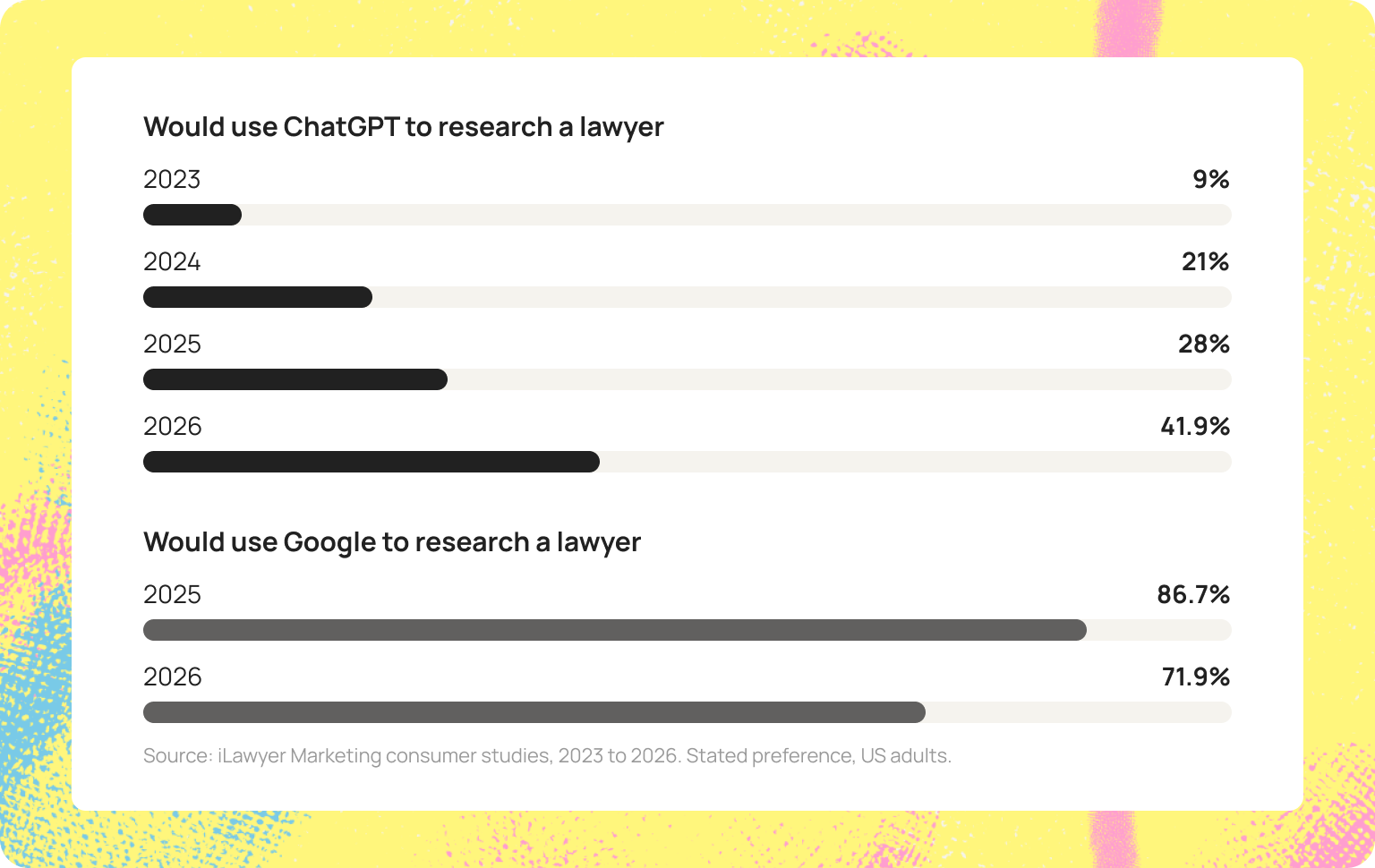
Your prospective clients now ask AI tools which lawyer to hire, often before they run a Google search. In iLawyer Marketing's 2026 survey, 41.9% of US consumers said they would use ChatGPT to research a lawyer, up from 9% in 2023. The AI generated answers they get lean heavily on legal directories, and the directory that wins changes by practice area and query type. Generative engine optimization (GEO) for law firms in 2026 means knowing which sources AI engines cite for your prompts, fixing the pages and profiles they read, and measuring whether your firm appears. Omnia, the AI visibility platform, shows you who gets named, then turns each gap into work your attorneys approve before it goes live.
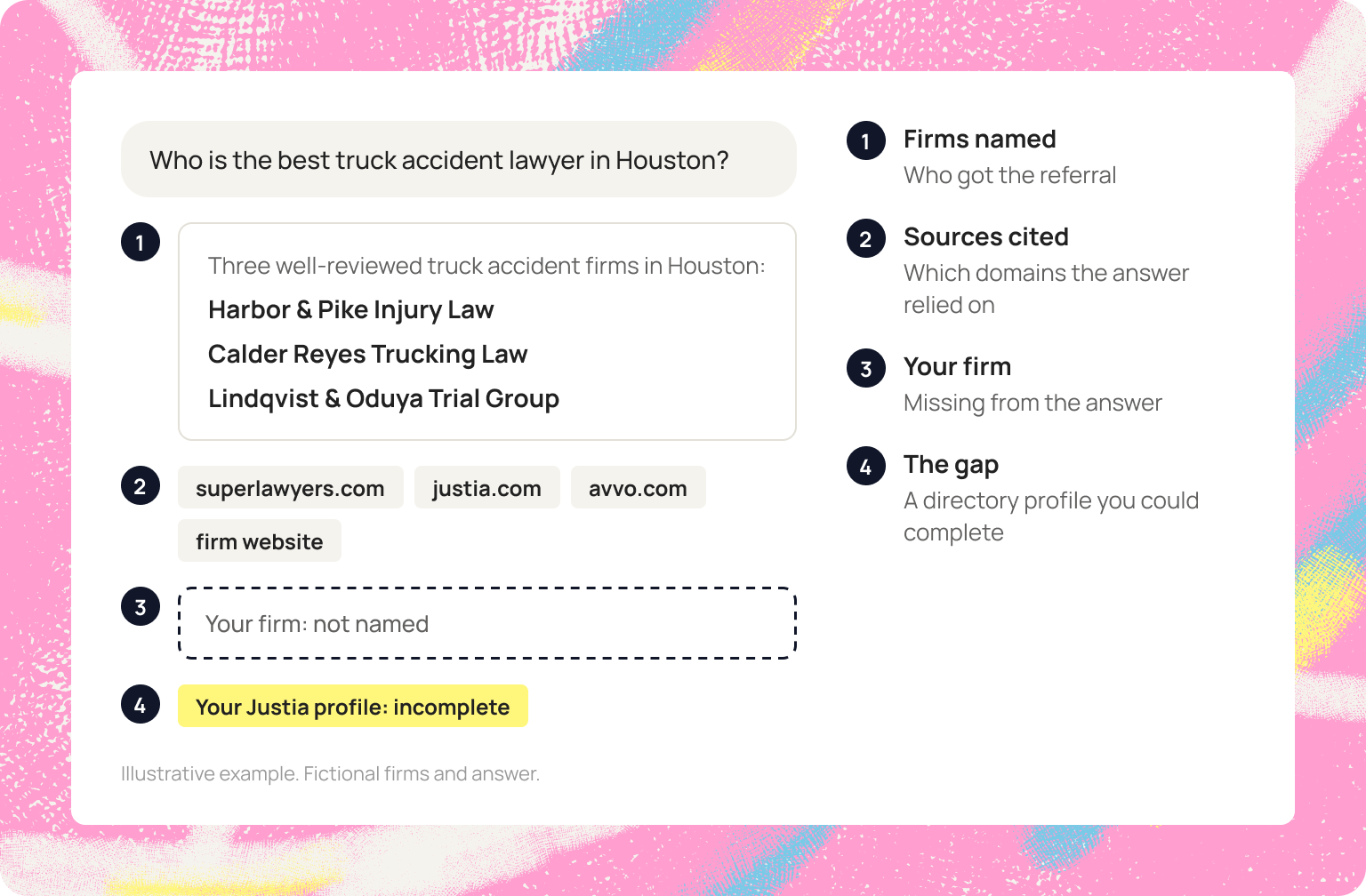
A man is rear-ended by an 18-wheeler on a Houston freeway on a Tuesday afternoon. By Wednesday evening he is still sore, an insurance adjuster has already called twice, and he opens ChatGPT to type: "Who is the best truck accident lawyer in Houston?" In Phoenix, a woman facing a DUI charge asks Google AI Mode what a criminal defense attorney costs and which ones nearby have good reviews. A family recovering from a car accident asks Perplexity whether they even need a personal injury lawyer. None of them has visited a law firm's website yet. Each of them already has a shortlist.
AI search has become a mainstream path to hiring counsel. iLawyer Marketing's 2026 consumer study of 1,110 US adults found that 41.9% would use ChatGPT to research which lawyer to hire. That figure was 28% in 2025 and 9% in 2023, while Google's share fell from 86.7% to 71.9% in a single year. Half of respondents (50.1%) said they would use at least one AI answer engine. These are stated preferences rather than tracked behavior, but four years of the same survey point in one direction.
The heaviest adopters are older than most marketers expect. In the same study, 76% of consumers aged 45 to 60 said they would use AI to research law firms, compared with 48% of those aged 18 to 29. That is the age group hiring counsel for injury claims, divorces and estate plans, the matters that bring many law firm clients through the door.
AI does more than answer questions. Clio's 2025 Legal Trends Report found that among consumers who asked AI a legal question, 28% were told to contact a lawyer and 12% concluded their issue was not worth pursuing. Though a potential client may rely heavily on the advice and referrals from friends and acquaintances, AI supplements, and can even influence a person’s decision.
It’s for this reason: for your legal practice, the question is whose name it gives.
What generative engine optimization (GEO) means for a law firm
Generative engine optimization is the practice of making your firm a source that AI systems trust and a name they repeat when someone asks a legal question. It covers the engines your prospects already use: ChatGPT, Claude, Perplexity, Google AI Overviews, Google AI Mode, and others.
GEO for law firms builds on search engine optimization, so a firm with strong SEO starts ahead. Traditional SEO focuses on ranking pages in search results so a prospect clicks through. GEO focuses on whether large language models understand your firm clearly enough to cite your content and name your attorneys in their answers. Put simply, SEO earns the click and GEO earns the referral. For the full comparison, see how GEO and SEO differ.
Who AI actually names when prospects ask for a lawyer
When a prospect asks AI for a lawyer, the answer usually comes from a short list of legal directories. The 2026 Legal AI Visibility Report by Haute Lawyer Network and 5W audited legal queries across ChatGPT, Claude, Perplexity and Google AI Mode. Three findings stand out:
- Seven directories dominate. Chambers, Legal 500, Super Lawyers, Best Lawyers, Martindale, Avvo and Justia lead AI citations across almost every legal query category.
- Firms appear inside the directories. Individual law firms show up within those profiles and rarely as independent sources.
- Even elite firms lose ground. For a query about Cravath, Swaine & Moore's own M&A expertise, four of the top six results were Chambers and Legal 500 profiles.
Which directory wins depends on how the question is asked:
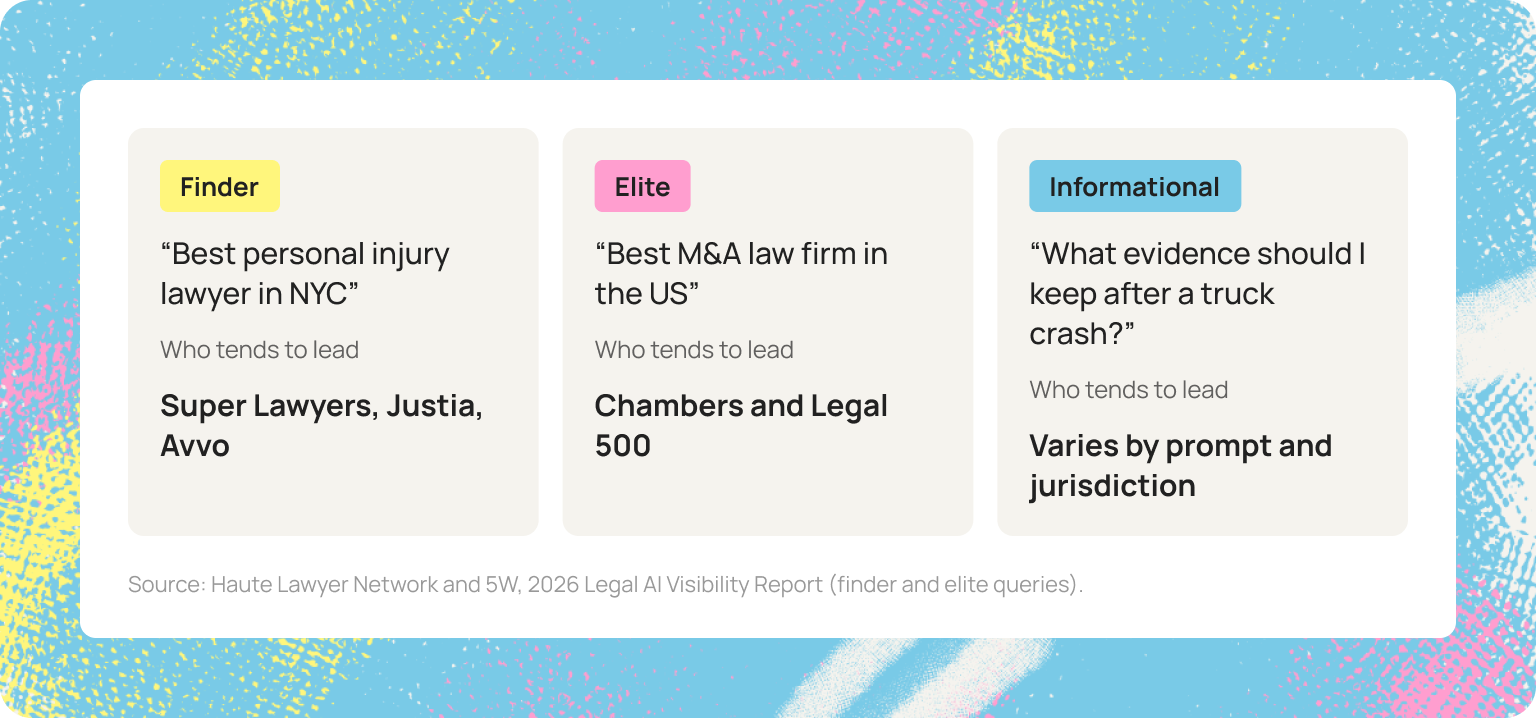
Each query type calls for a different move:
- Finder prompts: your directory profiles do the talking, so they need to be complete.
- Elite prompts: rankings submissions and outside publication carry the weight.
- Informational prompts: your own website has the best chance here, if one page answers the question clearly.
This is the map Omnia builds for law firms: which sources AI engines cite for each of your prompts, and where your firm appears among them.
Why a directory checklist is not a strategy
Nearly every GEO guide for law firms ends with the same advice: claim your Avvo, Justia and FindLaw profiles. That advice is useful but incomplete. It can't tell you which directory AI actually cites for your practice area, in your city.
Domain-level citation intelligence answers that. For each prompt your prospects ask, it shows:
- Which domains the AI cited, from directories to news sites to competitor firm pages
- How often each one appears, across repeated runs and across engines
- Which competing firms were named alongside or instead of yours
A personal injury firm in Houston and an estate planning firm in Palm Beach can see very different sources win, and the data turns a generic to-do list into specific tasks:
- If Justia is cited on your top prompts and your Justia profile is a skeleton, completing it is Monday's job.
- If a directory you pay for never shows up in AI overview citations, that budget may work harder elsewhere.
That is the practical case for tracking which sources AI cites.
What gets a firm named: six signals AI engines read
AI engines favor firms whose information is easy to verify, easy to quote and clearly tied to a place. Six signals do most of that work. Each can be improved without rebuilding your website.
1. Extractable facts about your attorneys
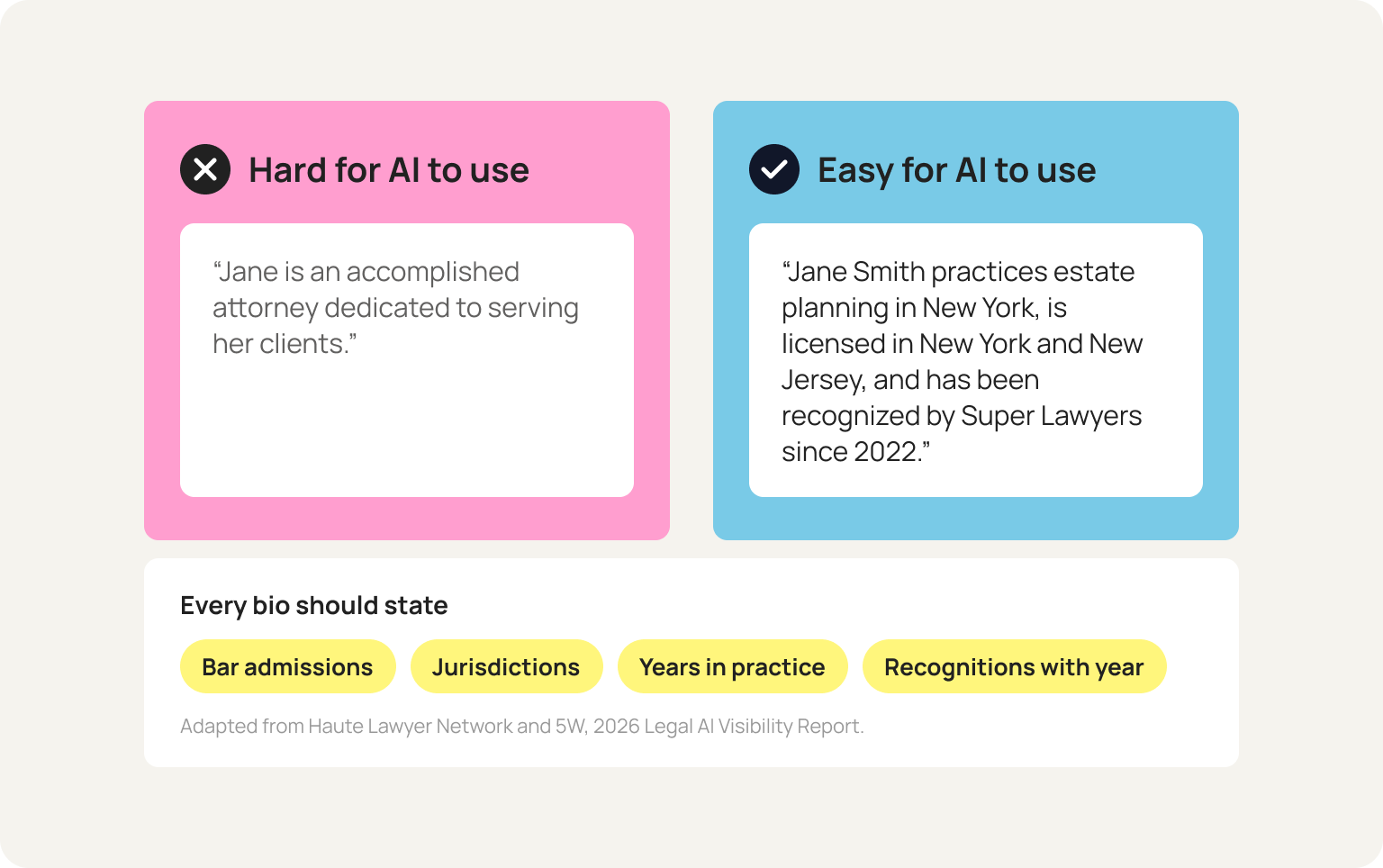
Large language models pull facts out of pages. The 5W report found that directory listings win partly because they state plain, checkable claims, while many firm bios offer rhetoric instead. Compare:
- Hard for AI to use: "Jane is an accomplished attorney dedicated to serving her clients."
- Easy for AI to use: "Jane Smith practices estate planning in New York, is licensed in New York and New Jersey, and has been recognized by Super Lawyers since 2022."
Give every attorney bio the attorney credentials an AI system can verify:
- Bar admissions and jurisdictions
- Practice areas, named plainly
- Years in practice and education
- Recognitions, each with its year
2. Complete, consistent directory profiles
A half-finished profile on a directory AI trusts is a missed citation. Treat profiles as part of your legal content:
- Prioritize by evidence. Start with the directories cited on your own prompts, whatever the sales pitch says.
- Match your details everywhere. Keep the firm name, address, phone number and practice areas identical across directories, your website and your Google Business Profile.
- Fill every field. Bios, practice areas, languages spoken, office hours and photos all give AI more to work with.
3. Answer pages built for one question and one jurisdiction
Scattered information is hard to cite. When Omnio reviewed one Houston personal injury firm's site, it found that the post-crash guidance was split between a 240-word section on the main page and a 184-word FAQ. A competing firm had a single dedicated evidence section naming the driver's logbook, truck black box, ECM records and accident reconstruction.
A citable answer page usually has:
- A direct answer in the first two sentences
- A named jurisdiction and statute, such as Texas Transportation Code Section 550.026 for crash reporting
- One question per page, so the AI doesn't have to assemble the answer from fragments
- Sources, statistics and quotations. A Princeton-led study of generative engine optimization found that adding these raised a source's visibility in AI answers by up to roughly 40%.
Start with your existing practice area pages. The answer is often already there, spread across three places.
4. Third-party corroboration
AI engines trust what several independent sources agree on. Build authority signals outside your own site:
- LinkedIn profiles. The 5W report found that ChatGPT cites LinkedIn heavily for questions about professionals, so write attorney headlines with plain facts: title, practice area, firm and credential.
- Bylines in legal publications such as Law360, Bloomberg Law or the ABA Journal
- Bar association and professional body pages that list your attorneys
- News coverage of your firm's work, where your ethics rules allow it
5. Technical access
None of the signals above count if AI crawlers can't read your pages. Check four things:
- AI crawlers are allowed. Review robots.txt for GPTBot, ClaudeBot, PerplexityBot and Google-Extended.
- Pages are server-rendered, so the content is visible without running scripts.
- Schema markup is in place. Use structured data for LegalService, Person (for each attorney), Organization and FAQPage.
- Core Web Vitals are healthy. They still matter for traditional search, and fast, clean pages are easier to crawl.
6. Local signals: the city, the courthouse and the interstate
Legal questions are local. A prospect rarely asks for "a truck accident lawyer." They ask for one in Houston, or for help after "a wreck on I-10 near the Katy Freeway exit."
That detail shapes the answer. It tells the AI which state's law applies, which county may handle the case, and which firms are close enough to help.
How location shows up in real prompts:
- City or suburb: "Best car accident lawyer in Sugar Land"
- Road or interstate: "Hit by an 18-wheeler on I-45 near Conroe, who should I call?"
- County or court: "Harris County criminal defense attorney for a DWI"
- Near me: "Personal injury lawyer near me open now." Some AI engines also factor in the user's approximate location (based on personalization and past conversations), so the same prompt can return different firms across town.
What local SEO still does for AI search
Local SEO feeds local AI search. The groundwork you already know still counts:
- Google Business Profile. Google says local results depend on relevance, distance and prominence. Choose the right primary category (for example, Personal Injury Attorney), list your real service areas, and keep hours current.
- Reviews in clients' own words. A review that mentions "my truck accident case in Pasadena" tells AI engines what you handle and where. You can ask satisfied clients to describe their experience, but check your state's rules on testimonials first, and never script a review.
- Consistent location details. The firm name, address and phone number should match everywhere (see signal 2).
Local answer pages that earn citations
A strong local page answers the questions a prospect has because of where the crash or arrest happened:
- Who responds. Houston Police, the Harris County Sheriff's Office and Texas DPS handle different roads, and each one produces its own report.
- How to get the report. In Texas, crash reports are available through TxDOT's online Crash Report system.
- Where the case may be filed. A crash on I-10 in Harris County and one near Beaumont can land in different courts.
Avoid near-duplicate pages. Forty pages that differ only by swapping "I-45" for "I-610" read as thin to search engines and AI engines alike. Google's spam policies classify pages built this way to rank as doorway pages. One substantive page per real local question does more.
Track local prompts the way clients ask them
Build your prompt set around the places your clients name:
- Cities and suburbs you actually serve
- Highways and interstates where your cases come from
- Counties and courthouses that appear in your matters
Then compare results by location. You'll see where your firm is named, where a competitor owns the answer, and which local question deserves the next page.
GEO content is still considered lawyer advertising
Every page you publish for AI search is a communication about your services. ABA Model Rule 7.1 prohibits false or misleading communications about a lawyer's services, whoever or whatever drafted them.
Before any AI generated content goes live, check it against these points:
- Review duty. ABA Formal Opinion 512 (July 2024) expects lawyers who use generative AI to understand the tools and review what they produce.
- Specialist claims. Model Rule 7.2(c) restricts implying that you are a certified specialist without approved certification. AI generated responses often reach for words like "expert" and "specialist," so watch for them.
- Outcome language. Remove anything that promises or implies results.
- State rules. Some states add filing, disclaimer or review requirements, and those rules control.
Whatever tool your firm uses, it should hold every draft for attorney review before anything publishes.
How to see whether your firm gets named (and which firms do)
Most GEO advice for lawyers stops at "ask ChatGPT and see who comes up." That's a reasonable first look. You can also check where your firm stands today, free.
A manual check has limits, though:
- Answers change run to run. Ask the same question twice and the firms named can differ.
- Answers change by engine. ChatGPT, Perplexity, Google AI Overviews and Google AI Mode draw on different sources.
- Answers change by place and language. A result in Houston says nothing about Dallas, or about Spanish-language prompts.
- One screenshot is not a trend. You can't tell whether last month's new page moved anything.
Traditional tools only fill part of the gap. Google Search Console gives limited visibility into AI answers, and Google Analytics can show referral visits from AI platforms. Neither one tells you which firms the AI named instead of yours.
What law firms should track instead for AI visibility
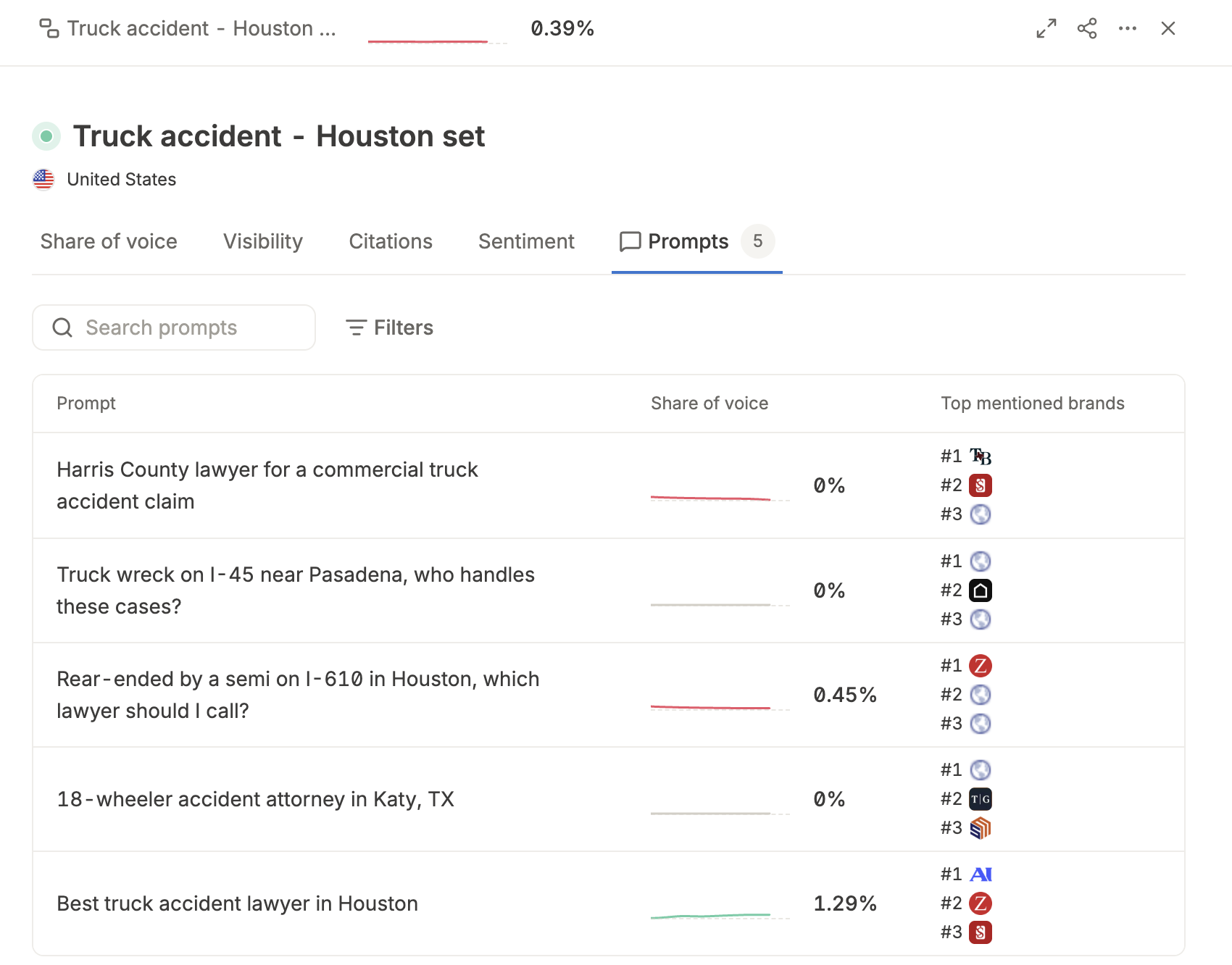
Build a prompt set that mirrors how clients ask, then track it daily across engines. Choosing the prompts worth tracking matters more than tracking many of them. Organize the set by:
- Practice area: truck accidents, estate planning, DWI defense
- Place: city, suburb, county, interstate
- Intent: finder ("best lawyer for…"), decision ("do I need a lawyer for…") and informational ("what happens after…")
Then watch four measures:
- Visibility: how often your firm appears at all
- Share of voice: your mentions compared with competing firms
- Citations by domain: which directories, sites and firm pages the AI relied on
- Sentiment: how the AI describes your firm when it does name you
Split every measure into branded and non-branded prompts. Branded prompts mention your firm by name, so you'll usually appear. Non-branded prompts, such as "best truck accident lawyer in Houston," are where new clients come from.
To find non-branded prompts you're missing, prompt discovery surfaces the questions prospects actually ask in your practice area.
From gap to published page: how Omnio handles it for a law firm
Knowing you're missing from an answer is half the job. The other half is doing something about it, which is where most solo and small firms stall. Omnia's GEO agent, turns each gap into a scoped project your firm can take on itself or hand to Omnio.
Here's how that worked for one Houston personal injury firm.
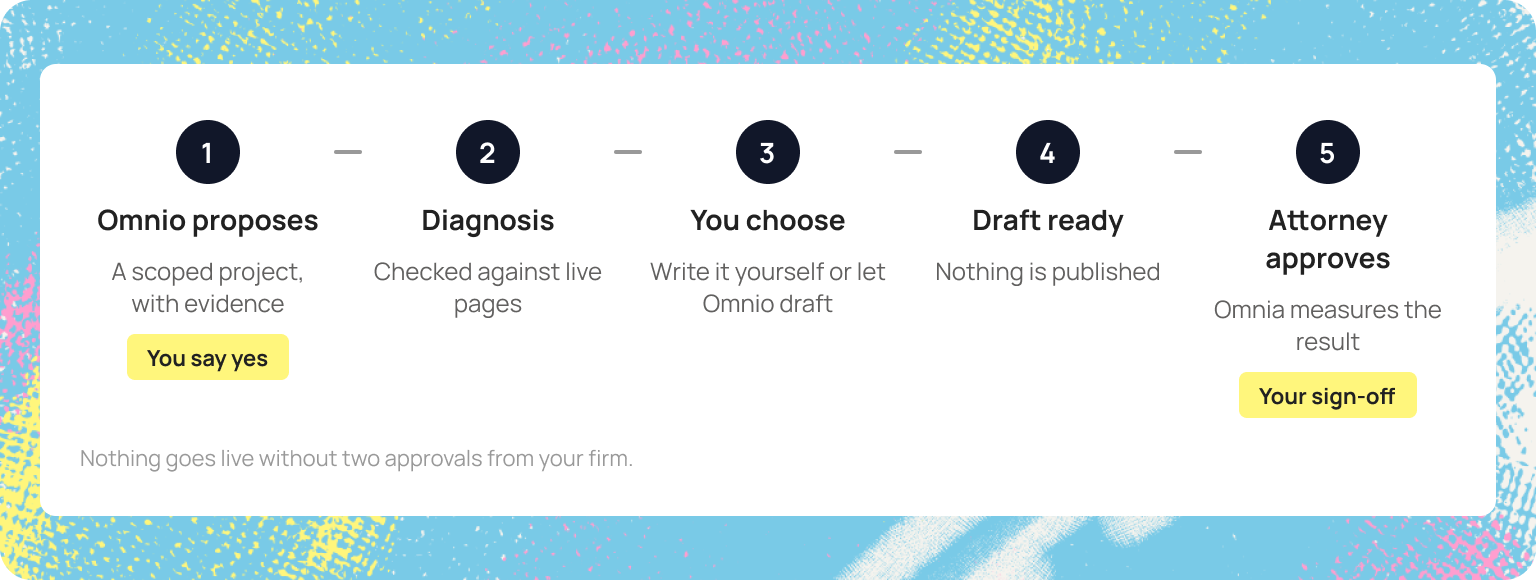
Step 1: Omnio proposes a project
Omnio reads your visibility data every night. When it finds a gap worth acting on, it creates a suggestion through Project Suggestions.
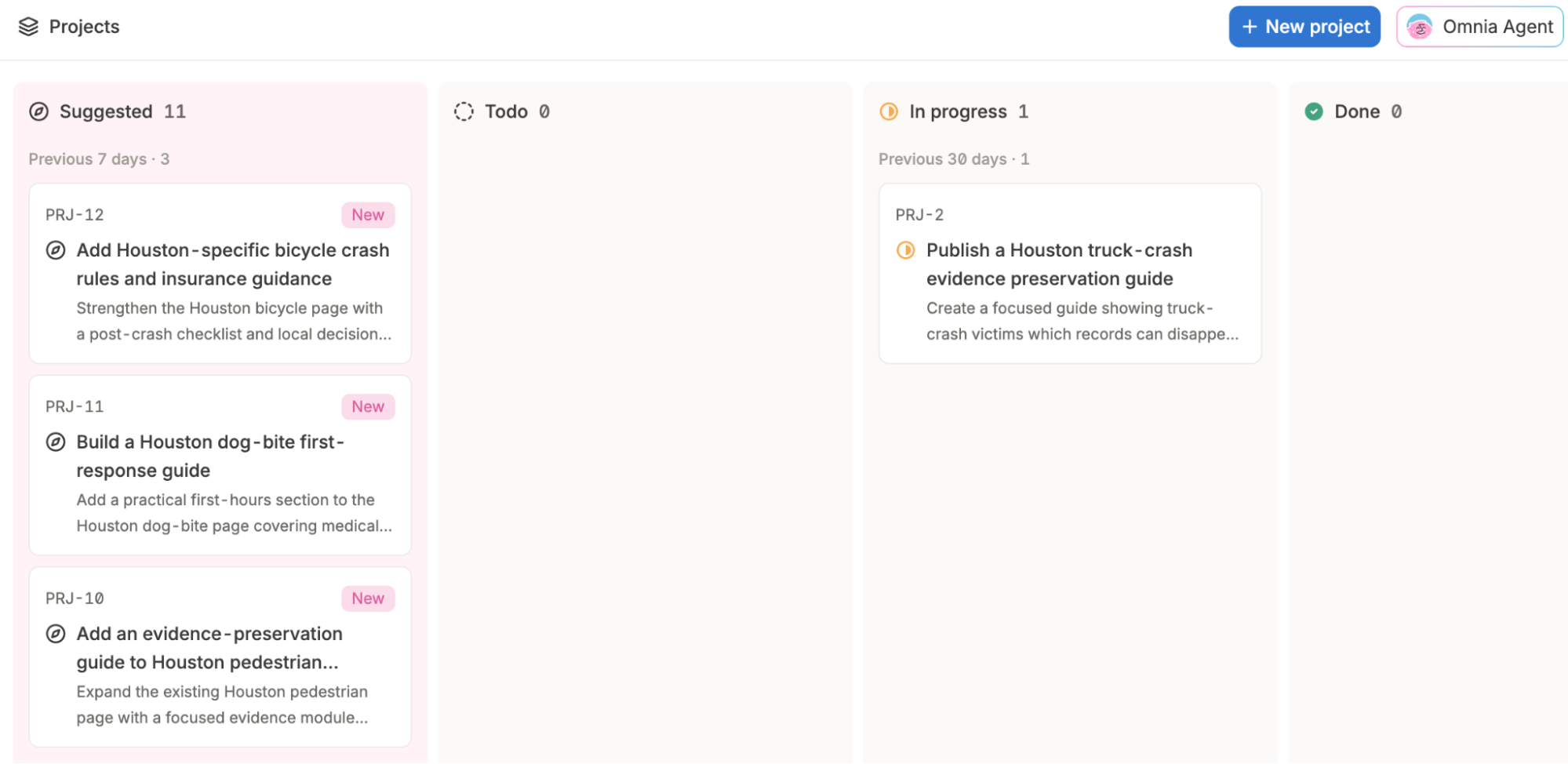
For this firm, the suggestions covered several practice areas, from bicycle crashes to dog bites. The firm took on one of them, a truck-crash evidence preservation guide. Omnia's AI Agent based it on three findings:
- The truck accident page was indexable, with FAQPage and LegalService schema in place
- Post-crash guidance was scattered across a 240-word section and a 184-word FAQ
- The first-day sample showed 0% non-branded visibility for serious truck-crash questions
The firm decides. Omnio asks one question: take it on, or not for us. Nothing starts without a yes.
Step 2: The diagnosis is grounded in real pages
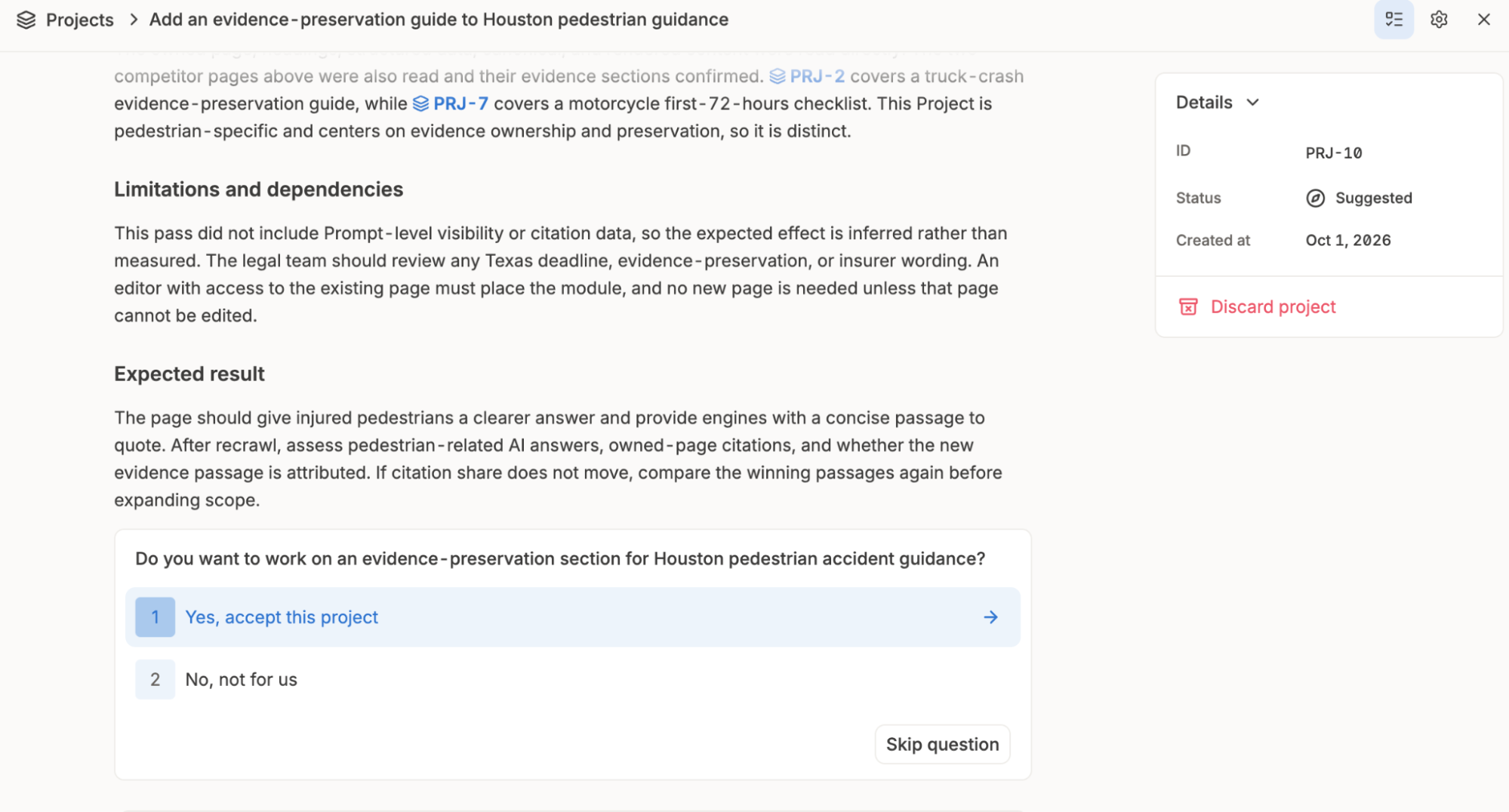
Before the firm says yes, each suggestion lays out what Omnio checked, what it couldn't check and how the result will be measured. The screenshot below shows the detail view for another suggestion on the same board: an evidence-preservation guide for the firm's Houston pedestrian page, still marked ‘Suggested’.
Reading it from top to bottom:
- What Omnio read. The opening notes confirm that Omnio read the firm's own pages and the competitor pages directly. It also checked the board for overlap and found that this project is distinct from the truck-crash guide already in progress and from another project covering a motorcycle checklist.
- Limitations and dependencies. Omnio states that this pass had no prompt-level data, so the expected effect is inferred and not yet measured. It flags any Texas deadline, evidence-preservation or insurer wording for the legal team, and notes that an editor needs to add the section to the existing page.
- Expected result. Omnio defines success before any work starts. After AI engines recrawl the page, it will check pedestrian-related AI answers and whether the new passage gets cited. If nothing moves, it compares the winning passages again before widening the scope.
- The decision. The view ends with one question and two answers: "Yes, accept this project" or "No, not for us."
For the truck-crash project, the same diagnosis found no dedicated evidence guide on the firm's site. A competing firm's page had one, naming the driver's logbook, black box, ECM records and accident reconstruction. How Omnio scans your visibility overnight explains the process in more detail.
Step 3: Choose who writes
Your firm has two options:
- Write it yourself. Take the scoped brief, draft in-house, and let Omnia measure the impact.
- Hand it to Omnio. Ask it to draft the page for your review.
Step 4: Draft ready, nothing published
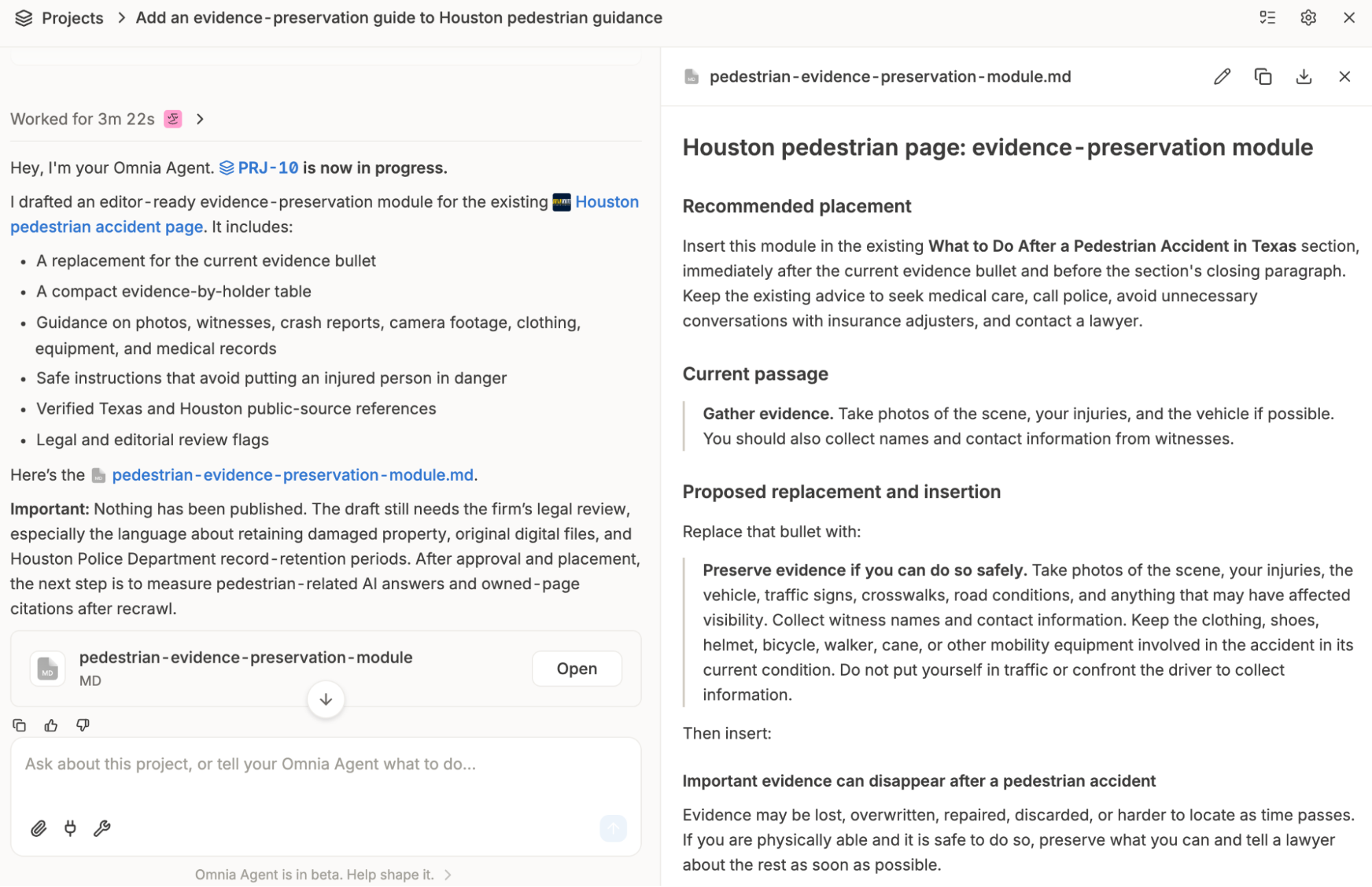
On the left, Omnia AI Agent summarizes what it drafted: an evidence-preservation module, ready for an editor, for the firm's existing Houston pedestrian accident page. The module includes:
- A replacement for the page's current evidence bullet
- A short table showing who holds each type of evidence
- Guidance on photos, witnesses, crash reports, camera footage, clothing, equipment and medical records
- Safety instructions that keep an injured person out of danger
- References to verified Texas and Houston public sources
- Flags for legal and editorial review
Below the summary, Omnia's AI Agent states plainly that nothing has been published. It also names the language the firm's lawyers should check first: keeping damaged property, keeping original digital files, and Houston Police Department record-retention periods.
On the right, the draft opens as a document. It starts with placement instructions that name the exact section on the page ("What to Do After a Pedestrian Accident in Texas"), then sets the current passage beside the proposed replacement. The current bullet tells clients to take photos and collect witness details. The replacement adds traffic signs, crosswalks and road conditions, asks clients to keep clothing and mobility equipment as they are, and warns them never to step into traffic or confront the driver.
Step 5: The attorney edits and approves
The draft opens in an editor inside Omnia, so the firm's attorney can change it directly before anything goes live.
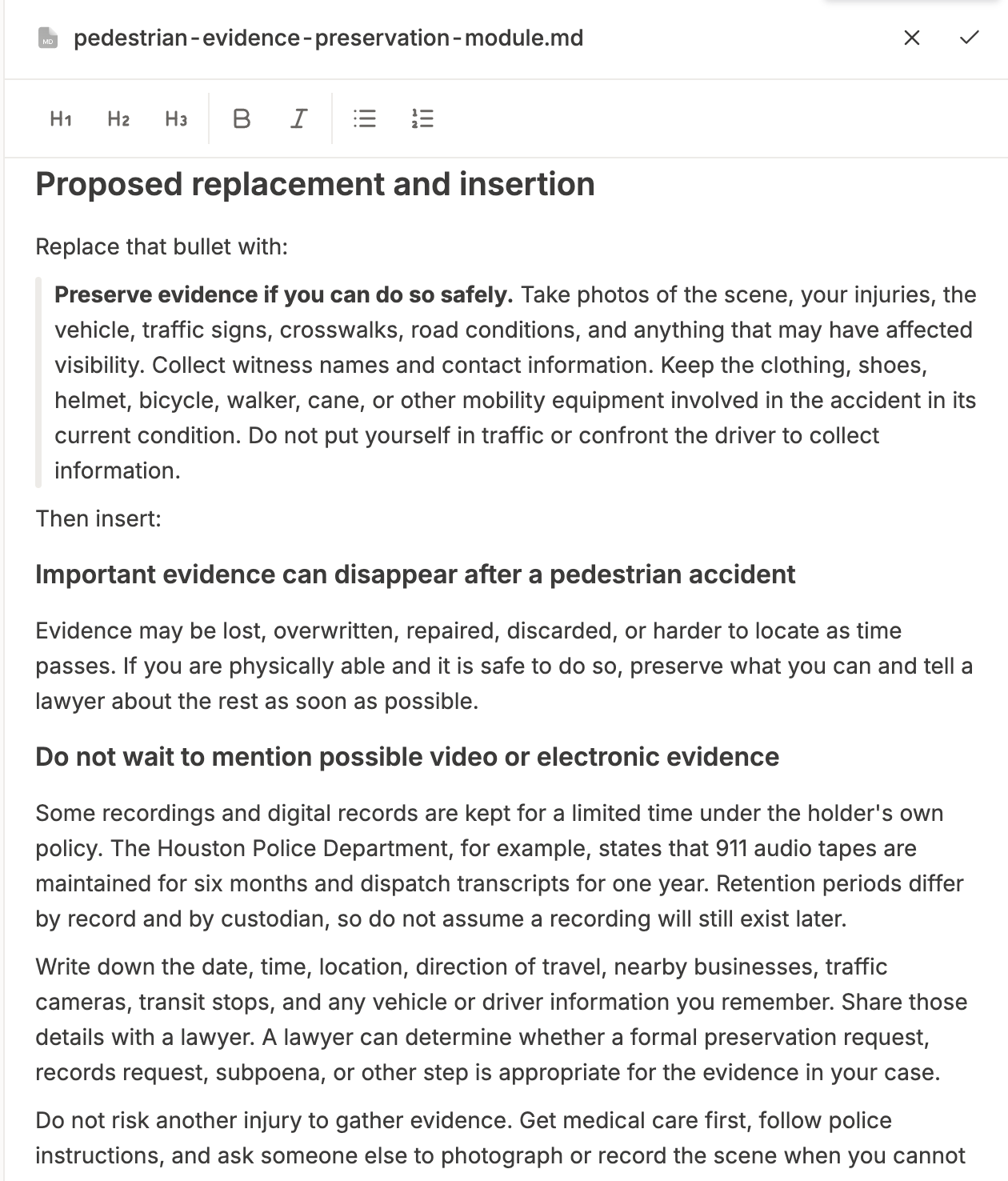
The screenshot shows the draft in editing mode, with a formatting toolbar at the top and buttons to cancel or save. Below the replacement bullet from Step 4, the module adds two short sections:
- "Important evidence can disappear after a pedestrian accident." It explains that evidence can be lost, overwritten, repaired or thrown away, and tells clients to keep what they safely can and tell a lawyer about the rest.
- "Do not wait to mention possible video or electronic evidence." It cites the Houston Police Department's stated retention periods, six months for 911 audio and one year for dispatch transcripts. It asks clients to note details such as nearby businesses, traffic cameras and transit stops, and leaves the choice of a preservation request, records request or subpoena to the lawyer.
This is where the review flags from Step 4 pay off. The record-retention periods are one of the points Omnio asked the legal team to check, so the attorney verifies them against the source, adjusts any wording and saves.
Once the attorney approves and the page is published, the same tracked prompts measure whether the new passage gets cited.
Omnio does 95% of the GEO work. You orchestrate the other 5%, including the parts only a licensed attorney should decide.
Law firms in more than one market: AEO by country and language
For some firms, the question goes beyond "do we get named in Houston?" It becomes "do we get named in Madrid, or in Spanish-language prompts in Miami?" That applies to:
- Cross-border practices such as immigration, international arbitration and M&A
- Firms opening an office abroad
- US firms serving clients in a second language
Three things change when the market changes.
The answer changes with the language of the question. A 2026 multilingual audit of AI citations in mental health queries, another high-stakes category, found that non-English queries surfaced fewer sources than English ones (an average of 9.2 against 12.3). ChatGPT returned no sources for 23% of Japanese responses, and Google AI Overviews returned none for 30% of Hindi responses. The study is a preprint, but the pattern is a warning for any firm that assumes English results travel.
The directories change. Chambers and Legal 500 cover many countries, but many markets also have national rankings and directories of their own.
The competitors change. The firms you meet in English-language answers may not be the ones AI names in another market.

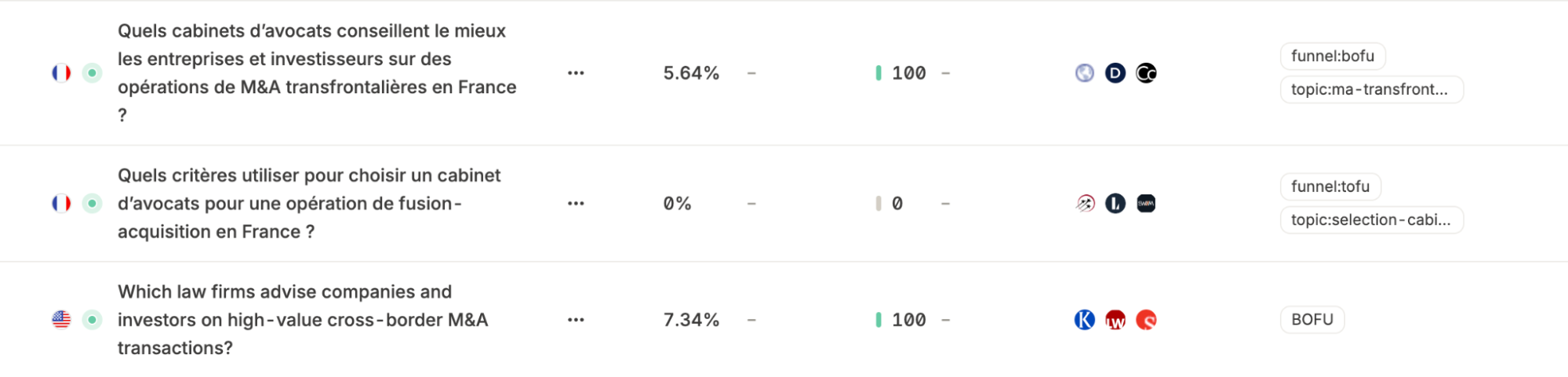
Each market gets its own prompts, written in the local language, with its own share of voice, sentiment and list of the firms AI names most often. The firms that lead in French-language answers are not always the ones that lead in English.
With Omnia, you open a project for each market you serve. Languages and regions are unlimited on every plan, and Omnia's AI Agent's suggestions produce content adapted to that market. Multilingual SEO for AI search covers the wider strategy.
A 30-day GEO starting plan for a law firm
You don't need a big budget to start. You need one month and a clear order of work.
For week 1, a GEO audit gives you a structured baseline. If you're a solo practitioner or a small team, GEO for small teams shows how to keep the work manageable.
Where Omnia fits for law firms
The blunt truth first. Omnia doesn't replace attorney judgment or bar compliance, and it can't buy you a Super Lawyers listing. If your firm handles a handful of matters from referrals alone, a monthly manual check may be enough for now.
For law firms who consider AI search is becoming a real intake channel, Omnia, the AI visibility platform, gives you:
- Daily tracking across ChatGPT, Perplexity, Google AI Overviews and Google AI Mode, with Claude, Gemini and Copilot available
- Citation intelligence showing which domains drive the answers for your prompts
- Share of voice and sentiment against the firms you actually compete with
- Local and international tracking, with unlimited languages and regions on every plan
- Project Suggestions and Omnio, which turn gaps into scoped work, with approval gates before anything is published or sent
Your team may already use ChatGPT or Claude for legal research and drafting. Why a general assistant falls short for GEO comes down to data: Omnia AI Agent acts on your tracked visibility, not on general knowledge.
The economics are simple. If one retained matter is worth more than a year of the plan, a single new client covers the cost. Omnia's published customer stories report results such as 45% more traffic from AI search and a 30% increase in leads from AI. These are individual outcomes, not guarantees.
See how Omnia works for law firms, and compare plans and pricing.
Start with your free 14-day trial with Omnia. No credit card required.

FAQs
What is generative engine optimization (GEO) for law firms?
GEO for law firms is the practice of making your firm a source that AI engines trust and a name they give when prospects ask for a lawyer. It covers ChatGPT, Perplexity, Google AI Overviews and Google AI Mode. It builds on SEO and adds a new goal: being cited and named inside AI answers.
Do ChatGPT and Google AI Mode recommend specific lawyers?
Yes. When asked for a lawyer, AI engines often name specific firms, usually drawing on legal directories such as Super Lawyers, Justia, Avvo and Chambers. Which firms appear depends on the practice area, the location in the prompt and the engine.
Which legal directories matter most for AI search?
A 2026 audit by Haute Lawyer Network and 5W found that seven directories dominate: Chambers, Legal 500, Super Lawyers, Best Lawyers, Martindale, Avvo and Justia. The most important one for your firm depends on your practice area and city. Tracking the domains cited on your own prompts is the only reliable way to know.
Is GEO for legal firms different from law firm SEO?
They overlap, but they measure different outcomes. SEO focuses on ranking pages in search results so prospects click through. GEO focuses on whether AI engines cite your content and name your firm in their answers, often before any click happens.
Do bar advertising rules apply to AI-drafted marketing content?
Yes. ABA Model Rule 7.1 applies to any communication about a lawyer's services, whoever or whatever drafted it, and ABA Formal Opinion 512 expects lawyers to review generative AI output. State rules vary and control, so an attorney should approve every page before it publishes.
How long before a law firm shows up in AI answers?
It varies. AI engines need time to recrawl and re-weigh a new or updated page, and results differ by engine and prompt. Measure your tracked prompts weekly so you can see when an answer changes and which page caused it.
Is AEO for lawyers worth it for a solo or small firm?
Often, yes, because the first steps are low cost: complete directory profiles, factual attorney bios and one strong answer page. The hard part for a small firm is sustained tracking and execution, which is where a tool with an agent can do most of the work.
How do I track AI visibility for a law firm in more than one country?
Track each market separately, with prompts written in the local language and a competitor set for that market. Answers, directories and competing firms all change by country and language, so English results won't tell you where you stand abroad.

%20(1).webp)