%20(1).webp)



Your next customer may choose a product before they ever see your store. Shoppers now ask an AI assistant what to buy, and ChatGPT and Google AI Mode answer with a short list of named products. OpenAI and Google both document what they weigh: price, availability, reviews and complete product data. GEO for ecommerce is the work of getting your products onto that list, described accurately and linked. Most of what AI reads about your brand lives off your own site, on review sites, marketplaces and Reddit threads, and the answer changes from one country to the next. Check what AI says in every market you sell to, fix the product page and review gaps it exposes, and keep checking, because the picks shift.
A shopper types "best leather briefcase for a 15-inch laptop" into ChatGPT. Three brands come back, each with a price, a line on why it fits and a link. Yours isn't one of them. There is no ranking report for that moment, no impression to review and no lost click to count. The potential customer simply buys somewhere else.
That is where product discovery is heading. Adobe's analysis of more than 1 trillion visits to US retail sites found that traffic from generative AI tools rose 693.4% year over year during the 2025 holiday season, and Adobe is clear that the base is still modest. McKinsey's AI Discovery Survey of 1,927 US consumers found that half now intentionally use AI-powered search. In categories such as consumer electronics, apparel and beauty, 40 to 55% of consumers use it to make purchasing decisions. Among AI-powered search users, 44% call it their primary and preferred source of insight, ahead of traditional search at 31% and brand or retailer websites at 9%. Buyer questions that used to end on a page of ten blue links now end in AI generated answers.
Most brands can't see where they stand. McKinsey found that a brand's own sites often make up only 5 to 10% of the sources AI search references, and that even top brands in electronics and apparel can be absent from some answers. Only 16% of the Fortune 500 consumer brand CMOs it surveyed said they systematically track AI search performance. Traditional SEO tools, built for traditional search engines, report positions and organic traffic. They can't tell you whether an AI assistant recommends your product, which competitor it names instead, or which review sites it trusted to decide.
That gap is what generative engine optimization closes. For a store, it comes down to three questions this guide answers: how ChatGPT and Google AI Mode choose products, in their own words; what makes your product pages and product data citable; and how to track your AI visibility market by market, so you know what to fix first.
Why shoppers now ask AI before they reach your store
The numbers show how big the shift is. The journey shows where you lose the sale.
In traditional search, McKinsey notes, reaching a buying decision means working through several review sites, product and category pages and online discussions, then pulling the insights together yourself. An AI assistant does that synthesis for the shopper. In Google AI Mode, the result often arrives as a shopping interface of its own.
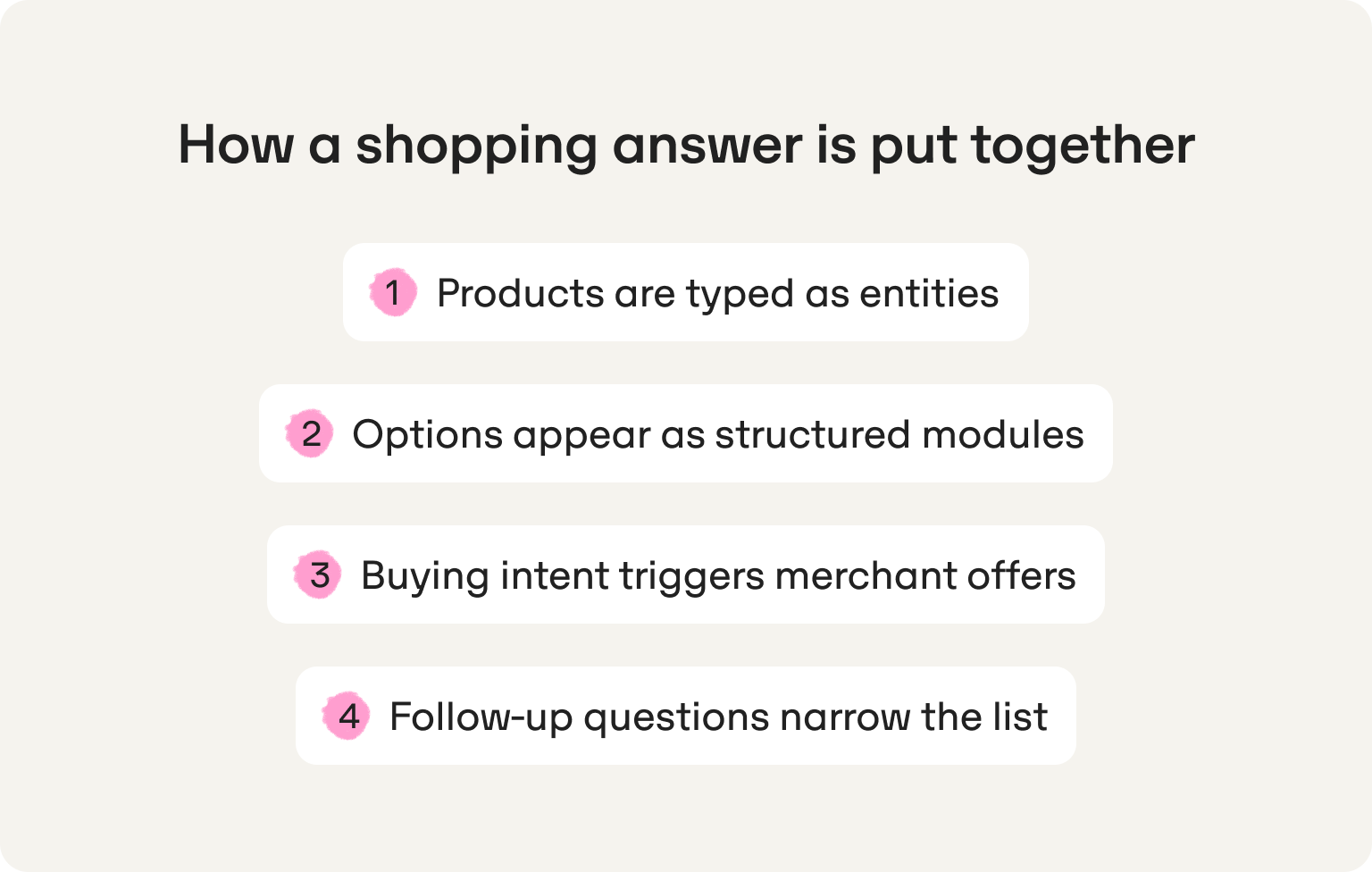
DEJAN's analysis of the internal tags AI Mode uses to build its responses shows how a shopping answer is put together:
- Products are typed as entities. AI Mode classifies what it mentions into entity types, including SKU-level products, shopping brands, purchasable electronics and purchasable equipment.
- Options appear as structured modules. These include product lists, horizontal carousels that can carry ratings, pricing and brand logos, and side-by-side comparison tables of specs and prices.
- Buying intent triggers merchant offers. When a shopper narrows to one item, AI Mode can show merchant offers with price, shipping, stock status, return policies and checkout links, drawn from merchant feeds.
- Follow-up questions narrow the list. AI Mode can close an answer by asking for missing details such as budget. McKinsey saw shoppers adding these same details themselves to fine-tune recommendations.
Behind that interface, three shifts change the math for a store:
- Research starts in AI, and it starts early. McKinsey found that more than 70% of AI-powered search users ask top-of-funnel questions, to learn about a category, brand or product. They then keep using AI to compare features and get recommendations. Miss the first answer and you often miss the shortlist.
- Google is heading the same way. McKinsey reports that about half of Google searches already show AI summaries, a share that trend analysis expects to pass 75% by 2028. Google AI Overviews and AI Mode put an answer above, or in place of, traditional search results.
- The clicks that remain come later in the journey. As decisions move into AI before the click, McKinsey expects the remaining traditional search clicks to come from shoppers further along the funnel. Its projection: unprepared brands could lose 20 to 50% of their traffic from traditional search.
The traffic AI does send is also improving. Adobe found that in July 2025, AI referrals to US retail sites were 23% less likely to convert than other traffic. By October, they had converted better than non-AI traffic for two months running and generated 8% more revenue per session.
Put together, the blunt truth for a store owner is this. A shopper who reaches your site from an AI answer already has your product on their shortlist. A shopper who never arrives saw a carousel without you in it, and nothing in your analytics records it. That's why the first step in GEO is monitoring what AI search says about you, before you change a single product page.
What GEO for e-commerce means for a product business
Generative engine optimization for ecommerce is the work of getting your products named, described accurately and linked when AI answers a shopping question. In practice, that means being a product AI can place in a carousel, a comparison table or a merchant offer, with the right price, the right facts and a path to buy.
Ecommerce GEO builds on SEO rather than replacing it. The GEO vs SEO question comes down to what you compete for and what decides the outcome:
Strong SEO still earns its keep. AI systems need crawlable pages and clean structured data to read your products at all. But traditional results and AI answers don't always agree: McKinsey found that some brands hold a lower share in AI search than their market share and traditional search performance would predict. In the GEO era, GEO visibility is its own metric, and ranking well in the blue links doesn't guarantee it.
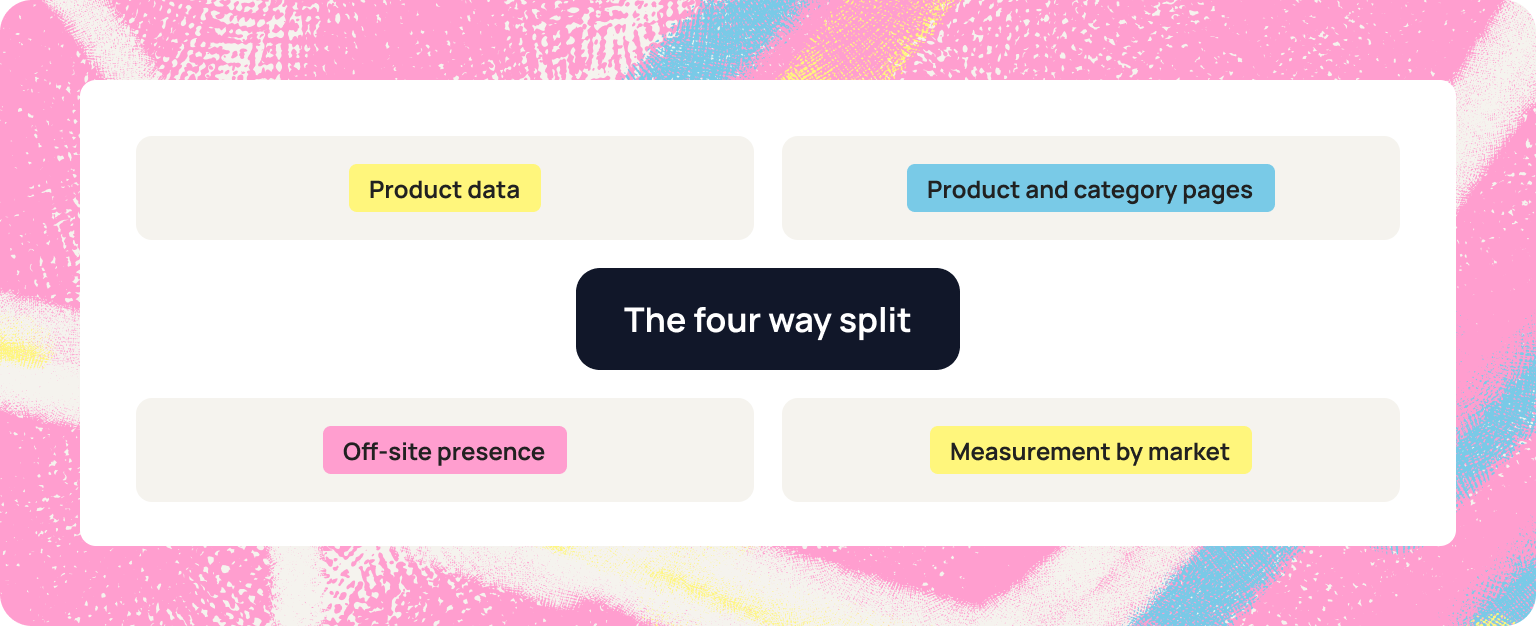
For a store, the work splits into four parts:
- Product data. According to DEJAN's analysis, AI Mode turns product pages into standard product modules with images, titles, review aggregates and manufacturer specifications. Its offer cards pull price, shipping, stock and returns from merchant feeds. Dan Petrovic’s work at DEJAN also lists identifiers such as GTIN and the manufacturer among the attributes products are grounded on. A missing field is a gap in the card.
- Product and category pages. Comparison layouts line up specs and prices side by side. Pages that state specs plainly and answer buyer questions in simple language are easier for AI to compare and quote.
- Off-site presence. This covers the review sites, marketplaces, Reddit threads and industry publications that AI cites far more often than your own site. AI Mode also types brands as entities in their own right, which suggests that what the web says about your brand shapes whether it appears at all.
- Measurement by market. Track which prompts name you, which name competitors, and how that differs in every country you sell to. DEJAN notes that carousels can show localized pricing, one more reason a single market's view doesn't travel.
Whatever your business model, whether you sell only through your own store or across marketplaces, the answer decides who gets the sale. And if you make the products you sell, you start with an advantage in ChatGPT, as the next section shows.
How ChatGPT and Google AI Mode decide which products to recommend
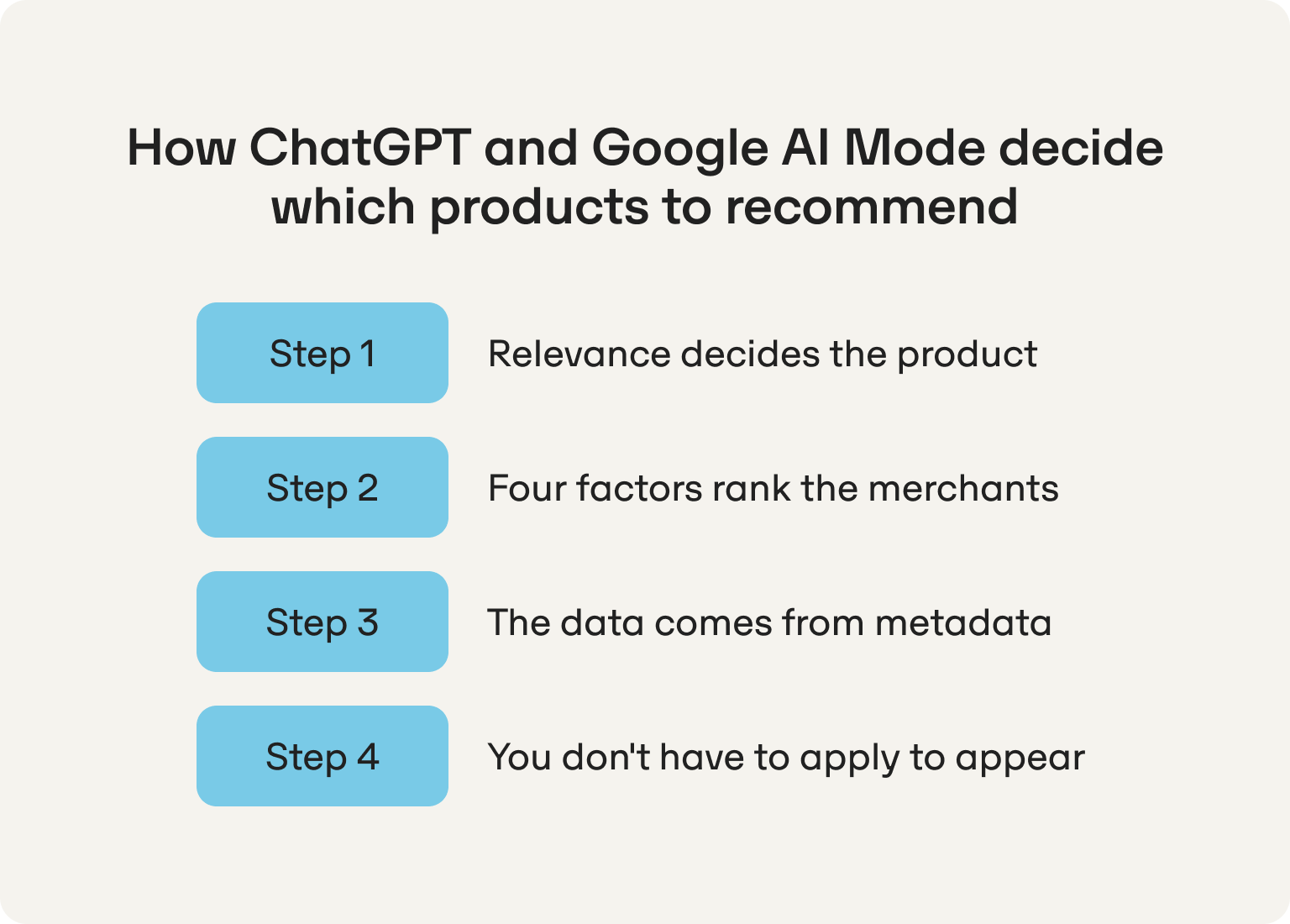
Most advice on this topic is guesswork repeated until it sounds like fact. Both platforms have published how their shopping answers work, so start there.
What OpenAI says about ChatGPT shopping results
When a question signals shopping intent, ChatGPT can show product options with images, details and links to buy. OpenAI's help documentation sets out how those results are chosen:
- Relevance decides the product. A product appears in the carousel when ChatGPT judges it relevant to the shopper's intent. OpenAI says product results are selected independently, are not ads and are not influenced by its partnerships. ChatGPT does carry paid ads, but they sit separately from product results.
- Four factors rank the merchants. When a shopper clicks a product, ChatGPT can list the merchants selling it. They are ranked on availability, price, quality and whether the merchant is the maker or primary seller.
- The data comes from metadata. That merchant list is built from product and merchant metadata supplied by third-party providers or by merchants directly.
- You don't have to apply to appear. OpenAI states that no extra work is required from individual merchants. Stores that want ChatGPT to reflect their latest prices and stock can apply to submit a direct product feed.
Two things follow for a store owner. First, being the maker is a ranking factor, which favors a D2C brand selling its own products over a reseller of the same item. Second, checkout matters later than most people think. OpenAI's Instant Checkout announcement says checkout-enabled items get no preference in product results. Checkout is only one of the factors when several merchants sell the same product. Relevance gets your product chosen; availability, price and checkout help you win the sale once it is.
What Google says about shopping in AI Mode
Google's AI Mode shopping announcement describes a system built on Gemini and the Shopping Graph. That is more than 50 billion product listings, from global retailers to local shops, each carrying details such as reviews, prices, color options and availability. More than 2 billion of those listings are refreshed every hour.
For a store, that hourly refresh is the key detail:
- Freshness is a visibility factor. If your feed says a briefcase is in stock and your page says sold out, Google AI Mode is reading a record that contradicts itself.
- Your inputs are the feed and the page. Your Merchant Center product feed and the product structured data on your pages are the two sources you directly control.
- The data becomes the interface. As DEJAN's analysis showed earlier, this data fills the product cards, carousels and merchant offers the shopper actually sees.
For the wider picture beyond shopping results, see what earns a place in AI Mode answers.
What researchers found when they watched AI agents shop
Platform documentation tells you the inputs. It doesn't tell you how stable the outputs are. Researchers at Columbia Business School tested that in the ACES study, running randomized experiments in which AI shopping agents built on large language models chose among competing products. Their findings:
- Agents concentrate demand. A few products capture most of the choices.
- Model updates reshuffle the winners. A new version of the same AI model can drastically change which products get picked.
- Each model weighs signals differently. Sensitivity to price, ratings and reviews varied sharply from one model to the next.
- Small, specific changes move share. Minor description edits tailored to the query produced significant gains in market share.
The implication runs through the rest of this guide. Generative results change when models change, and they change differently in each AI system. A single check shows you one moment. Knowing where you stand means checking again, across engines, over time.
What makes a product page citable
Most ecommerce GEO checklists recycle the same tricks: add quotations, sound authoritative, bolt on an FAQ block. E-GEO, a benchmark from researchers at MIT and Columbia, put those rules of thumb to the test. It paired 13,747 realistic, multi-sentence shopping queries with ten Amazon listings each, then tested fifteen hand-crafted rewriting heuristics across five generative engines. A 2026 review of GEO research summarizes the result: ten of the fifteen heuristics were neutral or negative. The authors also found that the gains that did hold reflected genuine content improvement rather than manipulation.
That is the most useful finding in GEO for ecommerce websites so far. Quality content wins over formatting tricks. E-GEO's queries look like real shoppers: long requests packed with intent, constraints and preferences. A shopper asking for a briefcase that fits a 15-inch laptop, survives a daily commute and costs under $300 needs a page that states all three. Real data such as "fits laptops up to 15.6 inches" is something AI can match to a constraint. "Spacious" is not.
So write descriptions for the questions shoppers actually ask. You don't need to create pages for every keyword variation. Every GEO for ecommerce site starts with the product pages you already have:
The last row is basic technical health, and it catches more stores than you'd expect. The shipping and returns row has a simple fix: keep one source-of-truth page for shipping and returns and point every other mention to it.
The same principle applies beyond the product page. For GEO for e-commerce sites with large catalogs, category pages often do more work than any single product. When a shopper asks which briefcase fits a 15-inch laptop, AI needs a page that compares options. A category page with a short buying guide, a comparison table by material and laptop size, and answers to real customer questions can be that page. We'll walk through exactly that later in this guide.
Review presence: the part of GEO that happens off your site
Your product page is one of the sources AI reads about you, and usually a small one. As McKinsey's research showed, a brand's own sites often make up just 5 to 10% of the sources AI search references. In categories such as consumer packaged goods, McKinsey found that more than 65% of sources were publishers, user-generated content and affiliate sites.
So review presence reaches well beyond the star widget on your page. It covers everywhere your products are discussed:
- Marketplace listings, where ratings and reviews sit on pages AI already reads.
- Review sites and comparison sites in your niche.
- Reddit threads and forums, where shoppers ask "has anyone actually used this?"
- Industry publications, gift guides and editorial roundups.
- YouTube reviews and creator content.
Reviews carry weight with both audiences you're trying to reach:
- With shoppers. The Spiegel Research Center at Northwestern analyzed 2017 data covering more than 100,000 products. It found that a product with five reviews was 270% more likely to be purchased than one with none, and that purchase likelihood peaked for ratings between 4.0 and 4.7 stars.
- With AI. The ACES study found that each AI model weighs ratings and reviews differently. The same review profile can carry more weight in one assistant than in another.
Here is how to act on it:
- Find the sources that matter. Check which domains AI cites when it answers your category's prompts. Tracking which domains AI cites for your category turns McKinsey's finding into a target list.
- Earn presence on those domains. Send products to the reviewers and publications AI already cites, and ask real buyers to review once their order arrives.
- Give publications something to quote. Thought leadership content, such as a founder explaining how a product is made or tested, gives industry publications material that AI can pick up.
- Stay clean. The FTC's final rule on consumer reviews bans fake reviews, including AI-generated ones. It also bans paying for reviews that express a particular sentiment, posting undisclosed insider reviews and suppressing negative reviews. Shortcuts here create legal risk and do nothing for the sources AI trusts.
Selling in more than one country? Your AI visibility changes with every market
The shift to AI shopping isn't a US story. Capgemini Research Institute's multi-country consumer survey found that 58% of consumers have replaced traditional search engines with generative AI tools for product and service recommendations, up from 25% in 2023.
What AI recommends, though, depends on where the question is asked. A check you run in the US tells you little about France or Germany:
- The prompt changes with the language. A French shopper asks for a "sacoche en cuir pour ordinateur 15 pouces," not a leather laptop briefcase. You need to track the words each market actually uses.
- The sources change. McKinsey found that the sources AI search draws on vary by model, location, category and question type. Local retailers, marketplaces and publications fill the answer.
- The competitors change. The rival you face in the US may not be the one you face in Germany.
- The offer changes. As DEJAN's analysis noted earlier, AI Mode carousels can show localized pricing.
A brand that leads in US answers can be missing entirely in another market, and one US report will never show it. The practical fix is to treat each market as its own project, with local-language prompts, a local competitor set and content adapted for local buyers rather than just translated. For the language side of that work, see our guide to multilingual SEO for AI search.
How to check whether AI recommends your products
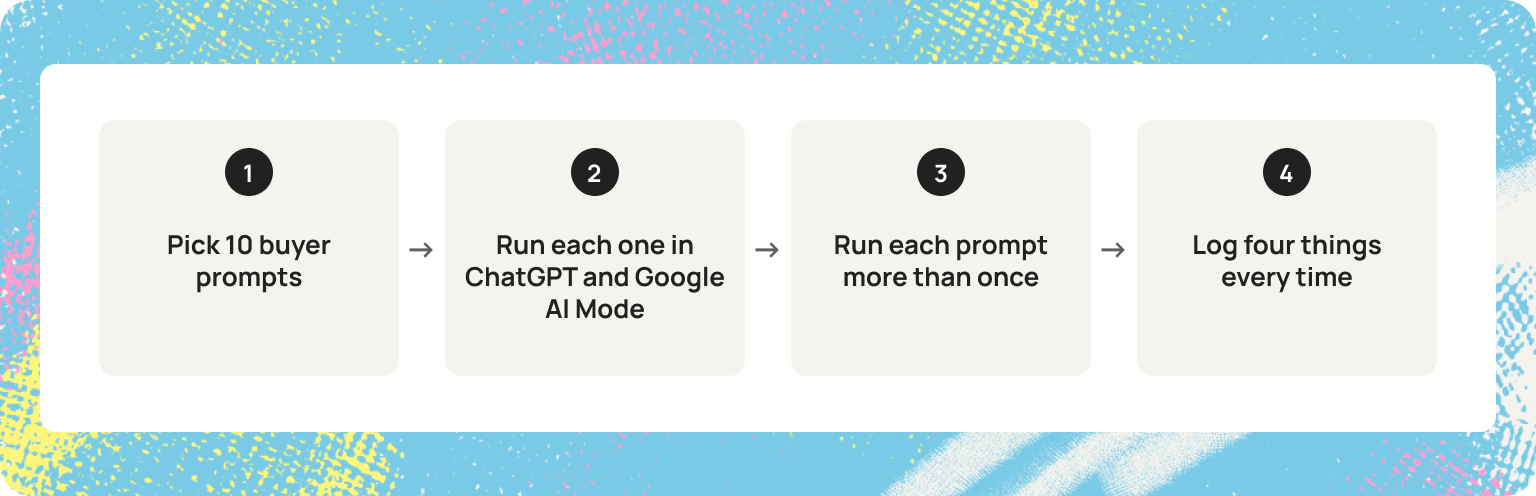
You can get a first read in an afternoon, with no tools:
- Pick 10 buyer prompts. Mix category questions ("best leather briefcase for work"), comparisons ("brand A vs brand B briefcase") and problem-led questions ("briefcase that fits a 15-inch laptop and a lunch"). Write them the way people search, in full sentences, and avoid your own product names. If you're unsure where to start, here's how to go about choosing the prompts worth tracking.
- Run each one in ChatGPT and Google AI Mode. Sign out, and set the country and language for each market you sell to.
- Run each prompt more than once. AI answers vary between runs, and one result can mislead.
- Log four things every time. Note whether you were named, whether you were linked, who was named instead and which sources were cited.
Copy this table into a spreadsheet:
Two cautions as you read the results:
- Skip the vanity metrics. "Mentioned in 4 of 10 prompts" means little until you know how often your top competitor appeared.
- Don't judge AI by referral clicks alone. Some shoppers who see you in an AI answer come back later through direct traffic or a branded search, so user clicks from AI undercount its effect.
Manual checking makes sense for a snapshot. It doesn't hold up as a routine. Ten prompts, two engines, two markets and two runs each already add up to 80 checks per round. And as the ACES study showed, a model update can reshuffle the picks the week after you finish. When you're ready for a tool, here is what ecommerce teams should look for in a GEO tool.
How Omnia turns AI visibility into work a small team can ship
If you want to see how this looks for your store, start with how Omnia works for ecommerce and D2C brands [industry page URL to confirm].
The blunt truth: most store owners don't lack GEO advice. They lack the hours to turn a dashboard into a finished page. Omnia tracks your AI visibility across ChatGPT, Perplexity, Google AI Overviews and Google AI Mode, then does the part a small team struggles with. It works out what to fix and drafts it.
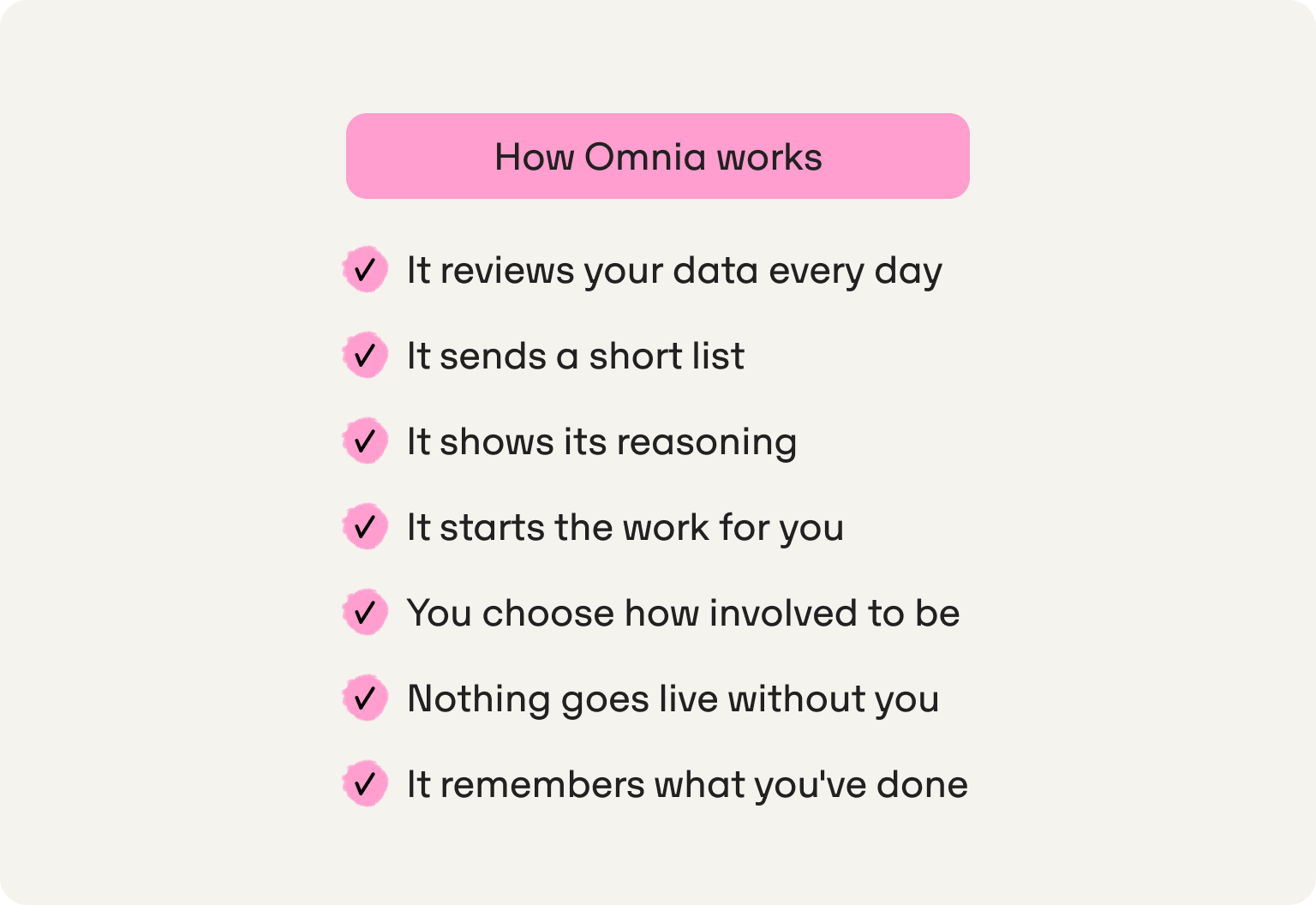
That happens through Project Suggestions, work Omnia’s AI Agent scopes for you daily:
- It reviews your data every day. Omnia's AI Agent, drafts the fix, reads your prompts, AI answers, citations, sentiment, your site, competitors' sites and connected tools such as Google Search Console.
- It sends a short list. You get up to three scoped projects per run, or fewer, or none, when the evidence doesn't support them.
- It shows its reasoning. Each suggestion carries its evidence, its confidence and what it still doesn't know.
- It starts the work for you. Accept a suggestion and a first draft is already loaded.
- You choose how involved to be. Let Omnio generate the content and edit it, or write it yourself.
- Nothing goes live without you. Approved work publishes through the tools you've connected.
- It remembers what you've done. It checks the last 60 days, so it never re-proposes work you declined or finished.
A worked example: how a briefcase store wins back its category page
The store is a D2C brand selling leather bags and briefcases, anonymized here. It already does well in AI answers. Even with branded prompts filtered out, it ranks first among the competitors it tracks for share of voice, visibility, citations and sentiment.
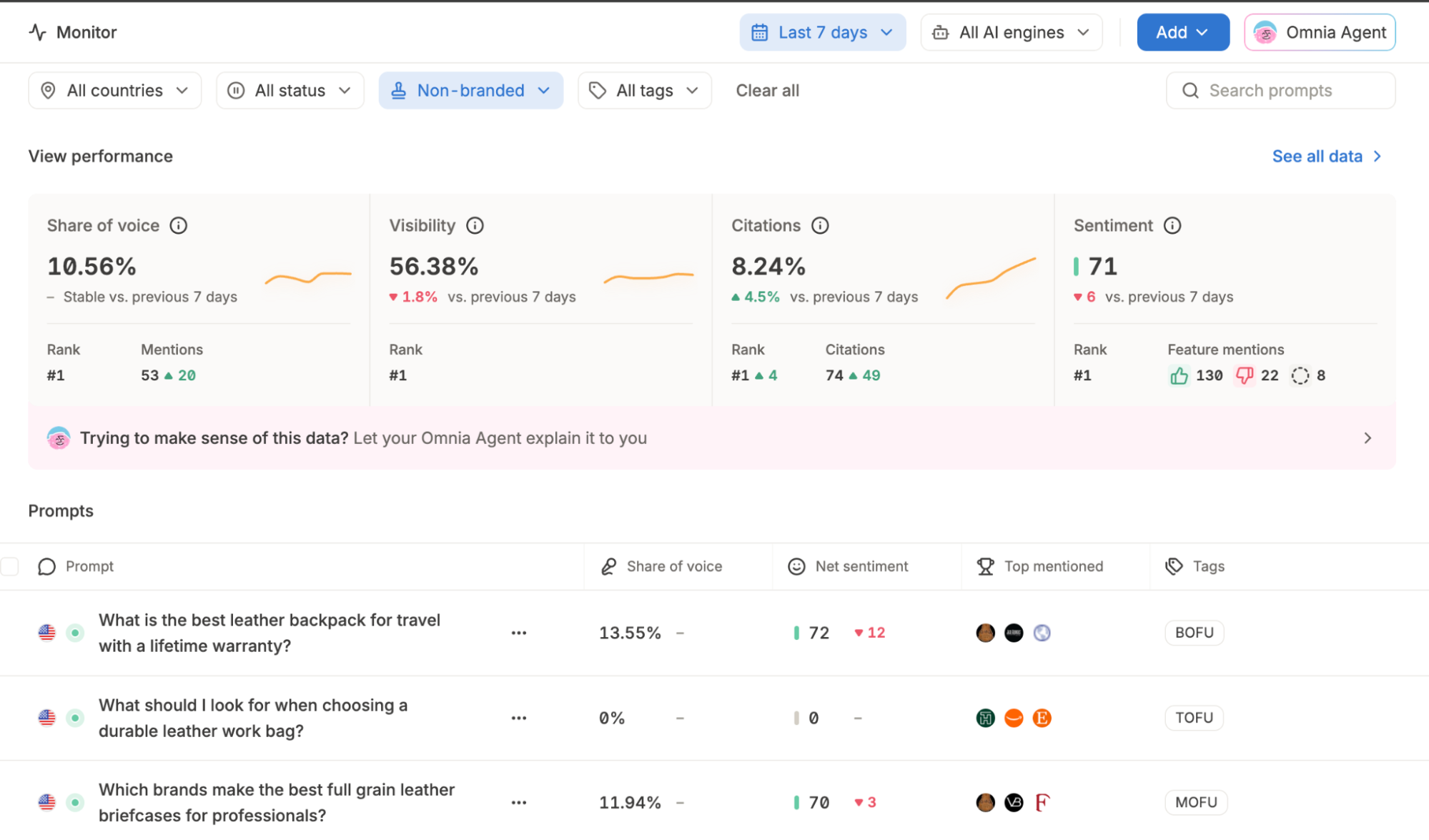
The screenshot shows the brand's non-branded prompts in Omnia's Monitor view. Two of them hold a healthy share of voice: one on the best leather backpack for travel, the other on which brands make the best full-grain leather briefcases. The third sits at 0%: "What should I look for when choosing a durable leather work bag?"
That's a topical gap. The brand wins when shoppers ask which bag to buy, but has nothing AI can use when they ask how to judge one. McKinsey found that more than 70% of AI search users start with this kind of top-of-funnel question, so this is often where a shopper's research begins.
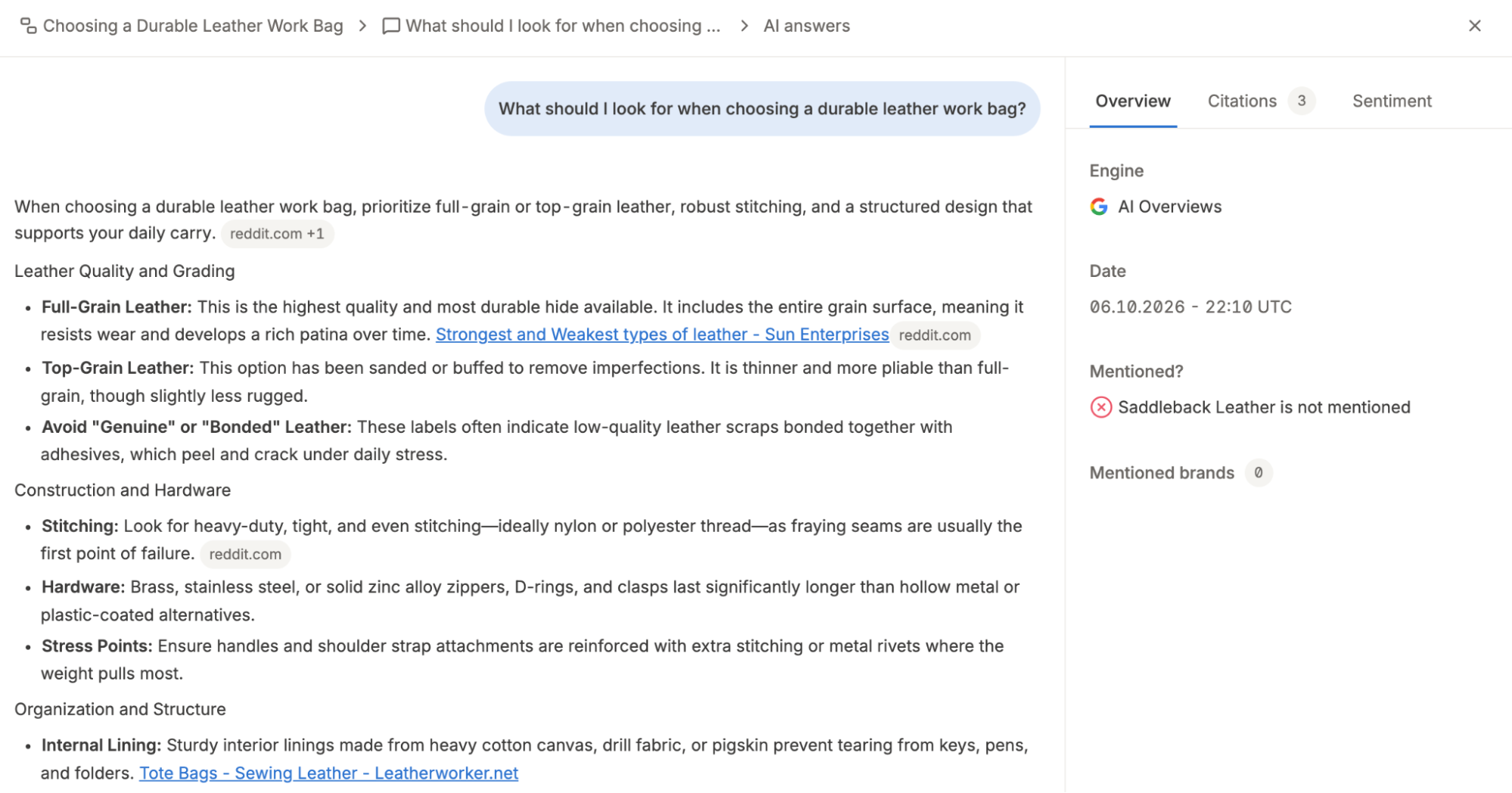
Opening the prompt shows how Google AI Overviews answered it. The answer covers leather grades, stitching, hardware, stress points and lining, and draws on three sources: Reddit threads, a leather supplier's page and a leatherworking forum. The panel on the right confirms that the brand isn't mentioned, and neither is any other brand.
No brand owns this answer yet. AI built it from forum posts and a supplier page because no maker has published a clear guide on the topic. For a brand that makes durable leather bags, that's an opening.
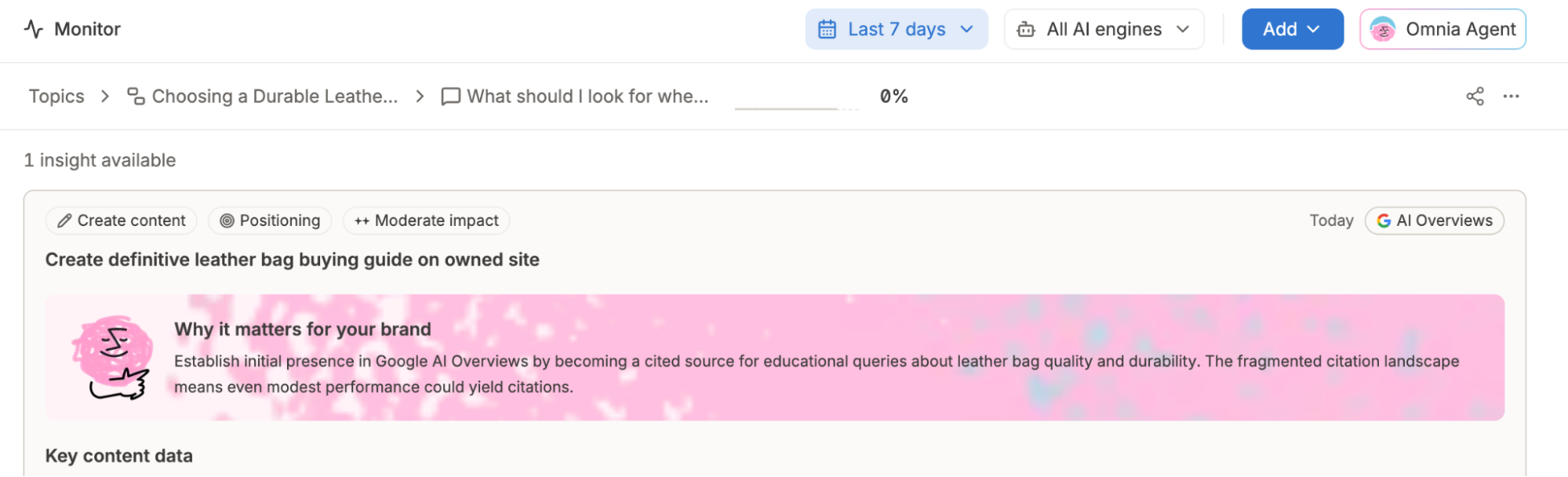
Omnia turns the gap into a specific recommendation. The insight on this prompt is labeled "Create content," with a moderate expected impact: create a definitive leather bag buying guide on the brand's own site. The reasoning is laid out under "Why it matters for your brand": becoming a cited source for questions about leather bag quality and durability establishes the brand's presence in Google AI Overviews, and because the current citations are fragmented, even a modest guide could earn them.
Closing the gap means publishing that guide, built on what only a maker can explain from experience, such as how the leather is sourced, how the stitching is done and how the bags are tested. The owner can write it in-house or have Omnia draft it for review. Either way, nothing goes live without approval, and the same tracked prompt shows whether AI starts citing the new page.
The owner didn't build a report or write a brief. They opened one prompt, and Omnia showed what was missing and what to publish.
If you sell in one market
Most companies start here. In your first weeks you'll see which prompts name competitors instead of you, which sources AI cites for your category, and your first suggested fix. Omnia also surfaces prompts your shoppers ask that you weren't tracking, so your picture keeps pace with how buyers actually search. For the wider playbook, see GEO for small teams.
If you're expanding abroad
Open a project per market. Omnia covers unlimited regions, meaning every country you sell to. Each project gets:
- Local-language prompts, so you track what shoppers in that market actually ask.
- Its own competitor set, because the rivals change from market to market.
- Real-location results, from browsers that run in the market itself to see what local shoppers see.
- Adapted content, built from that market's data for local buyers.
To be clear about scope: Omnia shows where you're missing from AI answers, connects to your Search Console data to decide what to improve, and scopes the fix. It can't collect reviews for you, so the review presence work above stays with your team.
Omnia comes with a 14-day free trial on Growth, no credit card required; see Growth plan pricing for details.
Start with your free 14-day trial with Omnia.

FAQs
Does GEO for ecommerce work differently in ChatGPT and Google AI Mode?
Yes, because the two read different inputs. ChatGPT builds merchant lists from product and merchant metadata supplied by third-party providers or by merchants. Google AI Mode draws on the Shopping Graph, where your Merchant Center feed and structured data are the inputs you control. The models also weigh signals differently: the ACES study found that sensitivity to price, ratings and reviews varied sharply from one model to the next. A product that wins in one engine can be absent in the other, so track each separately.
Will adding FAQ blocks or more schema to product pages lift my AI visibility?
Not by format alone. E-GEO's authors note that common GEO practice leans on rules of thumb such as quotations, an authoritative tone and FAQ-style structures, and a 2026 review reports that ten of the fifteen heuristics they tested were neutral or negative. The gains that held reflected genuine content improvement. Use FAQs and structured data to carry the facts shoppers need, such as fit, materials, compatibility and returns, and judge them by whether they answer real multi-constraint questions.
Should I submit a direct product feed to ChatGPT if my products already show up?
OpenAI says no extra work is required to appear, since ChatGPT can use metadata from third-party providers. A direct feed is how you make sure ChatGPT reflects your most up-to-date product information. That matters most if your prices, stock or variants change often, or if third-party data about your products is wrong. Treat it as a data accuracy move. It won't buy placement: OpenAI says checkout-enabled items get no preference in product results.
A reseller sells my product for less. Who gets listed first in ChatGPT?
It depends on more than price. When several merchants sell the same item, ChatGPT ranks them on availability, price, quality and whether the merchant is the maker or primary seller, and OpenAI's Instant Checkout announcement adds whether checkout is enabled. Being the maker works in your favor, but a stock-out or a noticeably higher price can hand the top slot to the reseller. Keep price and availability accurate everywhere your product is sold.
Should I prioritize category pages or product pages?
Match the page to the question. Comparison and "which one fits" prompts need a page that compares options, which is usually a category page with a buying guide and a comparison table. Once a shopper narrows to one item, DEJAN's analysis of AI Mode shows merchant offers pulling price, shipping, stock and returns for that specific product, so product page and feed data carry the weight. Most stores need both, starting with the category that drives the most revenue.
How do I prove GEO is working when AI referral traffic is still small?
AI's share of retail traffic remains modest, so referral clicks are a weak scoreboard. Measure the inputs to the sale instead, tracked per engine and market over time:
- how often you're named across a fixed prompt set
- your share against named competitors
- which sources are cited
- how accurately AI describes your products
Watch direct traffic and branded search alongside referrals, since some AI-influenced shoppers return that way.
How do I expand GEO into a new country without starting from zero?
Keep what travels and localize what doesn't. Product identifiers, specifications and structured data carry across markets. Prompts, competitor sets and cited sources do not: McKinsey found that the sources AI search draws on vary by location, and DEJAN's analysis notes that AI Mode carousels can show localized pricing. Build a prompt set in the local language, benchmark against local competitors, and adapt content for local buyers.
Will today's GEO tactics stop working as more stores adopt them?
Tricks likely will. A 2026 review of GEO research reports that on the C-SEO benchmark, gains from generic content transformations declined as adoption increased, approaching a zero-sum game. E-GEO's red-teaming found that, under a simple in-prompt defense, gains from optimization reflected genuine content improvement rather than manipulation. Complete product data, honest reviews and pages that answer real questions are the kind of improvement those studies found to hold.